Is Baking Soda Bad for a Low Sodium Diet? 48 mg Pancakes
Jump to RecipeBaking soda adds about 1,260 mg of sodium per teaspoon. Here is that against the 2,300 and 1,500 mg limits, plus a pancake recipe with no soda and about 48 mg of sodium per serving, worked out from USDA values.
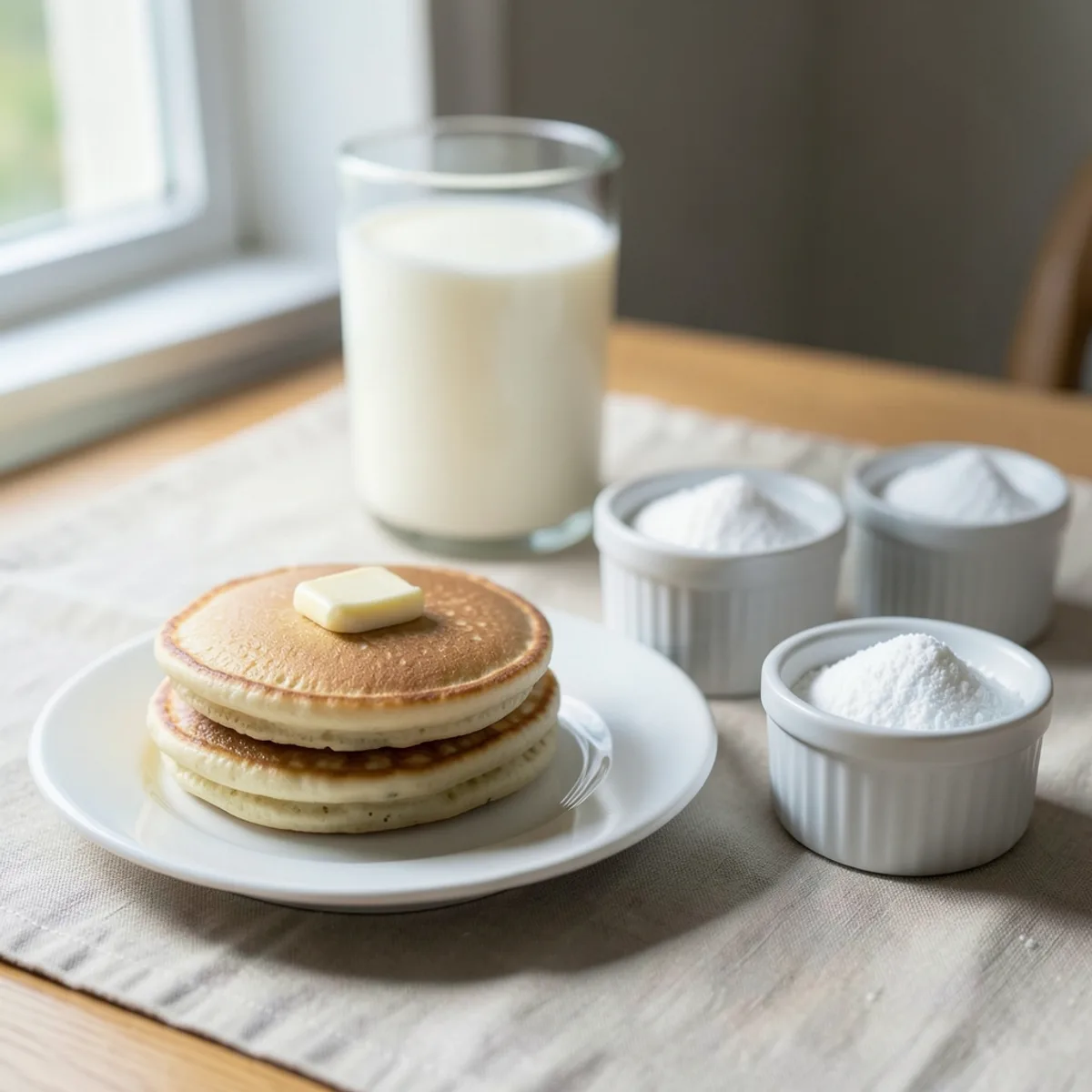 Save
Jump to:
Yes, baking soda adds a lot of sodium: about 1,260 mg of sodium per level teaspoon. These low-sodium pancakes use 2 tsp (10 g) low-sodium baking powder, with no salt and no baking soda, and come to about 48 mg of sodium per serving of 2.
Whether baking soda is "bad" for this diet comes down to a number: one level teaspoon is a big slice of a day's sodium, and the rest of a pancake batter is small by comparison.
This page is a data check, not a test kitchen. Nothing here was cooked, tasted or measured by us. Every figure is published USDA data or our own arithmetic on it. The soda-only math lives in how much sodium in baking soda water, and the powder side is in how much sodium in homemade baking powder. For other side effects, see baking soda side effects.
The Food Science / Lab Kitchen Note
Baking soda is sodium bicarbonate. Sodium is in the name, so it can't be removed from it. USDA FoodData Central lists it at 27,400 mg of sodium per 100 g. A teaspoon weighs 4.6 g, so a level teaspoon holds about 1,260 mg. That's our arithmetic on the USDA record.
Low-sodium baking powder looks different on paper. The USDA's generic low-sodium entry shows a different balance: 90 mg of sodium and 10,100 mg of potassium per 100 g. One teaspoon of that powder weighs 5.00 g, so it carries about 4.5 mg of sodium and about 505 mg of potassium. It's a generic entry, not a brand, and the product label wins.
Now the batch. With the low-sodium powder, the leavener supplies only about 9 mg of the roughly 191 mg of sodium in the whole batch. Most of it comes from two ingredients you wouldn't think of as salty. The whole milk adds about 105 mg (43 mg per 100 g, 244 g) and the egg about 71 mg (142 mg per 100 g, 50 g). Together that's about 176 mg, or roughly 92% of the batch. Flour adds about 2.5 mg, butter about 3.1 mg and sugar about 0.1 mg.
For scale, one teaspoon of baking soda holds more than six times the sodium of this entire batch. That's the whole case for leaving it out.
The leavener also brings potassium: about 1,010 mg per batch, or about 252 mg per serving.
Same batch, three leaveners
This table compares data, not finished pancakes. It's the same batch with only the leavener changed, and every figure is our calculation from the USDA values. Shares are against 2,300 mg and 1,500 mg.
| Variant | Leavener in the batch | Sodium from the leavener | Sodium per batch | Per serving of 2 | Share of 2,300 mg | Share of 1,500 mg |
|---|---|---|---|---|---|---|
| Low-sodium baking powder (this recipe) | 2 tsp (10 g), USDA 90 mg per 100 g | About 9 mg | About 191 mg | About 48 mg | 2.1% | 3.2% |
| Regular baking powder, straight phosphate | 2 tsp (9.2 g), USDA 7,890 mg per 100 g | About 726 mg | About 908 mg | About 227 mg | 9.9% | 15.1% |
| Regular baking powder plus salt | 2 tsp (9.2 g) powder and 1/4 tsp (1.5 g) salt, USDA 38,800 mg per 100 g | About 726 mg and 582 mg | About 1,490 mg | About 372 mg | 16.2% | 24.8% |
The gap between rows one and two is the powder alone. The gap between two and three is a quarter teaspoon of salt added by habit. Regular powder is a long way below baking soda, at about 363 mg per teaspoon, so this isn't a case against powder. It is a case for checking which one you're counting.
What to expect in the pan
We found one texture signal, and it comes from two separate sources. Many cooks report that reduced-sodium baking powder gives a crumb that is slightly denser and moister, with a little less loft than regular powder, though still very edible. A specialty-food site says older reduced-sodium powders gave less light baked goods, and that newer formulas dose like regular powder. That signal covers biscuits, cakes and brownies, not pancakes.
Treat that as a small trade-off to expect, not a failure. We haven't cooked this batch, so we can't tell you how it will turn out in your pan.
Common mistakes
Adding salt out of habit. A quarter teaspoon (1.5 g) adds about 582 mg to the batch, about 146 mg per serving. That's three times the whole serving's sodium. Leave it out and count what's left.
Trusting the generic number over your label. The USDA low-sodium entry isn't a brand. Brand formulas differ, so check the label for sodium and potassium. A King County page from 2018 also notes you may have to request these powders at the store or order them online.
Heaping the spoon. A heaped spoon carries more than the figures on the card, which rest on level spoons (4.6 g of baking soda and 5.00 g of low-sodium baking powder per teaspoon, per the USDA). That's why a scale helps.
Substitutes and swaps
| Original | Swap | Proportion | What changes |
|---|---|---|---|
| Baking soda | A sodium-free baking soda | Doesn't exist | Baking soda is sodium bicarbonate, so the swap is a low-sodium baking powder instead |
| Low-sodium baking powder | Regular baking powder | 2 tsp (9.2 g), as in the table | About 227 mg per serving instead of about 48 mg, by our calculation |
| Low-sodium baking powder | Potassium bicarbonate alone | No sourced ratio, so we give none | Not calculated here |
| Unsalted butter | Salted butter | Not calculated here | Adds sodium we haven't worked out |
| Whole milk | Another milk | Not calculated here | Milk is the biggest sodium source in the batch, so the figure would change |
What the sources say
The numbers above rest on two kinds of source. The first is a database. USDA FoodData Central is the federal nutrient database. We took baking soda from it, along with low-sodium baking powder, straight-phosphate baking powder, table salt, all-purpose flour, whole milk, egg, unsalted butter and sugar. It holds measured values, not studies, and it is the basis for our calculation, not a test of this recipe.
The second kind is guidance, and none of it is a clinical trial. The FDA is a federal agency page. It sets the sodium Daily Value at less than 2,300 mg a day, says Americans eat about 3,400 mg on average, and links uncontrolled high blood pressure to heart attack, heart failure, stroke, kidney disease and blindness. The American Heart Association newsroom is a professional organization's statement. It gives 2,300 mg as the general recommendation and 1,500 mg as the ideal limit for most adults, especially those with high blood pressure. MedlinePlus, from the NIH, says sodium bicarbonate increases the amount of sodium in your body and tells people on a sodium-restricted diet to check first. That page is about the medicine, not baking amounts. Its potassium page says that with chronic kidney disease your kidneys may not remove extra potassium, and that some medicines can raise it too. It doesn't mention potassium bicarbonate. We found no trial on baking amounts of soda.
Not the recipe: the sports dose
You may see baking soda dosed in grams for exercise. That's a separate protocol, and it has nothing to do with baking. An ISSN position stand from 2021, a consensus statement, studied single doses of 0.2 to 0.5 g per kg of body weight taken 60 to 180 minutes before exercise. It calls 0.2 g/kg the minimum effective dose and 0.3 g/kg the optimal one. For a 70 kg adult that's about 14 g to 21 g, or roughly 3,800 to 5,700 mg of sodium by our arithmetic. The most common side effects it lists are bloating, nausea, vomiting and abdominal pain. See the ISSN position stand. If you want the other baking-soda swaps, baking soda replacement covers them, and baking soda instead of baking powder for pancakes shows what happens when you go the other direction.
Storage and make-ahead
We found no sourced storage or reheating guidance for these pancakes, so this page gives no days or times. Make-ahead tip: weigh the flour, sugar and powder into a bowl ahead of time, and add the egg, milk and butter when you're ready to cook.
Nutrition note
Values on the recipe card are estimates calculated from typical USDA FoodData Central values, not measured. They assume the generic USDA low-sodium baking powder, whole milk 3.25%, a large egg and unsalted butter, per serving of 2 pancakes (1 of 4). Sodium is about 48 mg, or 2.1% of 2,300 mg and 3.2% of 1,500 mg. A different milk, butter or powder changes the numbers, so use your labels.
Servings: 8 pancakes
Is Baking Soda Bad for a Low Sodium Diet? 48 mg Pancakes
Baking soda adds about 1,260 mg of sodium per teaspoon. Here is that against the 2,300 and 1,500 mg limits, plus a pancake recipe with no soda and about 48 mg of sodium per serving, worked out from USDA values.
Ingredients
Reduced-sodium pancakes (no salt, no baking soda)
Equipment
- Kitchen scale (the sodium math is built on gram weights)
- Two mixing bowls (one for the dry mix, one for the wet)
- Skillet or griddle (lightly greased)
Instructions
- Whisk the dry mix. Whisk 1 cup (125 g) flour, 1 tablespoon (12.6 g) sugar and 2 teaspoons (10 g) low-sodium baking powder in a bowl. Add no salt and no baking soda.
- Mix the wet ingredients. In a second bowl, whisk 1 large egg (50 g), 1 cup (244 g) whole milk and 2 tablespoons (28.4 g) melted unsalted butter until smooth.
- Combine. Pour the wet mix into the dry and stir just until the flour is wet.
- Heat and grease the pan. Heat a skillet or griddle and grease it lightly. This page has no sourced pan temperature, so judge the heat by how the batter behaves when it hits the pan.
- Pour 8 pancakes. Pour the batter in 8 equal rounds, using the same scoop each time so the servings stay even.
- Cook until set, then flip. Cook until bubbles hold on the surface and the edges look set, flip, and cook until the second side is browned. No sourced minutes per side.
- Serve. Serve 2 pancakes per person. The sodium figure on this page is for that serving of 2, with nothing added on top.
Notes
Our recipe, calculated and untested. No one at SodaRecipe has cooked this exact formula, and no taste or texture result is claimed. The sodium and nutrition figures are our arithmetic on USDA FoodData Central values.
The 2 tsp of powder per 1 cup of flour is our own ratio. No source gives it, so follow your product label if it says otherwise.
The prep and cook times on the card are planning placeholders that the recipe format requires. They are not sourced or measured, so cook by the visual cues in the steps.
Sodium by ingredient, from the USDA lines: flour 2.5 mg, sugar 0.1, low-sodium powder 9.0, egg 71, milk 104.9, butter 3.1. That is about 191 mg per batch and about 48 mg per serving of 2.
Nutrition is per serving of 2 pancakes (1 of 4), estimated from typical USDA FoodData Central values. Fiber counts the flour only. Saturated fat is left off because we did not pull a USDA saturated-fat value for the milk or the egg.
Nutrition Facts
Per 2 pancakes (1 of 4 servings) (estimated)
- Total Fat
- 9.2 g
- Sodium
- 48 mg
- Total Carbohydrate
- 31 g
- Dietary Fiber
- 0.8 g
- Sugars
- 6.3 g
- Protein
- 6.7 g
Frequently asked questions
Is there a low sodium baking soda?
Not in our sources: baking soda is sodium bicarbonate, so it always carries sodium, about 1,260 mg per teaspoon. The usual low sodium substitute is a low-sodium baking powder, which is what the recipe above uses.
Can baking soda raise a low sodium level in the blood?
That is a medical question, not a baking one. MedlinePlus says sodium bicarbonate increases the amount of sodium in your body, but its page is about the medicine, so low blood sodium needs a clinician and not a kitchen fix.
Does low-sodium baking powder add potassium?
By the USDA generic entry, yes: about 10,100 mg of potassium per 100 g, which is about 505 mg per teaspoon and about 252 mg per serving of these pancakes. MedlinePlus says that with chronic kidney disease your kidneys may not remove extra potassium, and some medicines raise it too, so read your label.
Is baking powder lower in sodium than baking soda?
Per level teaspoon, yes: about 363 mg for straight-phosphate baking powder against about 1,260 mg for baking soda, by USDA values. They are not spoon-for-spoon swaps, though, so see our page on baking soda instead of baking powder for pancakes for ratios.

Steven Dony trained in a restaurant kitchen and lives in Nashville, Tennessee. He covers SodaRecipe’s fact-checks: what works, what does not, and why.
Comments