Baking Soda Side Effects: Label Dose, Sodium, Risks
Jump to RecipeA verdict-first safety check: the label dose in teaspoons, the sodium per spoon against the 2,300 mg daily limit, who is flagged as higher risk, and the warning signs, all sourced.
 Save
SaveJump to:
The short verdict: baking soda water has real side effects, and the serious ones are tied to dose, timing and a full stomach, not to the drink itself. This page gives the label numbers in kitchen units, the sodium in mg, and the study behind each risk, with the study type and size. It makes no health promise. If you came for weight, start with our evidence review on does baking soda help you lose weight. For the measured drink with lemon, see baking soda and lemon water and the baking soda recipe for weight loss. For timing, see the best time to drink baking soda water.
The Food Science / Lab Kitchen Note
Baking soda is sodium bicarbonate, NaHCO3. Stomach acid is hydrochloric acid, and the two react: NaHCO3 + HCl gives NaCl, water and carbon dioxide. That is the reason it works as an antacid, and the reason it can hurt. Poison Control says swallowed bicarbonate quickly makes a large volume of CO2, which can build dangerous pressure in the stomach. It adds that the risk rises with alcohol binging or large meals.
That explains the two kitchen rules on the antacid label: dissolve the powder completely, and never take it overfull. Poison Control ties the CO2 pressure risk to large meals, which is why both rules matter. Poison Control gives no toxic dose, so no amount on this page should be read as a safe one.
Sodium is the other cost. USDA FoodData Central lists 27,400 mg of sodium per 100 g of baking soda, and 1 tsp is 4.6 g. By our math, that gives the figures below. The FDA puts the Daily Value for sodium at less than 2,300 mg per day.
| Spoon | Weight | Sodium (our calculation) | Share of 2,300 mg |
|---|---|---|---|
| 1/4 tsp | 1.15 g | About 315 mg | About 14 percent |
| 1/2 tsp | 2.3 g | About 630 mg | About 27 percent |
| 1 tsp | 4.6 g | About 1,260 mg | About 55 percent |
That sodium comes on top of the food you eat that day. We did not verify the newer 2025-2030 figure, so we cite the FDA page as it stands.
Three doses compared from the data
This is a comparison of sourced numbers, not something we tried at home. Where no source gives a figure, the cell says so.
| Our glass (recipe card) | Label single dose | Label daily maximum | |
|---|---|---|---|
| Baking soda | 1/4 tsp (1.15 g) | 1/2 tsp (2.3 g) | 7 doses, so 3 1/2 tsp (16.1 g); 3 doses, so 1 1/2 tsp (6.9 g), if over 60 |
| Water | 8 fl oz (240 mL) | 4 oz (120 mL) | 4 oz per dose |
| Sodium | About 315 mg | About 630 mg | About 4,400 mg for 7 doses; about 1,890 mg for 3 doses (our math) |
| Against 2,300 mg | About 14 percent | About 27 percent | Nearly twice the limit for 7 doses; about 82 percent for 3 doses |
| How often | No sourced frequency | Every 2 hours, or as a doctor directs | No more than 7 doses in 24 hours, or 3 if over 60 |
| Duration | No sourced limit | Not more than 2 weeks | Do not use the maximum for more than 2 weeks |
The label figures come from the OTC antacid label on a common baking soda box. The page does not say whether the product is aluminum-free, and the 4,400 mg total is our own arithmetic, not a figure printed on it. Our glass is half the label dose in twice the water. Less than the label dose is a smaller dose, not a safe one.
Baking soda water side effects: what the studies show
MedlinePlus lists thirst, stomach cramps and gas as the mild effects. The studies below show where it gets worse, and how small each evidence base is.
A California Poison Control System review (J Clin Pharm Ther, 2014) looked back at 192 symptomatic baking soda cases from 2000 to 2012, in people aged 2 months to 79 years. Of those, 60.4 percent used it as an antacid, 11.5 percent to beat a urine drug test and 4.7 percent for a urinary infection. 55.2 percent had symptoms that needed medical evaluation, and 12 were admitted for electrolyte imbalance, metabolic alkalosis or respiratory depression. The authors flag chronic antacid users, people trying to beat urine drug screens, pregnant women and young children as highest risk, and note that baking soda can mask or delay needed care. We read the abstract only. It is a retrospective case review, so it shows who gets into trouble, not how often it happens in the general population.
A 2011 crossover trial (Carr and colleagues, Int J Sport Nutr Exerc Metab) gave 13 physically active people sodium bicarbonate in 8 protocols plus 1 placebo. The highest rate of gut symptoms came 90 minutes after 0.3 g/kg in solution. Taken with food, the same compound gave the highest blood bicarbonate (30.9 mmol/kg) and the lowest symptom rate. The sample is small, the setting is exercise, and we read only the abstract. It shows gut side effects depend on dose and timing. It does not show a general safe dose, and it is no reason to drink baking soda after a large meal, which the label and the next table warn against.
| Source | Type and size | What it shows |
|---|---|---|
| Han et al. 2022 | 2 case reports plus a review of 36 gastric rupture cases | 10 cases linked to sodium bicarbonate, nearly half tied to eating disorders, reported mortality 41.6 percent across the series (not bicarbonate alone). CO2 meets stomach acid in a stomach already full of food. Rare and severe, not a rate. |
| Hughes et al. 2016 | Case report, 1 patient | Severe metabolic alkalosis and hypernatremic (high blood sodium) hemorrhagic encephalopathy after acute intentional ingestion, called the first such case by its authors. Shows severity, not frequency. |
| Poison Control | Reported case, 1 woman aged 54 | Half a glass of sodium bicarbonate for indigestion, a 5 cm stomach tear, loss of the stomach to surgery, 5 days in hospital. |
We took the Han and Hughes details from abstract-level summaries and did not open the full texts.
Who is flagged as higher risk
MedlinePlus says to tell your doctor first if you have high blood pressure, congestive heart failure, kidney disease or recent stomach or intestinal bleeding. The same list covers anyone who is pregnant, planning pregnancy or breastfeeding, and anyone on a sodium-restricted diet. It also says not to give sodium bicarbonate to children under 12 without a doctor. The antacid label sets its own limit at under 5.
Searches add phrases like "for men" or "while pregnant". Those show demand, not permission. None of the sources used here gives sex-specific dosing, and the groups above are the ones they name.
Medicines add a second limit. MedlinePlus says to take sodium bicarbonate at least 2 hours apart from other medicines. The NHS Scotland guide is stricter for ciprofloxacin: 2 hours before or 4 hours after products containing sodium bicarbonate, antacids or iron, because antibiotic levels are expected to drop by 50 to 90 percent. Treat the 2-hour gap on the label as a minimum, and ask a pharmacist if you take antibiotics or iron. We verified no other drug class, so we name none.
Common mistakes
Powder that is not fully dissolved. The label says to dissolve it completely. Stir in cool water until the glass is clear, and wait for the fizz to stop before sipping.
A heaped spoon instead of a level one. Sodium scales with the spoon, as the first table shows. Level the measure with the back of a knife every time.
Drinking it after a big meal. The label says not to take it overfull, and the gastric rupture reports above involve a stomach already full of food. Wait, and sip rather than gulp.
Substitutes and swaps
| Original | Swap | Proportion | What changes |
|---|---|---|---|
| Baking soda (sodium bicarbonate only) | Baking powder | None; not a substitute | A different product, so it does not do the same job. Check the ingredient list. |
| Any box of baking soda | Food-grade, aluminum-free baking soda | Same level spoon | The antacid label page we read says nothing about aluminum, so read your own box. |
| Plain glass | Lemon juice or vinegar added | No sourced proportion | No sourced effect here. See baking soda and lemon water. |
Red flags: when to stop and who to call
Stop and call a doctor for severe headache, nausea, vomit like coffee grounds, loss of appetite, irritability, weakness, frequent urination, slow breathing, swelling of the feet or lower legs, or black or bloody stools. Those are the MedlinePlus warning signs. Call 911 for collapse, seizure, trouble breathing or inability to wake someone. After a large dose, early signs are vomiting and diarrhea. After absorption, the high sodium can cause seizures, dehydration and kidney failure, and a high blood pH can slow breathing, according to Poison Control.
The Poison Help line is 1-800-222-1222, free and open 24 hours. Severe stomach pain after taking baking soda also means seeing a doctor, per the antacid label. Keep the box out of children's reach.
Storage
Mix one glass at a time and drink it. We found no sourced shelf life for the mixed drink, so we state no duration, and there is nothing to reheat.
Nutrition note
Values on the recipe card are estimates calculated from typical USDA FoodData Central values for baking soda, per glass of 8 fl oz with 1/4 tsp (1.15 g). Plain water adds none. They are not measured. The only value above zero is sodium, about 315 mg by our math. This glass has no choice of ingredient variant, so the calculation uses plain baking soda only.
Servings: 1 glass (8 fl oz)
Baking Soda Side Effects: Label Dose, Sodium, Risks
A verdict-first safety check: the label dose in teaspoons, the sodium per spoon against the 2,300 mg daily limit, who is flagged as higher risk, and the warning signs, all sourced.
Ingredients
Equipment
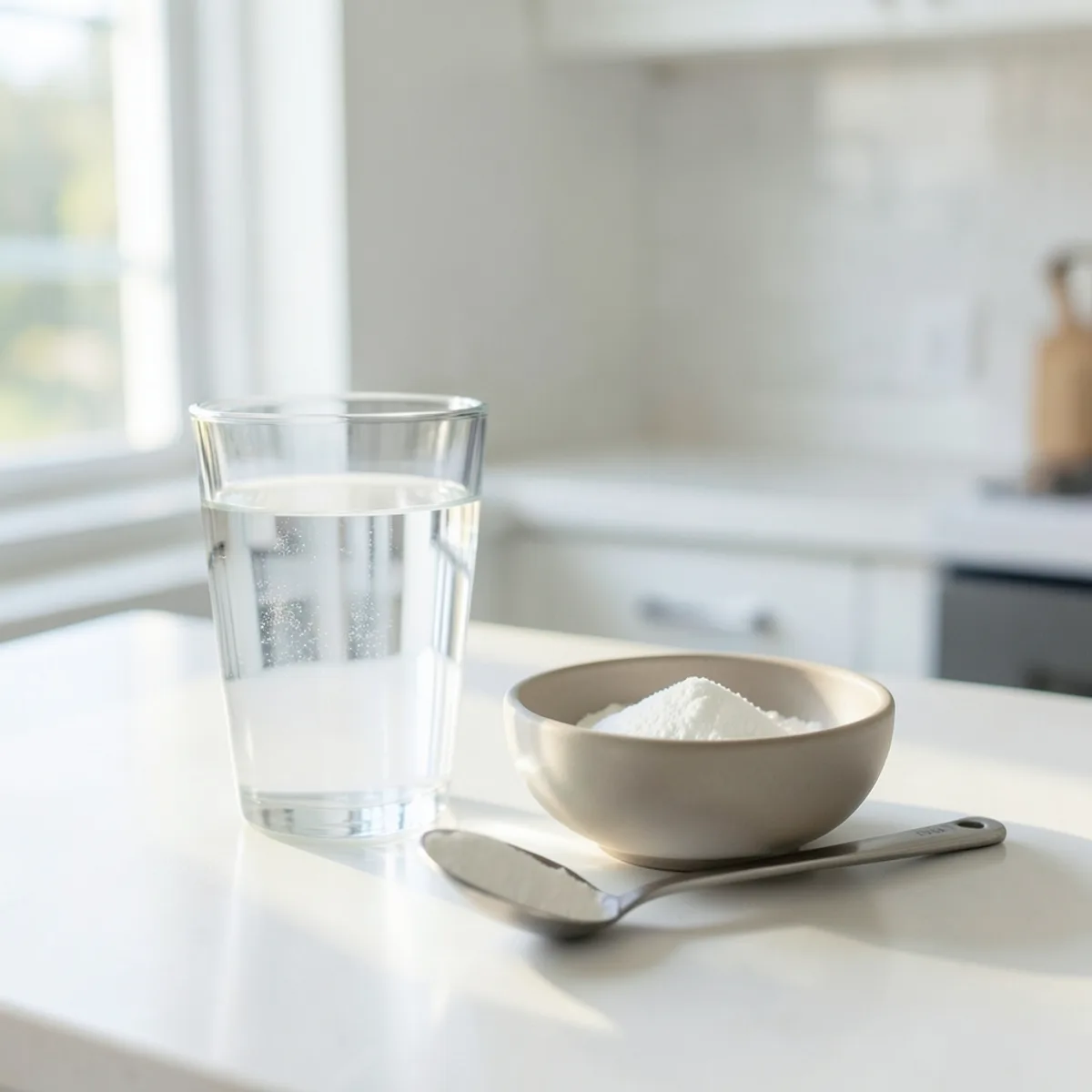
- Measuring spoons (a true 1/4 teaspoon, leveled with the back of a knife)
- Long-handled spoon (for stirring until no grains remain)
Instructions
- Check the box. Read the ingredient list. You want sodium bicarbonate only, food-grade and aluminum-free, not baking powder.
- Level the spoon. Fill a 1/4 teaspoon (1.15 g) and level it with the back of a knife. A heaped spoon holds more, and the sodium rises with it.
- Dissolve fully. Pour 8 fl oz (240 mL) of cool water into the glass, add the baking soda and stir until the water is clear and no white grains sit at the bottom.
- Wait for the fizz to stop. Let the glass stand until the bubbles stop, then sip it slowly instead of gulping. Do not drink it after a big meal or on a very full stomach.
- Mix fresh each time. Make one glass at a time and do not save leftovers. We found no sourced storage time for the mixed drink. Keep the box out of children's reach.
Notes
Metric amounts are rounded. The 1.15 g figure is 1/4 teaspoon at USDA's household portion of 4.6 g per teaspoon.
This card is a cautious kitchen measure: half the label dose (1/2 teaspoon in 4 oz of water) in twice the water. Less than the label dose is not a promise that it is safe for you.
Nutrition values are estimates calculated from typical USDA FoodData Central values for baking soda (SR Legacy, NDB 18372). Plain water adds none. They are not measured.
Nutrition Facts
Per 1 glass (8 fl oz water, 1/4 tsp baking soda) (estimated)
- Total Fat
- 0 g
- Saturated Fat
- 0 g
- Sodium
- 315 mg
- Total Carbohydrate
- 0 g
- Dietary Fiber
- 0 g
- Sugars
- 0 g
- Protein
- 0 g
Frequently asked questions
When should you drink baking soda water?
Not on a very full stomach. The antacid label says not to take it when overfull from food or drink, and MedlinePlus says to take it 1 to 2 hours after meals with a full glass of water, at least 2 hours apart from other medicines. For ciprofloxacin, NHS Scotland says 2 hours before or 4 hours after sodium bicarbonate, so anyone on antibiotics or iron should ask a pharmacist.
What are the side effects of drinking baking soda water daily?
MedlinePlus lists thirst, stomach cramps and gas as mild effects. We found no sourced safe daily amount, and the label says not to use the maximum dose for more than 2 weeks. Severe headache, vomit like coffee grounds, weakness, slow breathing, swelling of the feet or black or bloody stools mean stop and call a doctor. Poison Help is 1-800-222-1222.
What can you use instead of baking soda water?
Baking powder is not a swap: it is a different product from baking soda. We found no sourced alternative to name here, so a pharmacist is the right person to ask about other options for acid indigestion. Plain water carries none of the sodium that comes with the powder.
Comments