How Much Sodium in Baking Soda Water? Per 1/4 Tsp Glass
Jump to RecipeA 1/4 tsp glass holds about 315 mg of sodium. Here are the numbers for 1/8 to 1 tsp, a table salt comparison and who should ask a doctor first.
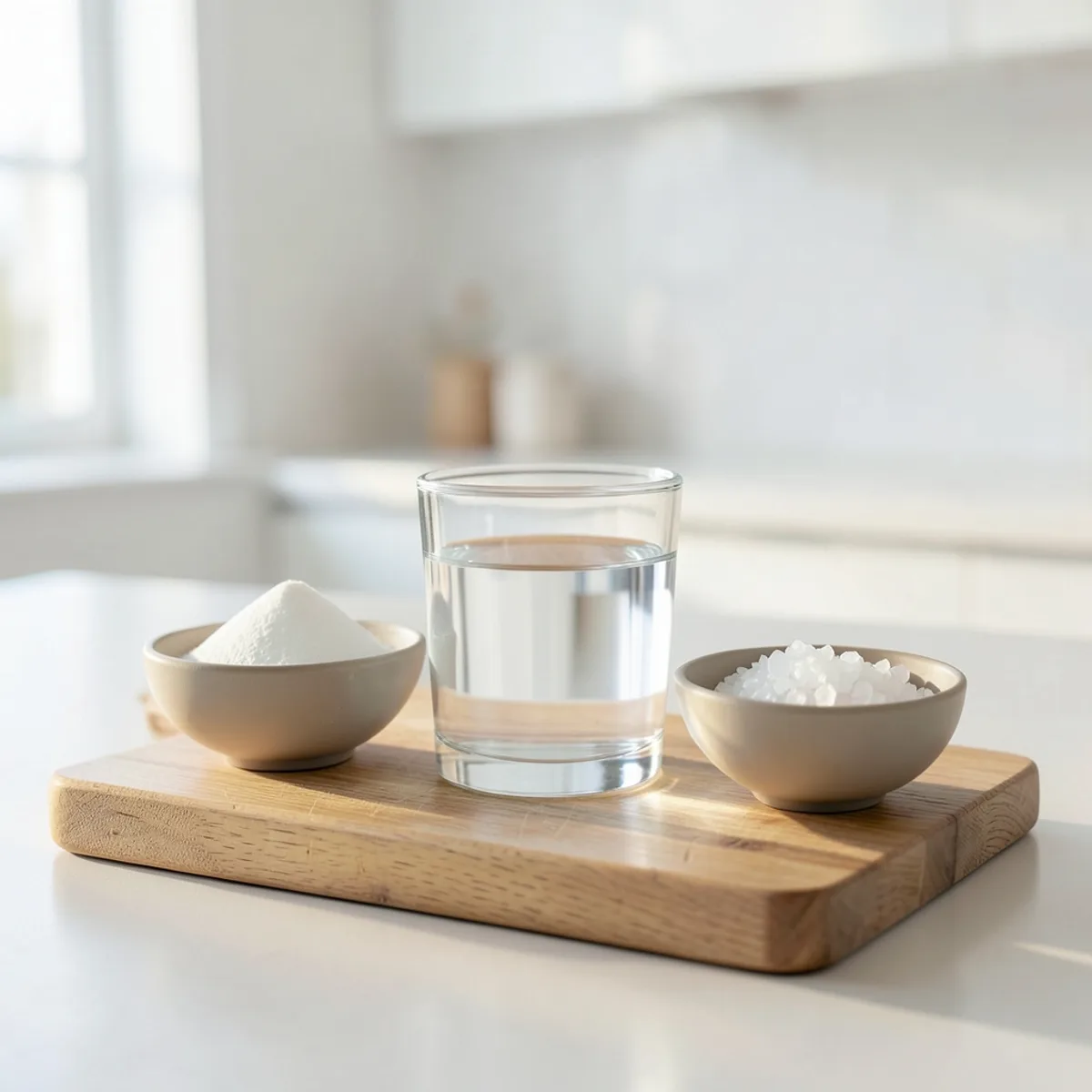 Save
Jump to:
The pages we opened on this question give no per-glass figure, so we calculated it and show the work below. Baking soda is sodium bicarbonate, and sodium is the whole story of this glass. We found no source showing that it burns fat or helps you lose weight, and this page makes no health promise.
The dose chart, label limits and water minimum live in how much baking soda in water, and the risks live in baking soda side effects. We link to them instead of repeating their tables. If weight is why you're here, start with does baking soda help you lose weight.
The Food Science / Lab Kitchen Note
Sodium bicarbonate is about 27% sodium by mass. USDA FoodData Central lists baking soda at 27,360 mg of sodium per 100 g, which is 273.6 mg per gram. That per-gram figure is the only constant you need.
The formula: grams of baking soda x 273.6 mg per gram = mg of sodium. For 1/4 tsp, that's 1.15 g x 273.6 = about 315 mg.
Two caveats. USDA gives a household portion of 4.6 g for 1 tsp and 2.3 g for 1/2 tsp. The weights for 1/8 and 1/4 tsp are our division of that 4.6 g teaspoon, not USDA portions. And the 100 g basis is our assumption, because the USDA page doesn't print it.
The spoon matters too. Only a level teaspoon gives the 4.6 g weight. A heaped spoon holds more powder and more sodium, so level it with a knife.
Sodium per spoon: 1/8 to 1 teaspoon
The FDA puts the sodium Daily Value at less than 2,300 mg per day, and says Americans average about 3,400 mg. The American Heart Association says most adults should eat no more than 2,300 mg a day, and names 1,500 mg as the ideal limit for most adults, especially people with high blood pressure. All figures below are our calculation at 273.6 mg per gram.
| Baking soda (level) | Weight | Sodium | Share of 2,300 mg | Share of 1,500 mg |
|---|---|---|---|---|
| 1/8 tsp | 0.575 g | About 157 mg | 6.8% | 10.5% |
| 1/4 tsp (our glass) | 1.15 g | About 315 mg | 13.7% | 21% |
| 1/2 tsp | 2.3 g | About 629 mg | 27.4% | 41.9% |
| 1 tsp | 4.6 g | About 1,259 mg | 54.7% | 83.9% |
That sodium arrives on top of everything else you eat that day. The FDA links too much sodium to high blood pressure, heart attack, heart failure, stroke, kidney disease and blindness.
Three sources of sodium compared (data only)
This is a comparison of published and calculated data, not a taste test or a trial of our own. So, is baking soda high in sodium? Weight for weight, baking soda has about 71% of the sodium in table salt (273.6 against 387.6 mg per gram). But a teaspoon of salt weighs more than a teaspoon of soda, so the spoon comparison looks different.
| Our glass | Table salt | Dill pickle | |
|---|---|---|---|
| Amount | 1/4 tsp baking soda (1.15 g) | 1 tsp (6 g) | About 39 g |
| Sodium per 100 g (USDA) | 27,360 mg | 38,758 mg | 809 mg |
| Sodium in that amount | About 315 mg | About 2,325 mg | About 315 mg |
| Share of 2,300 mg | 13.7% | 101.1% | 13.7% |
A level teaspoon of baking soda (about 1,259 mg) carries about 54% of the sodium in a teaspoon of table salt. Our 315 mg glass equals about 39 g of dill pickle, or about 46 g of undiluted, condensed canned chicken noodle soup (681 mg per 100 g, USDA). The salt figure is 6 g x 387.58 mg per gram, our calculation.
How baking soda compares with baking powder: no sourced data. They are different products, so we don't mix them.
The sports dose is a separate thing. The ISSN position stand, a consensus statement from 2021, names 0.3 g per kilogram of body weight as the optimal single dose and 0.2 g/kg as the minimum effective dose, taken 60 to 180 minutes before exercise. At 70 kg that is 14 to 21 g by our arithmetic, about 12 to 18 times the 1.15 g in our glass. It's an athletic protocol with bloating, nausea, vomiting and abdominal pain as listed side effects. It is never the recipe dose.
What the studies show
Searches for this topic often assume baking soda water does something to blood pressure or the body at large. The best controlled evidence we found comes from kidney patients, and it should be read that way.
The BiCARB trial (BMC Medicine, 2020) was a double-blind, placebo-controlled randomized trial of 300 adults aged 60 or older with advanced chronic kidney disease and low blood bicarbonate. They took 1.5 to 3 g a day of sodium bicarbonate tablets for up to 2 years. It found no effect on blood pressure (systolic difference 0 mmHg, 95% CI -4 to 3), no benefit on physical or kidney function, and more adverse events (457 against 400). The people in it were patients under medical care, not healthy cooks, so it's no dose guide for a kitchen glass.
A systematic review and meta-analysis of randomized trials (CJASN, 2023) pooled 14 trials and 2,110 adults with non-dialysis chronic kidney disease, using a median of 0.5 mEq/kg of oral sodium bicarbonate. It found no significant difference in systolic blood pressure against control (moderate certainty) and no higher need for blood pressure medicines. Again, the population is kidney-disease patients dosed under a doctor's care. Neither study tested people in good health, and neither tested a weight-loss claim.
Common mistakes
Heaping the spoon. Sodium scales with the powder. A heaped teaspoon holds more than the 4.6 g that USDA's figure assumes, so level it.
Skipping the dissolve. Undissolved powder is the usual slip. The label says not to drink it until it is completely dissolved, and never in less than 4 fl oz (120 mL) of water per MedlinePlus.
Counting only the glass. 315 mg looks small, and it is 14% of the daily limit before breakfast has started. Add it to the rest of your day.
Substitutes and swaps
| Original | Swap | Proportion | What changes |
|---|---|---|---|
| Baking soda | Baking powder | Not a substitute | A different product with different sodium; no sourced data here |
| Baking soda | Low-sodium baking soda | No sourced alternative | Readers search for it, but we found no sourced version or safety data, so we don't name one |
| Baking soda | Table salt | Not a substitute | About 2,325 mg of sodium per level teaspoon against about 1,259 mg |
Storage
Mix one glass and drink it. We found no sourced shelf life for the mixed drink, so we give no duration. Make-ahead tip: measure the dry soda into the spoon, level it, and add water only when you're ready to drink.
Nutrition note
Values on the recipe card are estimates calculated from typical USDA FoodData Central values for baking soda, per glass of 8 fl oz with 1/4 tsp (1.15 g), not measured. The glass is water and baking soda, so calories, carbohydrate, protein, fat, sugars and fiber are all zero. Sodium is about 315 mg, or 13.7% of 2,300 mg. For timing, see the best time to drink baking soda water, and for a flavored version, baking soda and lemon water.
Servings: 1 glass (8 fl oz)
How Much Sodium in Baking Soda Water? Per 1/4 Tsp Glass
A 1/4 tsp glass holds about 315 mg of sodium. Here are the numbers for 1/8 to 1 tsp, a table salt comparison and who should ask a doctor first.
Ingredients
Equipment
- Measuring spoons (a true 1/4 teaspoon, leveled with the back of a knife)
- Clear glass and spoon (so you can see when no white grains are left)
Instructions
- Level the soda. Fill a 1/4 teaspoon (1.15 g) with food-grade, aluminum-free baking soda and sweep the top flat with a knife. A heaped spoon holds more powder, and the sodium rises with it.
- Pour the water first. Pour 8 fl oz (240 mL) of water into a clear glass. Never go below 4 oz (120 mL), the MedlinePlus minimum for dissolving the powder.
- Stir until fully dissolved. Add the soda and stir until the water is clear and no grains sit on the bottom. The label says not to drink it until the powder is completely dissolved.
- Sip it slowly. Drink the glass in sips rather than as a shot, and not on an overfull stomach. Mix one glass at a time, since we found no sourced shelf life for the mixed drink.
Notes
Metric amounts are rounded. The 1.15 g figure is our division of the USDA household portion of 4.6 g per teaspoon, not a USDA portion itself.
Nutrition values are estimates calculated from typical USDA FoodData Central values for baking soda (27,360 mg of sodium per 100 g). They are not measured. The glass is water and baking soda only, so everything except sodium is zero.
Nutrition Facts
Per 1 glass (8 fl oz water, 1/4 tsp baking soda) (estimated)
- Total Fat
- 0 g
- Saturated Fat
- 0 g
- Sodium
- 315 mg
- Total Carbohydrate
- 0 g
- Dietary Fiber
- 0 g
- Sugars
- 0 g
- Protein
- 0 g
Frequently asked questions
When should you drink baking soda water?
MedlinePlus says that for heartburn you take it 1 to 2 hours after meals, with a full glass of water. It also says to keep it at least 2 hours apart from other medicines.
What are the side effects of baking soda water?
MedlinePlus lists thirst, stomach cramps and gas as mild effects. The sodium is the other cost, about 315 mg in a 1/4 tsp glass by our calculation, and our side-effects page covers the rest.
Can you use baking soda in a low sodium diet?
MedlinePlus says to tell your doctor if you are on a sodium-restricted diet, because sodium bicarbonate adds sodium. We found no sourced low-sodium version of baking soda, so we don't recommend one.
Is the sodium in baking soda the same as in table salt?
It is the same element, but a different amount. A level teaspoon of baking soda has about 1,259 mg of sodium, against about 2,325 mg in a teaspoon of table salt, by our calculation from USDA values.

Steven Dony trained in a restaurant kitchen and lives in Nashville, Tennessee. He covers SodaRecipe’s fact-checks: what works, what does not, and why.
Comments