Baking Soda and Buttermilk for Baking Powder (Biscuits)
Jump to RecipeSwap 1/4 teaspoon of baking soda and 1/2 cup of buttermilk for each teaspoon of baking powder, then see the math in a drop biscuit recipe with grams, a liquid check and sodium per biscuit.
 Save
Jump to:
Most baking powder swaps stop at one line: 1/2 cup of buttermilk and 1/4 teaspoon of soda per teaspoon. That line is correct as far as it goes. It leaves out the part that wrecks a recipe, which is where the extra liquid goes.
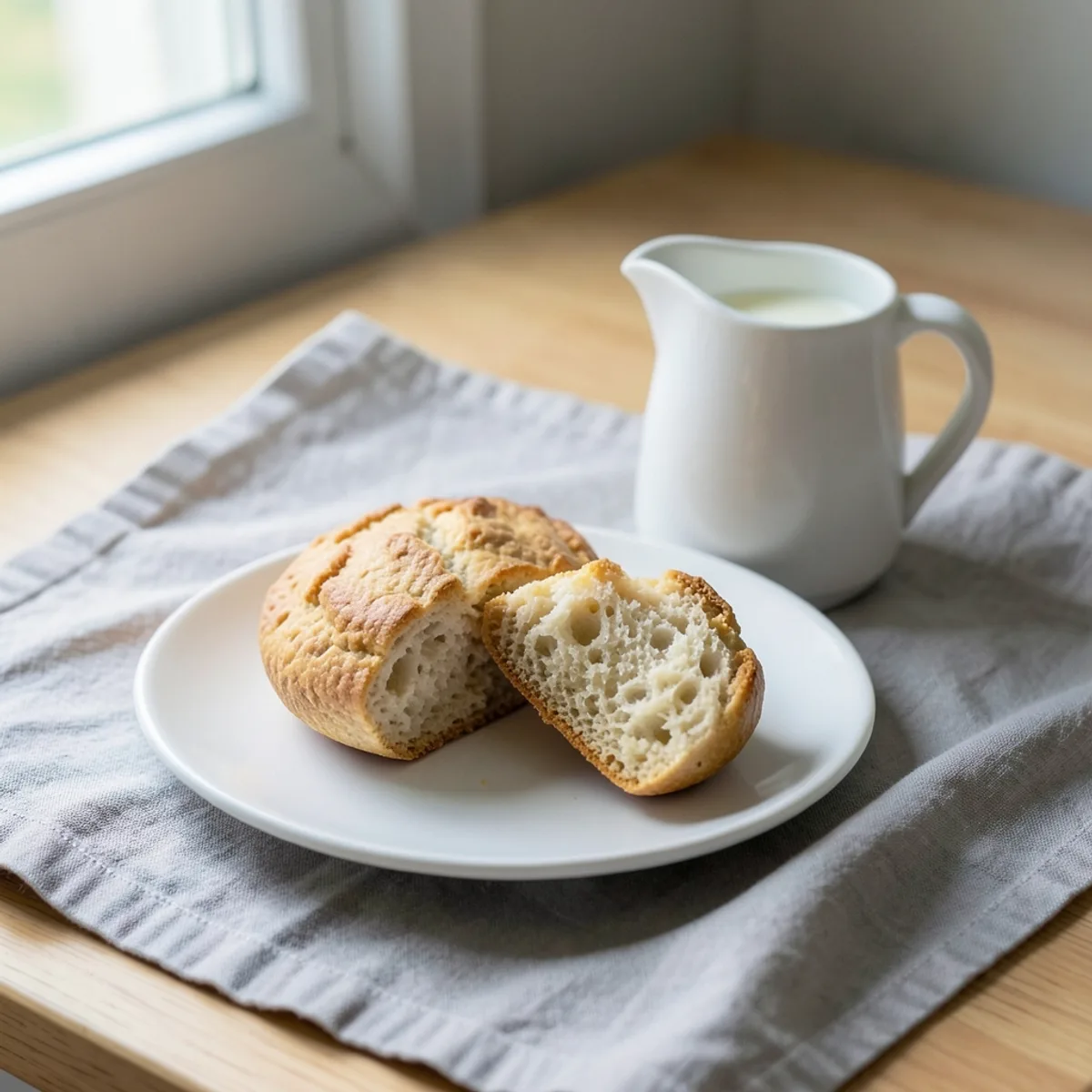
This page shows the swap inside a real recipe, soda-only buttermilk drop biscuits. It is our adaptation and it is untested: the ratios come from the sources below, and the full formula has not been baked here. For the wider list of swaps, see baking soda instead of baking powder and baking soda replacement.
Why the buttermilk replaces the liquid, not adds to it
Both Healthline and Betty Crocker say to cut the other liquid by the amount of buttermilk you add. In a biscuit there is no other liquid to cut. The buttermilk is the whole liquid, so it is also the acid. Count it as the liquid and set the soda by the cup of buttermilk, not by the teaspoon of powder you removed.
Here is our worked example. King Arthur's buttermilk biscuits use 3 cups (360 g) of flour and 1 tablespoon of baking powder, which is 3 teaspoons. Apply the per-teaspoon swap three times and you need 1 1/2 cups of buttermilk and 3/4 teaspoon of soda. King Arthur's dough takes 227 to 255 g of liquid, so the swap on its own overshoots the dough and turns it wet. Scale the card down to 2 cups of flour and the numbers land at 1 cup of buttermilk and 1/2 teaspoon of soda, and those agree with Bake School's per-cup rules.
The Food Science / Lab Kitchen Note
Except where a source is named, this section is standard food chemistry.
Baking soda is sodium bicarbonate, a base. Buttermilk is acidic. When the two meet, the acid and the bicarbonate react and release carbon dioxide, and that gas is what lifts the dough. The reaction starts on contact, which is why this page keeps saying to bake at once.
Baking powder works differently. It carries its own acid with the bicarbonate, and the double-acting kind releases gas twice, once when wet and again in the oven. Soda and buttermilk give you one reaction only, and most of it happens in the bowl. So the dough has less in reserve if it waits.
The soda amount has to match the acid. Too little soda leaves some of the acid unreacted. Too much leaves bicarbonate that has nothing to react with. Bake School describes that leftover soda as tasting soapy, and says more soda browns the crust faster because a higher pH speeds the Maillard reaction. Its bakes with extra soda came out flatter with a more open crumb. That was a baker's test, not a controlled study.
Why 1/2 teaspoon per cup of buttermilk? Kitchen Savvy and Bake School both give about that amount when the recipe has no other acid. If molasses or natural cocoa is in the mix, Kitchen Savvy says it needs more soda. Our biscuits have flour, butter, salt and buttermilk, so the plain figure applies.
Three leaveners compared
This table compares published data and our card, not finished bakes. Where no source gives a figure, the cell says so.
| Variant | Flour | Leavener | Liquid | Oven | Crumb, rise, taste |
|---|---|---|---|---|---|
| Baking powder (King Arthur buttermilk biscuits) | 3 cups (360 g) | 1 tablespoon baking powder | 1 cup to 1 cup plus 2 tablespoons (227 to 255 g) cold buttermilk or milk | 425 F, 15 to 20 minutes, 12 biscuits | No sourced data |
| Baking soda + buttermilk (this card, untested) | 2 cups (250 g) | 1/2 teaspoon (2.3 g) baking soda | 1 cup (245 g) buttermilk | 425 F, 15 to 20 minutes (King Arthur timing), 8 biscuits | No sourced data |
| Baking soda + cream of tartar (Arm and Hammer quick biscuits) | 2 cups | 1 teaspoon baking soda + 1 teaspoon cream of tartar | 1 cup buttermilk, plus 1 egg and 3 tablespoons shortening | 450 F, 10 to 11 minutes | No sourced data |
The Arm and Hammer row uses twice the soda of our card for the same 2 cups of flour, but it adds cream of tartar as a second acid and an egg. We did not try to reconcile the two formulas, so take all numbers for one recipe from one source.
Common mistakes
Adding the buttermilk on top of the usual liquid. The sources say to cut the other liquid by the buttermilk. In this recipe there is no other liquid, so the buttermilk is the entire amount. Adding milk as well makes the dough wet and slack.
Letting the dough wait. The reaction starts on contact, so a dough that sits has already spent part of its gas before the oven. Have the oven hot and the sheet lined first, mix the buttermilk in last, and scoop straight onto the sheet.
Adding extra soda to be safe. More soda does not mean more lift once the acid is used up. By Bake School's account it leaves a soapy edge and browns the crust faster. Measure the half teaspoon level, and weigh it if you have a scale that reads to a tenth of a gram.
Buttermilk alternatives and swaps
| Original | Replacement | Proportion | What changes |
|---|---|---|---|
| Buttermilk | Sour cream or yogurt | About 1/2 teaspoon baking soda per cup (Bake School) | Soda amount is sourced. The liquid change in a drop biscuit is not tested here. |
| Buttermilk | Sour milk | Not tested here | Healthline lists it as a swap, but no soda amount was checked for this page. |
| Buttermilk | Lemon juice or vinegar in milk | Not tested here | No soda amount was checked for this page. |
| Baking soda + buttermilk | Baking soda + cream of tartar | Arm and Hammer's biscuits use 1 teaspoon of each with 1 cup buttermilk | A different formula from this card, with an egg and shortening. |
Sodium per biscuit
This is our own calculation from USDA FoodData Central. USDA lists baking soda at about 27,400 mg of sodium per 100 g and gives 2.3 g per 1/2 teaspoon, so the half teaspoon in the recipe holds about 630 mg. Table salt is 38,800 mg per 100 g, so 1/2 teaspoon (3 g) holds about 1,164 mg. Divide by 8 biscuits.
Per biscuit that is about 79 mg from the soda, 146 mg from the salt, 46 mg from the butter and 45 mg from the buttermilk. The flour adds about 1 mg. The total is about 317 mg, or 14% of the 2,300 mg FDA Daily Value.
On the weight of a teaspoon: this page uses 4.6 g per teaspoon, the USDA figure. Other pages on the site say 6 g per teaspoon, which is King Arthur's number. The two sources weigh a level teaspoon differently, so check which one a recipe is using before you compare sodium.
Storing and rewarming
The only storage text we found comes from King Arthur's baking powder biscuits: leftovers keep well wrapped at room temperature for several days, freeze for longer, and should be rewarmed before serving. No fridge time is sourced. That advice is for a different leavener, so treat it as a starting point for this soda-only version, which has not been baked here.
Where the numbers come from
Bake School is a baking guide with a baker's own tests. Its soda per cup of flour and per cup of buttermilk figures are presented as guidelines, and its soapy taste and browning notes came from the author's bakes, not a controlled study. King Arthur Baking is a specialist baking site, and its biscuit page supplies the flour weight, liquid range, oven temperature and time, and the storage line. Healthline and Betty Crocker supply the per-teaspoon swap, and Kitchen Savvy the soda per cup of buttermilk. Arm and Hammer's quick biscuit page is a soda-leavened precedent from the product's maker.
USDA FoodData Central is a nutrient database, and the FDA Daily Value is a regulatory reference. The sodium and nutrition are our own calculations from those figures. We found no study that compares these leavening swaps in a biscuit, and none is cited here. For another bread that leans on soda and buttermilk alone, see Irish soda bread, and for the difference between the two leaveners, see baking soda vs baking powder.
Servings: 8 biscuits
Baking Soda and Buttermilk for Baking Powder (Biscuits)
Swap 1/4 teaspoon of baking soda and 1/2 cup of buttermilk for each teaspoon of baking powder, then see the math in a drop biscuit recipe with grams, a liquid check and sodium per biscuit.
Ingredients
Soda-only buttermilk drop biscuits
Equipment
- Large bowl (for the dry mix)
- Rimmed baking sheet (lined with parchment)
- Kitchen scale (the gram weights above are what the nutrition panel is built on)
Instructions
- Heat the oven. Heat the oven to 425 F with a rack in the middle and line a rimmed baking sheet with parchment before any liquid goes in.
- Whisk the dry ingredients. Whisk 2 cups (250 g) flour, 1/2 teaspoon (2.3 g) baking soda and 1/2 teaspoon (3 g) salt in a large bowl until no streaks of soda remain.
- Work in the butter. Rub or cut the 4 tablespoons (57 g) of cold butter into the flour until the pieces are small and coated.
- Add the buttermilk last. Pour in 1 cup (245 g) of cold buttermilk and stir with a spatula just until no dry flour shows. Do not add any other liquid.
- Scoop and bake at once. Drop 8 equal mounds onto the sheet and put it in the oven straight away. Bake for 15 to 20 minutes, until the biscuits are golden.
- Rest briefly and serve. Move the biscuits off the hot sheet and serve warm.
Notes
Our adaptation, untested. No one at SodaRecipe has baked this exact formula. It is built from sourced ratios: Bake School's 1/4 teaspoon of soda per 125 g (1 cup) of flour and 1/2 teaspoon per cup of buttermilk, with the oven temperature and time from King Arthur's baking powder buttermilk biscuits.
The math is ours. King Arthur's biscuits use 3 cups (360 g) of flour and 1 tablespoon (3 teaspoons) of baking powder. Healthline and Betty Crocker swap each teaspoon for 1/4 teaspoon of soda plus 1/2 cup of buttermilk, so the full swap would be 1 1/2 cups of buttermilk and 3/4 teaspoon of soda, more liquid than the 227 to 255 g in that recipe. Scaled to 2 cups of flour, the powder is 2 teaspoons, which gives 1 cup of buttermilk and 1/2 teaspoon of soda. That agrees with Bake School's per-cup rules.
Time: the 15 to 20 minute bake is King Arthur's figure for its baking powder version. Prep time and the yield of 8 are estimates. The cook time field uses the top of the range.
Soda weight: this page uses 4.6 g per teaspoon (USDA FoodData Central, 2.3 g per 1/2 teaspoon). Other pages on this site use 6 g per teaspoon, King Arthur's figure. The two sources weigh a teaspoon differently, so the sodium here is built on USDA.
Sodium is our own calculation, not a published figure: baking soda 79 mg, salt 146 mg, butter 46 mg, buttermilk 45 mg and flour about 1 mg per biscuit, which adds up to 317 mg, or 14% of the 2,300 mg FDA Daily Value.
Nutrition values are estimates calculated from typical USDA FoodData Central values, with low-fat cultured buttermilk, salted butter and all-purpose flour. Fiber is not listed because the fiber value for the flour was not checked for this page. Sugar counts only the carbohydrate in the buttermilk (all treated as sugar), so it is a rough figure.
Nutrition Facts
Per one biscuit (1 of 8) (estimated)
- Total Fat
- 6.5 g
- Saturated Fat
- 3.9 g
- Sodium
- 317 mg
- Total Carbohydrate
- 24 g
- Sugars
- 1.5 g
- Protein
- 5 g
Frequently asked questions
How soon do I bake dough made with baking soda and buttermilk?
Right away, because the reaction starts as soon as the soda meets the buttermilk. Mix the wet into the dry last and have the oven already at 425 F.
What happens if I add too much baking soda?
Bake School reports that unreacted soda can taste soapy and that more soda browns the crust faster, with bakes coming out flatter and more open. That was a baker's test, not a controlled study.
What can I use if I have no buttermilk?
Bake School gives the same 1/2 teaspoon of soda per cup for sour cream or yogurt as for buttermilk. No soda amounts were checked for sour milk or lemon juice, so this page states none.
How do I store leftover baking soda biscuits?
King Arthur says its baking powder biscuits keep well wrapped at room temperature for several days, freeze for longer, and should be rewarmed before serving. No fridge time is sourced, and this soda-only version is our untested adaptation.

Stella Nordi bakes in Portland, Oregon. She weighs everything in grams and explains why a bake fails. She covers SodaRecipe’s quick breads, biscuits and baking guides.
Comments