Sodium in 1 Tbsp Baking Soda: 3,780 mg (Bagel Bath Math)
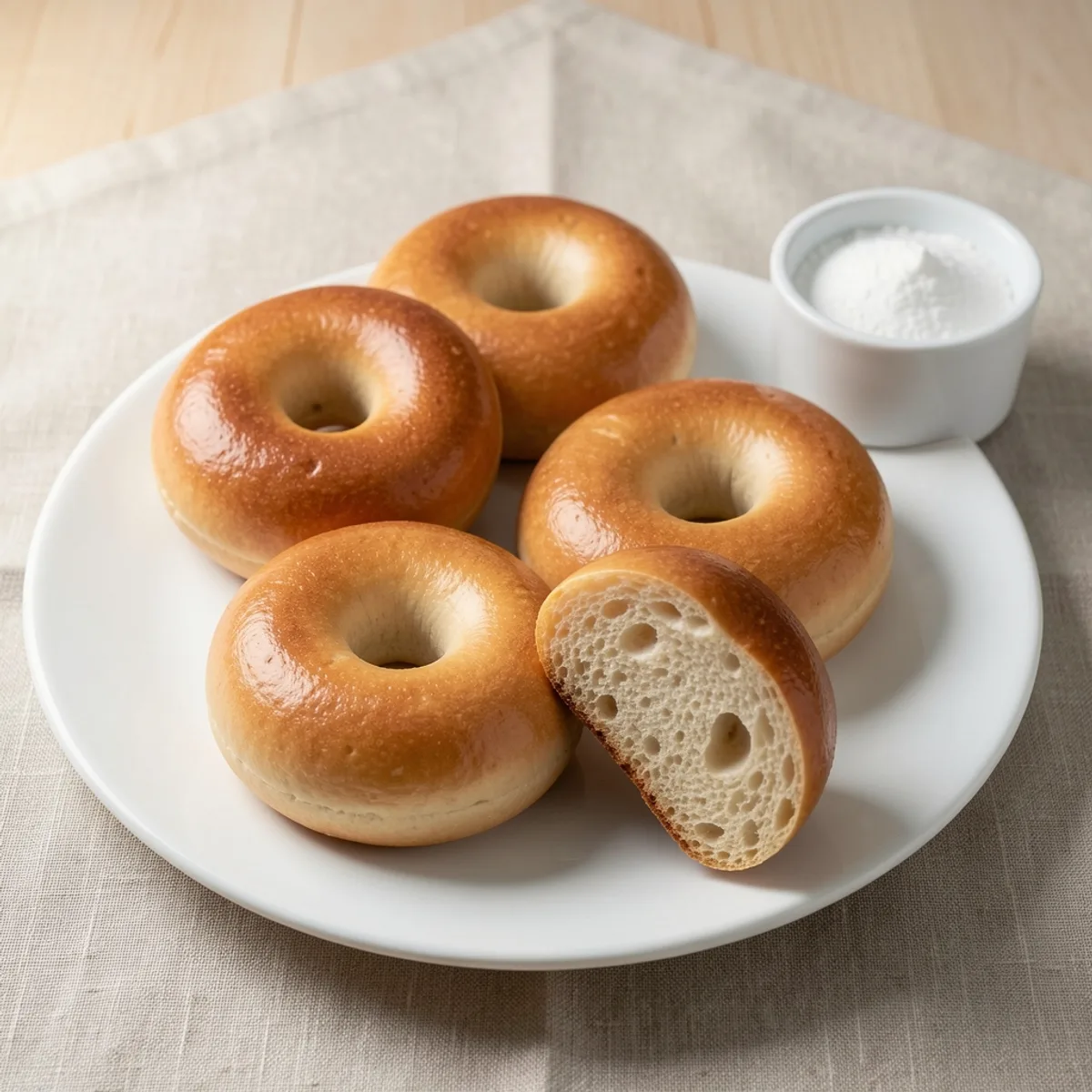
Jump to RecipeOne level tablespoon of baking soda holds about 3,780 mg of sodium. Here is that against the 2,300 mg limit, why a tablespoon is not a dose, and a bagel recipe with a 1 tbsp boil bath.
 Save
Jump to:
Sodium in 1 tablespoon of baking soda is about 3,780 mg, about 164% of 2,300 mg, from 13.8 g at USDA's 27,360 mg per 100 g. It's a bagel-bath amount, not a dose: at most about 772 mg of sodium per bagel.
Here's where people go wrong. They see "1 tablespoon of baking soda" in a bagel recipe and treat it like a dose. It isn't. It's the amount in a pot of boiling water, and most of that water goes down the drain.
This recipe is adapted from J. Cooks' homemade bagels. The ingredients, the times and the 1 minute boil come from there. The words and the sodium math are ours. Nothing on this page was cooked, tasted or measured by us. Every figure is published USDA data or our own arithmetic on it. For the per-teaspoon numbers, see how much sodium in baking soda water, and for spoon weights, 1 tsp baking soda in grams.
The Food Science / Lab Kitchen Note
Baking soda is sodium bicarbonate, NaHCO₃. USDA FoodData Central lists it at 27,360 mg of sodium per 100 g, so about 27% of its weight is sodium. That's our arithmetic. The same entry gives a household portion of 1 tsp = 4.6 g and prints no tablespoon weight. So we use 1 tbsp = 3 tsp = 13.8 g, and 13.8 × 273.6 gives about 3,776 mg, which we round to about 3,780 mg.
Against the FDA's Daily Value of less than 2,300 mg a day, that's about 164%. One teaspoon is about 55%.
Dissolved baking soda makes the bath alkaline. We found no source that measures why it browns the crust, so we skip the chemistry story. What does have a source is the effect of strength. Home bakers who compared bath strengths found that heavier soda mostly darkens the crust and tips the flavor toward pretzel, and a food site warns that too much gives bagel-shaped pretzels. Two separate sources agree.
Now the sodium inside the dough. The salt is the big one. USDA lists table salt at 38,800 mg of sodium per 100 g, so 1 tsp (6 g) is about 2,328 mg. Out of about 2,397 mg in the whole dough batch, that's about 97%. Flour, yeast and sugars together add only about 14 mg. Egg white adds up to 55 mg, a ceiling, because only part of it is used.
So the baking soda isn't the biggest sodium source in the dough. The salt is. The bath is a separate question, and it's the one we can't measure.
Three variants, compared
This table compares data, not finished foods. Every figure is our calculation from USDA values, against 2,300 mg.
| Variant | Weight | Sodium (USDA-based) | Share of 2,300 mg |
|---|---|---|---|
| Baking soda, 1 tsp | 4.6 g | About 1,260 mg | About 55% |
| Baking soda, 1 tbsp | 13.8 g | About 3,780 mg | About 164% |
| Table salt, 1 tsp | 6 g | About 2,328 mg | About 101% |
Per spoon, the baking soda is lower than table salt by the teaspoon (1,260 against 2,328 mg), but a tablespoon passes it. That's the tsp versus tbsp mix-up in one table.
Bath strength: the sodium ceiling
One baker on The Fresh Loaf ran an informal home test and posted it. It's not a study, and he tasted 3 of 6 bagels. He boiled bagels in 8 cups of water with 1 tbsp, 4 tbsp and 8 tbsp of baking soda. His 1 tbsp bath is the same strength as the one in the J. Cooks recipe. More soda gave a darker crust. At 4 tbsp he noted a faint alkaline, pretzel-like taste where moisture pooled, and at 8 tbsp a pretzel-like crust. He suggested 2 to 3 tbsp per 8 cups next time. We didn't run this test. We only turn his three strengths into sodium.
| Bath (8 cups, 2 quarts) | Baking soda | Sodium in the bath | If the bath served 8 bagels, ceiling per bagel | Share of 2,300 mg |
|---|---|---|---|---|
| 1 tbsp | 13.8 g | About 3,776 mg | About 472 mg | About 21% |
| 4 tbsp | 55.2 g | About 15,103 mg | About 1,888 mg | About 82% |
| 8 tbsp | 110.4 g | About 30,205 mg | About 3,776 mg | About 164% |
The bagel count in his test isn't clear from what we read, so the "8 bagels" column is a stand-in to compare against this recipe, not his result. And every row is a ceiling. The sodium that actually ends up in a bagel is lower, but no source we found says by how much. The takeaway is simple. A stronger bath multiplies the ceiling and gives a darker crust, not a better bagel.
Common mistakes
Reaching for the tablespoon when a recipe means a teaspoon. A tablespoon is 3 teaspoons, so it carries three times the sodium: about 3,780 mg instead of about 1,260 mg. Read the abbreviation twice.
Heaping the spoon. The figures on this page rest on level spoons. A heaped spoon holds more than the USDA weights, and a scale takes the guesswork out.
Thinking a stronger bath makes a better bagel. It makes a darker crust and a pretzel flavor. The signals we found agree on that, and the ceiling climbs with it.
Substitutes and swaps
| Original | Swap | Proportion | What changes |
|---|---|---|---|
| Baking soda in the bath | A sodium-free baking soda | Doesn't exist | Baking soda is sodium bicarbonate, so the sodium comes with it |
| Baking soda in the bath | Baking powder | No sourced proportion | The reference recipe says baking powder is not the same, so we don't suggest it |
| Baking soda in the bath | Lye or any other swap | No sourced proportion | Not suggested here |
| Salt in the dough | Less salt | No sourced proportion | Salt is about 97% of the dough's sodium, so this is the lever that matters, but we haven't calculated a lower amount |
What the sources say
The numbers on this page rest on a database and on guidance. None of it is a trial of this recipe.
The database is USDA FoodData Central, the federal nutrient database. We took baking soda (SR Legacy entry 175040) from it, along with table salt, egg white, active dry yeast, all-purpose flour, granulated sugar and brown sugar. It holds measured values, not studies. That's the basis for our math, and it isn't a test of the bagels.
The guidance comes from three kinds of source. The FDA sodium page is a federal agency page. It says the Daily Value is less than 2,300 mg a day and that Americans eat about 3,400 mg a day on average. It says higher-sodium diets raise the likelihood of high blood pressure, a major contributor to stroke and heart disease, and that uncontrolled high blood pressure can lead to heart attack, heart failure, kidney disease and vision loss. The MedlinePlus sodium bicarbonate page, from the NIH, is a drug monograph. It says sodium bicarbonate increases the amount of sodium in your body, and that the powder should be dissolved in at least 4 ounces (120 mL) of water and measured with a measuring spoon. As an antacid, it says to take it 1 to 2 hours after meals with a full glass of water and not when overfull. It also says not to use it longer than 2 weeks unless your care team approves. The page gave no fixed dose in the text we read and no tablespoon dose.
The third is a case report in the West Journal of Emergency Medicine (2016). It describes one patient: a 33-year-old man with psychiatric illness who swallowed a whole 16 oz (454 g) box of baking soda. He arrived confused with a serum sodium of 172 mEq/L, an estimated sodium load of 5,403 mEq and intracranial hemorrhages on CT. He recovered mental status within about 24 hours and left hospital on day 4. It's one person, not a dose guide, and a tablespoon (13.8 g) is about 3% of that box, by our arithmetic. We found no trial on bagel-bath amounts.
Storage and make-ahead
We found no sourced storage time or reheating guidance for these bagels, so this page gives no days or times. Make-ahead tip: weigh the flour, sugars, yeast and salt into a bowl ahead, and level 1 tbsp (13.8 g) of baking soda into a small cup, so you don't mix up the spoons at the stove.
Nutrition note
Values on the recipe card are rough estimates calculated from typical USDA FoodData Central values, not measured. The sodium uses the USDA lines in our research. The calories and macros use typical USDA values that are not in our research notes, so they are approximate. They assume plain table salt, granulated and packed brown sugar, active dry yeast and one large egg white, per bagel (1 of 8), with no topping. Calories and macros come from the dough only. Sodium on the card is the ceiling: about 300 mg from the dough plus about 472 mg if every milligram of the bath ended up on the bagel, so at most about 772 mg, or about 34% of 2,300 mg. The real number is lower, and we found no source that tells us how much.
Servings: 8 bagels
Sodium in 1 Tbsp Baking Soda: 3,780 mg (Bagel Bath Math)
One level tablespoon of baking soda holds about 3,780 mg of sodium. Here is that against the 2,300 mg limit, why a tablespoon is not a dose, and a bagel recipe with a 1 tbsp boil bath.
Ingredients
Bagel dough
Baking soda boil bath
Egg white wash
Equipment
- Kitchen scale (the sodium math is built on gram weights)
- Large wide pot (for the 2-quart bath)
- Slotted spoon
- Baking sheet
- Pastry brush (for the egg white)
Instructions
Dough
- Foam the yeast. Stir 2 tsp (8 g) yeast and 2 tsp (8.4 g) sugar into 1 cup (237 mL) warm water at 110°F (43°C) and leave it about 10 minutes, until foamy.
- Mix the dough. Add 2 1/2 cups (312 g) flour, 1 tbsp (13.8 g) packed brown sugar and 1 tsp (6 g) salt, then knead into a dough. No sourced kneading time, so judge by feel.
- Let it rise. Cover the dough and let it rise about 1 hour, or until doubled.
- Shape 8 bagels. Divide the dough into 8 equal pieces, weighing them if you can, and shape each into a ring. Equal pieces keep the per-bagel figures honest.
Bath and bake
- Heat the oven. Heat the oven to 450°F (230°C) before the bagels go in the bath.
- Make the bath. Bring 2 quarts (1.9 L) of water to a boil and stir in 1 level tbsp (13.8 g) baking soda. Use a tablespoon, not a teaspoon, and use baking soda, not baking powder.
- Boil each bagel. Boil each bagel for 1 minute, flipping it halfway through, then lift it out with the slotted spoon. With 8 bagels that is 8 minutes of boiling if you go one at a time.
- Brush with egg white and rest. Set the bagels on a baking sheet, brush them with the egg white and let them rest 10 minutes before baking.
- Bake. Bake at 450°F (230°C) for 10 to 15 minutes, until the crust is deep golden.
- Pour the bath away. Pour the bath down the drain once the bagels are out. It is a cooking liquid, not a drink.
Notes
Adapted from the reference recipe at J. Cooks. We reworded it and recalculated the sodium from USDA household weights. This page is a data check, not a test kitchen: nothing here was cooked, tasted or measured by us.
Times: the card shows the J. Cooks times of 30 minutes prep and 15 minutes cook. The 80 minutes of resting is our sum of the rests in that recipe: about 10 minutes for the yeast, about 1 hour for the dough and 10 minutes for the shaped bagels. The 1 minute boil per bagel is in the steps and is not added to the card times.
Dough sodium by ingredient, from USDA lines: salt 2,328 mg, egg white up to 55, flour 6.3, active dry yeast 4.1, brown sugar 3.9 (13.8 g at 28 mg per 100 g), granulated sugar 0.1. That is about 2,397 mg per batch, or about 300 mg per bagel.
The bath adds a CEILING, not a measurement. The bath holds 1 tbsp (13.8 g) of baking soda, about 3,776 mg of sodium, and 3,776 divided by 8 is about 472 mg per bagel. Most of the bath goes down the drain, and we found no source that measures how much sticks to a bagel.
Sodium on the card is the dough (about 300 mg) plus that full ceiling (about 472 mg), so at most about 772 mg per bagel, or about 34% of 2,300 mg. The real figure sits somewhere between 300 and 772 mg.
Nutrition is per bagel (1 of 8) and is a rough estimate. The sodium comes from the USDA lines in the brief. Calories, carbs, protein, fat, sugar and fiber come from typical USDA FoodData Central values that are not in the brief, so treat them as approximate. The bath adds no calories to the card. Saturated fat is left off. Plain bagels, no topping.
Nutrition Facts
Per 1 bagel (1 of 8); sodium is a ceiling including the full bath (estimated)
- Total Fat
- 0.5 g
- Sodium
- 772 mg
- Total Carbohydrate
- 33 g
- Dietary Fiber
- 1.3 g
- Sugars
- 2.9 g
- Protein
- 4.9 g
Frequently asked questions
How much sodium is in a teaspoon of baking soda?
About 1,260 mg per level teaspoon (4.6 g), which is about 55% of the 2,300 mg Daily Value. A half teaspoon is about 630 mg. Both are our arithmetic on the USDA value of 27,360 mg per 100 g.
How much baking soda do you put in bagel water?
This recipe uses 1 tbsp (13.8 g) in 2 quarts (1.9 L) of water for 8 bagels. Three sources in our research put a usual home bath at about 1 tbsp for 2 to 3 quarts.
Can you swallow baking soda by the tablespoon?
No source on this page gives a tablespoon dose, so we give none. MedlinePlus, the NIH drug page, describes a measured spoon dissolved in at least 4 oz (120 mL) of water, for no longer than 2 weeks unless your care team approves.
Is there a sodium-free swap for the bagel bath?
Not in our sources. Baking soda is sodium bicarbonate, and the reference recipe says baking powder is not a substitute. We don't suggest lye or any swap we can't source.

Steven Dony trained in a restaurant kitchen and lives in Nashville, Tennessee. He covers SodaRecipe’s fact-checks: what works, what does not, and why.
Comments