Does Apple Cider Vinegar Damage Teeth? (Diluted Glass)
Jump to RecipeYes, the acid can erode enamel in lab studies and case reports. Here is what the studies show, one measured diluted glass, and the straw, rinse and wait steps.
 Save
Jump to:
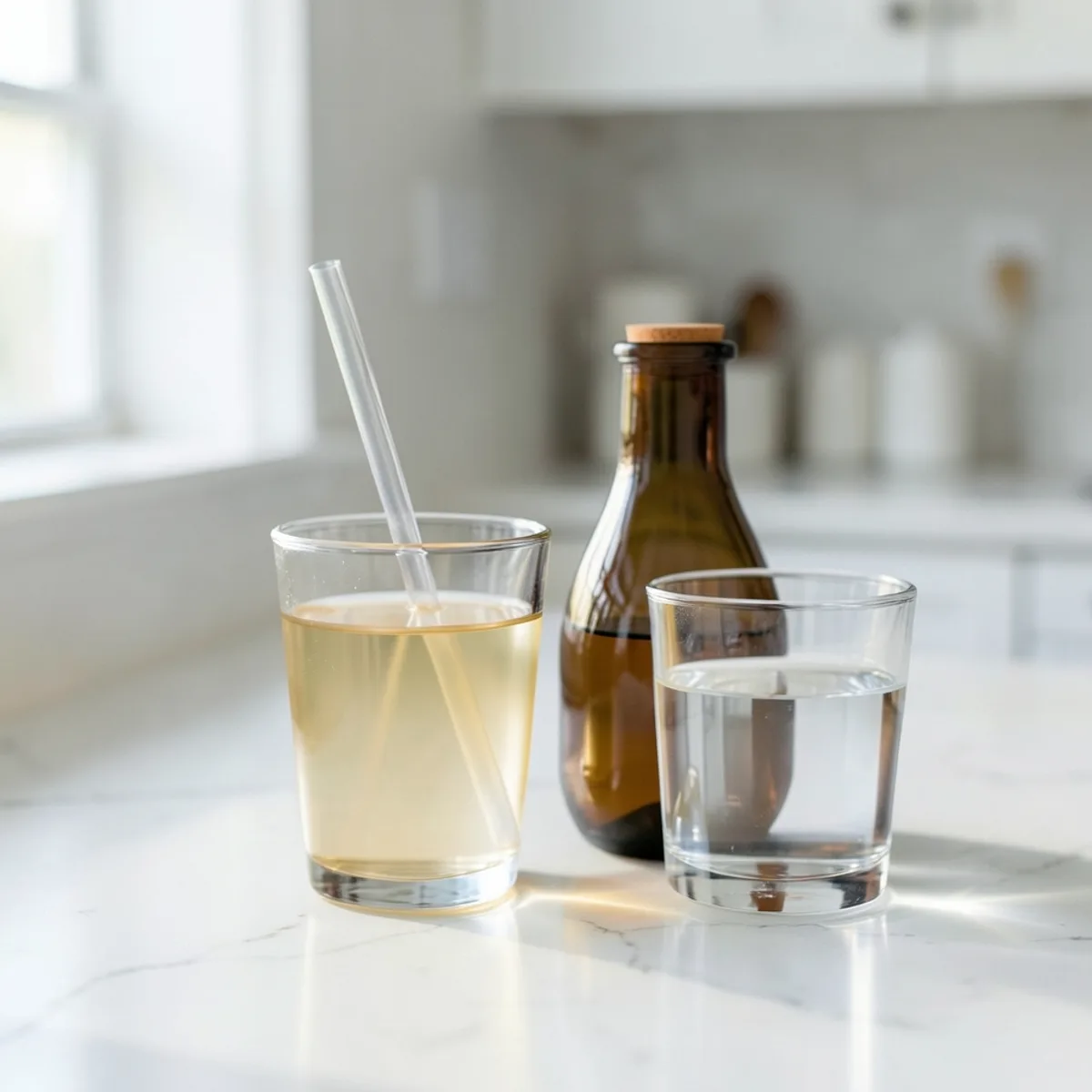
The classic is a splash of vinegar in a glass of water, every morning. Here's where it goes wrong: the splash is rarely measured, and the drink sits against your teeth.
What exists on this question is lab work on extracted teeth and a handful of case reports. We found no human trial of a diluted glass. So this page can't call the diluted glass harmless. It can show the steps the sources give to cut how much acid reaches your teeth, and it measures the glass so you're not guessing.
This page is about teeth, not fat loss, and it promises nothing on weight. For the dose range and what the weight studies found, see how much apple cider vinegar per day. There's no baking soda in this glass. If you've seen a pinch added, that's a different drink with sodium of its own: see baking soda and apple cider vinegar, and does baking soda neutralize apple cider vinegar for the chemistry.
Is apple cider vinegar bad for your teeth?
The sources agree on the direction. Healthline's teeth page, medically reviewed by a dentist, says the acidity may erode enamel, which can bring sensitivity and a higher chance of decay. It says to always dilute, because you may swallow some. Cleveland Clinic says the acid erodes tooth enamel and that once enamel is worn down, it can't be replaced.
The human evidence is case reports. Healthline's side effects page describes one: a girl whose severe dental decay was linked to 1 cup (237 mL) of undiluted vinegar a day, taken for weight loss. One case can't prove cause. It does show what the viral version looks like.
The ADA's dental erosion page is more careful. It says excessive use of vinegar-based dressings may lead to increased erosion, in a lifestyle section it calls relatively weak evidence. That's an honest range: the harm is plausible and documented in single cases, and well-run human trials aren't there.
One more point that matters for timing. ADA MouthHealthy says to wait before brushing so saliva can wash away acids and let enamel re-harden. Softened enamel can recover that way. Enamel that's worn away doesn't.
The Food Science / Lab Kitchen Note
Apple cider vinegar is about 5 percent acetic acid. Healthline's dentist-reviewed page gives an average pH of 2.5 to 3.0, against 7.0 for distilled water. Aspen Dental, a dental chain and so a secondary source, says enamel begins to soften once the pH in the mouth falls below 5.5. The ADA gives no such threshold. pH runs on a log scale, so the gap between 2.5 and 5.5 is bigger than it looks.
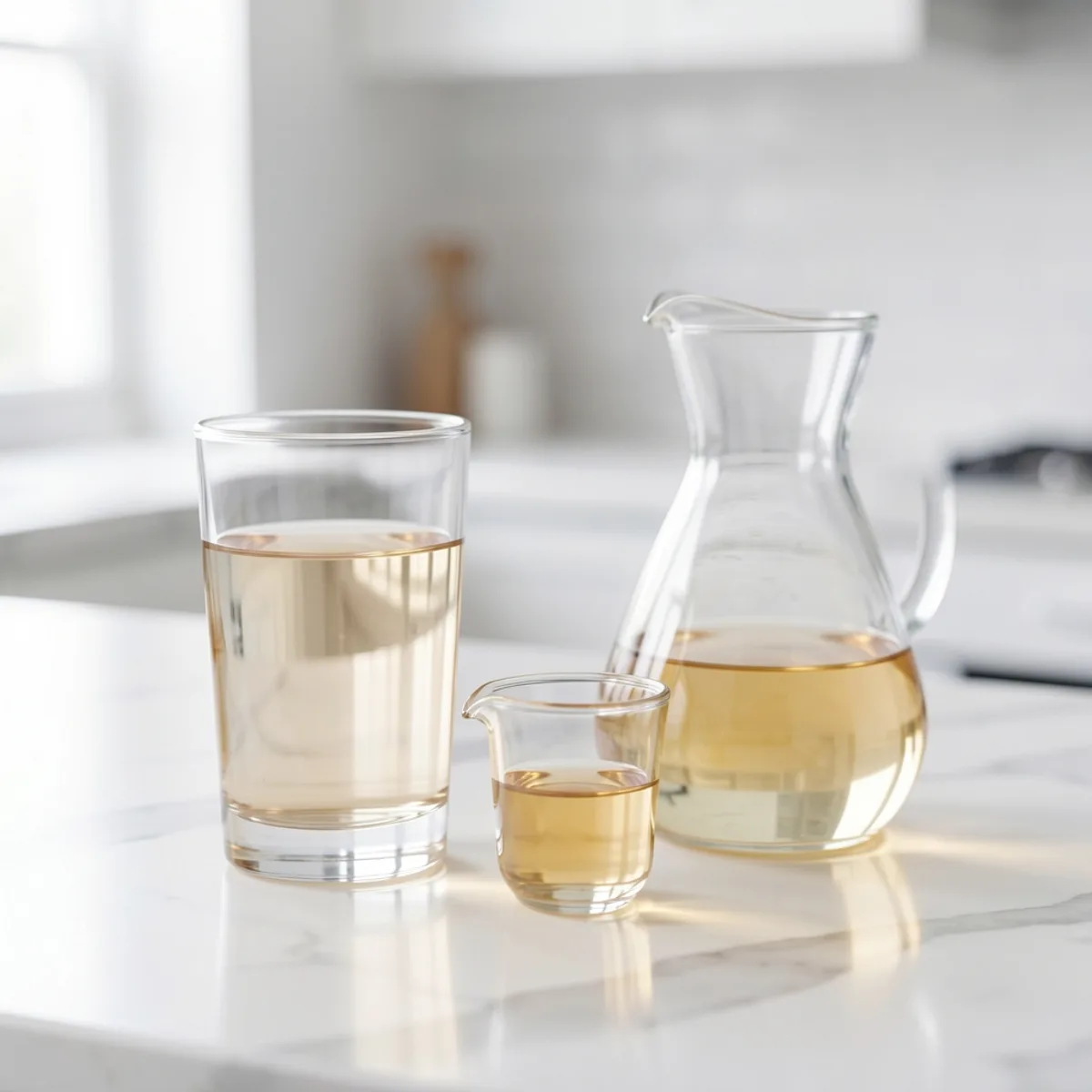
Now the dilution, which is our arithmetic, not a measurement. Stirring 1 tbsp (15 mL) into 1 cup (237 mL) of water makes about 252 mL if the volumes simply add. The vinegar is then about one-seventeenth of the glass, and the acetic acid falls from 5 percent to roughly 0.3 percent.
That number is concentration, not pH. We found no pH reading for a diluted glass, so we can't say whether it clears the 5.5 line. Dilution lowers the acid load on your teeth. It doesn't turn the drink into water.
Does apple cider vinegar damage tooth enamel? The lab studies
The 190-tooth study. An in vitro study in the European Journal of Dentistry (2022) sectioned 190 extracted human teeth (180 test teeth, 20 per solution, plus 10 controls) and soaked them in nine solutions for 12, 24, 48 and 96 days. Vinegar (pH 3.5) caused the greatest weight loss, 0.430 g at 96 days. "Apple cider" (pH 3.7) came second at 0.210 g, and both showed the most surface roughness and demineralization. Read the labels, though: the paper lists "apple cider" separately from vinegar and doesn't state it was apple cider vinegar, so it's not demonstrated as our drink. The limits are real too. The teeth soaked statically for days with no saliva, there were 10 sections per group per time point, and the scoring was the authors' own 0 to 3 scale, not a validated one. This isn't people drinking a diluted glass.
The five-vinegar study. An in vitro study in Clinical Laboratory (Willershausen et al.) incubated enamel slices from human wisdom teeth for up to 8 hours in five vinegars with pH 2.7 to 3.95: bio, raspberry, balsamic condiment, white Modena and sherry. None is apple cider vinegar. Mineral release depended on time and on the vinegar: raspberry vinegar lost about 20 percent up to 30 micrometers after 4 hours, and bio vinegar about 20 percent at 45 micrometers after 8 hours. The authors themselves warn the results carry over to the mouth only with caution, and Healthline adds that a mouth has saliva to buffer acid. Our notes don't give the sample size, so we won't guess one.
Three ways to drink it, compared on sourced data
This compares what the sources say. It isn't a test of any kind, and "no sourced data" means we found nothing to put in the cell.
| Way to drink it | What the sources say | Sourced data on teeth |
|---|---|---|
| Diluted glass, one sitting, straw, rinse, wait | Healthline and Aspen Dental: dilute, use a straw, rinse. ADA: a straw behind the front teeth can minimize bathing the teeth, and rinse with water instead of brushing right away | No human trial of this glass. No pH reading of the diluted glass |
| The same glass sipped through the day | ADA MouthHealthy: don't hold an acidic drink in the mouth longer than needed (the page covers drinks like juices and sodas, not vinegar by name) | No sourced data on sipping time |
| Undiluted shot (the viral version) | Cleveland Clinic: undiluted acetic acid can burn the esophagus. Healthline: one case report links a girl's severe decay to 1 cup (237 mL) of undiluted vinegar a day | Single case report, which can't prove cause. A lab study found 1 to 20 percent mineral loss after 4 hours in vinegars of pH 2.7 to 3.95, not in a mouth |
Straw, rinse, wait: what the dental sources say
Three habits show up again and again. Use a straw, rinse with water, and don't brush right away. The wait is where the sources split, so here they are side by side.
| Source | Wait before brushing | Other steps it gives |
|---|---|---|
| Healthline (side effects page) | At least 30 minutes | Dilute, use a straw, rinse with water |
| Aspen Dental (secondary source) | At least 30 minutes | At least 8 oz of water, a straw, rinse with water right after |
| The Conversation (a dentist's explainer, not a study) | About half an hour | Dilute, use a straw, take it with meals |
| ADA MouthHealthy | One hour | Use a straw, don't swish, rinse with water, drink milk or eat cheese |
| ADA News | Brush one hour later | Dilute, use a straw, swish water in the mouth afterward |
Thirty minutes versus an hour. The ADA's number is the longer one, and our call is to take it when you're unsure. Waiting costs nothing.
The ADA News summary also carries a harder line. It passes on expert advice that regularly drinking vinegar can degrade enamel, with pain, a higher risk of decay and costly dental work, and says the experts advised using apple cider vinegar only in cooking, not as a drink. The page names no experts and no date, and it gives no dose numbers. It's still the clearest statement from a dental body on the question. The steps above are for people who drink it anyway.
Common mistakes
Taking it as a shot. It's the viral version, and the one with the most warnings: esophagus burns from undiluted vinegar, and the decay case report above. Water goes in the glass first, then the tablespoon.
Sipping it all day, or swishing. Every sip is a fresh round of acid on the enamel, and holding it in your mouth makes it longer. We found no source on sipping time, so this is our practical call: one glass, one sitting, through a straw.
Brushing right away. Acid-softened enamel isn't the moment for a toothbrush. Rinse with water, then wait, as in the table.
Substitutes and swaps
| Original | Swap | Proportion | What changes |
|---|---|---|---|
| Cool plain water | Warm water, like a mug of tea | Cleveland Clinic: 1 tbsp in a mug of warm water | Same acid, warmer drink. We found no sourced mug size |
| Liquid vinegar | Gummies | No sourced data | The dentist in The Conversation advises avoiding acidic gummies that need lots of chewing |
| Liquid vinegar | Capsules or tablets | No sourced data | Healthline reports a throat burn from a lodged tablet. No sourced dose |
| Raw vinegar | Pasteurized vinegar | No sourced data | No source compares them for teeth, and brand-to-brand pH differences aren't sourced |
Storage
Mix one glass and drink it. No page we read says whether a mixed glass keeps or how to store it, so we give no duration. Make it fresh each time.
Nutrition note
The values on the card are estimates, not measurements. They're calculated from typical USDA FoodData Central values for cider vinegar, record 173469. Per 100 g, that record lists 21 kcal, 5 mg of sodium, 0.93 g of carbohydrate, 0.40 g of sugars, and 0 for protein, total fat, saturated fat and fiber. One tablespoon is 14.9 g. That gives about 3 kcal and about 0.7 mg of sodium per glass. Against the FDA's 2,300 mg Daily Value, 0.7 mg is about 0.03 percent.
For 1 tbsp, our calculation gives about 0.14 g of carbohydrate and about 0.06 g of sugars. The card rounds both to 0.1 g. The USDA record itself flags several of its values (energy, carbohydrate, sugars and saturated fat) as calculated or assumed, not measured.
Our how-much-per-day page lists 0.6 mg of sodium. That figure came from a mirror page that rounded sodium to 10 mg per cup, and 0.7 mg is from the USDA record itself. Plain water is counted as adding nothing, but tap water carries a variable amount of sodium that isn't counted here.
Servings: 1 glass (1 cup)
Does Apple Cider Vinegar Damage Teeth? (Diluted Glass)
Yes, the acid can erode enamel in lab studies and case reports. Here is what the studies show, one measured diluted glass, and the straw, rinse and wait steps.
Ingredients
Equipment
- Measuring spoons (a true tablespoon, not a soup spoon)
- Glass (holds at least 1 cup (237 mL) with room to stir)
- Glass or reusable straw (keeps the drink away from the front of your teeth)
Instructions
- Measure the water first. Pour 1 cup (237 mL) of plain water into a glass. The water goes in first so the vinegar never sits at the bottom undiluted.
- Add the vinegar. Level 1 tbsp (15 mL) of apple cider vinegar into the water and stir once. Never drink it straight or as a shot.
- Drink it through a straw. Drink the glass in one sitting through a straw, placed behind the front teeth. Don't swish it or hold it in your mouth.
- Rinse with water. Rinse your mouth with plain water right after the last sip.
- Wait before brushing. Wait before you brush: at least 30 minutes per Healthline and Aspen Dental, one hour per the ADA. If you're unsure, take the longer wait.
Notes
This is our ratio, not a medical rule. It sits inside the 1 to 2 tablespoon range the sources cite, and nothing on this page comes from tasting the drink or trying it out.
Nutrition is our calculation from the USDA FoodData Central record for cider vinegar (173469). Plain water is counted as adding nothing, though tap water carries a variable amount of sodium that is not counted.
Mix it fresh. We found no sourced storage time for a mixed glass, so we give none.
Nutrition Facts
Per 1 glass (1 tbsp apple cider vinegar in 1 cup water) (estimated)
- Total Fat
- 0 g
- Saturated Fat
- 0 g
- Sodium
- 0.7 mg
- Total Carbohydrate
- 0.1 g
- Dietary Fiber
- 0 g
- Sugars
- 0.1 g
- Protein
- 0 g
Frequently asked questions
When should you drink apple cider vinegar, and when can you brush?
We found no sourced best time of day for the glass. After the last sip, rinse with water and wait before brushing: at least 30 minutes per Healthline and Aspen Dental, one hour per the ADA.
What other side effects can apple cider vinegar cause besides enamel wear?
Cleveland Clinic and Healthline name throat or esophagus burns from undiluted vinegar, low potassium, and interactions with insulin, digoxin and diuretics. Most of the harm reports are single cases, which can't prove cause.
Are apple cider vinegar gummies or capsules better for your teeth?
We found no source that studies them and no sourced dose. A dentist writing in The Conversation advises avoiding acidic gummies that need lots of chewing, and Healthline reports a throat burn from a lodged tablet.
Does apple cider vinegar whiten teeth?
Healthline says the evidence for whitening is limited and that pages promoting it rarely mention erosion, and Aspen Dental calls whitening a myth. We found no source showing it whitens, so we make no promise.

Steven Dony trained in a restaurant kitchen and lives in Nashville, Tennessee. He covers SodaRecipe’s fact-checks: what works, what does not, and why.
Comments