Baking Soda Replacement: Ratios in Teaspoons and Grams
Jump to RecipeWhat to use when the box is empty: baking powder at 3 to 1, potassium bicarbonate with salt added back, sodium per spoon, and a pancake recipe that needs no baking soda.
 Save
Jump to:
The jar is empty and the batter is half mixed. It happens to everyone, and the swap is shorter than you'd think. If your problem is the opposite one, with baking soda in the cupboard and no baking powder, that's covered in baking soda instead of baking powder. This page goes in the other direction.
The Food Science / Lab Kitchen Note
Except where a source is named, this section is standard food chemistry.
Here's why this works. Baking soda is sodium bicarbonate, a base. When it meets an acid (buttermilk, yogurt, vinegar), it releases carbon dioxide, and those bubbles lift the batter.
Baking powder is the same bicarbonate with the acid already packed in, plus starch to keep the mix dry. Double-acting powder holds more than one acid, so it gives a first burst of gas when wet and another in the heat of the oven. (Bob's Red Mill, a source on this page, recommends double-acting powder for swaps.)
That's the reason the ratio is 3 to 1. Baking powder is only partly bicarbonate, so you need more of it to get the same lift. It also explains why a recipe built around buttermilk may need adjusting: the acid the soda was meant to use is still in the bowl, and the powder brings its own.
Three replacers compared
The table below compares published data, not finished bakes. Where no source gives a figure, the cell says so. Grams marked "our math" are conversions from King Arthur's ingredient weight chart: baking powder is 4 g per teaspoon, and baking soda is 3 g per half teaspoon, so about 6 g per teaspoon (our doubling).
| Replacer | Ratio per 1 teaspoon baking soda (as published) | Grams | Sodium | Salt and other notes |
|---|---|---|---|---|
| Baking powder | 3 teaspoons (Bob's Red Mill, Healthline, Lemons for Lulu, Bless This Mess) | 12 g, our math | About 1,270 mg, 55% of 2,300 mg (our math; 1 teaspoon of soda is about 1,640 mg, 71%) | Bob's Red Mill recommends double-acting powder. No salt change is given by these sources. |
| Potassium bicarbonate | 1 to 1 (Bob's Red Mill, Healthline, Lemons for Lulu) | No sourced data | None, per Bob's Red Mill and Healthline | Sources disagree on salt. Bob's Red Mill says 1 teaspoon salt per 3 teaspoons in its intro but per 2 to 3 teaspoons in its tips. Healthline says roughly 1/4 to 1/2 teaspoon per teaspoon as a starting point. Lemons for Lulu says adjust to taste. |
| Self-rising flour | Lemons for Lulu: replaces the flour 1 to 1, with any baking powder or soda left out. Bless This Mess: 1 to 1.5 teaspoons per teaspoon of soda, with the recipe's salt and baking powder left out. Healthline: no ratio. | 120 g per cup of flour (Healthline) | No sourced data | Sources conflict on the ratio, so this page doesn't pick one. It already holds baking powder and salt, so other acids may need adjusting. |
Two warnings sit under that table. First, don't blend rows: take the salt amount and the potassium bicarbonate amount from the same source. Second, self-rising flour is the riskiest swap. A reader on Smitten Kitchen found aluminum in self-rising flour, which had doubled the leavening unnoticed.
Other options with no sourced proportion
These show up in the competing guides, and the table keeps to what the sources say. Where a proportion isn't sourced, the cell says so.
| Original | Replacement | Proportion | What changes |
|---|---|---|---|
| Baking soda | Baker's ammonia | 1 to 1 (Healthline) | Best for thin, crisp baked goods and can smell in thick ones. Availability: no sourced data. |
| Baking soda | Whipped egg whites | Remove the same volume of liquid (Lemons for Lulu) | Use room-temperature whites. No ratio for the whites is sourced. |
| Baking soda | Club soda as part of the liquid | No sourced proportion | Not covered by the sources opened for this page. |
| Baking soda | Yeast | No sourced proportion | No sourced data on which bakes it suits. |
| Baking soda | Potassium bicarbonate | 1 to 1, plus salt (see above) | No sodium in the bicarbonate itself, but the salt you add back does carry sodium. |
Potassium bicarbonate and baker's ammonia are listed by the guides with no word on where to find them. For most kitchens, baking powder is the fallback.
Sodium per spoon, our math
USDA FoodData Central (SR Legacy, read through a mirror page) lists baking soda at 27,360 mg sodium per 100 g. With King Arthur's 6 g per teaspoon, 1 teaspoon holds about 1,640 mg. That's about 71% of the FDA's 2,300 mg Daily Value.
Double-acting baking powder, the sodium aluminum sulfate type, is listed at 10,600 mg per 100 g. Other powder types differ, and none was opened for this page. At 4 g per teaspoon, 1 teaspoon holds about 424 mg, or about 18% of 2,300 mg.
A worked conversion
Say a recipe calls for 1/2 teaspoon of baking soda.
- Baking soda weighs about 3 g per half teaspoon (King Arthur).
- Triple the teaspoons: 1 1/2 teaspoons of baking powder.
- Weigh it: 1 1/2 teaspoons at 4 g per teaspoon is 6 g.
On sodium, 3 g of baking soda is about 820 mg (36% of 2,300 mg). The 6 g of powder is about 636 mg (28%). Both figures are our math from the USDA values above.
Then check the rest of the recipe. If it also lists baking powder, you may already have the leavening covered. And if it uses buttermilk or vinegar, the swap changes the balance of acid, so keep the first bake plain.
Pancakes with baking powder only
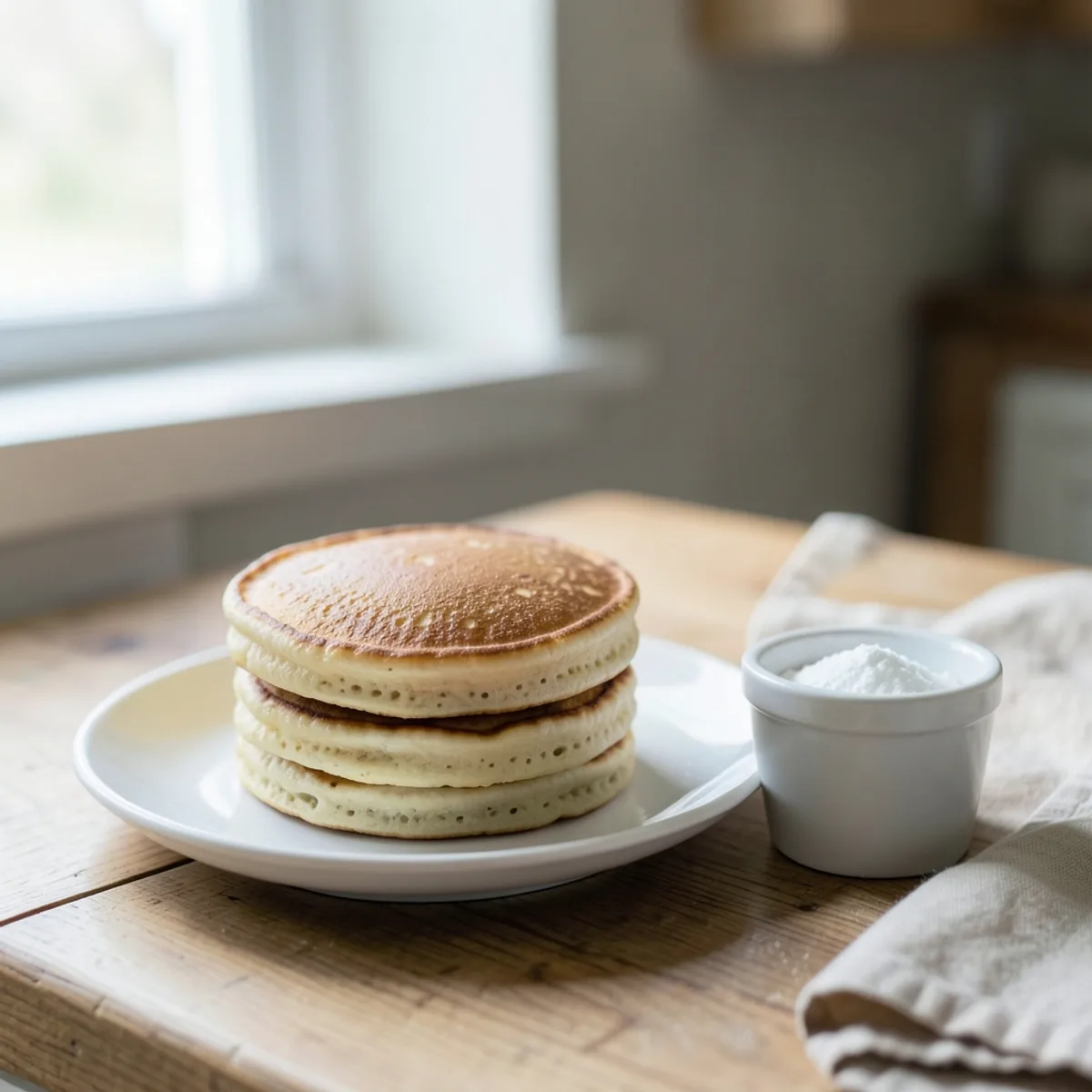
This pancake recipe needs no baking soda at all. It's adapted from King Arthur Baking's Simply Perfect Pancakes, reworded and with our own gram conversion for the salt. The recipe card above has the full list and steps.
Here are the points that matter most. King Arthur beats the eggs and milk for about 3 minutes, then stirs wet into dry without beating, because lumps are fine. The butter goes in last, and the batter rests at least 15 minutes. The first side cooks about 2 minutes, until bubbles break on top, then 1 1/2 to 2 minutes on the second. Flip once.
In hot, humid weather, or if you plan to rest the batter longer, King Arthur starts with 1 cup of milk instead of 1 1/4 cups. The card lists the 2 teaspoons of baking powder in the dry mix.
On sodium, our estimate is about 716 mg for one quarter of the batch, or about 31% of 2,300 mg. The salt makes up the largest share, not the baking powder. For other baking soda recipes, see Irish soda bread or baking soda bath for pretzels.
Common mistakes
Tripling by feel. Baking powder is lighter than baking soda, so a heaped spoon can mean a lot more than you meant. Level the spoon, or weigh the 12 g.
Skipping the salt with potassium bicarbonate. The bicarbonate has no sodium, and both sources pair it with added salt. Add salt back, and pick the amount from one source. Bob's Red Mill and Healthline give different ranges.
Ignoring the taste risk. None of the three top guides says what tripling the powder does to taste. Smitten Kitchen links a metallic, slightly bitter note to aluminum-containing powder, which quick-rise bakes use in quantity. If you're tripling, reach for an aluminum-free brand.
Storage and checking your leavener
Storage time for cooked pancakes: no sourced data, so this page gives no fridge time.
The batter itself rests at least 15 minutes before cooking, per King Arthur. To check whether a tin of leavener is still active, the freshness checks live in the reverse swap article.
Where the numbers come from
The ratios come from editorial guides, not trials. Bob's Red Mill is a specialist miller's page (dated 2018, no byline). Healthline's was written by Ansley Hill, RD, LD, and updated October 15, 2026. Lemons for Lulu is a food blog from 2022, and Bless This Mess is a food blog too. They agree on 3 to 1 for baking powder but conflict on salt with potassium bicarbonate and on self-rising flour, and we found no controlled comparison of finished bakes.
The weights and sodium figures come from reference data. King Arthur's ingredient weight chart is a miller's technical reference. USDA FoodData Central SR Legacy is a nutrient database, read here through a mirror page. The 2,300 mg Daily Value comes from the FDA. The taste lead comes from a Smitten Kitchen post (2009, updated 2016) with 12 comments, which is a baker's observation and not a study.
Tips for the swap
- Weigh the baking powder when you can. 4 g per teaspoon is easier to repeat than a heaped spoon.
- Change one thing at a time on the first bake.
- Keep your leavener tin closed and dry between uses.
Servings: 4 servings (one quarter of the batch each; pancake count not sourced)
Baking Soda Replacement: Ratios in Teaspoons and Grams
What to use when the box is empty: baking powder at 3 to 1, potassium bicarbonate with salt added back, sodium per spoon, and a pancake recipe that needs no baking soda.
Ingredients
Pancakes with baking powder only
Equipment
- Large bowl and whisk (one bowl for the eggs and milk, one for the dry ingredients)
- Skillet or electric griddle (medium heat on the stove, or an electric griddle set to 375 F)
- 1/4-cup measure (for even portions)
- Kitchen scale (the gram weights above come from King Arthur)
Instructions
- Beat the eggs and milk. Beat the 2 eggs and the milk together for about 3 minutes, until the mixture is well blended.
- Whisk the dry ingredients. In a second bowl, whisk the flour, salt, baking powder and sugar so the baking powder is spread evenly through the flour.
- Combine without beating. Pour the wet mixture into the dry and stir until just combined. Don't beat it. Lumps are fine.
- Add the butter and rest the batter. Stir in the melted butter or oil last, then let the batter rest for at least 15 minutes.
- Heat the pan. Heat a skillet over medium heat, or set an electric griddle to 375 F.
- Cook the first side. Pour the batter in 1/4-cup portions. Cook for about 2 minutes, until bubbles form on top and break.
- Flip once. Flip each pancake one time and cook for 1 1/2 to 2 minutes more, then serve.
Notes
Credit: this card is adapted from King Arthur Baking's Simply Perfect Pancakes, which uses baking powder only. The wording and the gram conversion for salt are ours.
King Arthur states no yield, so the number of pancakes is not sourced. The nutrition below is for one quarter of the batch, whatever the count.
Times: the 3-minute beating, the 15-minute rest and the cooking times are King Arthur's. The 5-minute prep time is our estimate. Cook time on the card is for one batch.
Bob's Red Mill recommends double-acting powder for swaps. The sodium figure for the baking powder in the nutrition uses USDA's value for the sodium aluminum sulfate type, 10,600 mg per 100 g. Other powder types differ, so check your tin.
If your recipe calls for baking soda instead, use 3 teaspoons of baking powder for each 1 teaspoon of baking soda. The pancake card above is a baking-powder-only recipe, so it needs no swap.
Nutrition values are estimates calculated from typical USDA FoodData Central values, with whole milk, all-purpose flour and unsalted butter.
Nutrition Facts
Per one quarter of the batch (estimated)
- Total Fat
- 13.9 g
- Saturated Fat
- 7.7 g
- Sodium
- 716 mg
- Total Carbohydrate
- 45.5 g
- Dietary Fiber
- 1.3 g
- Sugars
- 10.1 g
- Protein
- 10.2 g
Frequently asked questions
When do I add the baking powder if I'm replacing baking soda?
Whisk it into the dry ingredients, as King Arthur's pancake method does, and add the melted butter last. That batter then rests at least 15 minutes before it goes on the heat.
Why can a bake taste bitter or metallic after a swap?
Smitten Kitchen blames aluminum-containing baking powder, which quick-rise bakes use in quantity, and suggests aluminum-free brands or homemade powder. That is a blog post with 12 comments, not a controlled test, so treat it as a lead rather than proof.
Is there a baking soda replacement with no sodium?
Bob's Red Mill and Healthline both say potassium bicarbonate contains no sodium and swaps 1 to 1. It needs salt added back, and the sources disagree on how much.
What is the baking soda replacement for pancakes?
Baking powder alone. The recipe card on this page uses 2 teaspoons of baking powder and no baking soda, and for a recipe that calls for baking soda the sourced swap is 3 teaspoons of powder per 1 teaspoon of soda.

Stella Nordi bakes in Portland, Oregon. She weighs everything in grams and explains why a bake fails. She covers SodaRecipe’s quick breads, biscuits and baking guides.
Comments