Drinking Baking Soda: Is It Dangerous? Verdict by Situation
Jump to RecipeA sourced yes, no or ask-first for each situation: one glass, daily use, big doses, a full stomach and higher-risk groups, with sodium in mg and documented stomach rupture cases.
 Save
Jump to:
The usual question is simple: a spoonful of baking soda in a glass of water, yes or no? The answer changes with the dose, the meal before it and the person drinking it.
So this page doesn't give one blended answer. It gives a verdict for each situation, yes, no or ask first, and puts the source next to each one. It makes no promise about weight, muscle or blood sugar.
Prep is 2 minutes, with no cooking. For the dose and sodium in full, see baking soda side effects. For the upside people claim, see drinking baking soda and water benefits. For heartburn, see baking soda for heartburn.
Is baking soda safe to drink? The verdict by situation
Short version: a single dissolved dose at the label amount is the use the sources describe. The cases in the sources involve a large dose, a large meal or alcohol binging, or people the review flagged as higher risk.
| Situation | Verdict | Source and why |
|---|---|---|
| One dissolved dose, at the label amount | Yes, within limits | MedlinePlus: dissolve in at least 4 oz (120 mL) of water. The antacid label: 1/2 tsp in 4 oz |
| Daily, for more than 2 weeks | Ask first | MedlinePlus: not longer than 2 weeks unless a doctor says so. The label: not the maximum dose for more than 2 weeks. No sourced safe daily amount exists |
| A big dose or a concentrated shot | No | Poison Control: a large dose can cause seizures, dehydration, kidney failure and slowed breathing. No toxic dose is given, so no shot size is "known safe" |
| On a full stomach, or after a large meal | No | The label: do not take when overfull. Poison Control: stomach rupture risk after a large meal or alcohol binging |
| Powder not fully dissolved | No | The label: dissolve completely. MedlinePlus: dissolve the powder in water |
| For weight loss | No sourced benefit | We found no human trial. The ISSN sports review does not cover weight loss |
| Pregnancy, planning pregnancy, breast-feeding | Ask first | MedlinePlus says tell your doctor. The California Poison Control review flagged pregnant women as higher risk |
| High blood pressure, heart failure, kidney disease, recent stomach or intestinal bleeding | Ask first | MedlinePlus wording is "tell your doctor", not "never" |
| Children | No, not without a doctor | MedlinePlus: not under 12 without a doctor. The label: not for children under 5 |
| Within 2 hours of other medicines | No | MedlinePlus: keep at least 2 hours apart |
| With lemon juice | No sourced data | Nothing in our sources covers it |
Two cells need a note. "Yes, within limits" is not a clean bill of health. It means the use matches what MedlinePlus and the label describe, and nothing more. And "no sourced benefit" for weight isn't a verdict that nobody will lose weight on a diet. It means this drink has no trial behind it.
Does it help with weight? What we found
We found no human trial showing baking soda in water burns fat. The ISSN position stand, which is about exercise performance, says nothing on weight loss. Anything beyond that is a claim without a study behind it. For the viral claim itself, see the baking soda trick.
One more thing about the scale. A bathroom scale reports total body weight only. It doesn't separate fat from water or lean mass, so a number that drops after a few days of any drink doesn't tell you what changed. This drink doesn't replace a calorie deficit either. MedlinePlus describes it as an antacid.
The Food Science / Lab Kitchen Note
Baking soda is sodium bicarbonate. When it meets stomach acid, it neutralizes some of it and gives off carbon dioxide gas, plus table salt and water. The gas explains the burps. Poison Control says swallowed sodium bicarbonate makes a large volume of carbon dioxide quickly, and that can build dangerous pressure in the stomach.
A few forum posts mention burping and gas as the first thing people notice. That fits the chemistry, but the signal is thin and isn't a safety finding.
Now the sodium, which is our arithmetic, not a measurement. USDA FoodData Central lists baking soda at 27,400 mg of sodium per 100 g, with 4.6 g per teaspoon. That works out to:
- 1/4 tsp (1.15 g): about 315 mg, or about 14% of 2,300 mg.
- 1/2 tsp (2.3 g): about 630 mg, or 27%.
- 1 tsp (4.6 g): about 1,260 mg, or 55%.
The FDA sets the Daily Value for sodium at less than 2,300 mg a day, and says Americans eat about 3,400 mg on average. The label allows up to seven 1/2-tsp doses in 24 hours, or three if you're over 60. By our arithmetic, that's about 4,410 mg at the top of the range, and about 1,890 mg for three doses.
Three doses side by side
This is a comparison of sourced data, not a trial of any kind, and "no sourced data" means we found nothing to put in the cell. Don't read the third column as a bigger version of the first two. It's a different thing.
| Our glass | The antacid label dose | The ISSN sports dose | |
|---|---|---|---|
| Baking soda | 1/4 tsp (1.15 g) | 1/2 tsp (2.3 g) | 0.3 g/kg; about 21 g for a 70 kg person (our math) |
| Water | 8 fl oz (240 mL), our recipe | 4 oz (120 mL) | No sourced data |
| Sodium | About 315 mg (14%) | About 630 mg (27%) | About 5,750 mg (250%), our arithmetic |
| How often | One glass at a time | Every 2 hours, up to seven doses, three if over 60 | 60 to 180 minutes before exercise |
| Named effects | No sourced data for this dose; gas is a mild effect MedlinePlus names | Thirst, cramps, gas (MedlinePlus) | Bloating, nausea, vomiting, abdominal pain |
The gap is the point. The ISSN dose is about 9 times the label dose and about 18 times our glass, by our math. It's a sports dose for athletes. ISSN also notes that part of its effect seems placebo-driven. It's never the dose of a kitchen drink.
What the studies show, and what they don't
California Poison Control review. A retrospective case review in the Journal of Clinical Pharmacy and Therapeutics (2014) looked at 192 symptomatic baking soda cases from 2000 to 2012, ages 2 months to 79 years. Over half had symptoms that needed medical evaluation, and 12 were admitted for electrolyte imbalance, metabolic alkalosis or respiratory depression. The authors flagged chronic antacid users, people trying to beat urine drug tests, pregnant women and young children as higher risk. What it doesn't show: how common trouble is. We only had the abstract, and a case review counts people who got into trouble, not everyone who drank a glass without one. It gives no safe dose.
Han et al. 2022. This report in PMC describes 2 new cases and reviews 36 spontaneous gastric rupture cases from 1926 to 2021. Ten were linked to sodium bicarbonate. The authors point to sudden stomach distension with poor venting, usually after binge eating. Overall mortality was 41.6 percent across the series, but that's the whole series, not bicarbonate alone. It's rare and severe, and it isn't a rate. It also can't tell you what a single dissolved glass does.
Carr et al. 2011. A crossover trial in 13 physically active people compared 8 bicarbonate protocols with a placebo. Most gut symptoms came 90 minutes after a dose taken in solution, and a dose with a high-carbohydrate meal gave the fewest. It's small, set in exercise, and we saw only the abstract. It shows gut effects depend on dose and timing. It doesn't show a safe dose, and it doesn't cancel the label's rule against taking it when overfull.
A case Poison Control describes puts these in human terms: a 54-year-old woman drank half a glass for indigestion after a large meal, had a 5 cm stomach tear, lost her stomach to surgery, and left the hospital after 5 days. One case can't prove how often it happens. It shows why the full-stomach rule exists.
Common mistakes
Heaping the spoon. A heaped spoon holds more than a level one, and the sodium climbs with it. Level the spoon with the back of a knife.
Not dissolving it, or gulping through the fizz. The label says to dissolve completely. Stir until the water is clear, let the bubbles settle, then sip.
Grabbing the wrong box. Baking powder is not baking soda. Check that the box says sodium bicarbonate only, food-grade and aluminum-free.
Substitutes and swaps
| Original | Swap | Proportion | What changes |
|---|---|---|---|
| Baking soda | Baking powder | Not a swap | A different product. Never drink it in water |
| Baking soda water | Another antacid | No sourced data | Ask a pharmacist; we name none |
| 8 fl oz of water | 4 oz of water | The label dose uses 4 oz (120 mL) | MedlinePlus: at least 4 oz. Our 8 fl oz is just our recipe |
Storage
Mix one glass and drink it. We found no sourced shelf life for a mixed glass, so we give none. If you want a make-ahead tip, it's this: measure the dry spoonful ahead if you like, but add the water only when you're ready to drink.
Nutrition note
The values on the recipe card are estimates, not measurements: about 315 mg of sodium per glass, calculated from USDA FoodData Central values for baking soda. The card notes give the details.
Servings: 1 glass (8 fl oz)
Drinking Baking Soda: Is It Dangerous? Verdict by Situation
A sourced yes, no or ask-first for each situation: one glass, daily use, big doses, a full stomach and higher-risk groups, with sodium in mg and documented stomach rupture cases.
Ingredients
Equipment
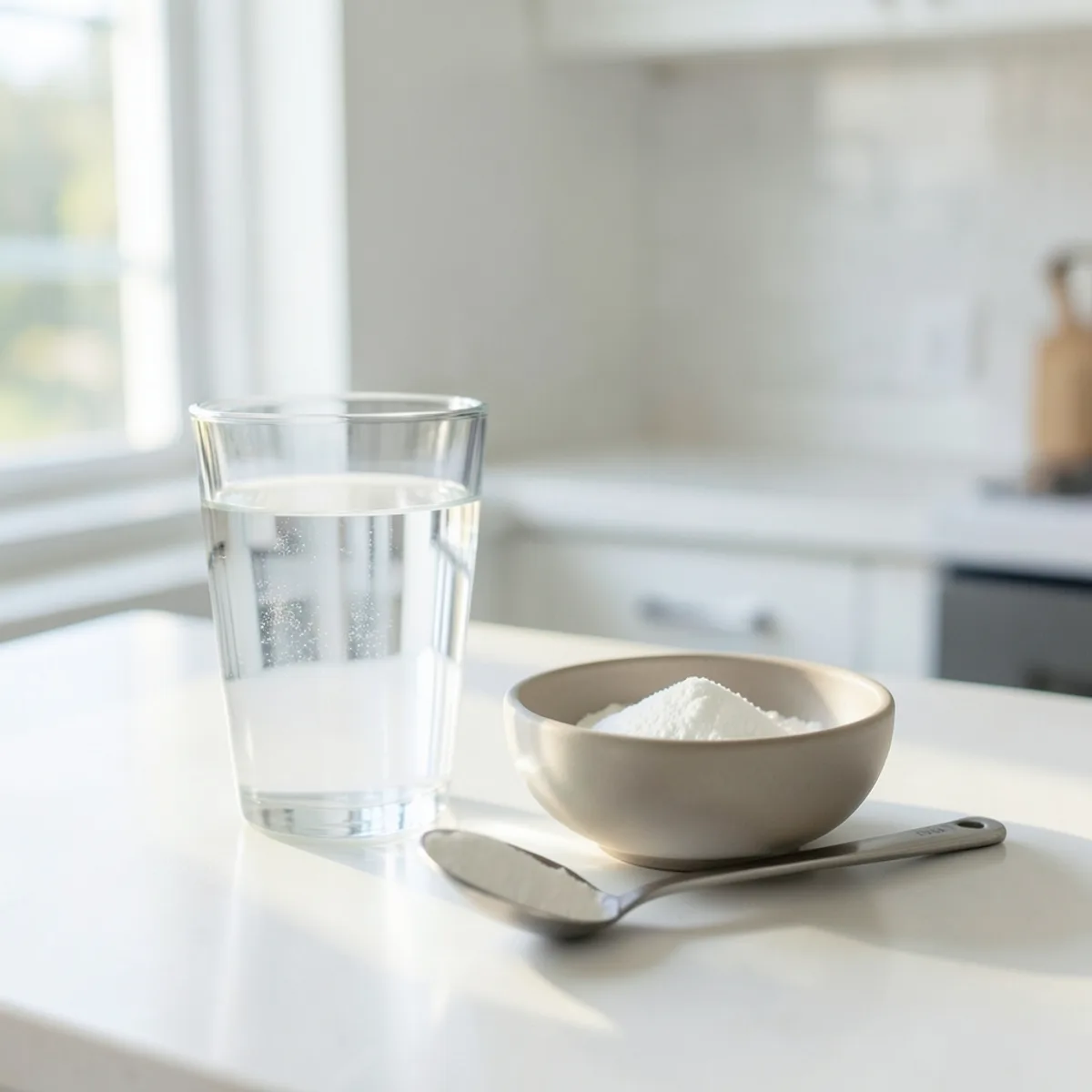
- Measuring spoons (a true 1/4 teaspoon, leveled with the back of a knife)
- Long-handled spoon (for stirring until no grains remain)
Instructions
- Check the box. Read the ingredient list. You want sodium bicarbonate only, food-grade and aluminum-free. Baking powder is a different product and does not belong in this glass.
- Level the spoon. Fill a 1/4 teaspoon (1.15 g) and level it with the back of a knife. A heaped spoon holds more, and the sodium climbs with it.
- Dissolve it completely. Pour 8 fl oz (240 mL) of cool water into a glass, add the baking soda and stir until the water is clear and no grains sit at the bottom.
- Wait out the fizz and sip. Let the bubbles settle, then sip slowly instead of gulping. Skip it if you feel overfull from food or drink.
- Mix one glass at a time. Make one glass, drink it, and don't save leftovers. Keep it at least 2 hours apart from other medicines, and keep the box away from children.
Notes
This card is our measure, not a medical rule. It is half the label dose of baking soda (1/2 tsp in 4 oz) in twice the water. Less than the label dose is not a promise that it suits you.
Nutrition values are estimates, calculated from the USDA FoodData Central record for baking soda (27,400 mg of sodium per 100 g, 4.6 g per teaspoon). Water is counted as adding no sodium.
Mix it fresh. We found no sourced shelf life for a mixed glass, so we give none.
Nutrition Facts
Per 1 glass (8 fl oz water, 1/4 tsp baking soda) (estimated)
- Total Fat
- 0 g
- Saturated Fat
- 0 g
- Sodium
- 315 mg
- Total Carbohydrate
- 0 g
- Dietary Fiber
- 0 g
- Sugars
- 0 g
- Protein
- 0 g
Frequently asked questions
When is the right time to drink baking soda water?
As an antacid, MedlinePlus says to take it 1 to 2 hours after meals with a full glass of water, and the antacid label says not to take it when overfull from food or drink. Keep it at least 2 hours apart from other medicines.
What side effects does drinking baking soda cause?
MedlinePlus lists thirst, stomach cramps and gas as the mild ones. Severe headache, vomit like coffee grounds, slow breathing, leg or foot swelling, or black or bloody stools mean stop and call a doctor.
Is it okay to drink baking soda every day?
MedlinePlus says not to use it longer than 2 weeks unless a doctor says so, while the label says not to use the maximum dose for more than 2 weeks. We found no sourced safe daily amount, and the California Poison Control review flagged chronic antacid users as higher risk.
What can you use instead of baking soda water?
We found no sourced swap to name, and baking powder is a different product, not a substitute. A pharmacist is the right person to ask about other options for indigestion.

Steven Dony trained in a restaurant kitchen and lives in Nashville, Tennessee. He covers SodaRecipe’s fact-checks: what works, what does not, and why.
Comments