Apple Cider Vinegar on an Empty Stomach: What Studies Say
Jump to RecipeDoes it matter if you drink apple cider vinegar on an empty stomach? We found no study comparing fasted with fed, so here is what the timing-related studies did measure, plus one measured glass.
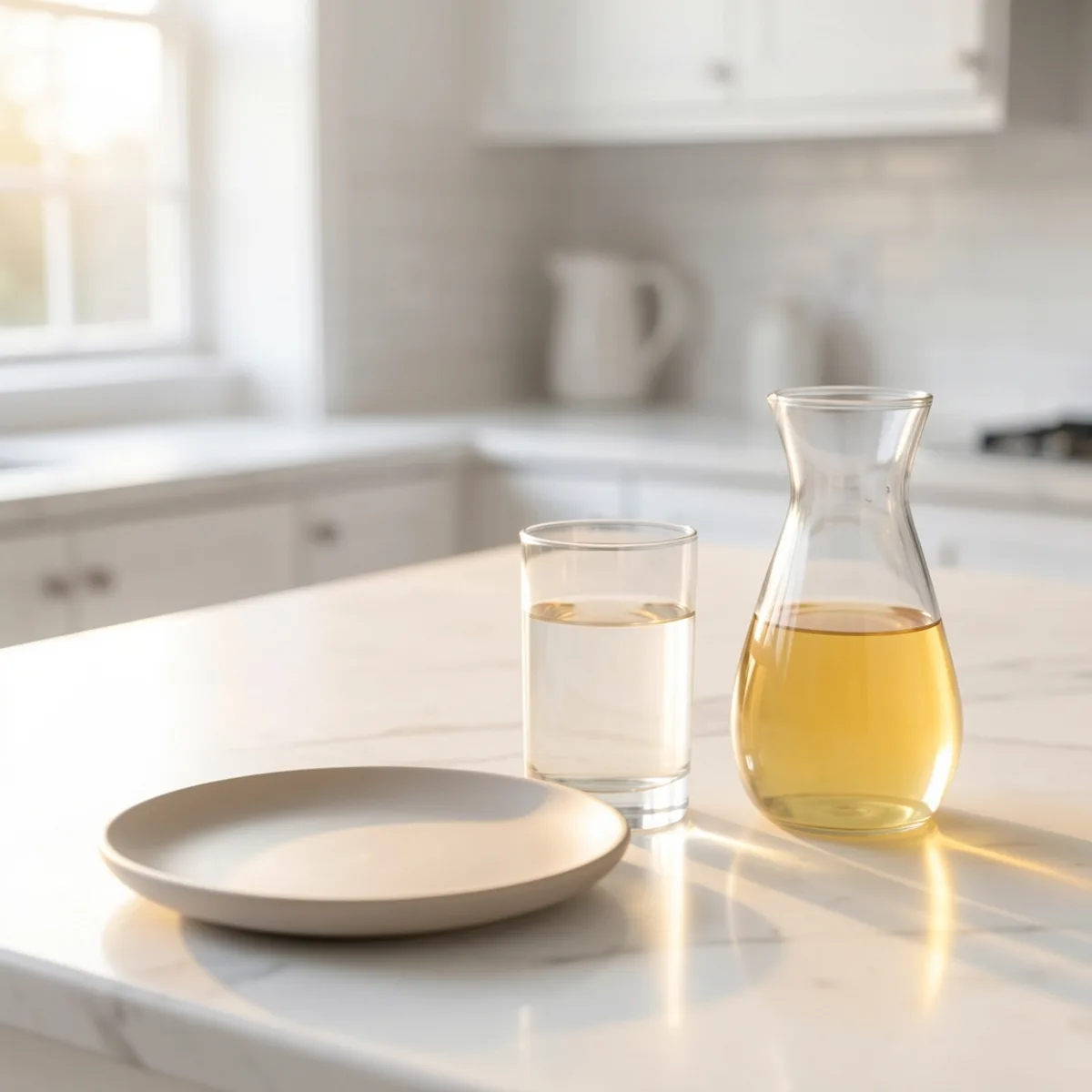 Save
Jump to:
Apple cider vinegar on an empty stomach is not shown to burn fat by any source we read. The drink here is 1 tbsp (15 mL) in 1 cup (237 mL) of water, and we found no study comparing fasted with fed.
Here's the shortcut: the viral claim says first thing in the morning works better, and we found no study that measured that. Nothing on this page comes from tasting the drink. It's published studies, health-site guidance and our labeled arithmetic. For the daily amount, see how much apple cider vinegar per day.
Does an empty stomach change anything?
We found no head-to-head comparison. Harvard Health Publishing says it's unclear when to drink apple cider vinegar and the best time is unknown. It doesn't address the empty stomach. Most recommendations it saw are on the order of 1 to 2 teaspoons before or with meals.
Healthline's dosage page skips the morning too. It says to take vinegar right before a high-carb meal for the blood-sugar use, with no significant effect before a low-carb or high-fiber meal, and that there's no evidence for a pre-meal dose for digestion. It adds that vinegar may cause stomach upset in some people.
The two pages we opened from sellers don't settle it either. BUBS Naturals, which sells apple cider vinegar gummies, says nausea is possible fasted and suggests taking it just before eating, but cites no study for that. Goyval Vinagres, a vinegar producer, gives no quantity at all.
The Food Science / Lab Kitchen Note
The acid is acetic acid. The USDA record for cider vinegar (FoodData Central 173469) notes about 5 percent. Brands vary, so every percent here assumes that 5.
The arithmetic is ours. USDA lists 1 tbsp as 14.9 g, so at 5 percent that's about 0.75 g of acetic acid. Stir it into 1 cup of water and the glass is about 252 mL. Counting water as 1 g per mL, 0.75 g in about 252 g is about 0.3 percent. The full unit conversion lives on the apple cider vinegar and water ratio page.
That's a concentration, not a pH. We found no sourced pH for a diluted glass. Dilution cuts the acid load, but it doesn't turn the drink into water.
Fasted, before a meal or with a meal: what the data show
This compares what published sources timed. It isn't a taste comparison, and we found no study that ran these three side by side. "No sourced data" means we found nothing. The first row is the closest data to fasting; it has no comparison with a dose taken at a meal.
| Variant | What a source timed or says | Nausea or comfort data |
|---|---|---|
| Before breakfast, first thing in the morning | Hlebowicz 2007 gave 30 mL of vinegar in 200 mL of water every morning before breakfast to 10 people with type 1 diabetes and gastroparesis. Slower gastric emptying. No fasted-versus-fed arm | Symptoms were not systematically recorded. No sourced comparison |
| Just before a meal | Healthline: right before a high-carb meal for the blood-sugar use, nothing before a low-carb or high-fiber meal. Harvard: recommendations are before or with meals | No sourced data |
| With a meal | Johnston 2010: glucose effect strongest with the meal, not 5 hours before. Hlebowicz 2008: no difference in 13 healthy adults (white wine vinegar on bread). 2022 review: appetite suppressed for up to 120 minutes in short-term trials with a solid-food meal; none in the 4 to 12 week trials | Darzi 2014 links the appetite effect to nausea, with no meal comparison. Otherwise no sourced data |
The table is a map of the data, not a ranking. The studies used different people, different vinegars and different outcomes.
What the studies actually found
Two small trials on stomach emptying. Hlebowicz and colleagues, BMC Gastroenterology 2007, was a pilot crossover trial in 10 people with type 1 diabetes and gastroparesis (mean age 67.9). Median gastric emptying rate was 27 percent with water and 17 percent with vinegar. The authors list their limits: small, not randomized, fixed order, no blinding, and postprandial glucose wasn't measured. The 2008 trial in Nutrition Journal was blinded, with 13 healthy adults (mean age 25) eating wheat bread dipped in white wine vinegar, not apple cider vinegar. It found no significant difference in gastric emptying or glucose. Two small groups, two different vinegars, no fasted arm.
Glucose, appetite and nausea. Johnston and colleagues (Annals of Nutrition and Metabolism, 2010) reported four randomized crossover trials of 9 to 10 adults each. Two teaspoons (about 10 g) of vinegar lowered post-meal glucose by about 20 percent versus placebo after a complex-carbohydrate meal, strongest taken with the meal rather than 5 hours before. We only read the abstract, and it tested glucose, not nausea or comfort, with no empty-stomach arm. Darzi and colleagues (International Journal of Obesity, 2014) ran two randomized crossover studies in healthy young normal-weight adults. Lower appetite came with higher nausea ratings, and tasting without swallowing did nothing. We read only the abstract, which doesn't give the sample size. The authors say the effect is largely due to poor tolerability. A 2022 review abstract of 13 studies found short-term appetite suppression with a solid-food meal and none in the long-term trials of 4 to 12 weeks.
Common mistakes
Taking it as a shot. Healthline describes case reports of throat burns after large volumes over long periods. Water goes in the glass first.
Sipping it slowly, straight. Harvard says to dilute because sipping it straight can damage tooth enamel. For the straw, rinse and wait steps, see does apple cider vinegar damage teeth.
Pushing through nausea. Cleveland Clinic lists nausea as a side effect and says if it makes you feel sick, stop. It suggests a few drops in water and working up, to no more than two tablespoons a day.
Substitutions and swaps
| Original | Swap | Proportion | What changes |
|---|---|---|---|
| Cool plain water | Warm water in a mug | Cleveland Clinic's example: 1 tbsp in a mug of warm water | Warmer drink. No sourced mug size, so no ratio |
| Liquid vinegar | Gummies or capsules | No sourced dose | Seller pages push gummies. No source covers taking them fasted |
| Raw vinegar with the mother | Pasteurized vinegar | Same 1 tbsp (15 mL) | No source compares them for comfort on an empty stomach |
| 1 tbsp (15 mL) | 1 tsp (5 mL) | Harvard: common recommendations are 1 to 2 teaspoons | A third of the vinegar. No sourced data on this glass |
Storage
Mix one glass and drink it. None of the pages we read say whether a mixed glass keeps, so we give no duration and there's nothing to reheat.
Nutrition note
The values on the card are estimates, calculated from typical USDA FoodData Central values for cider vinegar, record 173469. Per 100 g it lists 21 kcal, 5 mg sodium, 0.93 g carbohydrate and 0.40 g sugars. One tablespoon is 14.9 g, so about 3 kcal, 0.1 g carbohydrate, 0.1 g sugars and 0.7 mg of sodium. Fiber and saturated fat are entered as 0 per that record, our calculation. Protein and fat are 0. Plain water is counted as adding nothing.
The FDA sets the sodium Daily Value at 2,300 mg, so 0.7 mg is about 0.03 percent of it (our calculation).
Serving tip: water first, level spoon, straw.
Servings: 1 glass (1 cup)
Apple Cider Vinegar on an Empty Stomach: What Studies Say
Does it matter if you drink apple cider vinegar on an empty stomach? We found no study comparing fasted with fed, so here is what the timing-related studies did measure, plus one measured glass.
Ingredients
Equipment
- Measuring spoons (a true tablespoon (15 mL), not a soup spoon)
- Glass (holds at least 1 cup (237 mL) with room to stir)
- Glass or reusable straw (Healthline says a straw plus a water rinse afterward can help protect enamel)
Instructions
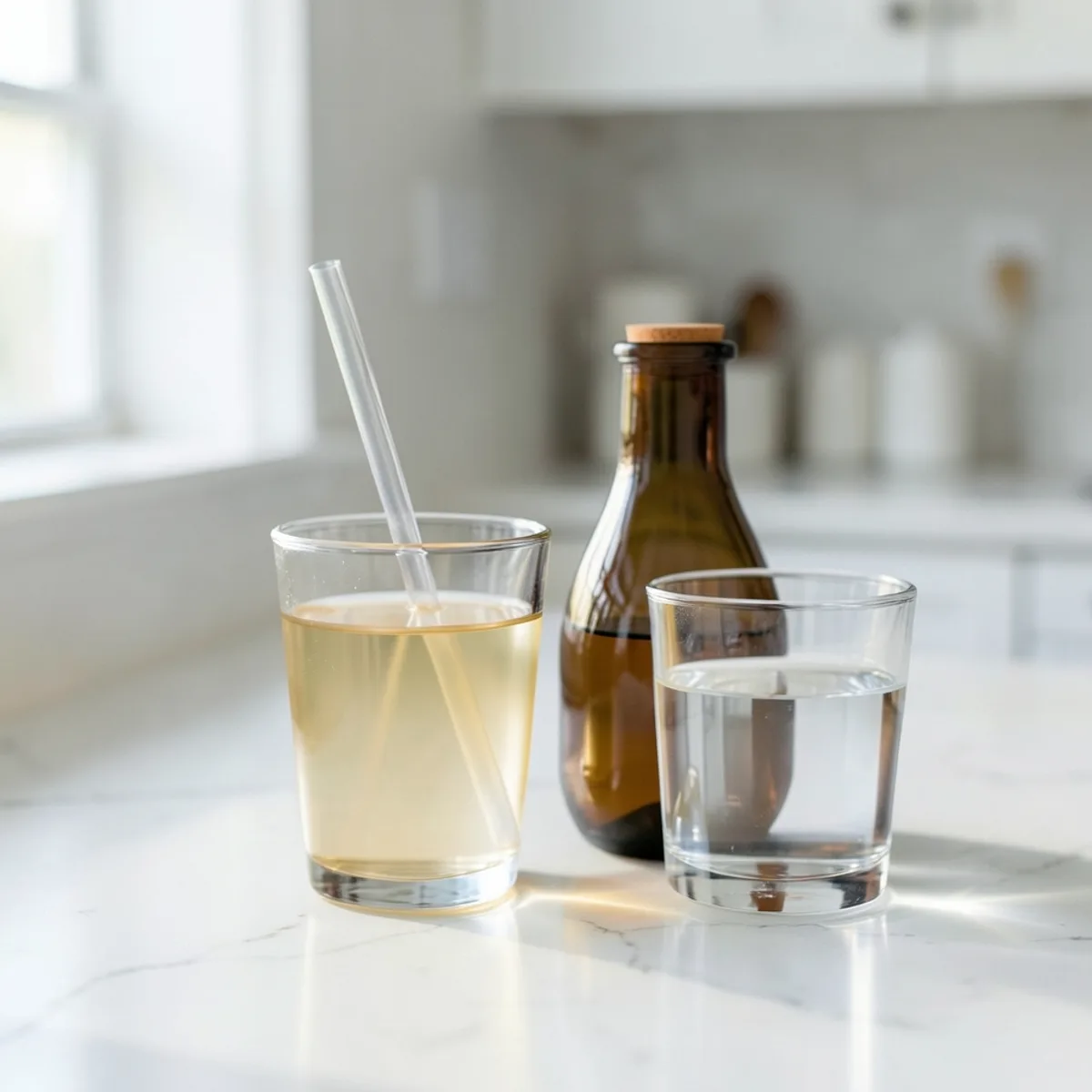
- Measure the water first. Pour 1 cup (237 mL, 8 fl oz) of plain water into a glass. Water goes in first so the vinegar never sits undiluted; this is our ordering, not a sourced rule.
- Add the vinegar. Level 1 tbsp (15 mL) of apple cider vinegar into the water and stir once. Don't drink it straight or as a shot.
- Drink it through a straw. Drink the glass in one sitting through a straw, then rinse your mouth with plain water. If it makes you feel sick, stop, as Cleveland Clinic advises.
Notes
This is our glass, not a medical rule. No source we read sets a minimum amount of water for vinegar.
Acid and percent figures are our own arithmetic and assume vinegar of about 5 percent acetic acid, as the USDA record notes.
Nutrition is our calculation from the USDA FoodData Central record for cider vinegar (173469). Plain water is counted as adding nothing.
Mix it fresh. No source we read says how long a mixed glass keeps, so we give no duration.
Nutrition Facts
Per 1 glass (1 tbsp apple cider vinegar in 1 cup water) (estimated)
- Total Fat
- 0 g
- Saturated Fat
- 0 g
- Sodium
- 0.7 mg
- Total Carbohydrate
- 0.1 g
- Dietary Fiber
- 0 g
- Sugars
- 0.1 g
- Protein
- 0 g
Frequently asked questions
Is it better to take apple cider vinegar on an empty stomach or with food?
We found no study that compares the two, and Harvard Health says the best time is unknown. Healthline's dosage page says to take it right before a high-carb meal if blood sugar is the goal, and it does not mention the empty stomach.
What side effects can apple cider vinegar cause on an empty stomach?
Nausea is the one our sources name. Cleveland Clinic lists it and says to stop if it makes you feel sick, and in a controlled study people who drank 25 g reported significantly more nausea, though none of the sources looked at the empty stomach on its own.
Can you take apple cider vinegar capsules or gummies on an empty stomach?
We found no sourced dose for gummies or capsules, and no source on taking them fasted. BUBS Naturals sells gummies, so its page is a seller's view and not a medical source.
Does apple cider vinegar on an empty stomach help with weight loss?
Nothing we read shows that, and none of these sources tested fasted dosing for weight. In Darzi's 2014 studies, lower appetite came with higher nausea ratings and the authors said promoting vinegar as an appetite suppressant seems inappropriate, and a 2022 review found no appetite-suppressing effect in the long-term trials of 4 to 12 weeks.
Comments