Apple Cider Vinegar and Water Ratio: Tbsp, mL, Parts, %
Jump to RecipeOne glass of apple cider vinegar and water written four ways: tablespoons, mL, parts and percent acetic acid. See how it compares with other pages' ratios and what the studies measured.
 Save
Jump to:
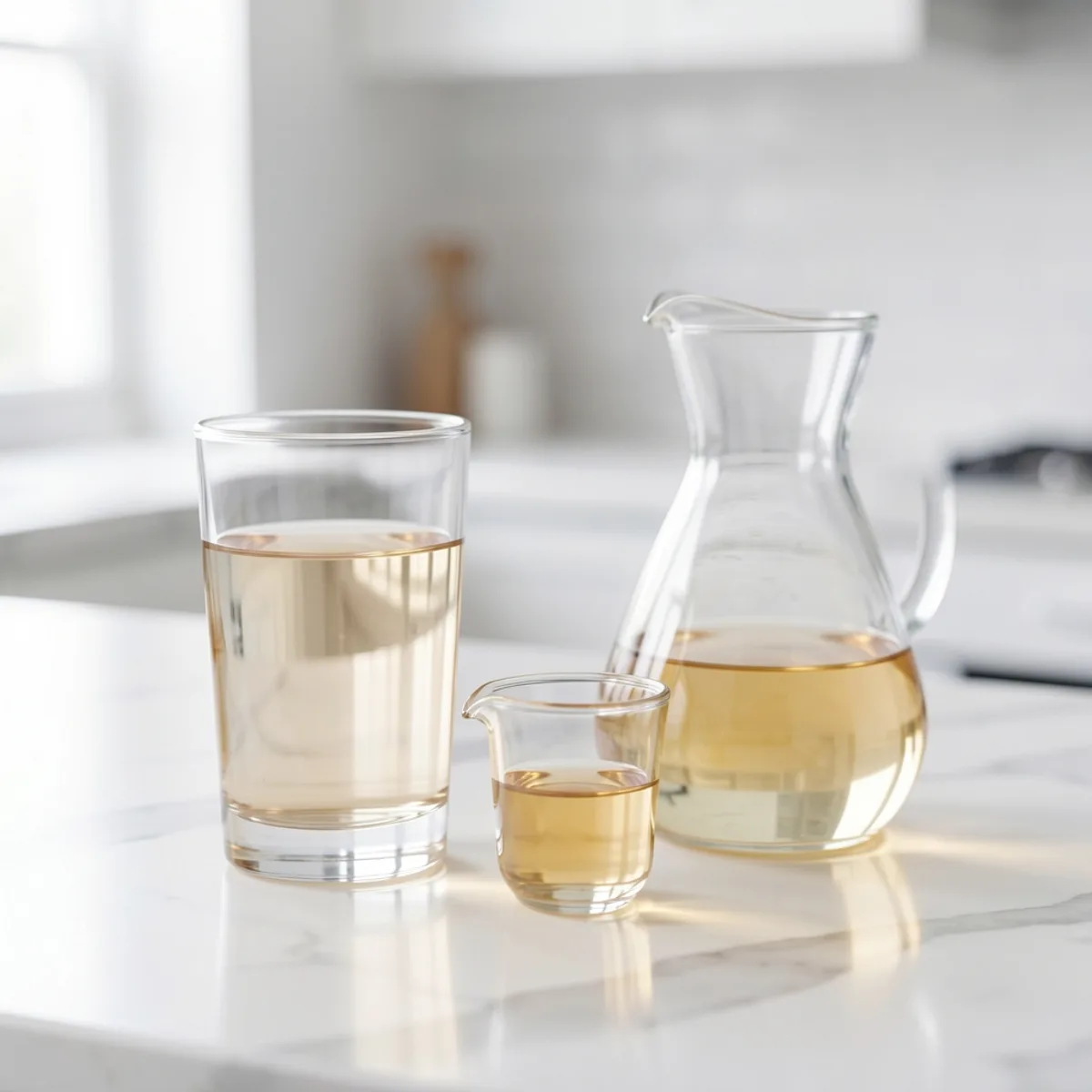
Apple cider vinegar and water ratio, in one line: 1 tbsp (15 mL) of vinegar to 1 cup (237 mL) of water, about 1 part to 16 and 0.3% acetic acid by our math. No ratio is proven to burn fat.
This page is about the ratio, so it converts that one glass into the other units people use and sets it beside the ratios other pages give. It isn't about the daily amount. For the 1 to 2 tablespoon range and what the weight studies found, see how much apple cider vinegar per day. Nothing here comes from tasting the drink or trying it out. It's sourced numbers plus our own arithmetic, and the arithmetic is labeled.
How much water to mix with apple cider vinegar
Our 8 fl oz (237 mL) is a recipe, not a medical rule. We found no source that sets a minimum amount of water for vinegar. What the health sources do give is a ceiling: Cleveland Clinic says no more than two tablespoons a day, and its example is 1 tablespoon in a mug of warm water.
Here is the same glass in four units.
| Unit | Our glass | How we got it |
|---|---|---|
| Tablespoons per cup | 1 tbsp in 1 cup | The recipe |
| Milliliters | 15 mL vinegar in 237 mL water, about 252 mL total | Assumes the two volumes simply add |
| Parts | 1 part vinegar to about 16 parts water | 237 divided by 15 is 15.8 (our calculation) |
| Percent | Vinegar is about 6% of the glass; acetic acid is about 0.3% | 15 divided by 252, then 5% of that (our calculation) |
One catch with the colon. A "1:16" can mean 1 part vinegar to 16 parts water, or 1 part in 16 parts total. Our glass is about 1:16 counting water only and about 1:17 counting the whole glass (252 divided by 15 is 16.8). When a page doesn't say which it means, the number can be off by a part. The percent figure doesn't have that problem.
A teaspoon start is the other common fork. Harvard Health Publishing says common recommendations are about 1 to 2 teaspoons, not tablespoons. A teaspoon is 5 mL, so 1 tsp in 1 cup (237 mL) works out to about 1 part to 47 and about 0.1% acetic acid (our calculation). That's a third of the vinegar in our glass.
The Food Science / Lab Kitchen Note
The acid in apple cider vinegar is acetic acid. The USDA record for cider vinegar (FoodData Central 173469) notes about 5 percent. Brands differ, so every percent on this page is a calculation from that assumed 5 percent. Check your bottle's label if it gives one.
The arithmetic. USDA lists 1 tbsp as 14.9 g, so at 5 percent that's about 0.75 g of acetic acid. Stir it into 1 cup of water and the glass is about 252 mL. Counting water as 1 g per mL, 0.75 g in about 252 g is about 0.3 percent. The 2009 trial below gives a quick cross-check on the 5 percent: its 15 mL of vinegar held 750 mg of acetic acid, which is 5 percent.
That's a concentration, not a pH. We found no sourced pH for a diluted glass, so we can't place it on the pH scale. Dilution cuts the acid load. It doesn't turn the drink into water.
Apple cider vinegar dilution ratio: what other pages give
This compares published data. The parts and percent columns are our calculations, and they assume 5 percent acid and volumes that add. None of the other pages gives an acid strength. "No sourced data" means we found nothing for that cell.
| Variant | Amount | Parts (vinegar to water) | Acetic acid after dilution | What the source reports |
|---|---|---|---|---|
| Our glass | 1 tbsp (15 mL) in 1 cup (237 mL) | About 1:16 | About 0.3% | No sourced pH or human data for this glass. Cleveland Clinic's mug example uses the same 1 tbsp |
| Healthline dosage page | 1 tbsp (15 mL) with about 7 oz (100 mL) of water, from the description of a 3-month study | About 1:6.7 at 100 mL; about 1:14 at 207 mL (7 fl oz) | About 0.65% at 100 mL; about 0.34% at 207 mL | No recommended ratio, and no mention of acetic acid. Says people typically drink 1 to 2 tbsp (15 to 30 mL) with a glass of water before meals. Says a straw plus a rinse can help prevent enamel damage |
| Elmsleigh House Dental Clinic blog (2018) | At least 1 part vinegar to 5 to 10 parts water; about 24 to 47 mL per 1 cup (237 mL) of water (our calculation) | 1:5 to 1:10 | About 0.45% to 0.83% | A dental clinic's blog with no sources for the ratio. Its pH of 2.5 to 3.0 describes the vinegar itself; it gives no pH for a diluted mix |
Three things worth knowing about that table.
Healthline. Its dosage page gives no recommended ratio. The pairing in the table comes from its description of a 3-month study, in which people drank 1 tbsp (15 mL) of apple cider vinegar with about 7 oz (100 mL) of water right after dinner. The page's own units don't match: 7 fl oz is about 207 mL (our conversion). We show both readings, and the parts and percent for each are our math. It says people typically drink 1 to 2 tbsp (15 to 30 mL) with a glass of water before meals.
Elmsleigh. The phrase is "at least" 5 to 10 parts water. At the 1:5 end, a cup of water would take about 3 tbsp of vinegar (our calculation), more than Cleveland Clinic's 2 tbsp daily ceiling. Read the row as data about dilution, not as a dose.
Bubs Naturals. This is a seller's page, not a medical source. It calls 1:10 or 1:16 the most widely accepted standard, and never says whether the ratio is by volume. It also says to use at least 8 oz of water per tablespoon of vinegar. By our math that is about 1:16 (237 mL for 15 mL), and 1:10 would be only about 5 oz per tablespoon, so the page disagrees with itself. At 1:16 the acid is about 0.29 percent, matching our glass; at 1:10 it is about 0.45 percent. Its beginner dose is 1 tsp in 8 to 10 oz in the prose, but 1 tsp in 10 oz in its table. Its maximum row is 2 tbsp in 12 to 16 oz. By our math, 1 tsp (5 mL) in 8 to 10 oz (237 to 296 mL) is about 1:47 to 1:59, and 2 tbsp (30 mL) in 12 to 16 oz (355 to 473 mL) is about 1:12 to 1:16. So even one page uses several dilutions.
What the studies behind the ratios measured
The 2009 trial. Kondo et al., Bioscience, Biotechnology and Biochemistry, was a double-blind randomized controlled trial in obese Japanese adults. Three groups drank 500 mL a day for 12 weeks of a beverage with no vinegar, 15 mL of vinegar (750 mg acetic acid), or 30 mL (1,500 mg). Weight, BMI, visceral fat area, waist and triglycerides were lower than with placebo. The abstract we read doesn't give the head count; Harvard Health says 175 people, so that figure is Harvard's, and it describes a modest loss of about 2 to 4 pounds in three months. Harvard also notes that the vinegar was vinegar in general, not apple cider vinegar specifically, and that evidence for reliable long-term weight loss isn't compelling. By our math, 15 mL in 500 mL is about 1 part vinegar to 32 parts drink, and 30 mL in 500 mL is about 1 to 16 and 0.3 percent acetic acid. Those two ratios count the whole 500 mL drink, not water only. That's the same dilution as our glass with twice the vinegar. It's a comparison of numbers, not a claim that our glass does what that drink did.
The dilution case. A case report in Clinical Endoscopy (2019) describes one 15-year-old boy who drank 100 to 150 mL of a pomegranate vinegar beverage (2.7 percent acidity, pH 2.6) every morning for about a month without adequate dilution. The maker advised 3:1 water. Endoscopy showed deep ulcers along the esophagus, which resolved by day 7 with treatment. One patient and a pomegranate vinegar can't show cause, and the report doesn't tell you how much water is enough. What it shows is what too little dilution, daily, over weeks can look like.
On enamel, we rely on the health sources rather than a ratio study. Cleveland Clinic says the acid erodes it and it cannot be regained, and Harvard says to dilute because vinegar can damage enamel when sipped. For the tooth research and the straw, rinse and wait steps, see does apple cider vinegar damage teeth.
Common mistakes
Copying a ratio without its units. "1:10" from one page and "5 parts water" from another aren't the same thing, and neither says tablespoons per cup. Convert to mL and percent, as in the tables above, before you compare.
Eyeballing a splash or grabbing the wrong spoon. A tablespoon is three times a teaspoon, so a "spoonful" can triple the vinegar. Use a true measuring spoon, level.
Taking it as a shot. Cleveland Clinic says undiluted acetic acid can burn the esophagus, and the case report above is what under-dilution looked like in one patient. Water goes in the glass first.
Hair, dogs, spritz, ribs and brisket
No sourced data. The pages we found disagree, and we found no veterinary or dermatology source, so we give no ratio and no advice for pets.
Substitutions and swaps
| Original | Swap | Proportion | What changes |
|---|---|---|---|
| Cool plain water | Warm water, like a mug of tea | Cleveland Clinic: 1 tbsp in a mug of warm water | Same vinegar, warmer drink. We found no sourced mug size, so it has no ratio here |
| Plain water | Unsweetened tea | No sourced proportion | Adds whatever the tea carries; not counted in our nutrition |
| 1 tbsp (15 mL) | 1 tsp (5 mL) | Harvard: common recommendations are 1 to 2 tsp. In 1 cup it's about 1:47 (our calculation) | A third of the vinegar and about 0.1% acid. No sourced data on this glass |
| Unpasteurized vinegar with the mother | Pasteurized vinegar | Same 1 tbsp (15 mL) | Healthline's pregnancy page treats unpasteurized as the cautious case and pasteurized as the safer option. Acidity varies by brand, so our percent figures would shift |
Storage
Mix one glass and drink it. None of the pages we read say whether a mixed glass keeps, so we give no duration. There's nothing to reheat. If you want it warm, Cleveland Clinic's example is a mug of warm water, and we found no sourced temperature.
Nutrition note
The values on the card are estimates, not measurements. They're calculated from typical USDA FoodData Central values for cider vinegar, record 173469. Per 100 g, that record lists 21 kcal, 5 mg of sodium, 0.93 g of carbohydrate, 0.40 g of total sugars, and 0 g of protein and fat. One tablespoon is 14.9 g, which gives about 3 kcal, about 0.14 g of carbohydrate (rounded to 0.1), about 0.06 g of sugars (rounded to 0.1) and about 0.7 mg of sodium. Fiber and saturated fat are entered as 0. The record doesn't separate raw vinegar with the mother from filtered or pasteurized, so the numbers are for plain cider vinegar. The record itself marks energy and carbohydrate as calculated or assumed, and plain water is counted as adding nothing.
The FDA sets the sodium Daily Value at 2,300 mg, so 0.7 mg is about 0.03 percent of it (our calculation). The 0.7 mg comes straight from the USDA record.
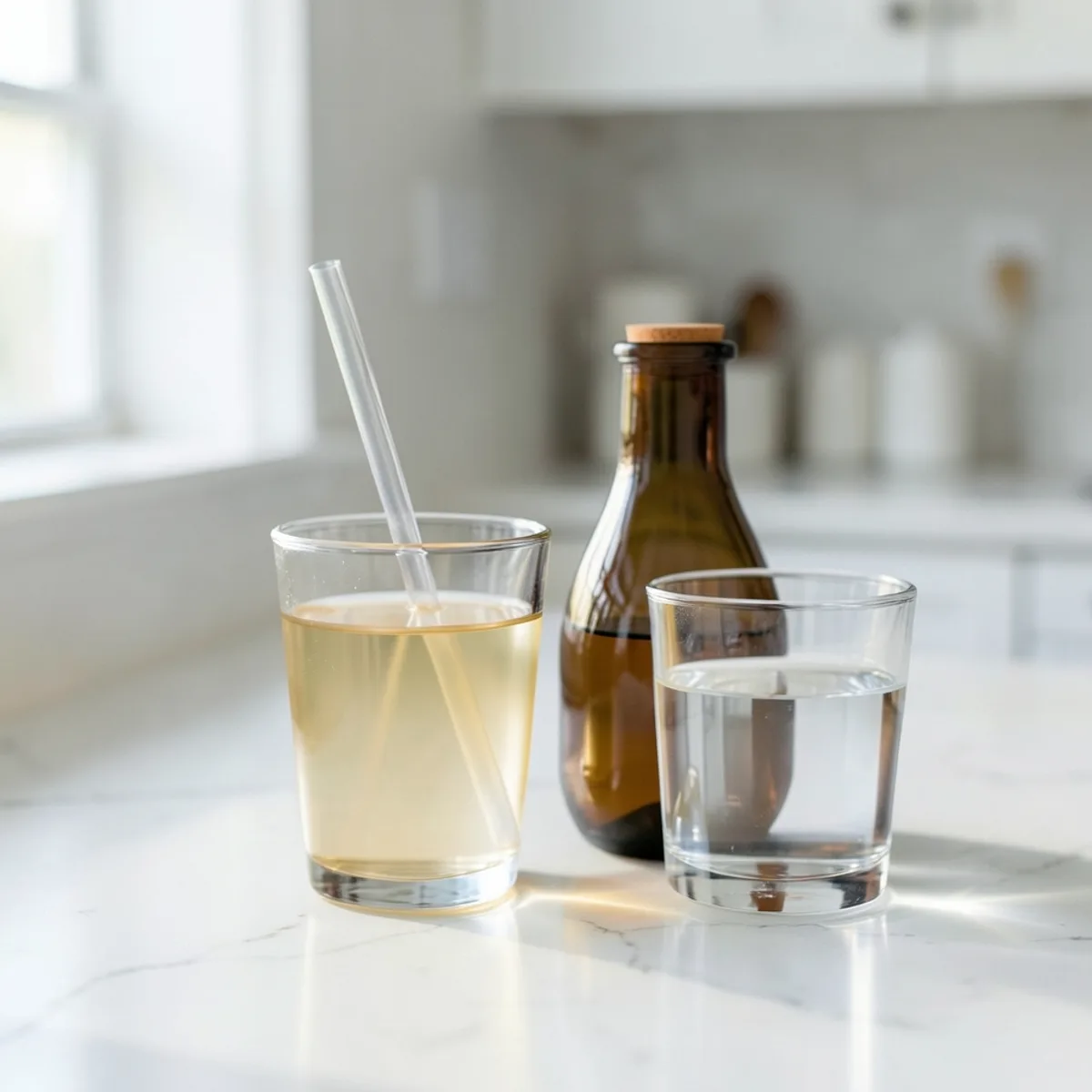
Serving tip: pour the water first, level the spoon, and drink it through a straw.
Servings: 1 glass (1 cup)
Apple Cider Vinegar and Water Ratio: Tbsp, mL, Parts, %
One glass of apple cider vinegar and water written four ways: tablespoons, mL, parts and percent acetic acid. See how it compares with other pages' ratios and what the studies measured.
Ingredients
Equipment
- Measuring spoons (a true tablespoon (15 mL), not a soup spoon)
- Glass (holds at least 1 cup (237 mL) with room to stir)
- Glass or reusable straw (Healthline says a straw plus a rinse afterward can help prevent enamel damage)
Instructions
- Measure the water first. Pour 1 cup (237 mL, 8 fl oz) of plain water into a glass. The water goes in first, our practice and not a sourced rule, so the vinegar never sits at the bottom undiluted.
- Add the vinegar. Level 1 tbsp (15 mL) of apple cider vinegar into the water and stir once. Never drink it straight or as a shot.
- Drink it through a straw. Drink the glass in one sitting through a straw. Rinse your mouth with plain water right after the last sip.
Notes
This is our ratio, not a medical rule. We found no sourced minimum amount of water for vinegar.
Every percent and parts figure is our own arithmetic. It assumes the vinegar is about 5 percent acetic acid (the USDA record's note) and that the volumes add up.
Nutrition is our calculation from the USDA FoodData Central record for cider vinegar (173469). Plain water is counted as adding nothing.
Mix it fresh. We found no sourced storage time for a mixed glass, so we give none.
Nutrition Facts
Per 1 glass (1 tbsp apple cider vinegar in 1 cup water) (estimated)
- Total Fat
- 0 g
- Saturated Fat
- 0 g
- Sodium
- 0.7 mg
- Total Carbohydrate
- 0.1 g
- Dietary Fiber
- 0 g
- Sugars
- 0.1 g
- Protein
- 0 g
Frequently asked questions
Is it better to drink diluted apple cider vinegar in the morning or at night?
We found no sourced best time of day for this glass. Pick a time when you can drink it in one sitting through a straw and rinse your mouth with water afterward, which Healthline says can help prevent enamel damage.
What happens if you do not dilute apple cider vinegar enough?
Cleveland Clinic says undiluted acetic acid can burn the esophagus, and that worn tooth enamel cannot be regained. A 2019 case report describes one teenager with esophageal ulcers after about a month of an under-diluted pomegranate vinegar drink, which cannot show cause.
Can you drink apple cider vinegar straight if you follow it with water?
We found no source showing that a water chaser makes a straight shot acceptable. Cleveland Clinic warns that undiluted acetic acid can burn the esophagus, so we give no shot version.
Can you mix apple cider vinegar with tea instead of water?
Cleveland Clinic's example is 1 tablespoon in a mug of warm water, and we found no sourced proportion for tea. Tea is not counted in our nutrition numbers.
Comments