Baking Soda Instead of Baking Powder for Pancakes (Grams)
Jump to RecipeA soda-only buttermilk pancake recipe that swaps baking soda in for the baking powder, with US measures and grams, a liquid check, sourced ratios side by side and sodium per pancake.
 Save
Jump to:
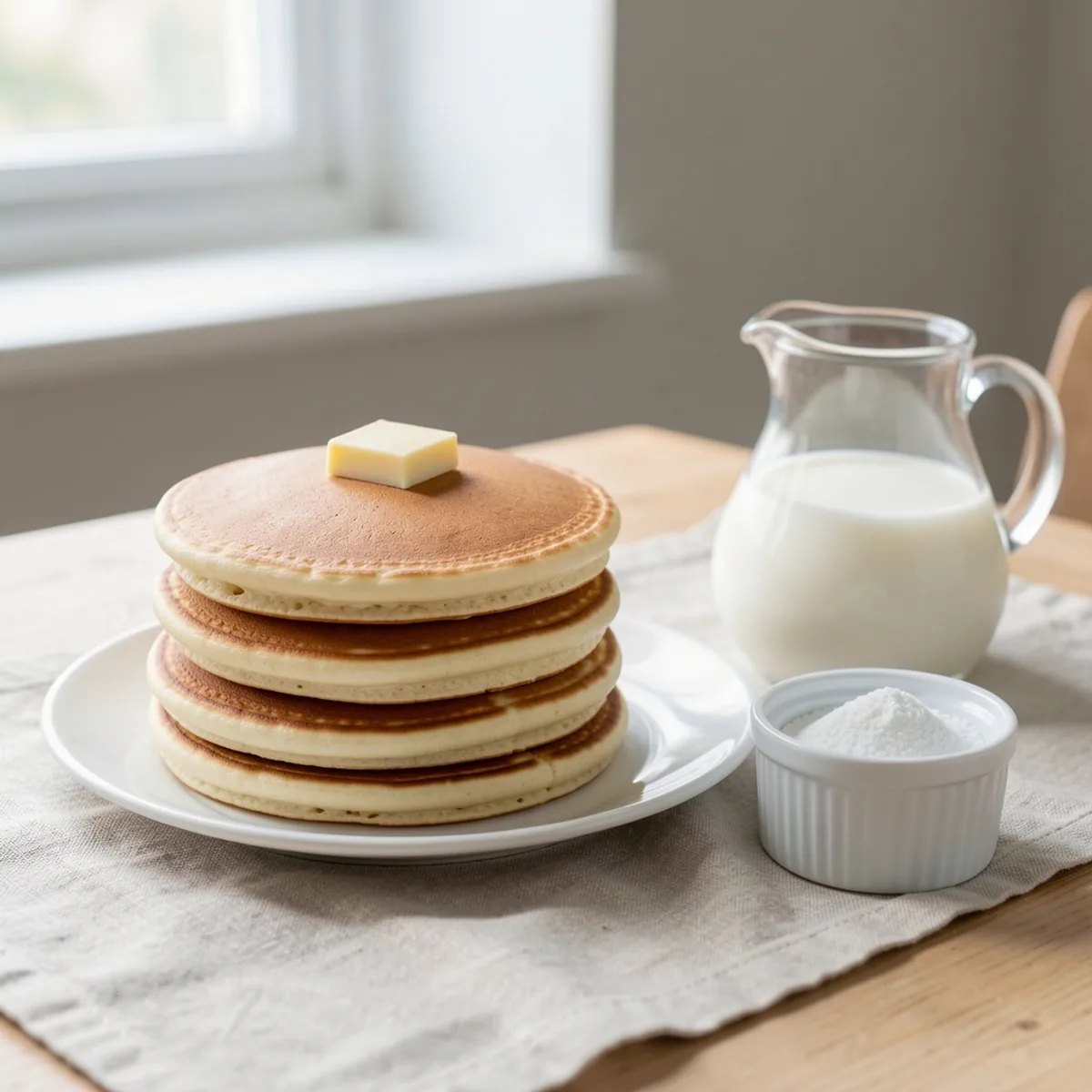
Yes: use 1 1/4 teaspoons (5.75 g) of soda for 2 cups (240 g) of flour, provided the buttermilk supplies the acid. This is our untested adaptation of King Arthur's quantities, with the 1 teaspoon of baking powder removed and 1/4 teaspoon of soda added.
For the wider list of swaps, start with the pillar, can I use baking soda instead of baking powder. This page is the pancake-sized version of the same question.
How the swap works in a batter that already has buttermilk
Swap lists such as Zestful Kitchen's and Flavorful Home's pair 1/4 teaspoon of soda with an acid like buttermilk, yogurt or sour milk, in amounts from 1/4 to 1/2 cup per teaspoon of baking powder. That suits a recipe with no acid. A buttermilk pancake batter already has 2 cups of it, so adding another 1/2 cup per teaspoon removed would count the liquid twice.
The formula here starts from King Arthur's buttermilk pancakes: 2 cups (240 g) flour, 3 tablespoons (35 g) sugar, 1 teaspoon baking powder, 1 teaspoon baking soda, 1/2 teaspoon salt, 1 large egg, 2 cups (454 g) buttermilk and 2 tablespoons (28 g) melted butter. Take out the 1 teaspoon of powder, add 1/4 teaspoon of soda in its place, and the soda becomes 1 1/4 teaspoons (5.75 g). Nothing else changes.
That dose is our math, and the sources do not agree on it. Kitchen Savvy's ratio of about 1/2 teaspoon per cup of buttermilk works out to 1 teaspoon for 2 cups (the page says there is some latitude, gives no amount per flour and does not mention pancakes). Live Eat Learn's soda-only recipe uses 2 teaspoons for 2 cups, and Zestful Kitchen's soda-alone line would give 1 1/3 teaspoons here. We did not average them.
The Food Science / Lab Kitchen Note
Baking soda is sodium bicarbonate, a base. Moisten and heat it and it releases carbon dioxide. LibreTexts' Chemistry of Cooking (a university course text, not a study) says it releases about twice as much when acid is present. The gas comes off fast at the start, while the batter is still acidic at about pH 5 to 6. Once the acid is neutralized, the batter turns alkaline and the release slows, so the text says mixes must be handled promptly. Recipes differ on how long a pancake batter should rest, 5 minutes against 15, as the table below shows. Scope: the text covers cakes and muffins, with no pancake test.
LibreTexts links too much soda without enough acid to a yellowish-brown crumb and a strong soda smell. Some home bakers describe bitter pockets or an aftertaste in soda pancakes, but the causes they name (uneven mixing, missing acid, the powder itself) do not agree, so no cause is established for pancakes.
Browning is the other effect. A peer-reviewed review (El Hosry et al., Foods 2025) says pH is a key parameter in the Maillard reaction: the lower the pH, the slower the reaction, and it generally runs faster under basic than acidic conditions. The article does not mention baking soda or pancakes. Linking soda to browning is general chemistry here, not a measured pancake result.
Three leavening setups compared
This table compares published data, not finished pancakes. Where no source gives a figure, the cell says so.
| Variant | Flour | Leavener | Liquid and acid | Rest | Yield and time | Crumb, rise, taste |
|---|---|---|---|---|---|---|
| Baking powder + soda (King Arthur) | 2 cups (240 g) | 1 teaspoon baking powder + 1 teaspoon baking soda | 2 cups (454 g) buttermilk | 15 minutes, uncovered | 14 to 16 four-inch pancakes, 45 minutes total | No sourced data |
| Soda + buttermilk (this card, untested; Live Eat Learn for comparison) | 2 cups (240 g) | This card: 1 1/4 teaspoons (5.75 g) soda. Live Eat Learn: 2 teaspoons soda | This card: 2 cups (454 g) buttermilk. Live Eat Learn: 2 cups (480 mL) buttermilk | This card: 15 minutes. Live Eat Learn: at least 5 minutes | This card: 14 to 16 (King Arthur yield). Live Eat Learn: 12 pancakes, 20 minutes total | No sourced data. Live Eat Learn's own title says "Fluffy", which is its claim |
| Soda + milk + lemon juice or vinegar (Flavorful Home swap) | No sourced data | 1/4 teaspoon soda per 1 teaspoon baking powder | 1/2 cup sour milk (1 cup milk + 1 tablespoon vinegar or lemon juice), or 1/2 teaspoon lemon juice or vinegar | No sourced data (the swap mix loses potency after about 15-20 minutes) | No sourced data | No sourced data |
The sour milk row is a per-teaspoon swap, not a pancake recipe, so it has no flour or yield. We did not convert it for this batter.
Common mistakes
Adding the swap liquid on top of the buttermilk. The 1/2 cup per teaspoon in the swap lists is for batters with no acid. Here the 2 cups of buttermilk are already the acid and the liquid, so add none.
Pockets of dry soda. Some forum posters blamed uneven mixing for bitter pockets. Whisk the soda through the flour until no specks show, and weigh it if your scale reads to 0.1 g. It's a small amount, so sloppy measuring shows up fast.
Not knowing which rest to trust. The sources give 5 minutes (Live Eat Learn) and 15 minutes (King Arthur), and Flavorful Home says a swap mix loses potency after about 15-20 minutes. This card follows King Arthur, but those facts pull in different directions, so don't leave the batter sitting longer than the card says.
Swaps and what changes
| Original | Replacement | Proportion | What changes |
|---|---|---|---|
| Buttermilk | Sour milk (1 cup milk + 1 tablespoon vinegar or lemon juice) | 1/2 cup per 1/4 teaspoon soda (Flavorful Home) | Per teaspoon of powder removed. Not tested here for this batter. |
| Buttermilk | Plain yogurt | 1/4 cup (Flavorful Home) or 1/2 cup (Zestful Kitchen) per 1/4 teaspoon soda | The two sources disagree. Not tested here. |
| Buttermilk | Lemon juice or vinegar | 1/2 teaspoon per 1/4 teaspoon soda (Zestful Kitchen, Flavorful Home) | Gives acid only, not the liquid. Not tested here. |
| Baking powder | Soda + cream of tartar | 1/4 teaspoon soda + 1/2 teaspoon cream of tartar per 1 teaspoon powder | Used when the batter has no acid. Not tested here. |
| Baking powder or soda | Self-rising flour, club soda or whipped egg whites | No sourced data | No sourced amounts or results for pancakes. Not tested here. |
| Egg or wheat flour | Egg-free or gluten-free batter | No sourced data | Not covered by this page. |
Sodium per pancake
This is our own calculation from USDA FoodData Central. USDA lists baking soda at about 27,400 mg of sodium per 100 g (the single-food record shows 27,360) and 1 teaspoon at 4.6 g, so 4.6 g x 274 mg per gram is about 1,260 mg per level teaspoon. The batch holds about 1,576 mg from the soda, 1,164 mg from the salt (USDA lists table salt at 38,800 mg per 100 g, so 3 g is about 1,164 mg) and about 672 mg from the buttermilk (148 mg per 100 g, 454 g). Salted butter adds about 180 mg (643 mg per 100 g, 28 g), the large egg about 71 mg (142 mg per 100 g, 50 g) and the flour under 10 mg.
Divide the total of about 3,670 mg by 14 pancakes and you get about 262 mg per pancake, about 11% of the 2,300 mg daily value. At 16 pancakes it is about 230 mg. The soda alone is about 98 to 113 mg per pancake over the 14 to 16 range.
Live Eat Learn's card lists sodium of 990 mg for a 3-pancake serving against a yield of 12, so its unit is unclear and we don't reuse it.
Storing cooked pancakes
No source covers storing cooked pancakes or leftover batter, so this page gives no days and no reheating times. The only handling advice we have is Live Eat Learn's: keep finished pancakes warm in a 200 F oven. Flavorful Home covers only the baking powder jar, and Zestful Kitchen says opened baking powder keeps about 6 months stored cool, dry and dark. That doesn't tell you how long a batter lasts.
Where the numbers come from
The leavening chemistry comes from two sources, and neither is a pancake study. LibreTexts, Chemistry of Cooking is a university course text and covers cakes and muffins. El Hosry et al., Foods 2025 is a peer-reviewed review of the Maillard reaction, and it never mentions soda or pancakes.
The quantities come from recipe pages and swap guides: King Arthur Buttermilk Pancakes, Live Eat Learn, Kitchen Savvy, Zestful Kitchen and Flavorful Home. Kitchen Savvy does not mention pancakes. The sodium figures are our calculation from USDA FoodData Central baking soda, table salt and low-fat buttermilk. We found no study that compares these swaps in pancake batter.
If a batch tastes bitter, the sources point to uneven mixing and missing acid, not to one proven cause. For the basics behind the two leaveners, see baking soda vs baking powder, and for the same swap in a biscuit dough, see baking soda and buttermilk instead of baking powder.
Servings: 14 pancakes
Baking Soda Instead of Baking Powder for Pancakes (Grams)
A soda-only buttermilk pancake recipe that swaps baking soda in for the baking powder, with US measures and grams, a liquid check, sourced ratios side by side and sodium per pancake.
Ingredients
Soda-only buttermilk pancakes
Equipment
- Two mixing bowls (one for the dry mix, one for the wet)
- Kitchen scale (reads to 0.1 g or better for the soda; the nutrition panel is built on the gram weights)
- Skillet or griddle (for the pancakes)
Instructions
- Whisk the dry mix. Whisk 2 cups (240 g) flour, 3 tablespoons (35 g) sugar, 1 1/4 teaspoons (5.75 g) baking soda and 1/2 teaspoon (3 g) salt in a large bowl until no streaks or specks of soda remain.
- Mix the wet ingredients. In a second bowl, whisk 1 large egg, 2 cups (454 g) buttermilk, 2 tablespoons (28 g) melted butter and the vanilla, if using. Add no other liquid.
- Combine. Pour the wet mix into the dry and stir until the flour is wet. Stop there, since a few lumps are expected.
- Rest the batter. Let the batter sit uncovered for 15 minutes, as King Arthur does. Live Eat Learn rests its soda-only batter for at least 5 minutes, so the sources disagree.
- Cook until bubbles form. Heat a skillet or griddle over medium to low heat, the setting Live Eat Learn gives for its soda-only batter. Pour the batter in rounds about 4 inches wide, cook until bubbles form, flip and cook the second side. No sourced pan temperature or minutes per side.
- Keep warm and serve. Keep finished pancakes warm in a 200 F oven, as Live Eat Learn does, until you have the whole batch of 14 to 16.
Notes
Our adaptation, untested. No one at SodaRecipe has cooked this exact formula. It is King Arthur's buttermilk pancake quantities with the 1 teaspoon of baking powder removed and 1/4 teaspoon of soda added, the per-teaspoon swap that Zestful Kitchen and Flavorful Home both give.
Soda dose is disputed. Kitchen Savvy gives about 1/2 teaspoon per cup of buttermilk, so 1 teaspoon for 2 cups. This card uses 1 1/4 teaspoons (our math). Live Eat Learn uses 2 teaspoons for 2 cups. Zestful Kitchen's soda-alone line would give 1 1/3 teaspoons. We did not average them.
Yield and time: 14 to 16 four-inch pancakes, 10 minutes hands-on and 45 minutes total are King Arthur's figures for the powder version. The card shows 14, the low end, so the per-pancake sodium is the higher figure. Cook time of 20 minutes is our subtraction (45 minus 10 minus the 15 minute rest).
Sodium is our own calculation, not a published figure: soda 1,576 mg, salt 1,164 mg, buttermilk 672 mg, salted butter about 180 mg, egg about 71 mg and flour under 10 mg, about 3,670 mg for the batch, or about 262 mg per pancake at 14 (about 11% of 2,300 mg) and about 230 mg at 16.
Nutrition values are our estimate from USDA FoodData Central records for all-purpose flour, granulated sugar, a large egg, low-fat cultured buttermilk, salted butter, baking soda and table salt, divided by 14. Saturated fat, sugar and fiber are not listed, and vanilla is left out.
Nutrition Facts
Per one pancake (1 of 14) (estimated)
- Total Fat
- 2.6 g
- Sodium
- 262 mg
- Total Carbohydrate
- 17 g
- Protein
- 3.8 g
Frequently asked questions
How soon should pancake batter with baking soda hit the pan?
Soon after the buttermilk meets the soda, because LibreTexts says gas comes off fast at the start and slows once the acid is used up (its text covers cakes and muffins, not pancakes). Sources disagree on resting: Live Eat Learn says at least 5 minutes, King Arthur says 15, and Flavorful Home says a swap mix loses potency after about 15-20 minutes.
Why do some soda pancakes taste bitter or metallic?
Some home bakers report a bitter aftertaste or small bitter pockets, but the evidence is thin: one recipe-page comment and one forum thread of about 10 posters who blamed uneven mixing, missing acid or the powder itself and did not agree. LibreTexts says too much soda without enough acid gives a strong soda smell, so whisk the soda through the flour and keep the buttermilk as the acid.
What can I use if I have no buttermilk?
Flavorful Home lists sour milk (1 cup milk plus 1 tbsp vinegar or lemon juice) at 1/2 cup per 1/4 tsp of soda, and plain yogurt at 1/4 cup, while Zestful Kitchen says 1/2 cup of yogurt. Those amounts are per teaspoon of baking powder removed and were not converted for this batter, so no tested swap is given here.
What if I don't have baking soda for pancakes?
This page covers soda used in place of baking powder, not the reverse, and it has no sourced amounts for a batter with no soda at all. The pillar page on soda and powder swaps is the better starting point for that question.

Jimmy Blair spent years in pastry kitchens and lives in Brooklyn, New York. He covers SodaRecipe’s pancakes, cookies, cakes and other sweet bakes.
Comments