Best Time to Drink Baking Soda Water (Morning or Workout)
Morning, before a meal or before a workout? A plain look at the two sourced timing windows, the exact dose, the sodium in mg and who should skip baking soda water.
 Save
SaveJump to:
Many searches ask about timing, so here is what we could and could not source. This page tells you what we could and could not find, so you can decide calmly. If you came for the drink itself, the baking soda recipe for weight loss has the full steps and a look at the evidence. Here, we stay on the clock.
One note on wording. "We found none" is not the same as "none exists." Our search turned up no sourced time of day for weight goals, and we say so rather than guess.
Morning on an empty stomach
This is the most popular answer online, and it is the one we could source least. MedlinePlus, the US National Library of Medicine's drug page for sodium bicarbonate as an antacid, gives no morning advice and no "empty stomach" advice. It lists no weight-loss use either. The advice we saw elsewhere was anecdotal, without a source.
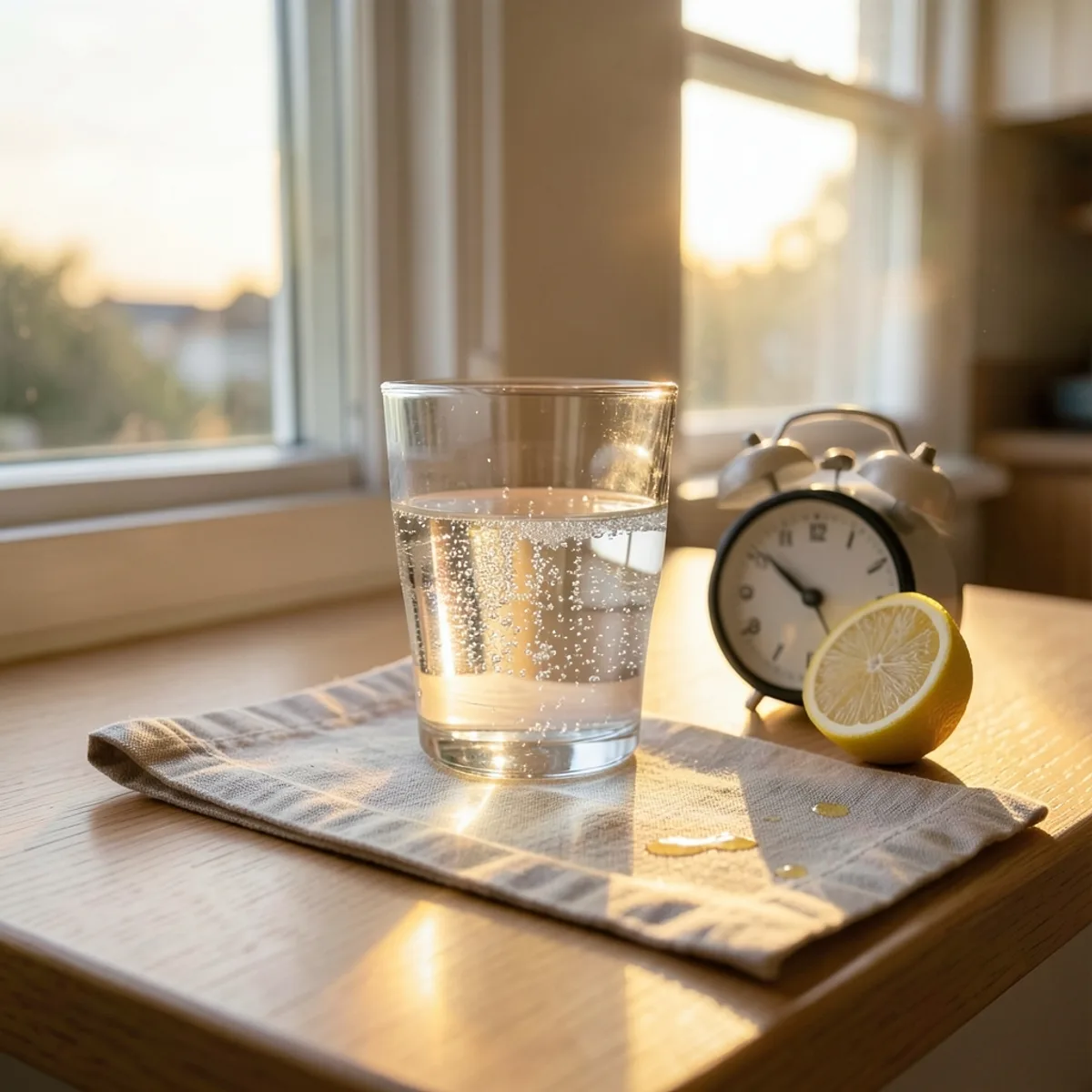
So morning is a habit, not a sourced time. If a morning glass fits your routine, the dose and spacing in the box above still apply, and the glass should have finished fizzing before you drink it. If you take other medicines in the morning, the spacing rule further down matters.
Before a meal
The label points the other way. For heartburn or acid indigestion, MedlinePlus says to take sodium bicarbonate 1 to 2 hours after meals, with a full glass of water, and not on an overly full stomach. For other uses it may be taken with or without food.
You will also read that a glass 20 to 30 minutes before eating helps you feel full. If that works, the credit goes to the water, not the baking soda. We found no source showing that bicarbonate changes appetite, so we treat "before a meal" as a hydration habit and nothing more. Plain water would give the same hydration without sodium.
Before a workout
This is the one place where research names a clear window, with one big catch: it is about performance, not fat loss. The International Society of Sports Nutrition position stand (Grgic and colleagues, 2021) says a single dose is taken 60 to 180 minutes before exercise, and that about 180 minutes may reduce side effects. It applies to high-intensity effort lasting roughly 30 seconds to 12 minutes, and it says some of the benefit may be placebo.
Now the sodium math, which is our own calculation and not in the paper. The stand gives a dose of 0.2 to 0.5 g per kg of body weight, with 0.3 g/kg as the optimal figure. For a 70 kg (154 lb) person, 0.3 g/kg is 21 g of baking soda, about 4.5 teaspoons. At the USDA figure of 27,400 mg of sodium per 100 g, that is roughly 5,750 mg of sodium, more than twice the 2,300 mg daily limit.
That is a sports protocol, not a kitchen glass, and we do not offer it as a recipe. A glass of 1/4 teaspoon holds about 315 mg. Please do not scale one up to the other because the numbers sit on the same page.
When to skip it
Skip or pause in these cases:
- On a very full stomach. MedlinePlus advises against it.
- Close to other medicines. Keep at least 2 hours between baking soda and anything else you take.
- With blood pressure, heart or kidney conditions, or a sodium-restricted diet. MedlinePlus says baking soda increases the sodium in the body, so these groups should check first.
- For children under 12. MedlinePlus says not without medical advice.
- For more than 2 weeks. That is the label limit for antacid use.
- While the glass is still fizzing. The gas is the reaction still running. Wait for it to settle.
What about night-time use? We found no evidence for or against it, so we have no timing to give.
The Food Science / Lab Kitchen Note
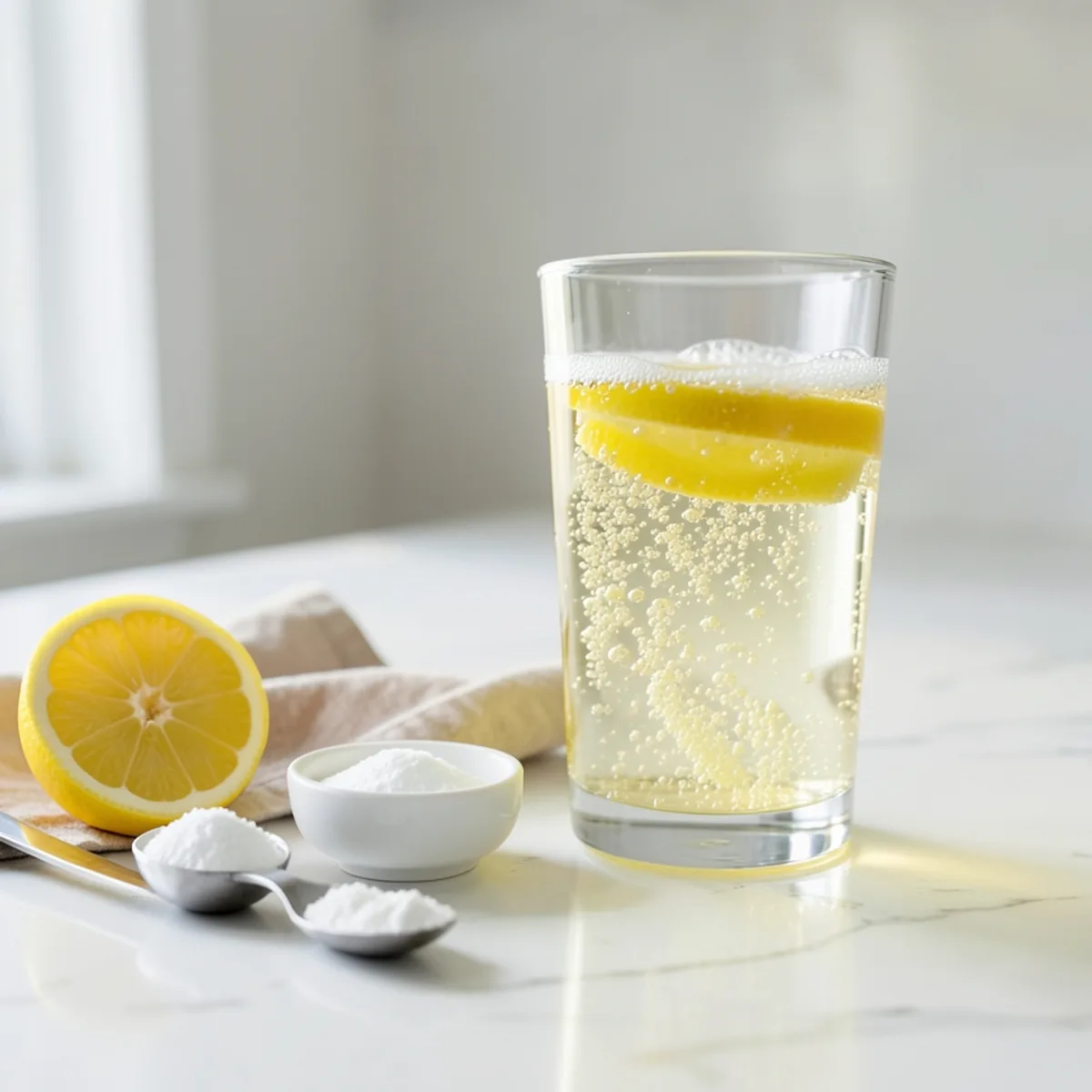
Baking soda is sodium bicarbonate, a base. Acid releases carbon dioxide from it, which is the fizz. If you add lemon, the citric acid does that work (see baking soda and lemon water). Penniston and colleagues, in a 2008 Journal of Endourology analysis of fresh and commercial juices, measured fresh lemon juice at about 1.44 g of citric acid per ounce.
From that figure, we calculate that 1 g of citric acid neutralizes about 1.31 g of bicarbonate. Half a lemon (about 24 g of juice) can neutralize about 1.5 g, roughly 1/3 teaspoon, so it can cover a 1/4 teaspoon dose on paper. Lemons vary, so wait for the bubbles to stop before drinking.
Neutralizing does not remove the salt. The sodium stays in the glass as sodium citrate. Baking powder is a different product and not a substitute.
By the USDA's household measure (4.6 g per teaspoon), we calculate:
| Dose | Weight | Sodium | Share of 2,300 mg |
|---|---|---|---|
| 1/4 tsp | 1.15 g | About 315 mg | About 14 percent |
| 1/2 tsp | 2.3 g | About 630 mg | About 27 percent |
| 1 tsp | 4.6 g | About 1,260 mg | About 55 percent |
The 2,300 mg figure is the Daily Value in the FDA's sodium guidance, which also says limits are lower for children under 14. The sodium values come from USDA FoodData Central, and the shares are our arithmetic. Dry aside: the spoon in your drawer is rarely as level as the spoon in the table.
What the research shows
The ISSN stand is an expert position statement built on a literature review, though it is still not a fat-loss study. It says the benefit for high-intensity exercise starts at about 0.2 g/kg, and that higher doses add side effects (bloating, nausea, vomiting, abdominal pain) without extra benefit. It also describes a multi-day option of 3 to 7 days at 0.4 to 0.5 g/kg per day, split across breakfast, lunch and dinner, and notes that a high-carbohydrate meal and smaller doses may help with side effects. Its scope is athletes, not a morning glass, and it says nothing about weight.
The caution side is a single patient. In a 2022 case report with literature review in Experimental and Therapeutic Medicine, a 69-year-old man who used baking soda as a gout remedy was hospitalized with metabolic alkalosis (blood pH 7.61), low potassium (2.6 mEq/L), acute kidney injury and liver injury. He improved after treatment. One patient shows that a risk exists. It cannot tell us how often it happens, and it was not a weight-loss drink.
Safety in one place
In short: use the smallest dose, dissolve it fully, mind the 2-hour spacing, and count the sodium. If you have a medical condition, take medicines or are unsure, speak with your doctor or a dietitian before trying it.
Mix one glass and drink it fresh. We found no sourced storage time for a mixed glass, so we do not state one.
Frequently asked questions
What is the best time to drink baking soda water?
We found no sourced best time of day for weight loss. The two sourced windows are different jobs: the antacid label says 1 to 2 hours after meals for heartburn, and the ISSN sports stand says 60 to 180 minutes before intense exercise. Either way, keep it at least 2 hours apart from other medicines.
What are the side effects of drinking baking soda water?
MedlinePlus lists thirst, stomach cramps and gas as mild effects. The ISSN stand reports bloating, nausea, vomiting and abdominal pain at sports doses. A published case report describes metabolic alkalosis (blood pH too high) in one man who used baking soda as a gout remedy, so it shows a risk, not how often it happens.
What can I drink instead of baking soda water?
Plain water carries no sodium bicarbonate and no added sodium, and it is the simplest swap. Lemon water without any baking soda is another option. We found no source showing that any of these drinks changes body fat, so none of them is a weight-loss method.
Comments