Baking Soda and Lemon Water: Ratio, Fizz and Sodium
Jump to RecipeHow much baking soda goes in lemon water, in US and metric measures, why it fizzes, and how many milligrams of sodium each spoonful adds to the glass.
 Save
SaveJump to:
One popular version of this recipe pairs 1 teaspoon of juice with 1/2 teaspoon of soda. By our calculation that is too little acid to use up the soda. This page fixes the ratio, shows the sodium in milligrams, and keeps the claims modest. If you came here for weight loss, start with our baking soda recipe for weight loss, which covers what the research does and does not show. Nothing here promises weight loss or any other health effect.
The Food Science / Lab Kitchen Note
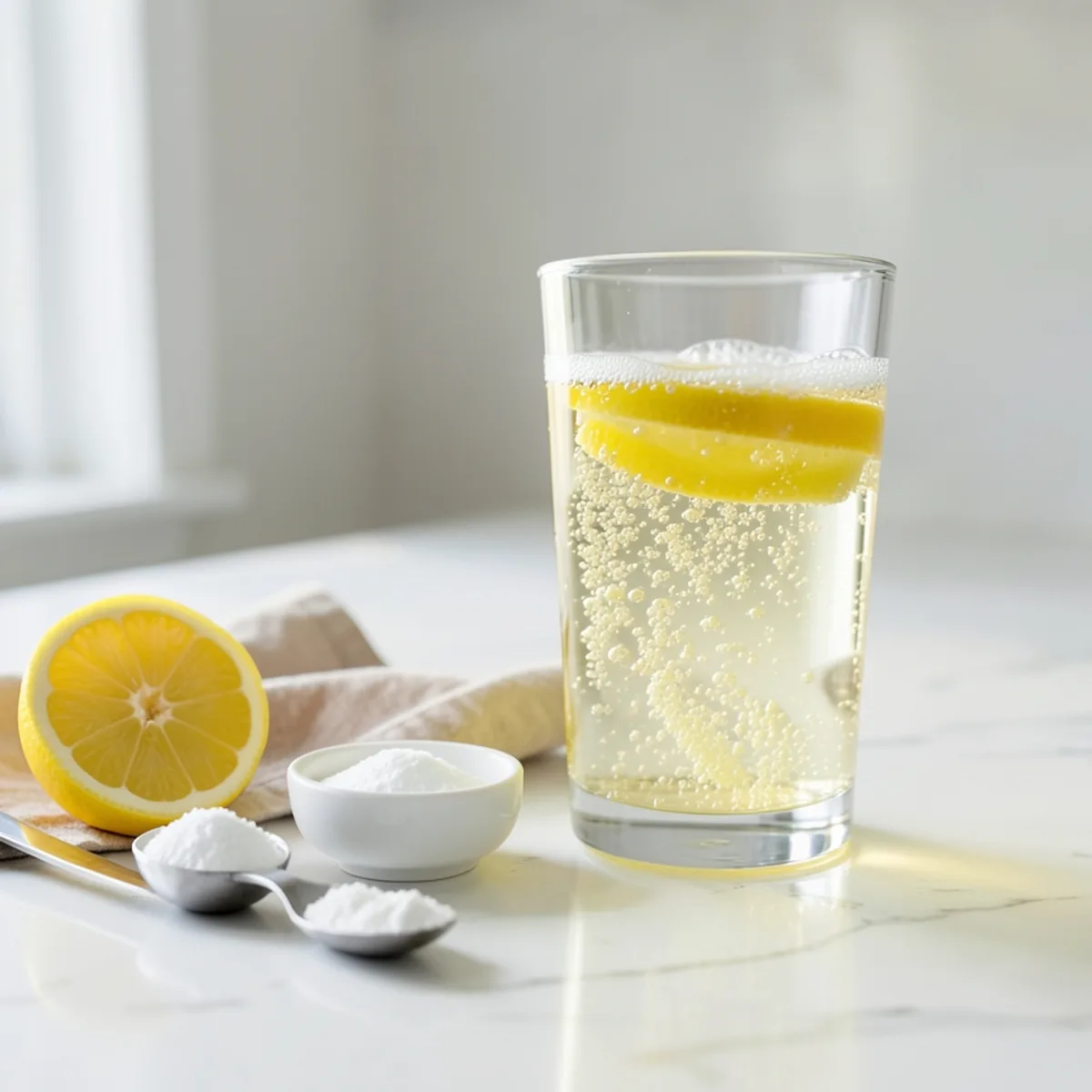
Baking soda is sodium bicarbonate, a base. Lemon juice is sour because of citric acid. When they meet, the acid takes up the bicarbonate and releases carbon dioxide gas, which is the fizz. What stays in the glass is sodium citrate, water and some dissolved gas. So lemon juice and baking soda make a mild salt solution with bubbles.
The numbers below are a calculation from published figures, not a result from a study. Penniston and colleagues measured fresh lemon juice at 48.0 g/L of citric acid, or 1.44 g per ounce (see the study below). Citric acid (192.12 g/mol) can neutralize up to three moles of sodium bicarbonate (84.007 g/mol each, 252.02 g in all), per PubChem. One gram of citric acid therefore neutralizes about 1.31 g of bicarbonate.
Half a lemon gives about 24 g of juice, roughly 1.1 g of citric acid, enough for about 1.5 g of bicarbonate. That covers 1/4 teaspoon (1.15 g) on paper. A 1/2 teaspoon (2.3 g) needs a whole lemon. Lemons vary, so treat this as a likely outcome, not a guarantee.
The sodium does not go anywhere. Neutralizing turns bicarbonate into sodium citrate, which still counts toward your day. For the same reason, adding more juice does not lower the sodium.
Temperature does not decide whether the soda dissolves. PubChem cites 9.3 g per 100 mL of water at 20 C, rising as water gets warmer. Our dose is about 0.5 g per 100 mL, far below that at any drinking temperature. Whether temperature changes fizz speed or taste, we found no source.
Sodium by spoonful
Using USDA's figure of 27,400 mg of sodium per 100 g of baking soda (FoodData Central), we calculate:
| Dose | Weight | Sodium | Share of 2,300 mg |
|---|---|---|---|
| 1/4 tsp | 1.15 g | About 315 mg | About 14 percent |
| 1/2 tsp | 2.3 g | About 630 mg | About 27 percent |
| 1 tsp | 4.6 g | About 1,260 mg | About 55 percent |
The FDA gives a Daily Value of less than 2,300 mg of sodium per day, and the Dietary Guidelines for Americans advise adults to stay under that. The sodium in the glass arrives on top of everything else you eat that day.
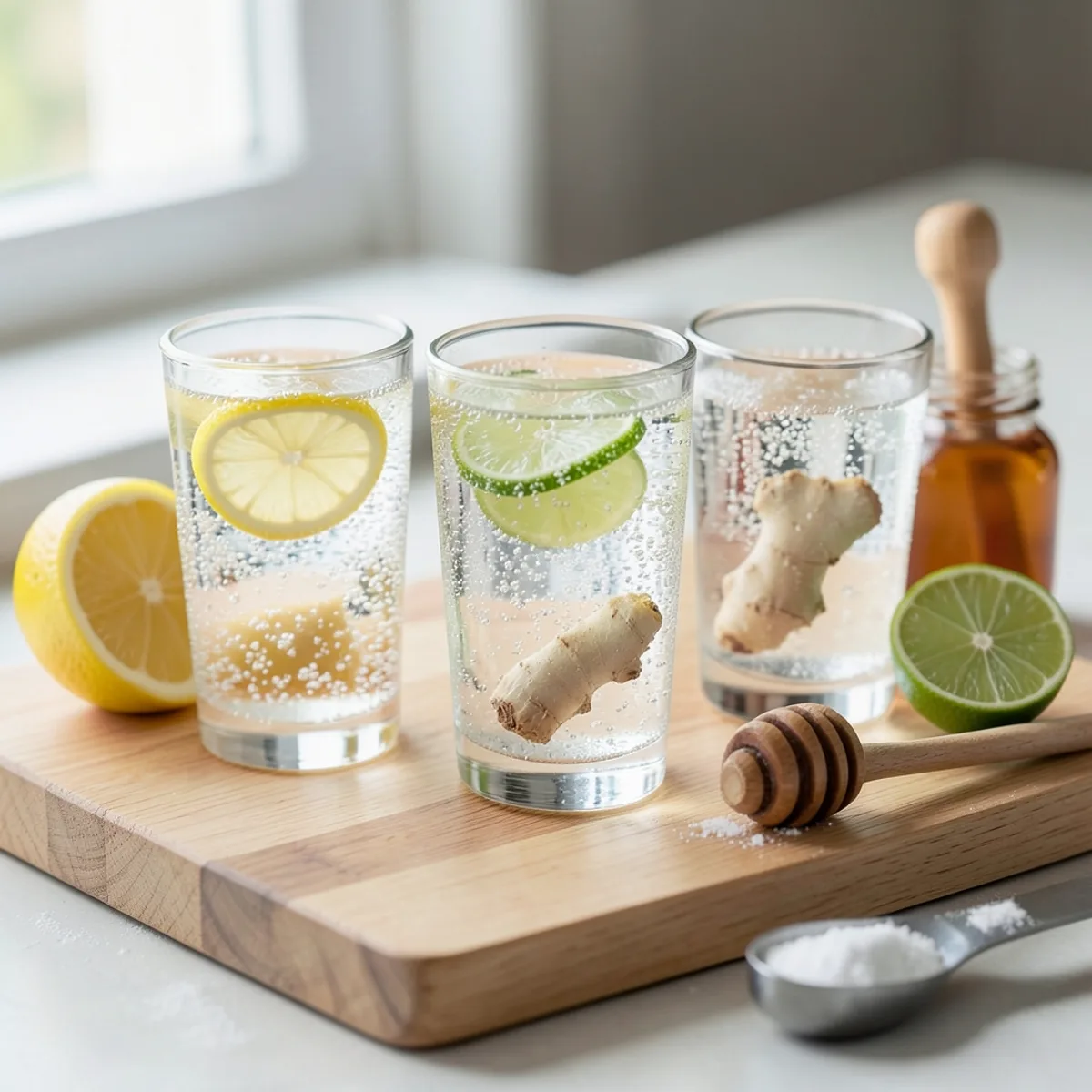
Lemon, lime, honey, ginger, warm or cold: what the data shows
This is a comparison of published data, not a taste test or a test of our own. Where a column says "no sourced data", we found nothing to compare. Each add-on is shown for one glass, next to the base glass above.
| Variant | Citric acid or sugar | Calories, sugars | Potassium, sodium added | What it changes |
|---|---|---|---|---|
| Lemon (24 g fresh juice) | 48.0 g/L citric acid; about 1.1 g in 24 g | About 5 kcal, 0.6 g sugars | About 25 mg potassium, about 0.2 mg sodium | Neutralizes up to about 1.5 g bicarbonate |
| Lime (24 g fresh juice) | 45.8 g/L citric acid; no significant difference from lemon | About 6 kcal, 0.4 g sugars | About 28 mg potassium, about 0.5 mg sodium | About the same as lemon; no sourced taste data |
| Bottled juice | About 34 to 39 g/L for bottled lemon, 35.4 g/L for bottled lime | No sourced data | No sourced data | Weaker than fresh, so it neutralizes less |
| Honey (1 tsp, about 7 g) | About 5.7 g sugars | About 21 kcal | About 3.6 mg potassium, about 0.3 mg sodium | Adds sugar and calories; effect on the fizz not sourced |
| Ginger with lemon | No sourced data | No sourced data | No sourced data | No sourced data on effects or amounts |
| Warm vs cold water | Soda dissolves fully at either temperature at this dose | Not applicable | Not applicable | Effect on fizz speed or taste not sourced |
On these numbers lime and lemon are close, so either works at the same 24 g of juice; no taste data was sourced. For the 1/2 teaspoon (2.3 g) dose, use the juice of a whole lemon, about 48 g, so the acid still matches the soda and the sodium stays at about 630 mg.
What the sources say
The citric acid figures come from Penniston and colleagues, published in the Journal of Endourology in 2008. It is a laboratory analysis using ion chromatography, not a trial with people. Each fresh juice was measured on only two samples, lemon at 48.0 g/L and lime at 45.8 g/L, and the difference was not significant (P = 0.35). The bottled concentrates were single samples each, so the finding that bottled juice is weaker is a small-sample result. It tells us what is in the juice, not what the drink does in the body.
The usage directions come from MedlinePlus, a drug information page, not a study. It describes sodium bicarbonate as a treatment for heartburn and acid indigestion, with the powder dissolved in at least 4 oz (120 mL) of water, no more than 2 weeks unless a doctor says so, and not for children under 12 without a doctor. It lists no weight-loss use. Search suggestions mention constipation, reflux and upset stomach, but we found nothing in our sources that supports a claim for any of them.
Common mistakes
Too little juice. A teaspoon of juice cannot use up half a teaspoon of soda. Match the acid to the dose, or stay with 1/4 teaspoon and half a lemon.
Pouring soda onto the juice. The reaction is immediate and the foam can climb the glass. Dissolve the soda in water first.
Baking powder instead of baking soda. Baking powder is a different product and not a substitute. Check the label for sodium bicarbonate alone.
Heaping the spoon. Sodium rises in step with the dose, as the table shows. Level it every time.
Storage and safe use
Mix one glass and drink it. We found no sourced shelf life for the mixed drink, so we do not give one, and batching a pitcher is not covered by any source.
MedlinePlus says to take sodium bicarbonate at least 2 hours apart from other medicines. Because it adds sodium, people with high blood pressure, heart failure, kidney disease or a sodium-restricted diet are told to check first. If any of this applies to you, speak with your doctor or a dietitian before trying it.
Nutrition note
Values on the recipe card are estimates calculated from typical USDA FoodData Central values for raw lemon juice and baking soda, per glass. They are not measured. The glass comes to about 5 kcal, 1.7 g of carbohydrate and 0.6 g of sugars. It holds about 25 mg of potassium and about 315 mg of sodium, nearly all of the sodium from the baking soda. A glass made with lime juice is within a calorie or two of this.
Servings: 1 glass (about 8 fl oz)
Baking Soda and Lemon Water: Ratio, Fizz and Sodium
How much baking soda goes in lemon water, in US and metric measures, why it fizzes, and how many milligrams of sodium each spoonful adds to the glass.
Ingredients
Equipment
- Measuring spoons (a true 1/4 teaspoon, leveled with a knife)
- Long-handled spoon (for stirring without splashing)
Instructions
- Level the soda. Fill a 1/4 teaspoon (1.15 g) with food-grade, aluminum-free baking soda and sweep the top flat with the back of a knife. The spoon should look flush, not mounded.
- Dissolve it in the water. Pour 8 fl oz (240 mL) of water into the glass, add the soda and stir until the water looks clear and no white grains sit on the bottom.
- Add the juice slowly. Pour the juice of half a lemon in a thin stream while stirring gently. Fine bubbles rise and a thin layer of foam forms on the surface.
- Wait for the fizz to stop. Let the glass stand until the bubbles thin out and the surface is nearly still. Still water means the reaction has finished.
- Drink it fresh. Drink the glass in one sitting. Mix a new one each time, since we found no sourced shelf life for the mixed drink.
Notes
Metric amounts are rounded. The 1.15 g figure is 1/4 teaspoon at USDA's household portion of 4.6 g per teaspoon.
Nutrition values are estimates calculated from typical USDA FoodData Central values for raw lemon juice (half a lemon, 24 g) and for baking soda. They are not measured. The calculation uses lemon juice, not lime juice or honey.
Potassium, calculated from USDA lemon juice data: about 25 mg per glass. The recipe card has no potassium field.
Nutrition Facts
Per 1 glass (8 fl oz water, 1/4 tsp baking soda, juice of 1/2 lemon) (estimated)
- Sodium
- 315 mg
- Total Carbohydrate
- 1.7 g
- Sugars
- 0.6 g
Frequently asked questions
When should you drink baking soda and lemon water?
We found no sourced best time of day. The only sourced directions are MedlinePlus antacid directions: dissolve the powder in at least 4 oz (120 mL) of water and keep it 2 hours apart from other medicines. Our recipe has you drink the glass once the fizzing has stopped.
What are the side effects of baking soda and lemon water?
MedlinePlus lists thirst, stomach cramps and gas as mild effects. Baking soda also adds sodium, about 315 mg in this glass, and MedlinePlus says to tell a doctor first if you have high blood pressure, heart failure or kidney disease, or follow a sodium-restricted diet. Acidic drinks and tooth enamel were not covered by our sources.
What can I use instead of baking soda and lemon water?
Lemon juice in plain water skips the bicarbonate and its sodium. By our USDA-based calculation, juice of half a lemon adds about 5 kcal, 0.6 g of sugars and about 25 mg of potassium. Lime juice is a close swap on the numbers, with about 6 kcal and 28 mg of potassium for the same 24 g.
Comments