Baking Powder Instead of Baking Soda in Cookies (Ratio)
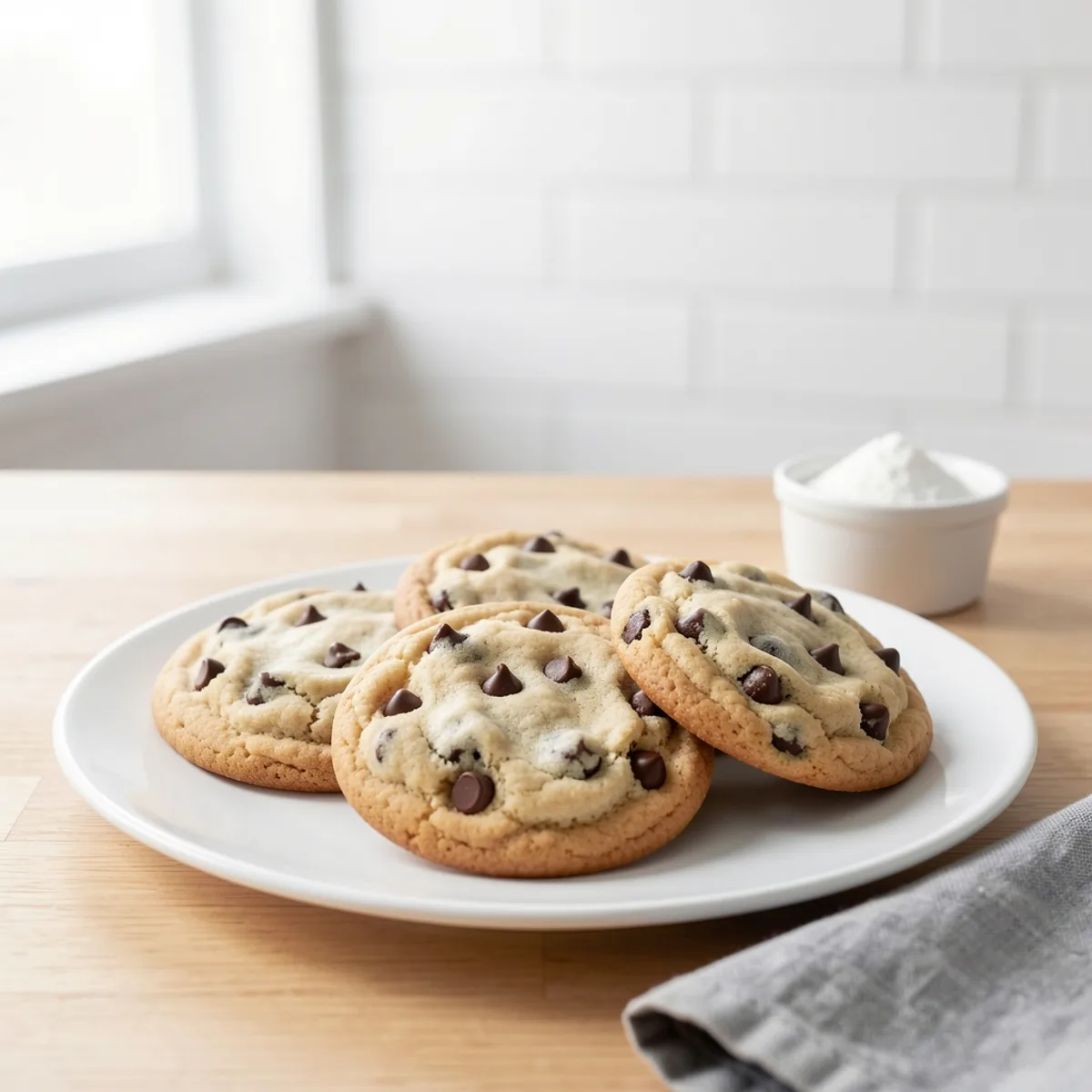
Jump to RecipeA yes-or-no answer, the 3 to 1 swap ratio and why the published rules disagree, plus a chocolate chip cookie adapted from a published recipe that uses baking powder only. A formula, not a bake of our own.
 Save
Jump to:
- So, can you use baking powder instead of baking soda in cookies?
- How much baking powder to use: 3 to 1, 4 to 1, or far less
- The Food Science / Lab Kitchen Note
- Soda, single-acting powder, double-acting powder
- What the published sources actually are
- The formula, and what we changed
- Common mistakes
- Swaps and what changes
- Tips for the dough
- Storing the cookies
- Nutrition note
Treat this as a different cookie, not a copy of your soda cookie. The swap works, and this page gives you the ratio, the reasons behind it, and a full dough written for baking powder only.
Nobody at SodaRecipe has baked this cookie. It's a published formula from Cookie Madness, adapted by us, and every result described below comes from someone else's published test.
So, can you use baking powder instead of baking soda in cookies?
Yes. The cookie that comes out is different, though. Many bakers who swap powder in for soda report the same drift: a puffier, taller, cakier, paler cookie that spreads less and browns less. Bakers who write powder-only recipes on purpose pack them with chips and nuts, or bake hotter, to get color.
Cookie Madness, the source of our formula, quotes the saying that soda spreads and powder puffs. It says a baking-powder-only dough tends toward soft, puffy and pale, which is why the author raised the oven from 350 F to 375 F and loaded the dough with chips and nuts. Chowhound describes it the same way: powder gives lighter, fluffier cookies, soda promotes browning and flatter edges.
This page stays on the powder-only question. For the two leaveners side by side in one dough, see baking soda vs baking powder in cookies. For every other replacement, see baking soda replacement.
How much baking powder to use: 3 to 1, 4 to 1, or far less
Three numbers circulate, and they don't agree.
3 to 1. Bob's Red Mill states the swap as 3 teaspoons of baking powder for every 1 teaspoon of baking soda the recipe calls for. Its page is an editorial article with no cookie recipe, no oven time or temperature and no nutrition. This is the rule to start from, and it matches the one on our baking soda replacement page.
4 to 1. Handle the Heat says about 1 tsp of baking powder raises 1 cup of flour, against about 1/4 tsp of baking soda. That is a lift-only rule, and it is 4 to 1. It's a rule about rising, not about spread or browning, and the same page advises against swapping in recipes that rely on soda for browning or spread.
Far less. The published powder-only formulas use much less than either rule would suggest. Cookie Madness uses 1 tsp of baking powder for 380 g of flour. By our math that is about 1/3 tsp per cup of flour, about a third of the 1 tsp per cup in the lift-only rule. Taste of Home's Chunky Drop Cookies use 3/4 tsp of baking powder for 2 1/2 cups of flour, with no soda.
So treat 3 to 1 as a starting point. If a recipe has 1 tsp of soda for 3 cups of flour, 3 tsp of powder is a lot, and the published powder-only recipes suggest you may want less. The sources don't settle where the right amount sits for a given dough.
The Food Science / Lab Kitchen Note
According to Handle the Heat, baking soda is pure sodium bicarbonate. It needs an acid in the recipe, like buttermilk, lemon juice or brown sugar, to release carbon dioxide. Baking powder contains baking soda plus a dry acid, usually cream of tartar or tartaric acid, and a little cornstarch to keep it dry.
Brown sugar is among the acids that Handle the Heat and Bob's Red Mill name. No source we opened puts a number on that acid, so we don't either. Bob's Red Mill also says cookies that rely heavily on acidic ingredients are not the best candidates for replacing baking soda.
Handle the Heat says most U.S. baking powders are double-acting and that single-acting powders react only once when wet. Tasty's panel scored single-acting and double-acting powder in cookies, but no source gives a measurement.
Now the arithmetic, which is ours. Our dough has 380 g of flour and 1 tsp of powder. At the Handle the Heat lift-only rate of 1 tsp per cup, 3 cups of flour would take about 3 tsp, so our dough sits at about a third of that. The 3 to 1 rule needs a soda amount to start from, and this dough has none.
On sodium, the leaveners are a minor share here. By our math, 1 tsp of salt at about 6 g carries roughly 39 mg of sodium per cookie over 60 cookies, and the powder about 8 mg. These come from typical USDA values and our weight estimates.
Soda, single-acting powder, double-acting powder
This table compares published data, not our bakes. Where no source gives a value, the cell says so.
| Variant | Tasty panel score (five batches, same amount of leavener) | Handle the Heat (its own cookie) | Chowhound |
|---|---|---|---|
| Baking soda | No sourced data | Recipes that rely on soda for browning and spread should not be swapped | Promotes browning and flatter edges |
| Single-acting baking powder | 3 out of 10: much cakier than expected, too much air, no chew | Not stated in our sources | Not stated in our sources |
| Double-acting baking powder | 2 out of 10: very pale, little spread, overly cakey, not chewy | Not stated in our sources | Not stated in our sources |
Handle the Heat tested the leaveners in its own Bakery Style Chocolate Chip Cookie recipe. The powder-only batch was extra thick and tall, not chewy, more fluffy and not quite as flavorful, and it did not brown or spread as much. Chowhound describes baking powder as giving lighter, fluffier cookies. No source gives pH, spread diameter or height for any of the three variants.
What the published sources actually are
No peer-reviewed study of baking powder versus baking soda and cookie spread turned up in our search. What exists is informal testing, and we call it that. Tasty ran a published five-batch side-by-side test on the classic Nestle Toll House chocolate chip dough, changing only the leavener and keeping the amount the same across batches. It doesn't state the quantities or the number of tasters, so it's a panel test, not a measurement. Handle the Heat is a single-author blog test of its own recipe, and it doesn't give the leavener amounts per batch either.
The other sources are not tests at all. The Bob's Red Mill page is an editorial article that states the 3 to 1 rule without showing a bake. Cookie Madness and Taste of Home are published recipes, not experiments: they show that powder-only cookies are made and what amounts their authors chose. Because of all this, treat every number on this page as a starting point for your own bake.
The formula, and what we changed
The dough is Cookie Madness's Big Batch Triple Chip Cookies, adapted. We kept its flour, baking powder, salt, butter, sugars, eggs and vanilla, with its weights, its 375 F oven, its 12 to 15 minutes and its 5-minute rest on the sheet. The original loads the dough with 1 cup of bittersweet chips, 1 cup of extra dark chips, 1 cup of white chips and 1 cup of toasted chopped pecans.
Our adaptation drops the white chips and the pecans and uses 3 cups of chocolate chips only. That changes the mix-in weight and type from the source, so treat the texture and browning as unknown. The chip weights are our estimate, because the source doesn't give them.
Common mistakes
Tripling by heaped spoon. Three heaped teaspoons of powder is far more than three level ones, and the published powder-only recipes use much less anyway. Level the spoon, and weigh 4.6 g per teaspoon if you use a scale. That weight is our estimate.
Expecting the same spread. Powder puffs and soda spreads, so expect a taller, paler cookie than a soda cookie.
Using old powder. Handle the Heat says it's best to use both leaveners within about 6 to 12 months once opened. If the cookies come out flat and dense, check the date on the tin before you blame the recipe.
Swaps and what changes
| Original | Replacement | Proportion | What changes |
|---|---|---|---|
| Baking soda | Baking powder | 3 tsp per 1 tsp soda (Bob's Red Mill); 4 to 1 for lift only (Handle the Heat); published powder-only recipes use far less | Paler, puffier, less spread. A starting point, not a fixed rule. |
| Baking soda | Potassium bicarbonate | 1 tsp for 1 tsp (Bob's Red Mill) | Harder to find. No cookie data in our sources. |
| Salted butter | Unsalted butter | Salt: 1 tsp, or 1/2 tsp with salted butter (Cookie Madness) | Salt level only. |
For longer lists of replacements, see baking soda replacement.
Tips for the dough
Weigh the flour: the 380 g is the source's weight, and a cup scooped by hand can differ.
Whisk the powder into the flour first. 1 tsp for 380 g of flour is the source's amount, even though it looks like too little leavener.
Portion by weight if you want 60 cookies. A generous scoop gives you fewer, bigger cookies.
Storing the cookies
No storage time is sourced for this cookie.
As a labeled benchmark only, Taste of Home gives these times for a different baking-powder-only cookie: airtight at room temperature up to 4 days, refrigerated up to a week, frozen up to 2 months, either as baked cookies or as unbaked dough balls. Don't read those as a promise for our dough.
Nutrition note
The numbers on the card are our calculation from typical USDA FoodData Central values, for one cookie at a yield of 60, assuming unsalted butter and double-acting baking powder. The source page gives no nutrition, so these are estimates.
Servings: 60 cookies
Baking Powder Instead of Baking Soda in Cookies (Ratio)
A yes-or-no answer, the 3 to 1 swap ratio and why the published rules disagree, plus a chocolate chip cookie adapted from a published recipe that uses baking powder only. A formula, not a bake of our own.
Ingredients
Dough
Mix-ins (our adaptation)
Equipment
- Kitchen scale (for the flour, sugars, butter and chips)
- Level measuring spoons (for the baking powder and salt)
- Large mixing bowl
- Baking sheets and parchment
- Medium cookie scoop (optional; see the yield note)
Instructions
Make the dough
- Preheat the oven. Heat the oven to 375 degrees F (190 C) and line baking sheets with parchment.
- Whisk the dry ingredients. Whisk the flour, the baking powder and the salt together until no clumps of powder remain. There is no baking soda in this dough.
- Cream the butter and sugars. Beat the softened butter with the granulated sugar and the brown sugar until the mixture is combined and smooth.
- Add the eggs and vanilla. Beat in the eggs one at a time, then the vanilla, until the mixture looks uniform.
- Stir in the flour and chips. Add the dry ingredients and stir just until no dry streaks remain, then fold in the chocolate chips. Chilling the dough is optional, according to the source.
- Portion the dough. The dough weighs roughly 1,630 g in total (our math), so 60 cookies come out at about 27 g each. A generous medium scoop makes fewer, bigger cookies: the source says at least 40.
Bake
- Bake the cookies. Bake at 375 degrees F (190 C) for 12 to 15 minutes, the range from the source recipe. Start checking at the low end.
- Cool on the sheet. Let the cookies cool on the baking sheet for 5 minutes, then move them to a rack.
Notes
Formula source: adapted from Big Batch Triple Chip Cookies by Cookie Madness (https://www.cookiemadness.net/2012/07/04/big-batch-triple-chip-cookies). The flour, baking powder, salt, butter, sugars, eggs, vanilla, weights, oven temperature, bake time and 5-minute rest come from that page. Nobody at SodaRecipe has baked this cookie.
Our adaptation: the source uses 1 cup bittersweet chips, 1 cup extra dark chips, 1 cup white chips and 1 cup toasted chopped pecans. We list 3 cups of chocolate chips only, with no white chips and no pecans. The chip weights are our estimate. The vanilla, salt and baking powder weights are also our estimates.
Yield: the source card says 60 cookies, and says a generous medium scoop gives at least 40. We use 60 throughout, which works out to about 27 g of dough per cookie by our math. Nutrition is per cookie at 60.
Nutrition values are our calculation from typical USDA FoodData Central values, using unsalted butter, enriched all-purpose flour, semi-sweet chocolate chips, large eggs, table salt and double-acting sodium aluminum sulfate baking powder. The source page gives no nutrition. These are estimates, not measurements.
Nutrition Facts
Per one cookie (1 of 60), our calculation (estimated)
- Total Fat
- 5.9 g
- Saturated Fat
- 3.6 g
- Sodium
- 52 mg
- Total Carbohydrate
- 16.1 g
- Dietary Fiber
- 0.7 g
- Sugars
- 10.2 g
- Protein
- 1.3 g
Frequently asked questions
When is it fine to swap baking powder for baking soda in cookies?
It works if you accept a puffier, paler cookie, as the published powder-only recipes do. Handle the Heat advises against the swap in recipes that rely on soda for browning or spread.
What happens to cookies if you use baking powder instead of baking soda?
Published tests and many bakers report paler, taller, cakier cookies that spread and brown less. Level the spoon when you measure the powder.
Will cookies spread without baking soda?
Less than with soda. Cookie Madness quotes the saying that soda spreads and powder puffs, and raised its oven from 350 F to 375 F to get more browning.
What else can replace baking soda in cookies besides baking powder?
Bob's Red Mill says to swap 1 tsp of baking soda for 1 tsp of potassium bicarbonate, though it is harder to find. The full list of options is on our baking soda replacement page.

Jimmy Blair spent years in pastry kitchens and lives in Brooklyn, New York. He covers SodaRecipe’s pancakes, cookies, cakes and other sweet bakes.

Comments