How Much Baking Soda in Water? Dose Chart by Use
Jump to RecipeLabel dose, daily maximum by age, minimum water volume and sodium per spoonful, in one dose chart by use, plus the limits and who should skip it.
 Save
SaveJump to:
Baking soda in water is the same thing as a plain antacid powder, and the advice online often mixes doses without saying where they come from. This page puts the sourced numbers in one chart: what the label says, how much water it needs, and how much sodium each spoonful adds. If you came for weight loss, our baking soda recipe for weight loss and does baking soda help you lose weight cover what the research does and doesn't show.
Dose chart by use
Everything in this chart comes from a label, a drug information page or our own arithmetic, and each row says which. We measured nothing ourselves.
| Use | Baking soda | Water | Sodium (our calculation) | Source and limit |
|---|---|---|---|---|
| Antacid label dose | 1/2 tsp (2.3 g) | 1/2 glass, 4 fl oz (120 mL) | About 630 mg | Arm & Hammer label: dissolve completely, every 2 hours or as a physician directs |
| Our glass | 1/4 tsp (1.15 g) | 8 fl oz (240 mL) | About 315 mg | Our recipe, half the label dose; not a medical rule |
| Minimum water | Any dose | At least 4 fl oz (120 mL) | Not applicable | MedlinePlus |
| Daily maximum, adults 60 and under | Seven 1/2 tsp (about 16.1 g) | Spread over 24 hours | About 4,410 mg | Arm & Hammer label; not for more than 2 weeks at the maximum |
| Daily maximum, over 60 | Three 1/2 tsp (about 6.9 g) | Spread over 24 hours | About 1,890 mg | Arm & Hammer label |
| Children | No sourced dose | No sourced dose | No sourced data | MedlinePlus: not under 12 unless a doctor says so; the label says not under 5 |
| Pretzel or bagel bath | 2 tbsp (28 g) | 1 cup (227 g) boiling water, cooled to lukewarm | Not a drink, no sourced data | King Arthur pretzel recipe; bagel ratio not sourced |
The gram weights and sodium figures in the daily maximum rows are our multiplication of the label's spoon counts at 4.6 g per teaspoon. The label itself gives no grams and no sodium.
How much baking soda dissolves in water is a separate question, and we found no sourced figure for it, so the chart gives none. For infants there is no sourced data either, and the only age limits we found are the ones in the chart.
The Food Science / Lab Kitchen Note
Baking soda is sodium bicarbonate. Stomach acid is an acid, so when the two meet, the bicarbonate neutralizes some of it and gives off carbon dioxide gas. That's why the powder works as an antacid, and why the gas is the catch. The Journal of Eating Disorders review describes gas from bicarbonate reacting with stomach acid as a possible trigger when the stomach is already stretched.
Dilution is the other half of the rule. MedlinePlus says to dissolve the powder in at least 4 ounces (120 milliliters) of water. Our 8 fl oz (240 mL) glass is simply our recipe, double that minimum for half the label dose. It is not a medical threshold.
Sodium is the number most pages skip. USDA FoodData Central lists baking soda at 27,360 mg of sodium per 100 g, as mirrored by getfoodfacts.com. At 1.15 g for 1/4 tsp we calculate about 315 mg, and at 2.3 g for 1/2 tsp about 630 mg. As a cross-check, a Kroger-brand label lists 160 mg of sodium in 1/8 tsp (0.6 g), 7% of the Daily Value, which doubles to about 320 mg for 1/4 tsp.
How much sodium each spoonful adds
The FDA gives a Daily Value for sodium of less than 2,300 mg per day, and the Dietary Guidelines recommend that adults limit sodium to less than 2,300 mg. The FDA also says Americans eat about 3,400 mg per day on average, and limits for children under 14 are lower. By our arithmetic against 2,300 mg:
| Dose | Sodium | Share of 2,300 mg |
|---|---|---|
| 1/4 tsp (1.15 g) | About 315 mg | About 14% |
| 1/2 tsp (2.3 g) | About 630 mg | About 27% |
| Three 1/2 tsp (label maximum over 60) | About 1,890 mg | About 82% |
| Seven 1/2 tsp (label maximum, adults 60 and under) | About 4,410 mg | About 192% |
That sodium arrives on top of whatever else you eat. The label maximum for adults is a ceiling for treating indigestion, not a target.
Three doses compared (data only)
This is a comparison of published and calculated data, not a taste test or a trial of our own. Where a cell says "no sourced data," we found nothing to put there.
| Label dose | Our glass | Pretzel bath | |
|---|---|---|---|
| Baking soda | 1/2 tsp (2.3 g) | 1/4 tsp (1.15 g) | 2 tbsp (28 g) |
| Liquid | 4 fl oz (120 mL) water | 8 fl oz (240 mL) water | 1 cup (227 g) boiling water, cooled |
| Concentration | About 2.3 g per 120 mL, our division | About 1.15 g per 240 mL, our division | About 28 g per 227 g |
| Sodium | About 630 mg | About 315 mg | No sourced data |
| Purpose | Antacid (MedlinePlus) | Our recipe, not a medical rule | Dipping dough 2 minutes before baking |
| Drink it? | Yes, fully dissolved | Yes, fully dissolved | No |
The pretzel bath is the only culinary ratio with a source, from King Arthur Baking's Hot Buttered Soft Pretzels. It is far stronger than anything you'd drink, which is why it never belongs in a glass.
The sports dose is a different thing and sits on its own line. The ISSN position stand names 0.3 g per kilogram of body weight as the optimal single dose for exercise performance and 0.2 g/kg as the minimum effective dose, taken 60 to 180 minutes before exercise. At 70 kg that is 14 to 21 g, about 12 to 18 times our 1/4 tsp. It is an athletic protocol, not a kitchen dose, and not equivalent to anything in the tables above.
What the sources say
Start with the strongest warning. A 2022 paper in the Journal of Eating Disorders reported two case studies and reviewed 36 published cases of spontaneous gastric rupture. Ten of the 36 involved sodium bicarbonate, and overall mortality was 41.6%. The setting was mostly binge eating, so it's a warning about large amounts on a very full stomach. It is a case review, not a trial, and it can't tell you a threshold for a normal glass.
On the other end, a 2008 case report describes a single patient: a man with severe metabolic alkalosis who took 10 to 15 g of baking soda daily for about 40 years, rising to more than 50 g daily. He also had seizures, rhabdomyolysis and end-stage renal failure, though the authors judged baking soda alone unlikely to have caused the kidney failure. One patient is not a dose benchmark. The 2021 ISSN position stand, a consensus statement, lists bloating, nausea, vomiting and abdominal pain as the most common side effects at sports doses and says part of the performance effect seems placebo-driven.
The usage directions come from MedlinePlus, a drug information page rather than a study. It describes sodium bicarbonate as an antacid for heartburn and acid indigestion and gives no specific dose amounts, which is why the amounts in this chart come from the manufacturer label.
Common mistakes
Skipping the stir. Undissolved powder is the usual slip. The label says not to drink it until it has completely dissolved.
Taking a "shot." Concentrated versions skip the dilution rule. Keep the water at 4 fl oz (120 mL) or more.
Taking it on a full stomach. The label says not to take it when overfull from food or drink, and the review above explains why.
Reaching for baking powder. Baking powder is a different product and not a substitute. Check that the label says baking soda or sodium bicarbonate alone, food-grade and aluminum-free.
Storage and safe use
Mix one glass and drink it. We found no sourced shelf life for the mixed drink, so we don't give one. If you want a flavored version, our baking soda and lemon water and baking soda and apple cider vinegar pages show the ratios and the sodium. For timing, see best time to drink baking soda water, and for the full list of effects, baking soda side effects.
Nutrition note
Values on the recipe card are estimates calculated from typical USDA FoodData Central values for baking soda, per glass, not measured. The glass is water and 1/4 tsp of baking soda, so calories, carbohydrate, protein, fat, sugars and fiber are all zero. The only number that moves is sodium, about 315 mg.
Servings: 1 glass (about 8 fl oz)
How Much Baking Soda in Water? Dose Chart by Use
Label dose, daily maximum by age, minimum water volume and sodium per spoonful, in one dose chart by use, plus the limits and who should skip it.
Ingredients
Equipment
- Measuring spoons (a true 1/4 teaspoon, leveled with a knife)
- Clear glass and spoon (so you can see when no white grains are left)
Instructions
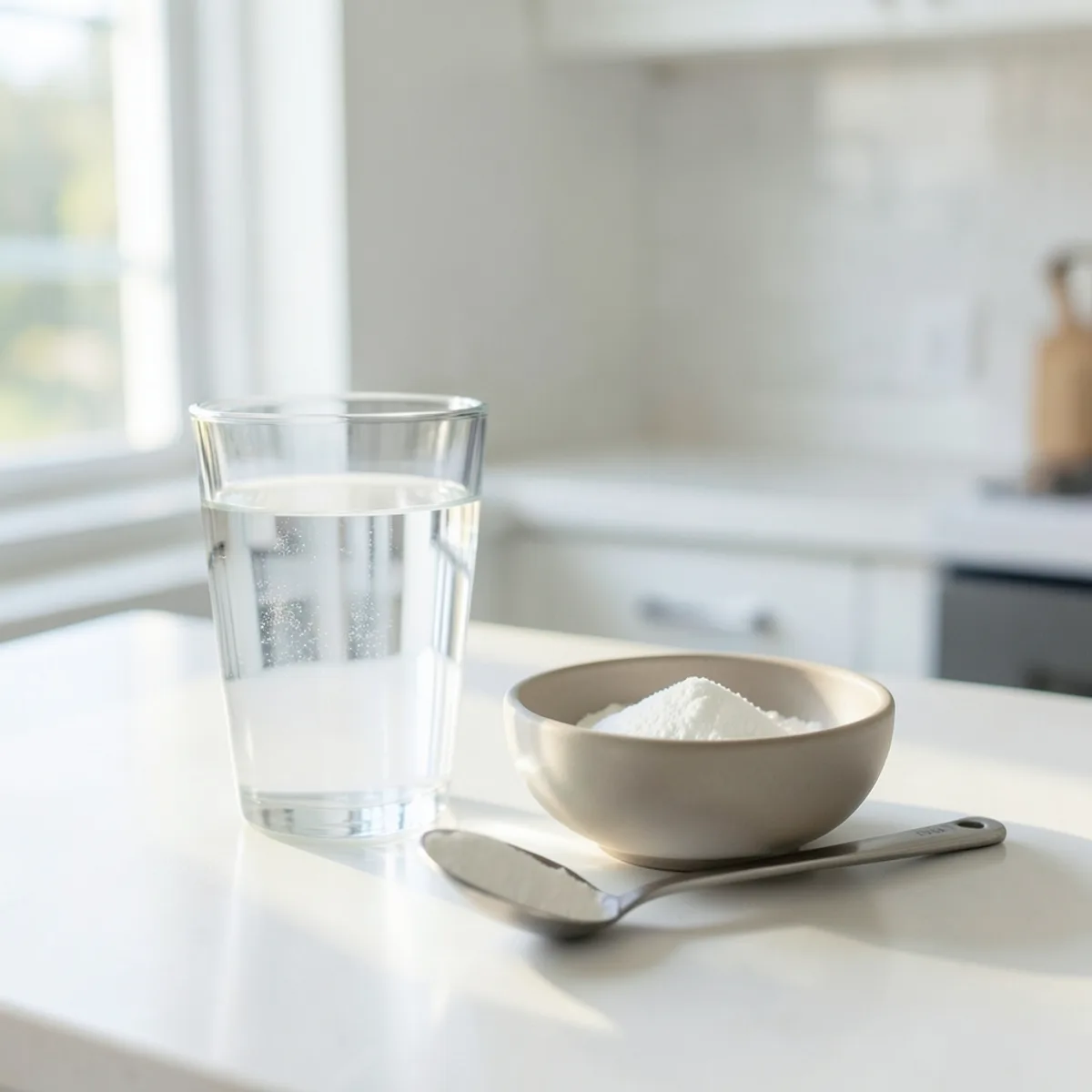
- Level the soda. Fill a 1/4 teaspoon (1.15 g) with food-grade, aluminum-free baking soda and sweep the top flat with the back of a knife. The spoon should look flush, not mounded.
- Pour the water first. Pour 8 fl oz (240 mL) of water into a clear glass. Do not go below 4 oz (120 mL), which is the minimum MedlinePlus gives for dissolving the powder.
- Stir until fully dissolved. Add the soda and stir until the water looks clear and no grains sit on the bottom. The manufacturer label says not to drink it until the powder is completely dissolved.
- Sip it, don't shoot it. Drink the glass slowly, not on an overfull stomach. Mix a fresh glass each time, since we found no sourced shelf life for the mixed drink.
Notes
Metric amounts are rounded. The 1.15 g figure is 1/4 teaspoon at 4.6 g per teaspoon, a household weight taken from USDA-based nutrition mirrors, not from an opened USDA page.
Nutrition values are estimates calculated from typical USDA FoodData Central values for baking soda (27,360 mg of sodium per 100 g). They are not measured. The glass is water and baking soda only, so everything except sodium is zero.
Nutrition Facts
Per 1 glass (8 fl oz water, 1/4 tsp baking soda) (estimated)
- Total Fat
- 0 g
- Saturated Fat
- 0 g
- Sodium
- 315 mg
- Total Carbohydrate
- 0 g
- Dietary Fiber
- 0 g
- Sugars
- 0 g
- Protein
- 0 g
Frequently asked questions
When should you drink baking soda water?
MedlinePlus says that for heartburn you take it 1 to 2 hours after meals, with a full glass of water. It also says to keep it at least 2 hours apart from other medicines.
What are the side effects of drinking baking soda in water?
MedlinePlus lists increased thirst, stomach cramps and gas as effects to report if severe. Baking soda also adds sodium, about 315 mg in 1/4 tsp by our calculation, and the Arm & Hammer label says not to take it when overfull from food or drink.
How much baking soda is too much in a day?
The Arm & Hammer antacid label says no more than seven 1/2 teaspoons in 24 hours, or three if you are over 60, and not at the maximum dose for more than 2 weeks. Those are label limits for an antacid, not a daily habit.
How much baking soda goes in water for pretzels or bagels?
King Arthur's pretzel bath is 2 tablespoons (28 g) of baking soda in 1 cup (227 g) of boiling water, cooled to lukewarm, and that bath is for dipping dough, not drinking. We found no sourced bagel ratio, only forum comments that disagree.

Sana Nikia cooks fresh, balanced food in Austin, Texas, with flavor first and no diet rules. She covers SodaRecipe’s baking soda drinks.
Comments