Baking Soda and Vaseline for Men: What the Evidence Says
Jump to RecipeA viral trick pairs baking soda with petroleum jelly and promises a boost for men. Here is what the sources say about it, and a separate measured glass of baking soda water.
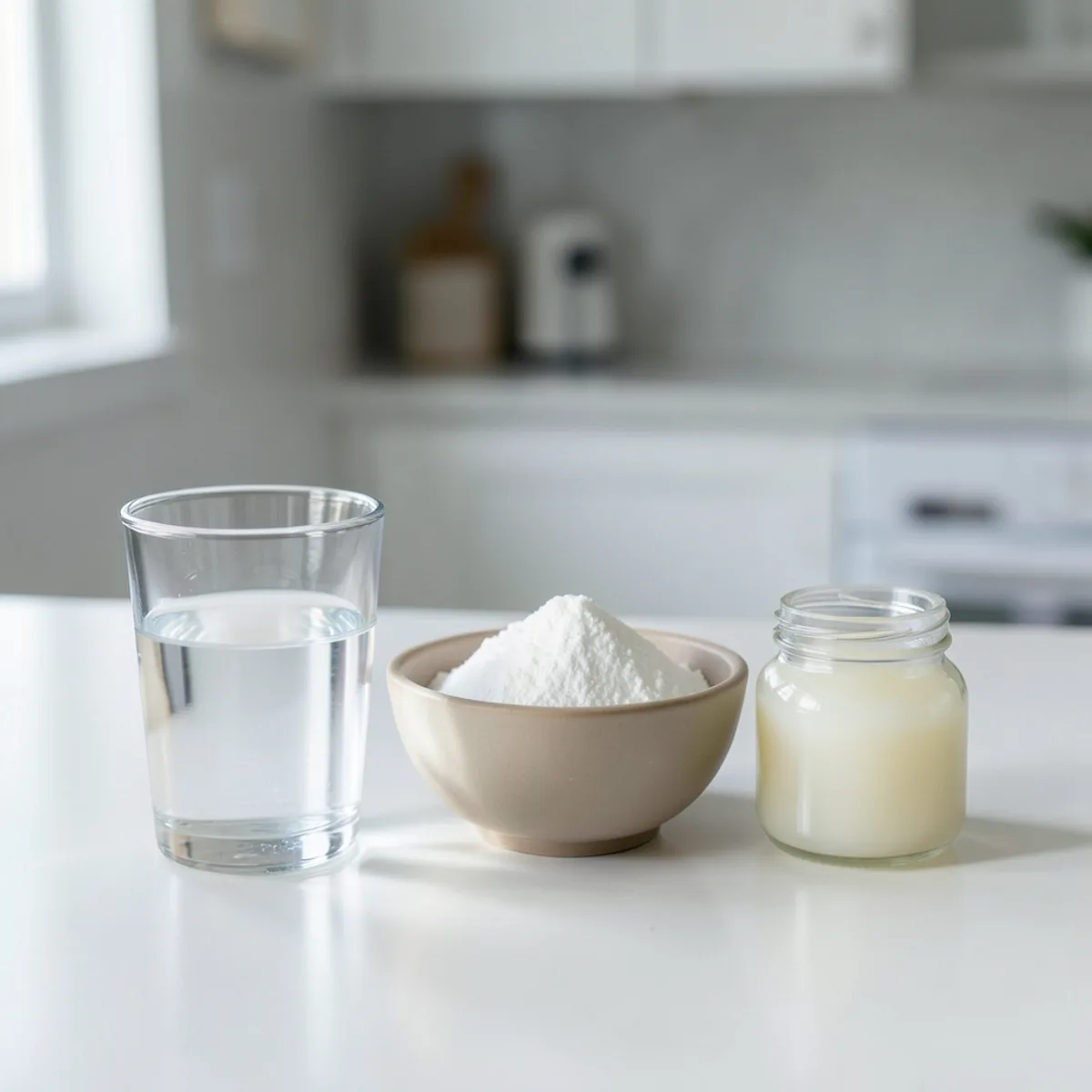 Save
Jump to:
Here's where this one goes wrong first: a viral ad recipe says two kitchen items, mixed and applied, change something about men's bodies. No study we found looked at that mix in people. This page checks the claim against the sources we could open, then gives you a separate, plain glass of baking soda water for anyone who wants a measured one. It has nothing to do with the viral mix.
What the baking soda and Vaseline trick claims
Search the phrase and the promise is vague: a paste of baking soda and petroleum jelly, or a baking soda drink, is said to boost size or performance. This page won't supply amounts or steps for it.
"Vaseline" is only the search term here. In the rest of this page, we use the generic name, petroleum jelly.
The Food Science / Lab Kitchen Note
Baking soda is sodium bicarbonate. Its pH is about 9, according to Acne.org, a consumer skin site and a secondary source. The same page puts skin at about 5.5.
Sodium is the number that matters for the glass. Two secondary pages, a commercial wellness page and a physician-reviewed health service, both state about 1,260 mg of sodium per teaspoon of baking soda. Our calculation, not a source figure: 1,260 divided by 4 is about 315 mg of sodium in 1/4 tsp (1.15 g). The FDA sets the sodium Daily Value at less than 2,300 mg a day and says Americans eat roughly 3,400 mg a day on average. So the glass is about 14% of 2,300 mg, since 315 divided by 2,300 is about 0.137.
The Arm & Hammer antacid label says to dissolve 1/2 teaspoon in a 1/2 glass (4 oz) of water, repeat every 2 hours or as a physician directs. Our glass uses half that powder in twice the water. It's a smaller dose than the label's single dose, and it's our recipe, not a medical dose.
Three versions, compared on sourced data
This is a comparison of published data, not a trial of our own. Where nothing is sourced, the cell says so.
| Viral mix, applied | Shower version | Measured baking soda glass | |
|---|---|---|---|
| What it claims | Boosts size or performance | Same claim, in the shower | Plain glass, not the viral mix |
| Human study | no sourced data | no sourced data | Not applicable; antacid label directions |
| Closest evidence | One 2019 skin trial of baking soda on psoriasis found no benefit (via Acne.org) | no sourced data | Label directions; sodium from published figures |
| Risks named by a source | Alkaline skin pH, per Acne.org; weakened latex condoms, per Healthline | no sourced data | Alkalosis and other effects from misuse, per a 2013 review |
| Sodium | Not applicable | Not applicable | About 315 mg, about 14% of 2,300 mg (our calculation) |
The baking soda trick for men in the shower
A second version of the claim moves the same mix into the shower, sometimes as a rinse or a soak. We found no credible source for it. No study, no label and no health agency describes it, so there's nothing sourced to say about what it does or how long to leave anything on.
What we can say is limited to the ingredients. Baking soda is alkaline against skin, and the Acne.org summary says raising skin pH may impair the skin barrier and that baking soda is abrasive. That page speaks about skin and face in general, not about any other part of the body. Treat it as a general caution, nothing more.
Other viral tricks follow the same pattern of big promises and thin sources. See the baking soda trick, the baking soda horse trick and Vicks and baking soda.
What the sources actually show
Skin pH and petroleum jelly
On skin, the evidence is thin. Acne.org cites a 2019 randomized study, Mazzarello and colleagues, of sodium bicarbonate on plaque psoriasis that found no benefit. We read only that summary, so we can't give you the number of people in it, and psoriasis is not what this trick is about. It's the closest skin trial we found.
On petroleum jelly, Healthline says it is incompatible with latex and will weaken latex condoms, which may then break or tear. It also says petroleum jelly stays in the body longer than other lubricants and advises avoiding it for sex when possible. Healthline cites no study for this point, and we found no agency source repeating it, so read it as one consumer health site's advice.
The swallowing risks
The best-documented risks are about drinking, not applying. Al-Abri and Olson, Journal of Medical Toxicology, 2013 is a case presentation plus narrative review, built around one patient with long daily baking soda use. It reports metabolic alkalosis, low potassium, high sodium, irregular heart rhythms, muscle twitching and seizures, kidney failure in one long-term user, and gastric rupture from carbon dioxide. It says one teaspoon holds about 59 mEq of sodium and of bicarbonate. A single patient and a review can show what's possible, not how often it happens, and it proves nothing about the viral mix. For the wider list of effects, see baking soda side effects.
The sports dose is a different thing
Some pages borrow the sports idea to make baking soda sound serious. The ISSN position stand is a consensus statement for athletes. It names 0.2 g/kg as the minimum effective single dose and 0.3 g/kg as optimal, taken 60 to 180 minutes before exercise, and lists bloating, nausea, vomiting and abdominal pain as common side effects. For a 70 kg adult, 0.2 to 0.3 g/kg is about 14 to 21 g (our arithmetic), against 1.15 g in our glass. The two aren't equivalent, and the sports figure is never the dose for this recipe.
Sold products and hidden drugs
Another risk has nothing to do with baking soda. In an FDA public notification issued January 19, 2021, the agency said a product sold for sexual enhancement contained undeclared tadalafil and sildenafil, the active ingredients of prescription drugs. The notice says these may interact with nitrates and may lower blood pressure to dangerous levels. We aren't naming the product. The point is that a "natural" kitchen trick is often followed by an ad for something sold.
Ubie Doctor's Note, a health information service reviewed by an internal medicine physician, calls the baking soda trick for men unproven and potentially dangerous. It says relying on it can delay diagnosis of heart disease, diabetes or hormonal disorders. That's a publisher's opinion, not a trial. Still, the delay point is worth keeping in mind.
Common mistakes
Heaping the spoon is the first one. Sodium rises with every extra grain, so level it with a knife.
The second is treating the glass as a stand-in for the viral mix, or the reverse. They share one ingredient and nothing else. Keep the jar of petroleum jelly away from the glass, the spoon and the counter where you mix.
The third is drinking it when you're overfull or alongside medicines. Antacid directions say not to, and MedlinePlus says to keep 2 hours between it and other medicines.
Substitutes and swaps
| Original | Swap | Proportion | What changes |
|---|---|---|---|
| Baking soda | Baking powder | Not a substitute | A different product, so the drink isn't the same thing |
| Baking soda | Plain water | Not applicable | No added sodium; the option for a sodium-restricted diet |
| 8 fl oz (240 mL) water | 4 fl oz (120 mL) water | no sourced proportion for 1/4 tsp | 120 mL is the MedlinePlus minimum for antacid use; the glass becomes stronger |
| Petroleum jelly | Any other lubricant | no sourced data | Not covered by our sources; a clinician or pharmacist can advise |
Storage and handling
Mix one glass and drink it. We found no sourced shelf life for baking soda water, so mix it fresh and pour out what's left.
Nutrition note
Values on the recipe card are estimates calculated from typical USDA FoodData Central values for baking soda and plain water, per glass. They aren't measured. The glass carries 0 kcal and about 315 mg of sodium, about 14% of 2,300 mg (our calculation). For other amounts, see how much baking soda in water and how much sodium is in baking soda water.
Servings: 1 glass (about 8 fl oz)
Baking Soda and Vaseline for Men: What the Evidence Says
A viral trick pairs baking soda with petroleum jelly and promises a boost for men. Here is what the sources say about it, and a separate measured glass of baking soda water.
Ingredients
Equipment
- Measuring spoons (a true 1/4 teaspoon, leveled with a knife)
- Long-handled spoon (for stirring until the water is clear)
Instructions
- Level the soda. Fill a 1/4 teaspoon (1.15 g) with food-grade, aluminum-free baking soda and sweep the top flat with the back of a knife. The spoon should look flush, not mounded.
- Pour the water first. Pour 8 fl oz (240 mL) of plain water into a clean glass before adding anything, so the powder has room to dissolve.
- Stir until dissolved. Add the soda and stir until the water looks clear and no white grains sit on the bottom. Nothing else goes in this glass.
- Drink it fresh. Drink the glass in one sitting, and not when you're overfull from food or drink. Mix a new glass each time, since we found no sourced storage time.
Notes
This card is a plain baking soda glass. It is not the viral mix and contains no petroleum jelly or any other ointment.
Metric amounts are rounded. The 1.15 g figure is the weight we use for 1/4 teaspoon.
Nutrition values are estimates calculated from typical USDA FoodData Central values for baking soda and plain water. They are not measured. Sodium is our arithmetic from about 1,260 mg per teaspoon.
The 8 fl oz (240 mL) of water is our recipe, not a medical rule. MedlinePlus gives at least 4 oz (120 mL) for antacid use.
Nutrition Facts
Per 1 glass (8 fl oz water, 1/4 tsp baking soda) (estimated)
- Total Fat
- 0 g
- Saturated Fat
- 0 g
- Sodium
- 315 mg
- Total Carbohydrate
- 0 g
- Dietary Fiber
- 0 g
- Sugars
- 0 g
- Protein
- 0 g
Frequently asked questions
When should you drink the baking soda glass from this page?
We found no sourced time of day for any goal, and none for the viral mix. The antacid label says not to take baking soda when you're overfull from food or drink, and MedlinePlus says to keep 2 hours between it and other medicines.
What are the side effects of the baking soda and petroleum jelly mix?
We found no study of the mix, so no source describes its effects. For swallowed baking soda, a 2013 case report and review lists metabolic alkalosis, low potassium, high sodium, irregular heart rhythms and seizures, and the sports position stand lists bloating, nausea, vomiting and abdominal pain.
What can you do instead of the baking soda trick for men?
Plain water adds no sodium, which matters on a sodium-restricted diet. For a concern about size, performance or stamina, a doctor can check for causes, and Ubie says relying on the trick can delay a diagnosis.
Is there a baking soda trick for men in the shower that works?
We found no credible source or study for a shower version. It is the same claim in a different setting, and the same gaps apply.

Steven Dony trained in a restaurant kitchen and lives in Nashville, Tennessee. He covers SodaRecipe’s fact-checks: what works, what does not, and why.
Comments