Baking Soda Burger Patties: Dose, Rest Time and Texture
Jump to RecipeA fact-check of baking soda in formed hamburger patties: the dose per pound, the rest, the 160 F check, what a student study found on flavor, and the sodium per patty.
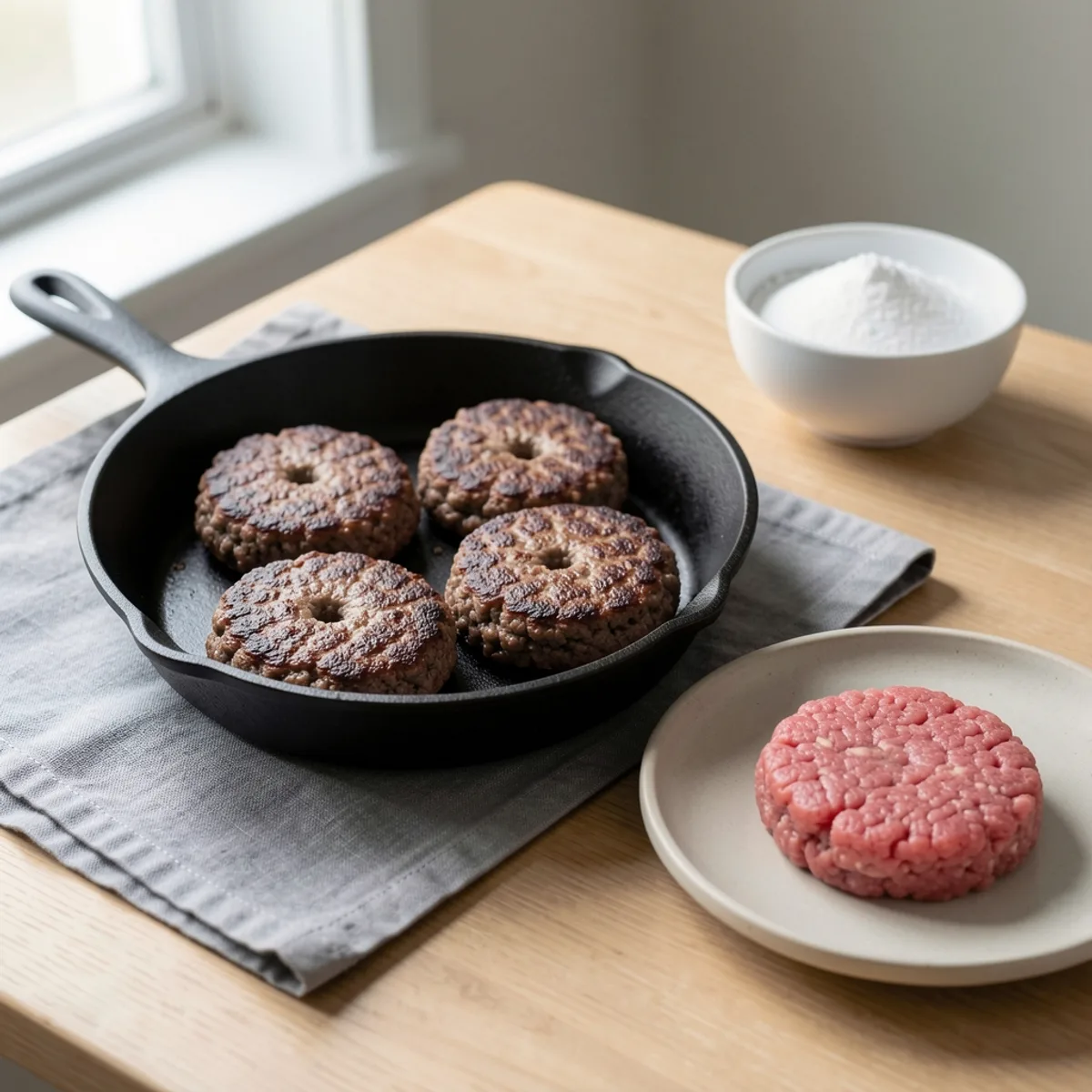 Save
Jump to:
Most burger advice starts with the soda and skips the part that does the damage. A dense, hockey-puck bite usually comes from handling, not from what's in the bowl. Here's where it goes wrong: people add baking soda on top of an overworked patty and expect it to fix the texture.
This page fact-checks baking soda on formed patties. Nothing here was cooked side by side by us, so there's no "we tried it" verdict. You'll find a dose, a rest, a thermometer check and what the sources say, including the part that counts against it. For crumbled beef, see baking soda ground beef.
Why you might try it
- Formed patties are their own case, and one student study looked at exactly that.
- The dose, the rest and the 160 F check sit in one place.
- The sodium is counted per patty, not per pound.
Baking soda for burgers: the dose
Our default is 1/4 tsp (1.15 g) per pound, in 1 tbsp (15 mL) water. That's the low end of what's published. America's Test Kitchen (ATK) used 1/4 tsp on 12 oz (340 g) of ground beef, about 1/3 tsp per pound by our conversion. The Daily Meal uses 1/2 tsp plus 1 tbsp water per pound. Food Republic gives about 1/4 tsp per 12 oz with a 15 minute rest, and calls the water slurry optional.
The rest is short for a reason. ATK found 15 minutes is enough: a 45 minute soak retained only about 3 percent more moisture after cooking.
The Food Science / Lab Kitchen Note
Baking soda is a base, so it raises the pH of the meat. ATK's stated mechanism is that a higher pH makes it harder for proteins to bond too tightly. In a patty, the reasoning goes, tight bonding reads as a firm, dense bite and squeezes water out as the meat cooks. That's the reasoning behind the trick, not a measurement we made.
The WTAMU abstract (details below) gives the patty-level evidence. As the soda rate rose, pH went up, shear force went down (more tender) and cook loss went down. Juiciness scores went up. Browning is the third piece. Why a higher pH speeds up Maillard browning is covered in why baking soda browns meat faster, so it isn't repeated here.
Our calculation: 1.15 g of soda on 454 g of beef is about 0.25 percent of the meat's weight, which lines up with the lowest level in the WTAMU study. Treat that as our conversion, not the authors'.
Three variants compared on published data
This compares published data. It isn't a test we ran. The WTAMU abstract used 0, 0.25 and 1.0 percent baking soda on raw 80/20 patties, and we converted those to teaspoons per pound.
| Variant | Dose per lb (our conversion) | pH | Cook loss | Shear force (tenderness) | Juiciness score | Beef odor and flavor scores | Sodium from soda per patty (our math) |
|---|---|---|---|---|---|---|---|
| None (control) | 0 | baseline | baseline | baseline | baseline | baseline | 0 mg |
| 0.25 percent | about 1/4 tsp (1.15 g) | rises with rate | falls with rate | falls with rate | rises with rate | worse with rate | about 79 mg |
| 1.0 percent | about 1 tsp (4.6 g) | rises with rate | falls with rate | falls with rate | rises with rate | worse with rate | about 315 mg |
The abstract reports directions across the rates, not a separate result for each level, and it publishes no actual numbers. Every pH, cook loss and shear value is therefore no sourced data. We can't tell you how much better or worse the middle level is than the control.
What the research says
The patty study. It's a West Texas A&M University (WTAMU) McNair Scholar research abstract, a student project with a faculty mentor, Dr. Trent Schwartz. It tested raw 80/20 beef patties with sodium bicarbonate at 0, 0.25, 0.50 and 1.0 percent. Rising rates raised pH (p below 0.001), lowered shear force (p below 0.05), lowered cook loss (p below 0.001) and raised juiciness (p below 0.002). But beef odor, flavor identity and flavor intensity scored worse (p below 0.001), and the authors say the rate must be closely monitored. The page doesn't give the number of patties, the replications or the raw values. That's a small student abstract, not a peer-reviewed trial, so it shows a direction and nothing more. Read the abstract yourself.
The kitchen tests. ATK's tenderizing test used 12 oz (340 g) samples each of ground beef, sliced chicken and sliced pork, and the page reports no repeat trials (ATK). Its sloppy joe test put 1/2 tsp baking soda with 1 tbsp water into 1 lb of 85 percent lean ground beef and called the result "juicier and more tender" (ATK). That's one pound, one test, with no measurements and no rest time stated. The Daily Meal and Food Republic are editorial guides with no lab data, and The Daily Meal warns that burgers can turn "unpleasantly tough and way too chewy". Don't read any of this as proof that baking soda makes a better burger.
What cooks report
The signals are thin, so here is exactly what there is. A couple of cooks report trouble at a heavy hand: one forum poster who put 2 tsp in a batch got puffy burgers that weren't juicy, and one writer who tried 1/4 tsp per pound noticed no flavor change but called larger amounts he'd tasted slippery and unpleasant. Both are single anecdotes.
On the texture side, a couple of forum cooks put the blame on handling. Their advice is to work the meat as little as possible, pack it loosely and season the outside, and one prefers 85/15 over 80/20 only when worried about dryness. Treat overmixing as the main texture risk, baking soda or not. ATK's turkey burger page says the same: overwork the meat and the burgers may become dense.
Ingredients and method
The recipe card has everything in US and metric. Three notes before you start:
- Use food-grade, aluminum-free baking soda, not baking powder.
- Rest the loose beef, then shape. Season the outside after the rest.
- Smash burgers and the crust: we found no sourced data on how baking soda changes a smashed patty.
Common mistakes
Overmixing. This is the one that makes a dense patty. Fold the soda water in with your fingertips only until it's spread, and form the patty loosely. ATK's turkey burger page and Food Republic both warn about overworking.
Doubling the dose. More isn't better. The WTAMU abstract scored beef odor and flavor worse as the rate rose, and the forum report of 2 tsp in a batch ended with puffy, dry burgers. Stay at the low end.
Judging doneness by color. A higher pH speeds browning (see why baking soda browns meat faster), which makes color an even weaker cue. USDA FSIS says some patties brown before reaching 160 F and some that are done stay pink. Use the thermometer.
Check 160 F with a thermometer
Here's the source, cited as it stands. It's a repost by the Missouri Department of Elementary and Secondary Education (DESE) of a June 10, 1997 USDA FSIS release, not a current FSIS page. It says ground beef must be cooked to 160 F, that meat color is no longer considered a reliable indicator of ground beef safety, and to insert the thermometer in the thickest part of the patty, or sideways if the patty is too thin. Read the USDA advisory repost. Hold the meat out of the refrigerator no longer than 2 hours, the limit Food Republic gives for raw ground meat.
Sodium: the math
Baking soda is a sodium compound. USDA data as reproduced by Matvaretabellen lists 27,360 mg sodium per 100 g, which is about 273.6 mg per gram. This site uses 4.6 g per teaspoon, so 1/4 tsp is 1.15 g. The FDA sets the sodium Daily Value at 2,300 mg, with 5 percent or less per serving counted as low (115 mg) and 20 percent or more as high (460 mg).
Our math splits 1 lb (454 g) into four 4 oz (113 g) patties and counts the soda only:
| Dose per lb | Sodium in the dose | Per patty | Share of 2,300 mg per patty |
|---|---|---|---|
| 1/4 tsp (1.15 g) | about 315 mg | about 79 mg | 3.4 percent |
| 1/2 tsp (2.3 g) | about 630 mg | about 157 mg | 6.8 percent |
| 1 tsp (4.6 g) | about 1,259 mg | about 315 mg | 13.7 percent |
The beef's own sodium comes on top. The card's total of about 154 mg per patty, roughly 6.7 percent of 2,300 mg, adds our estimate of about 75 mg from raw 90/10 beef. Salt and a bun aren't counted.
Substitutes and swaps
| Original | Swap | Proportion | What changes |
|---|---|---|---|
| 90/10 beef | 80/20 beef | same dose per pound | The WTAMU patties were 80/20; the card's nutrition uses 90/10, so fat and calories rise |
| Baking soda | Baking powder | no sourced ratio | Unchecked, so don't swap by guesswork |
| 1 tbsp water | No water | no sourced data | Food Republic calls the slurry optional; the effect on spreading is not sourced |
| Ground beef | Ground turkey, 93 percent lean | 1/4 tsp soda in 1 tsp water per 1 lb, rest 5 minutes | ATK's skillet turkey burger dose, divided into four portions of about 4 oz; check doneness against the USDA guideline for poultry, not the beef one |
Storage and make-ahead
Treat the mixed beef as raw. We found no source on refrigerating or freezing patties already treated with baking soda, or on reheating cooked ones, so none of that is covered here. Cook to 160 F (71 C) and check with the thermometer.
Make-ahead tip: mix the soda water into the beef at the stove and let the 15 minute rest run while the skillet heats. The treated meat then goes straight from the bowl to the pan instead of sitting around.
Servings: 4 patties (4 oz / 113 g raw beef each)
Baking Soda Burger Patties: Dose, Rest Time and Texture
A fact-check of baking soda in formed hamburger patties: the dose per pound, the rest, the 160 F check, what a student study found on flavor, and the sodium per patty.
Ingredients
Patties
Equipment
- Wide mixing bowl (room to spread the beef without packing it)
- Cast-iron or heavy skillet (wide enough not to crowd the patties)
- Food thermometer (needed for the 160 F (71 C) check)
Instructions
Method
- Dissolve the soda. Stir 1/4 tsp (1.15 g) baking soda into 1 tbsp (15 mL) water until no grains are left.
- Work it through lightly. Pull 1 lb (454 g) beef apart in a wide bowl. Drizzle the solution over it and fold with your fingertips just until it is spread evenly. Overworking is how burgers turn dense.
- Rest 15 minutes. Let the beef sit for 15 minutes. A longer soak adds very little, and raw ground beef should not stay out of the refrigerator past 2 hours in total.
- Shape loosely. Divide into four 4 oz (113 g) portions. Form each into a loose patty, handling it as little as you can. A shallow dimple in the center is optional.
- Season and sear. Season the outside. Heat the skillet, add the patties without crowding and leave them alone until the bottom is browned, then flip once.
- Check 160 F. Insert a food thermometer into the thickest part of the patty, or sideways if it is thin. Cook until it reads 160 F (71 C). Color is not a reliable sign it is done.
Notes
Dose: 1/4 tsp per lb is the low end of the published range. ATK used 1/4 tsp per 12 oz (340 g), about 1/3 tsp per lb, and The Daily Meal uses 1/2 tsp per lb.
Nutrition note: values are estimates calculated by us from typical USDA FoodData Central values for raw 90/10 ground beef (FDC 174030) plus the baking soda, per 4 oz (113 g) raw patty. Salt is not counted. The calculation uses 90/10, not 80/20, so an 80/20 patty has more calories and fat. Cooking loss changes the final numbers.
Sodium: about 79 mg per patty comes from the baking soda and about 75 mg from the beef, for about 154 mg total, roughly 6.7 percent of the 2,300 mg Daily Value.
Storage: treat the mixed beef as raw ground beef and keep it refrigerated. We found no source on refrigerating or freezing patties already treated with baking soda, or on reheating cooked ones.
Nutrition Facts
Per 1 patty (4 oz / 113 g raw beef with its share of the baking soda) (estimated)
- Total Fat
- 11.3 g
- Saturated Fat
- 4.4 g
- Sodium
- 154 mg
- Total Carbohydrate
- 0 g
- Dietary Fiber
- 0 g
- Sugars
- 0 g
- Protein
- 22.6 g
Frequently asked questions
Why do you add baking soda to hamburger, and when?
ATK's stated reason is that baking soda raises pH and makes it harder for the meat proteins to bond too tightly. Dissolve it in water, work it gently through the loose beef, rest it 15 minutes, then shape the patties.
What happens if you use too much baking soda on burgers?
A couple of cooks report puffy burgers that weren't juicy at a heavy dose, and a slippery, unpleasant bite at larger amounts. The WTAMU student abstract also scored beef odor and flavor worse as the rate rose, so stay near 1/4 tsp per pound.
Can you use baking powder for burgers instead of baking soda?
We found no sourced ratio for it, so there's no swap to give you. Baking powder is a different product, and every dose on this page is for plain baking soda.
Do you need baking soda for burgers that aren't dense?
Not necessarily. Forum cooks put most of the blame on handling, so work the meat as little as possible, pack it loosely and season the outside of the patty.

Steven Dony trained in a restaurant kitchen and lives in Nashville, Tennessee. He covers SodaRecipe’s fact-checks: what works, what does not, and why.

Comments