Honey and Baking Soda Trick: Does It Work? Sodium Facts
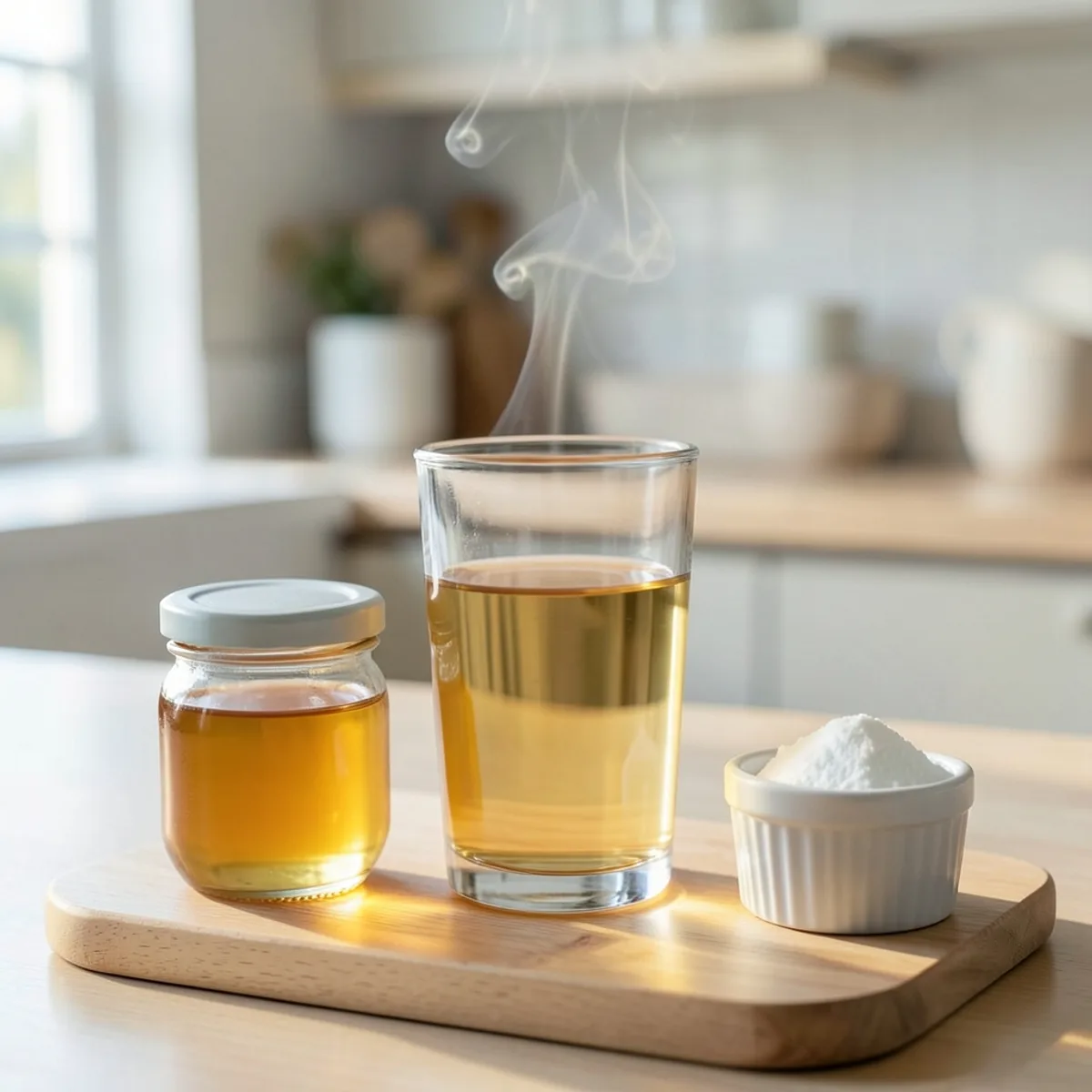
Jump to RecipeA sourced check of the viral honey and baking soda drink: what it promises, what the sources say, the sodium in mg, the honey age rule and one diluted 1/4 tsp glass.
 Save
Jump to:
Here's where the trick goes wrong first: it isn't backed by a single study of the mix. We found none. The viral claims cover energy, digestion, weight, cough and a men's claim, and the sources below speak to only one of them, honey for a cough.
This page is about the drink. If you want the candy, see our honey and baking soda honeycomb. Different recipe, different article.
What the trick claims, and what the sources say
Searching the phrase turns up the same list of promises. Here's each one against what we could source.
- Weight: we found no study of this mix for fat loss. Our baking soda trick page covers the weight evidence for plain baking soda water, and our does baking soda help you lose weight article goes deeper.
- Digestion: sodium bicarbonate is an antacid, and that is its sourced use. MedlinePlus limits it to 2 weeks unless a doctor says otherwise. See baking soda for heartburn.
- Cough: honey has some support, baking soda has none in the sources we opened. More in the studies section.
- Energy and "alkaline" claims: we found no sourced evidence that the drink changes your blood pH or gives you energy.
- The men's claim: a viral ad recipe says the mix helps men. We found no study of it, so there is nothing to measure. The safety limits below apply to anyone.
The Food Science / Lab Kitchen Note
Baking soda is sodium bicarbonate, a base. Stomach acid is hydrochloric acid. They react:
NaHCO3 + HCl → NaCl + H2O + CO2
Acid gets used up, and you get salt, water and carbon dioxide. The CO2 is a gas, which is why gas shows up among the mild effects MedlinePlus lists. Honey doesn't change that reaction. It adds sugar and a little flavor, and almost no sodium.
Now the numbers. USDA FoodData Central lists baking soda at 27,400 mg of sodium per 100 g, and 1 teaspoon weighs 4.6 g. So 1 tsp is about 1,260 mg, and a level 1/4 tsp (1.15 g) is about 315 mg. That's our arithmetic, not a measured value.
Honey, per USDA: 304 kcal, 82.1 g of sugars and 4 mg of sodium per 100 g, with 1 tablespoon at 21 g. One teaspoon is about 7 g, so about 21 kcal, 5.7 g of sugars and under 1 mg of sodium (our arithmetic).
The FDA sets the sodium Daily Value at less than 2,300 mg a day, and calls 5% DV or less low and 20% DV or more high per serving. Our 315 mg is about 14% of 2,300 mg. A full teaspoon of soda, 1,260 mg, is about 55%.
Three versions compared from the data
This compares published data. Two columns are viral recipe cards we opened; we don't name them. Sodium and honey figures in the table are our arithmetic from the USDA values above.
| Viral card A | Viral card B | Our glass | |
|---|---|---|---|
| Baking soda | 1/2 tsp (2.3 g) | 1/2 tsp (2.3 g) | 1/4 tsp (1.15 g) |
| Honey | 1 tbsp (21 g) | 1 tsp (7 g) | 1 tsp (7 g) |
| Water | 8 fl oz (240 mL) | 1 cup (240 mL) | 8 fl oz (240 mL) |
| Sodium, our arithmetic | About 630 mg (27% of 2,300 mg) | About 630 mg (27%) | About 315 mg (14%) |
| Sodium on the card | 630 mg | 320 mg | Not applicable |
| Honey sugars, our arithmetic | About 17.2 g | About 5.7 g | About 5.7 g |
| Sourced evidence for the mix | No sourced data | No sourced data | No sourced data |
Card B's 320 mg doesn't match its own 1/2 tsp of soda. By USDA data, that spoon holds about 630 mg. A third card we opened used a pinch of soda and listed 40 mg of sodium while its text gave 1,260 mg per teaspoon. The cards don't agree with each other or with themselves. Level the spoon, and count the sodium yourself.
What the studies show
Honey for cough is the one claim with a source. A Mayo Clinic staff FAQ, republished by Beacon Health System, suggests 0.5 to 1 teaspoon (2.5 to 5 mL) of honey for a cough in children 1 and older. It says studies suggest honey may reduce coughing, but that higher-quality studies are needed. Cleveland Clinic says honey may ease throat irritation and may be more effective than over-the-counter cough suppressants at night, citing a JAMA Pediatrics study without giving details. It adds that honey is not a cure for strep throat. Neither page mentions baking soda, so none of this supports the mix.
For baking soda, the sports literature is the nearest thing to a dose study, and it isn't the same drink. The 2021 ISSN position stand is an expert review, not a trial. It gives a single sports dose of 0.2 to 0.5 g per kg of body weight, calls 0.3 g/kg optimal, and puts it 60 to 180 minutes before exercise. It lists bloating, nausea, vomiting and abdominal pain as common side effects and says part of the effect may be placebo. For a 70 kg adult, 0.2 to 0.3 g/kg is about 14 to 21 g (our arithmetic), against 1.15 g in our glass. The sports dose is shown for contrast only. It isn't equivalent to the recipe, and you shouldn't copy it.
MedlinePlus, for its part, gives antacid directions but no strength per dose, and says to follow the product label.
The honey age rule
Never give honey to a child younger than 1. The Mayo Clinic staff FAQ says so because of infant botulism. ANSES, the French food safety agency, says the same, whatever the honey's origin: infant botulism comes from Clostridium botulinum spores, which can be found in honey. Raw, local or pasteurized doesn't change the rule. Some viral cards skip this line entirely.
Common mistakes
Heaping the spoon
Cards run from a pinch to 1/2 tsp, and sodium rises with the spoon. Level it with a knife. A heaped 1/4 tsp is no longer 1.15 g.
Skipping the water
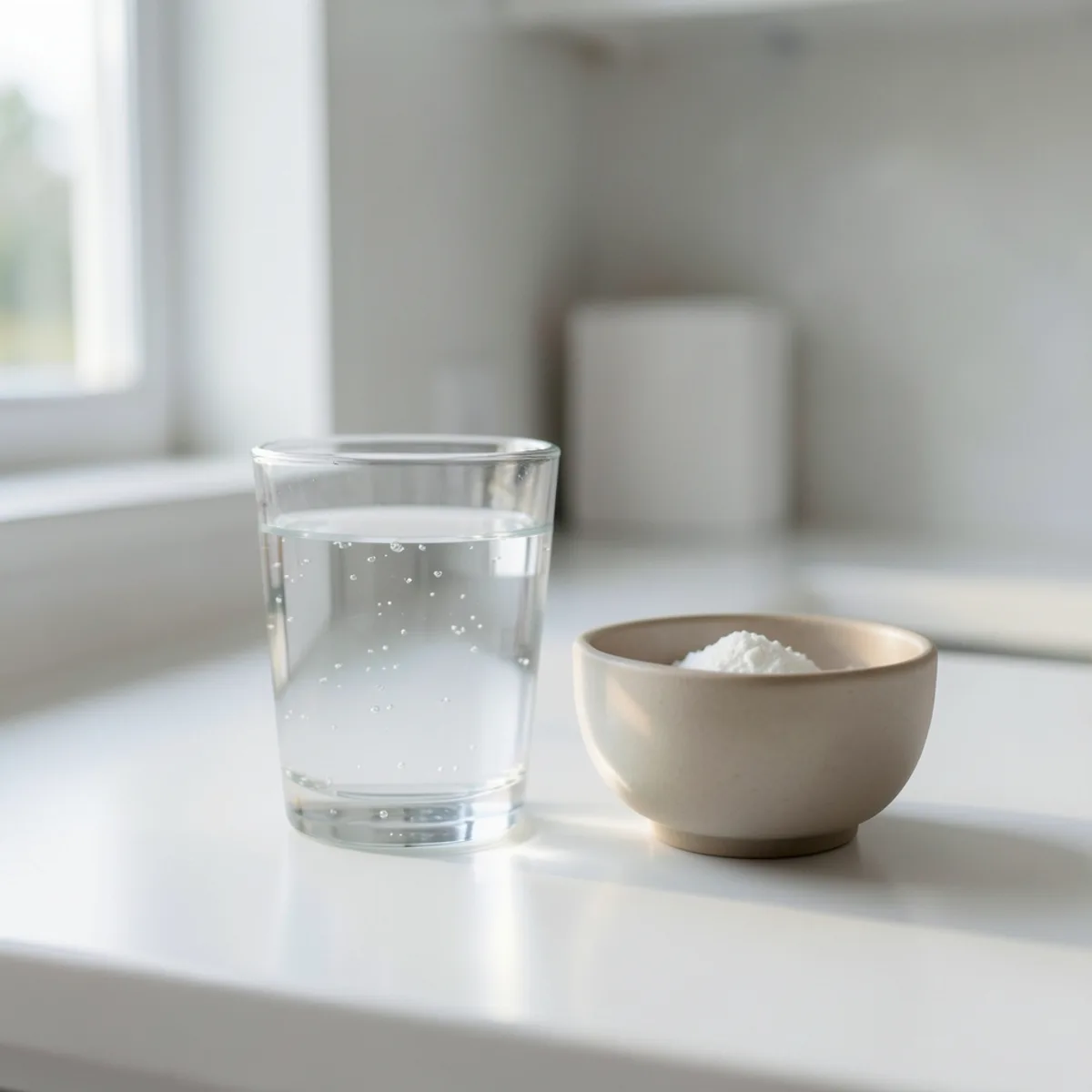
Taking it as a shot skips the dilution rule. MedlinePlus says to dissolve the powder in at least 4 oz (120 mL) of water. Pour the water first, then stir.
Boiling water on the honey
Cleveland Clinic says boiling water can destroy some of honey's properties. Use warm water.
Substitutes and swaps
| Original | Swap | Proportion | What changes |
|---|---|---|---|
| Baking soda | Baking powder | Not a substitute | A different product; no sourced data here |
| Baking soda | Leave it out | Honey in warm water | Under 1 mg of sodium per teaspoon of honey (USDA, our arithmetic); the option for a sodium-restricted diet |
| Honey | Other sweeteners | Not covered by our sources | No sourced data; and never give honey to a child under 1 |
Storage
Mix one glass and drink it. No food-safety authority we found gives a shelf life for baking soda water, so we give no duration. Make-ahead tip: measure and level the dry soda into the spoon, and add the water and honey only when you're ready to drink.
Nutrition note
Values on the recipe card are estimates calculated from typical USDA FoodData Central values for baking soda and honey, per glass of 8 fl oz with 1/4 tsp baking soda and 1 tsp honey. They aren't measured. The glass has about 21 kcal and 5.7 g of sugars, nearly all from honey, plus about 315 mg of sodium from the soda. That's about 14% of the 2,300 mg limit (our arithmetic).
Servings: 1 glass (8 fl oz)
Honey and Baking Soda Trick: Does It Work? Sodium Facts
A sourced check of the viral honey and baking soda drink: what it promises, what the sources say, the sodium in mg, the honey age rule and one diluted 1/4 tsp glass.
Ingredients
Equipment
- Measuring spoons (a true 1/4 teaspoon, leveled with the back of a knife)
- Clear glass and spoon (so you can see when no white grains are left)
Instructions
- Level the soda. Fill a 1/4 teaspoon (1.15 g) with food-grade, aluminum-free baking soda and sweep the top flat with a knife. The spoon should look flush, not mounded.
- Pour the warm water first. Pour 8 fl oz (240 mL) of warm water into a clear glass. Never go below 4 fl oz (120 mL), the MedlinePlus minimum for dissolving the powder. Skip boiling water, which Cleveland Clinic says can destroy some of honey's properties.
- Add the soda and stir. Add the soda and stir until the water looks clear and no white grains sit on the bottom.
- Stir in the honey. Add 1 teaspoon (7 g) of honey and stir until it dissolves.
- Sip it fresh. Drink the glass in sips, not as a shot and not on an overly full stomach. Mix one glass at a time, since we found no sourced shelf life.
Notes
Metric amounts are rounded. The 1.15 g figure is 1/4 teaspoon at the USDA household portion of 4.6 g per teaspoon; the 7 g of honey is our division of the USDA 21 g per tablespoon.
Nutrition values are estimates calculated from typical USDA FoodData Central values for baking soda and honey. They are not measured. Sodium is our arithmetic from 27,400 mg per 100 g of baking soda.
The 8 fl oz (240 mL) glass is our recipe, not a medical rule. MedlinePlus gives at least 4 oz (120 mL) for antacid use.
Nutrition Facts
Per 1 glass (8 fl oz water, 1/4 tsp baking soda, 1 tsp honey) (estimated)
- Total Fat
- 0 g
- Saturated Fat
- 0 g
- Sodium
- 315 mg
- Total Carbohydrate
- 5.7 g
- Dietary Fiber
- 0 g
- Sugars
- 5.7 g
- Protein
- 0 g
Frequently asked questions
When should you drink honey and baking soda?
We found no sourced time of day for this mix. The only sourced directions are MedlinePlus antacid ones: 1 to 2 hours after meals, in at least 4 oz (120 mL) of water, 2 hours apart from other medicines.
Can you drink honey and baking soda, and what are the side effects?
MedlinePlus lists increased thirst, stomach cramps and gas as mild effects, and its antacid use stops at 2 weeks unless a doctor says otherwise. MedlinePlus flags high blood pressure, heart or kidney disease, pregnancy and other medicines; see the Who Should Not Drink This box.
What can I use instead of honey and baking soda?
Honey in warm water without the soda has under 1 mg of sodium per teaspoon (USDA, our arithmetic), which matters on a sodium-restricted diet. Baking powder is a different product and not a swap, and we found no sourced alternative for the soda.
Why does the scale drop in the first days?
A scale reads total body weight. It can't tell fat from water or lean mass, so a quick drop isn't proof of fat loss.

Steven Dony trained in a restaurant kitchen and lives in Nashville, Tennessee. He covers SodaRecipe’s fact-checks: what works, what does not, and why.
Comments