Honey and Baking Soda Honeycomb (No Corn Syrup)
Jump to RecipeA honey-forward sponge candy with no corn syrup: ratios in US and metric units, a hard-crack temperature chart with altitude steps, sodium in the nutrition, and fixes for chewy or sticky batches.
 Save
Jump to:
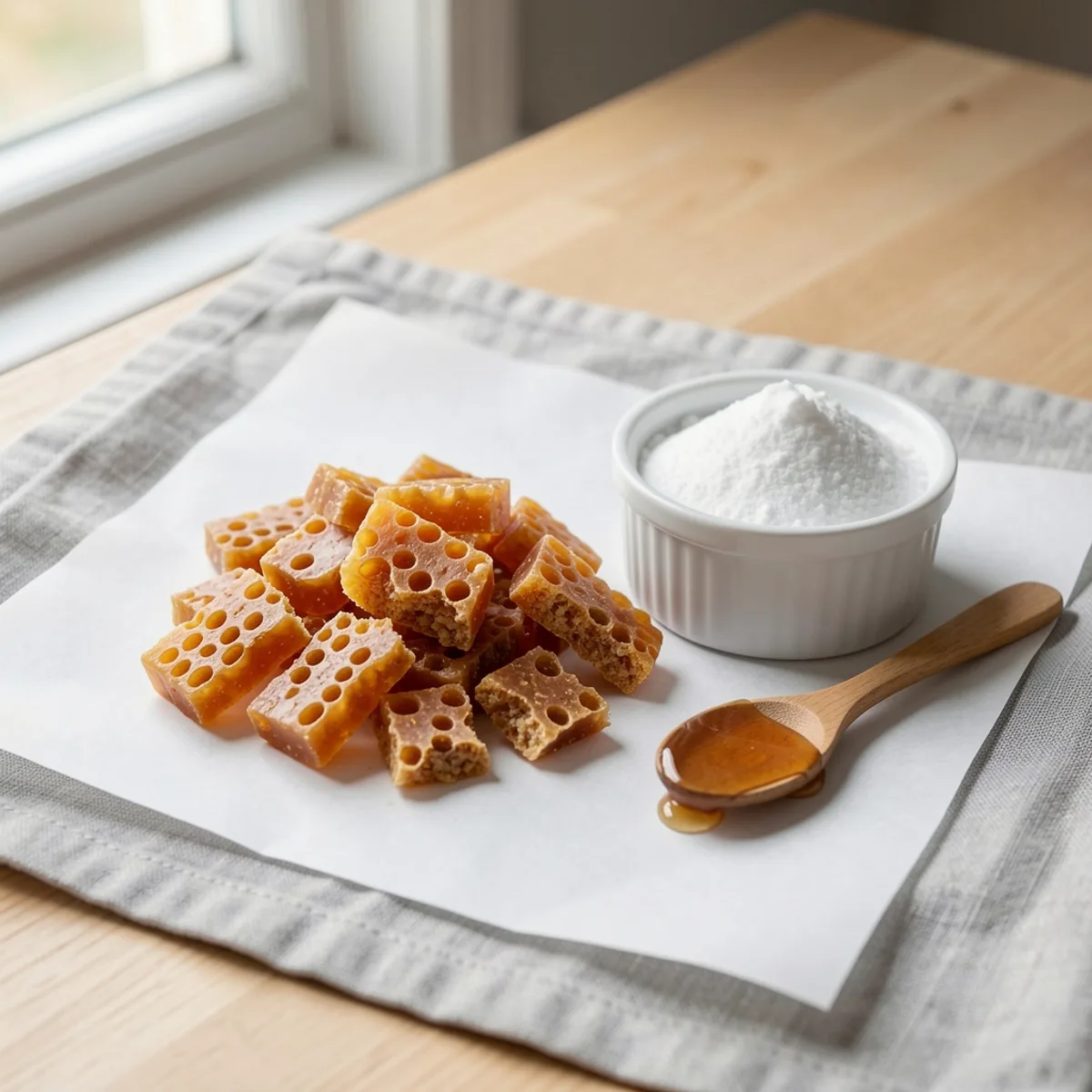
Honey and baking soda honeycomb is a corn-syrup-free sponge candy made from 1 1/4 cups sugar, 1/2 cup honey and 1 tablespoon baking soda, cooked to 300-310 F. It takes about 1 hour 25 minutes, mostly cooling, and keeps honey as the only liquid sweetener.
Pull the syrup early and you get chewy. Stir too long and you get brittle. The rest of this page is about those two moments.
What this version changes
- No corn syrup: sugar and honey only.
- One temperature chart in F and C, with an altitude step.
- A failure table for chewy, sticky, flat and soda-tasting batches.
Prep 10 minutes, cook 15 minutes, cool 60 minutes. About 1 hour 25 minutes in all, and prep and cook are our estimates.
Honey is not for infants under one year of age, according to ANSES, the French food safety agency, because of infant botulism.
The Food Science / Lab Kitchen Note
Baking soda is sodium bicarbonate. Heat breaks it down and gives off carbon dioxide, and acid makes it react too. Honey is acidic, with a pH of about 3.70 to 4.20 according to Kansas State University, while sugar is neutral at 7.0. So a honey syrup gives the soda a little acid to react with.
Only a little, though. Kansas State's baking rule is 1/2 teaspoon of baking soda per cup of honey, and that is a baking rule, not a candy rule. For the 1/2 cup of honey on this card, the rule works out to 1/4 teaspoon by our calculation. The card uses 3 teaspoons, about 12 times that. By our calculation, the card's soda far exceeds what the honey's acid could use, so most of the gas probably comes from the heat.
The temperature matters because of what is left in the pot. The Exploratorium puts hard crack at 300-310 F, where the syrup is about 99 percent sugar. At that point almost no water remains. The foam gets trapped in sugar that sets glassy and brittle instead of chewy. Soft crack, at 270-290 F, still holds water, which is a likely reason for chewy honeycomb.
Temperature chart: US and metric, with altitude
The stage figures come from the Exploratorium. The altitude rule is theirs too: subtract 1 F for every 500 feet above sea level. The rows for each elevation are our arithmetic, with Celsius rounded to the nearest degree.
| Elevation | Soft crack | Hard crack target |
|---|---|---|
| Sea level | 270-290 F (132-143 C) | 300-310 F (149-154 C) |
| 2,500 ft | No sourced data here | 295-305 F (146-152 C) |
| 5,000 ft | No sourced data here | 290-300 F (143-149 C) |
| 7,500 ft | No sourced data here | 285-295 F (141-146 C) |
| 10,000 ft | No sourced data here | 280-290 F (138-143 C) |
One more thing before you trust any number on any page. What's Cooking America pulls honeycomb at 285 F and calls that hard crack. That conflicts with the Exploratorium, where 285 F falls inside soft crack. This card keeps 300-310 F. A Cozy Kitchen, whose ratios we follow, heats to 295 F, which is also below the range.
Three published honeycomb recipes, side by side
This is a comparison of published data, not a record of batches we cooked. The grams are our conversions unless the source gave them. Where nothing was sourced, the cell says so.
| A Cozy Kitchen (food blog recipe) | Crayons and Cravings (food blog recipe) | Cake by Courtney (food blog recipe) | This card | |
|---|---|---|---|---|
| Baking soda | 1 tbsp, sifted (13.8 g) | 4 tsp (18.4 g) | 2 1/2 tsp (10 g, as listed) | 1 tbsp (13.8 g) |
| Sugar | 1 1/4 cups (250 g) | 1 1/2 cups (300 g) | 1 3/4 cups (350 g) | 1 1/4 cups (250 g) |
| Honey | 1/2 cup (170 g) | 3 tbsp (63 g) | 1 tbsp (21 g) | 1/2 cup (170 g) |
| Corn syrup | None | 1/3 cup light | 2/3 cup (218 g) | None |
| Water | None listed in the source | 1/2 cup | 1/2 cup (120 g) | None |
| Other | Pinch of salt, 1 tsp vanilla | No sourced data here | 1/4 tsp cream of tartar | Pinch of salt, 1 tsp vanilla |
| Cooked to | 295 F (146 C) | 300 F (149 C) | 300 F (149 C) | 300-310 F (149-154 C) |
| Soda per 100 g sugar (our calculation) | 5.5 g | 6.1 g | 2.9 g | 5.5 g |
| Storage claim | Humid climates lose crispness | Up to 5 days airtight | Airtight, no duration | See storage below |
Two notes on the math. Cake by Courtney lists 2 1/2 teaspoons as 10 g; at 4.6 g per teaspoon from USDA, that amount would be 11.5 g, or 3.3 g per 100 g of sugar. And honey is a small share in two of the three recipes. Only A Cozy Kitchen goes honey-forward without corn syrup, which is why the card follows it.
Common mistakes
Pulling the syrup early. Many cooks who end up with chewy honeycomb say the syrup came off the heat too soon, and they point to a candy thermometer rather than color. Clip it on, and wait for 300-310 F.
Stirring too long or spreading the foam. Both pop the bubbles, and the candy then sets as dense brittle. Stir only until the soda disappears, pour, and leave the pan alone.
Using a small pot. The mixture foams to a large volume, and cooks suggest a big pot and separate batches for large amounts. This card is one small batch, so size the pot for the foam, not for the syrup.
Substitutes and swaps
| Original | Replacement | Proportion | What changes |
|---|---|---|---|
| Honey and sugar syrup | Add corn syrup (Crayons and Cravings, Cake by Courtney) | See the comparison table for their amounts | Not corn-syrup-free anymore |
| Corn syrup (in other recipes) | Liquid glucose or molasses (an author reply on Cake by Courtney) | No sourced proportion | Reply only, not a card in this recipe |
| Sifted fresh baking soda | Baking powder | No sourced proportion | Cooks say the rise is weak |
| Honey | Honey only, no sugar | No sourced data here | Nothing we opened shows it |
| Baking soda | None (honeycomb without soda) | No sourced data here | The foam comes from the soda |
Nutrition note: calories and sodium per piece
Values on the recipe card are estimates calculated from typical USDA FoodData Central figures, for one of 12 pieces. The sugar line uses 387 kcal and 99.8 g of sugars per 100 g. The honey line uses USDA's honey (SR Legacy): 304 kcal, 82.1 g of sugars and 4 mg of sodium per 100 g. Vanilla and the pinch of salt are left out.
That comes to about 124 calories, 32.4 g of sugars and 316 mg of sodium per piece. Nearly all of the sodium is the baking soda. USDA lists it at 27,400 mg per 100 g, about 1,260 mg per teaspoon at 4.6 g. By our calculation, the 3 teaspoons on the card hold about 3,780 mg in the whole batch, and we assume all of it stays in the candy.
Where these numbers come from
The hard-crack range, the soft-crack range and the altitude rule come from the Exploratorium's page on sugar stages, a science museum resource. The honey pH and the 1/2 teaspoon per cup baking rule are from Kansas State University. The nutrition inputs come from USDA FoodData Central, for baking soda, honey and granulated sugar. The advice on infants is from ANSES.
The three recipes in the comparison are blog pages, not tested by us: A Cozy Kitchen, Crayons and Cravings and Cake by Courtney. We adapted an idea, not their text. The tips on sifting the soda, using a large pot and storing airtight appear on all three pages. We found no scientific study on honeycomb, so none is cited.
Storing honeycomb
Honeycomb soaks up moisture from the air and turns sticky or soft, according to cooks across several pages, so it needs an airtight container and goes best on a dry day. The storage figures belong to the blogs, not to a food-safety authority. Crayons and Cravings says it keeps up to 5 days airtight and recommends eating it in the first 1 to 2 days. Cake by Courtney says airtight and gives no duration.
We found no sourced guidance on freezing, reheating or rescuing candy that has already gone sticky, so this page gives none.
Troubleshooting
| Problem | Likely cause | Fix |
|---|---|---|
| Chewy | Syrup taken off the heat too early (2 sources) | Use a candy thermometer and wait for 300-310 F, less 1 F per 500 ft |
| Sticky or soft later | Moisture from the air (3 sources) | Store airtight right away, and make it on a dry day |
| Flat or dense | Foam stirred too long or spread in the pan (2 sources) | Stir only until the soda is gone, pour, and do not touch it |
| Weak rise | Old soda, or baking powder used instead (2 sources) | Use fresh baking soda; one source says under 6 months |
| Soda taste | Unsifted clumps, old soda or a high ratio may be to blame | Cooks sift it and use fresh soda. The published range is 2.9 to 6.1 g per 100 g of sugar; we have no sourced data on which tastes least of soda |
| Boils over | Pot too small (3 sources) | Go bigger, or cook in separate batches |
If a batch fails, it is almost always the thermometer or the stirring. Check those two first.
Servings: 12 pieces
Honey and Baking Soda Honeycomb (No Corn Syrup)
A honey-forward sponge candy with no corn syrup: ratios in US and metric units, a hard-crack temperature chart with altitude steps, sodium in the nutrition, and fixes for chewy or sticky batches.
Ingredients
Honeycomb
Equipment
- Large, heavy-bottomed pot (the mixture foams to a large volume, so go bigger than looks necessary)
- Candy thermometer (rather than judging by color)
- Fine sieve or sifter (for the baking soda)
- Pan lined with parchment (the foam goes in without being spread)
- Heatproof spatula
Instructions
Prepare
- Set up. Line the pan with parchment. Sift the baking soda into a small bowl and keep it, the vanilla and the salt next to the stove. Once the syrup is at temperature, there is no time to measure.
Cook and foam
- Melt the sugar and honey. Put the sugar and honey in the large pot over medium heat. Melt low and slow, stirring gently only until the sugar looks dissolved, and clip the candy thermometer to the side.
- Cook to hard crack. Cook until the thermometer reads 300-310 F (149-154 C). Lower that target by 1 F for every 500 feet above sea level. Watch the thermometer, not the color.
- Add the soda. Take the pot off the heat. Stir in the salt and vanilla, then sift the baking soda over the syrup and stir only until it disappears. The foam climbs fast. It will look wrong. Keep going, but stop stirring early.
- Pour without spreading. Pour the foam straight into the lined pan. Do not spread it with a spatula, because that pops the bubbles and the candy sets as dense brittle.
Set
- Cool undisturbed. Leave the honeycomb alone until it is fully cool and hard. A source says 1 to 2 hours; this card counts the short end.
- Break and store. Break the slab into pieces and move them to an airtight container right away, because honeycomb takes moisture from the air.
Notes
The ratios follow A Cozy Kitchen's corn-syrup-free honeycomb (1 tablespoon soda, 1 1/4 cups sugar, 1/2 cup honey, a pinch of salt, 1 teaspoon vanilla). We moved the target temperature from its 295 F to the 300-310 F hard-crack range of the Exploratorium.
That source lists no water, so the card has none. Melt gently.
Gram weights are our conversions from USDA FoodData Central: 1 cup sugar 200 g, 1 cup honey 339 g, 1 teaspoon baking soda 4.6 g.
Prep and cook times are our estimates; no source gives them. The yield of 12 pieces is our serving size, not a sourced figure.
The order of steps and the heat level are our assembly of the three published recipes, not a tested method, and this ratio at 300-310 F is not a tested pairing.
Celsius and milliliter figures are our conversions.
Nutrition values are estimates calculated from typical USDA FoodData Central values for granulated sugar, honey and baking soda, per 1 of 12 pieces. Vanilla and the pinch of salt are not counted. All the sodium from the baking soda is assumed to stay in the candy.
Nutrition Facts
Per 1 piece (1/12 of the batch) (estimated)
- Total Fat
- 0 g
- Saturated Fat
- 0 g
- Sodium
- 316 mg
- Total Carbohydrate
- 32.5 g
- Dietary Fiber
- 0 g
- Sugars
- 32.4 g
- Protein
- 0 g
Frequently asked questions
Can you mix honey and baking soda, or drink it?
You can mix them as a candy. This page gives no drink recipe or dose, so read our baking soda trick article for the drink.
Why is my honeycomb candy chewy?
Many cooks who get chewy candy say the syrup came off the heat too early, and they trust a candy thermometer over color. Aim for the 300 to 310 F hard-crack range, and subtract 1 F for every 500 feet above sea level.
Why does honeycomb candy taste like baking soda?
Unsifted clumps or old soda may be to blame; cooks sift it and use fresh soda (one source says under 6 months). The card holds 5.5 g of soda per 100 g of sugar by our calculation, near the top of the published range.
Can you make honeycomb candy without corn syrup?
Yes, the card uses only sugar and honey, following one published recipe that skips corn syrup. Two of the three recipes we compared use it, and an author reply suggests liquid glucose or molasses as a swap with no sourced proportion.

Jimmy Blair spent years in pastry kitchens and lives in Brooklyn, New York. He covers SodaRecipe’s pancakes, cookies, cakes and other sweet bakes.
Comments