Baking Soda Trick: Does It Work? What Studies Show
Jump to RecipeThe baking soda trick means three different things. Here's what the studies found for each, the sodium in every spoon, and a measured 1/4 tsp version for anyone who still wants to try it.
 Save
SaveJump to:
Here's where the trick goes wrong first: it isn't one trick. And no matter which one you mean, we found no human trial showing it burns fat. What it reliably does is add sodium to your day. The full weight evidence lives in our pillar, does baking soda help you lose weight. This page sorts out what people mean and what the research behind each meaning found.
What is the baking soda trick? Three meanings
Search the phrase and you land on three different things.
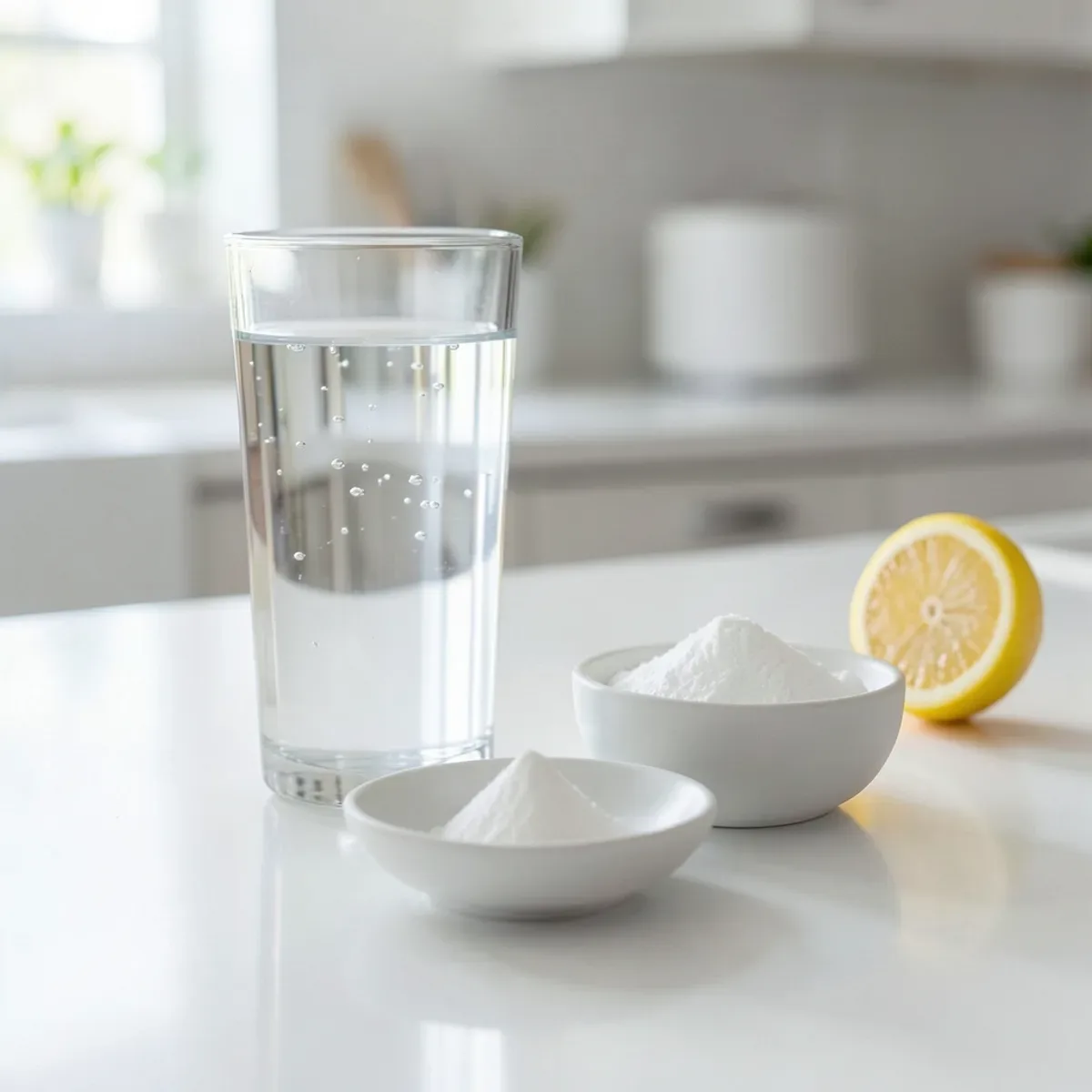
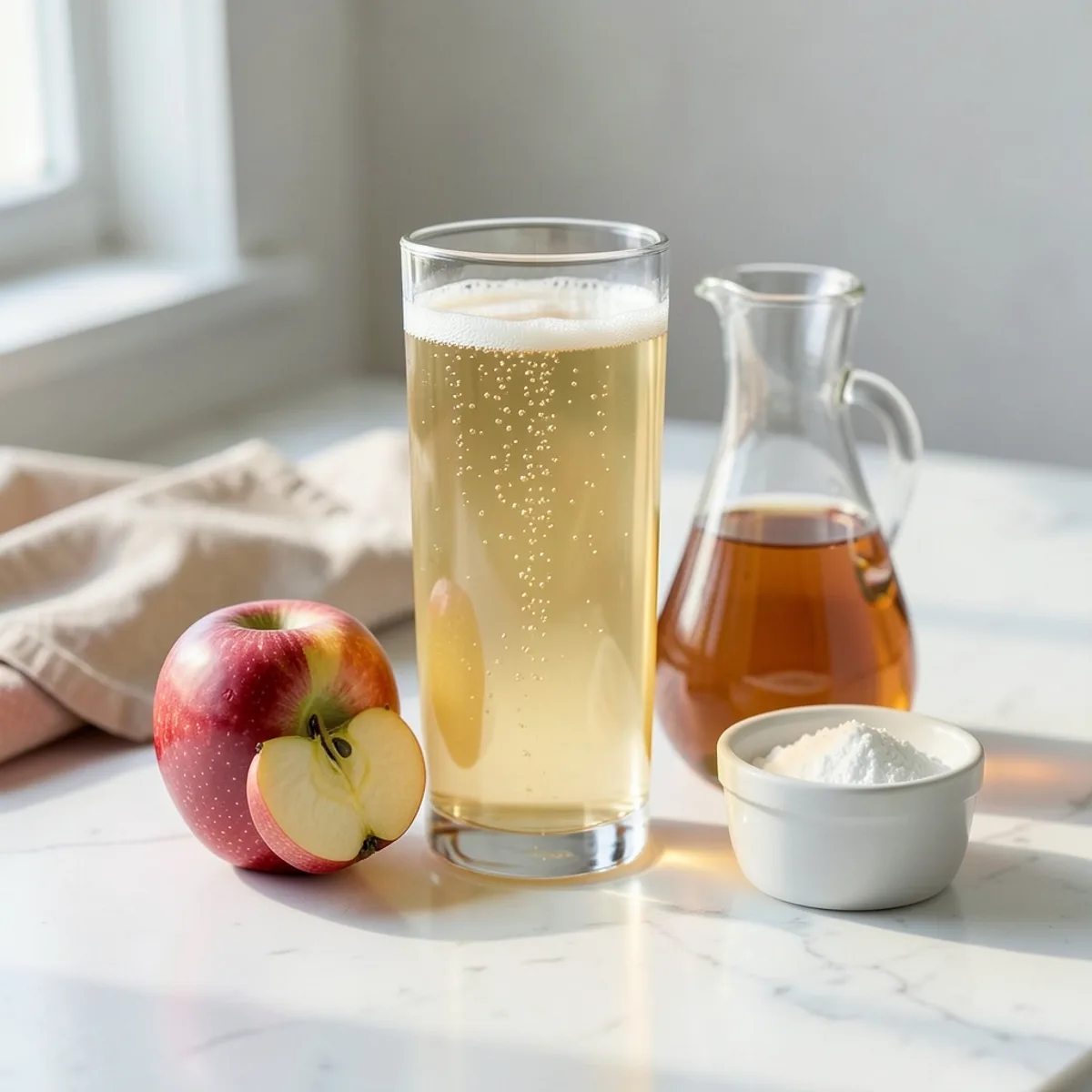
The morning drink is a spoon of baking soda stirred into water and drunk first thing, often with lemon or apple cider vinegar, and sold as a weight-loss move. Most pages describe this version. Their doses disagree, from 1/4 tsp (1.15 g) to 1 tsp (4.6 g) in a glass.
Soda loading means athletes drinking a large, weight-based dose of sodium bicarbonate before hard exercise. MedlinePlus describes drinking it to try to boost athletic performance as dangerous. It has its own research, covered below, and it isn't the morning drink.
Then there's the men's version. A viral ad recipe claims baking soda has an effect on sexual performance. We found no human trial behind that claim, so there's nothing to measure. The safety limits below apply to anyone who drinks it.
One more, to clear the air: the salt and baking soda trick is a household cleaning tip, not a drink, and this page doesn't cover it.
The Food Science / Lab Kitchen Note
Baking soda is sodium bicarbonate. Poison Control says swallowed baking soda rapidly makes a large volume of carbon dioxide, which can build dangerous pressure in the stomach. The risk is higher after heavy drinking or a large meal.
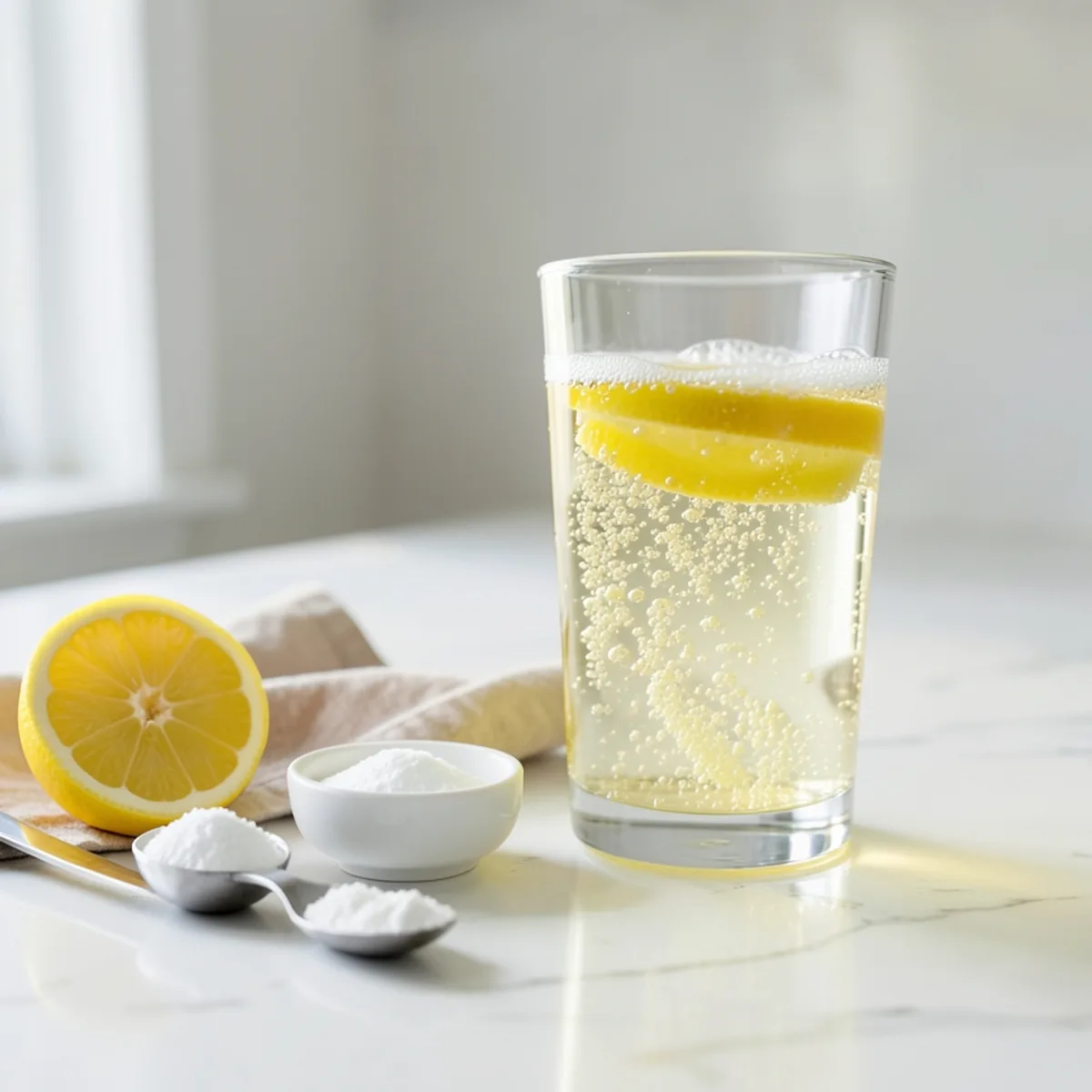
Lemon juice or vinegar makes the glass fizz with carbon dioxide. That changes the bubbles, not the sodium, which stays in the water.
The numbers below are our own arithmetic from published figures, not a study result. USDA FoodData Central lists 27,400 mg of sodium per 100 g of baking soda and 1 tsp as 4.6 g. A level 1/4 tsp (1.15 g) works out to about 315 mg of sodium. A 1/2 tsp (2.3 g) is about 630 mg, and 1 tsp is about 1,260 mg. One brand label on retailer pages lists 616 to 656 mg per 1/2 tsp, so we write about 600 to 650 mg for a half teaspoon.
What the studies show
The weight evidence
The pooled evidence we found is a 2023 systematic review and meta-analysis in Food Science & Nutrition by Navab and colleagues. It pooled 17 randomized trials (21 arms, 2,203 participants), all in patients with chronic kidney disease, and found no significant effect of oral sodium bicarbonate on body weight. It isn't a weight-loss study and says nothing about healthy people. We found no human trial of baking soda for fat loss.
The exercise evidence
For exercise, the 2021 International Society of Sports Nutrition position stand (Grgic and colleagues, 10 statements from an expert panel, a review and not a trial) says 0.2 to 0.5 g per kg of body weight improves high-intensity and muscular-endurance performance, best established for efforts of about 30 seconds to 12 minutes. It also says part of the effect may be placebo. A 2011 meta-analysis in Sports Medicine (Carr, Hopkins and Gore) pooled 59 studies of buffering agents. For sodium bicarbonate (38 studies, 137 estimates) it found a possibly moderate 1.7 percent enhancement, plus or minus 2.0 percent, in a single 1-minute sprint. A 2025 meta-analysis (Miller and colleagues) pooled 11 randomized, double-blind, placebo-controlled crossover studies of continuous running (126 participants, 84 percent male). It found a negligible overall benefit (SMD 0.18, not significant, p = 0.06), with stomach and gut symptoms in 29.5 percent of runs on bicarbonate against 2.6 percent on placebo. None of this speaks to weight.
The gap in dose is the part viral posts skip. The sports panel calls 0.3 g/kg optimal for a single dose. For a 70 kg adult that's about 21 g (about 4.6 tsp, about 5,750 mg of sodium), and even the 0.2 g/kg low end is about 14 g. Our recipe uses 1.15 g, roughly 18 times less than the 21 g figure (our arithmetic). Those numbers are here for contrast. They aren't instructions.
Three versions compared from the data
This is a comparison of published data, not a taste test or a trial of our own. Where nothing is sourced, the cell says so.
| Weight-loss drink | Antacid label use | Exercise dose | |
|---|---|---|---|
| Amount | 1/4 tsp (1.15 g) to 1 tsp (4.6 g) in a glass, per viral cards | no sourced data; follow the product label | 0.2 to 0.5 g per kg, with 0.3 g/kg called optimal for one dose |
| Example | Our card: 1/4 tsp (1.15 g) in 8 fl oz (240 mL) | Dissolve in at least 4 oz (120 mL) of water | About 21 g (about 4.6 tsp) for a 70 kg adult, our arithmetic, contrast only |
| Sodium | About 315 mg to about 1,260 mg, our arithmetic | no sourced data | About 5,750 mg, our arithmetic, about 2.5 times the 2,300 mg daily limit |
| Timing | no sourced time | 1 to 2 hours after meals | 60 to 180 minutes before exercise |
| Evidence | No human fat-loss trial; the kidney meta-analysis found no significant effect on body weight | MedlinePlus lists it for heartburn and gives no weight-loss use | Expert review, mixed meta-analyses, more stomach symptoms than placebo |
Sodium scales with the spoon, so here it is per dose, against the American Heart Association limit of 2,300 mg a day for most adults (ideal limit 1,500 mg):
| Dose | Weight | Sodium (our arithmetic) | Share of 2,300 mg |
|---|---|---|---|
| 1/4 tsp | 1.15 g | About 315 mg | About 14 percent |
| 1/2 tsp | 2.3 g | About 600 to 650 mg | About 27 percent |
| 1 tsp | 4.6 g | About 1,260 mg | About 55 percent |
The AHA also notes the 1,500 mg goal may not fit people who lose a lot of sodium in sweat.
How to make the plain version
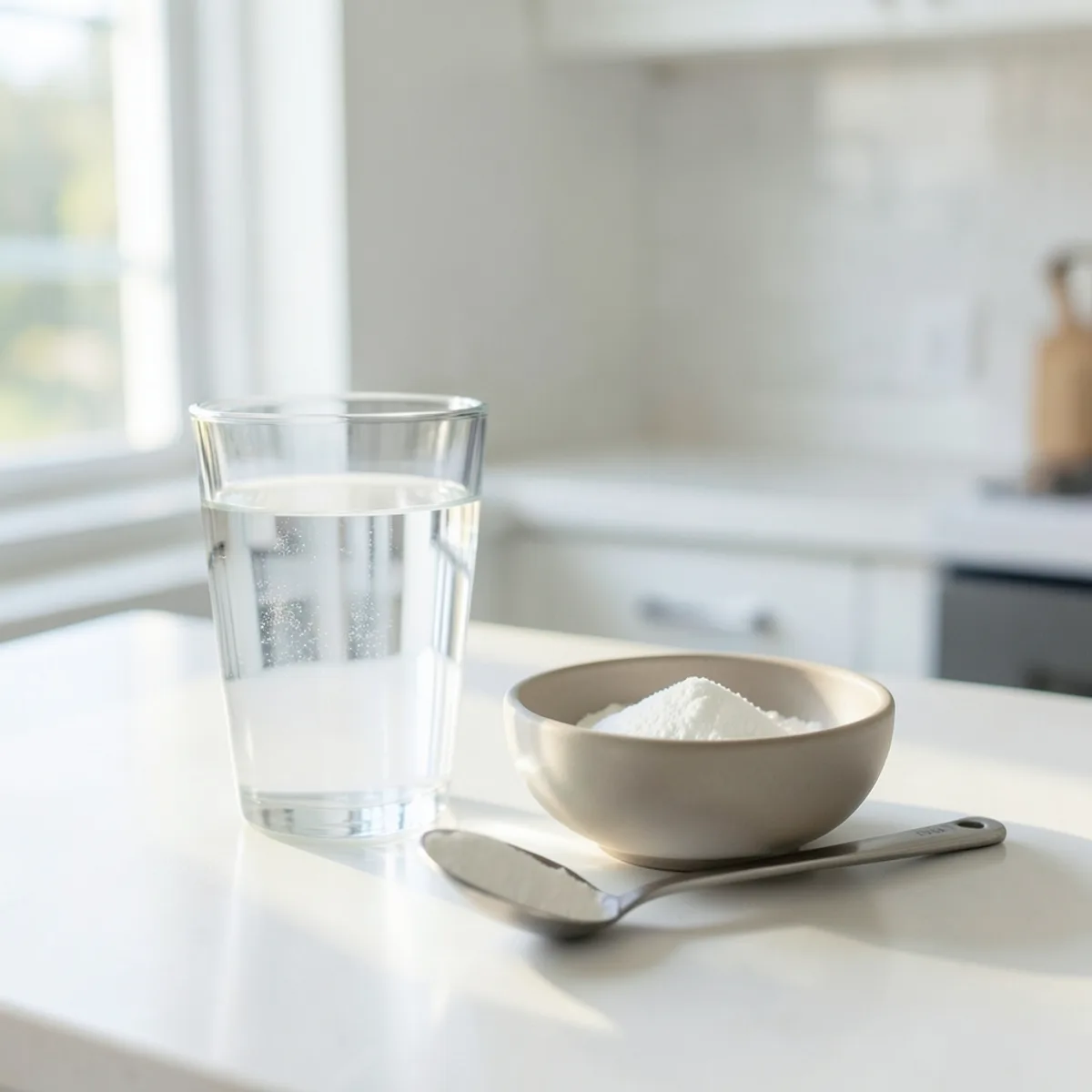
The card above is the whole recipe: 1/4 tsp (1.15 g) in 8 fl oz (240 mL) of plain water, stirred until clear. It's the low end of the viral range, and it's still about 315 mg of sodium in a glass of water.
Many cooks report that baking soda water tastes salty, bitter or soapy, and some say it's hard to get down. The usual workarounds are more water, a pinch of lemon or honey, or mixing it into another drink. Each one changes what's in the glass. If you want the lemon version with the numbers worked out, see baking soda and lemon water. For the vinegar version, see baking soda and apple cider vinegar. The weight-loss ratio with sodium counted is in our baking soda recipe for weight loss.
Common mistakes
Heaping the spoon is the first one. Viral cards run from 1/4 tsp to 1 tsp, and sodium rises in step, so level it with a knife every time.
Next comes drinking it fast on a full stomach. The carbon dioxide has to go somewhere, and Poison Control ties stomach tears to pressure after a large meal. Stir until clear, sip, and keep it away from big meals.
The last is making it a daily habit. MedlinePlus sets a 2-week limit for antacid use. A morning routine has no sourced limit at all, so we don't recommend one.
Substitutes and swaps
| Original | Swap | Proportion | What changes |
|---|---|---|---|
| Baking soda | Baking powder | Not a substitute | A different product, so the drink isn't the same thing |
| Baking soda | Plain water | Not applicable | No added sodium; the option for a sodium-restricted diet |
| Plain water | Lemon juice or apple cider vinegar added to the glass | not tested here | Carbon dioxide fizz and a different taste; the sodium stays |
Storage and handling
Mix one glass and drink it. We found no USDA or FDA storage guidance for baking soda water, so there's no shelf life to quote. Keep the dry box closed and away from moisture and children. No make-ahead tip here. Fresh is the only version we can source.
Nutrition note
Values on the recipe card are estimates calculated from typical USDA FoodData Central values for baking soda and plain water, per glass. They aren't measured. The glass carries 0 kcal and about 315 mg of sodium, all of it from the baking soda. That's about 14 percent of the 2,300 mg daily limit (our arithmetic). Lemon or honey would change the other numbers, but not the sodium.
Servings: 1 glass (about 8 fl oz)
Baking Soda Trick: Does It Work? What Studies Show
The baking soda trick means three different things. Here's what the studies found for each, the sodium in every spoon, and a measured 1/4 tsp version for anyone who still wants to try it.
Ingredients
Equipment
- Measuring spoons (a true 1/4 teaspoon, leveled with a knife)
- Long-handled spoon (for stirring until the water is clear)
Instructions
- Level the soda. Fill a 1/4 teaspoon (1.15 g) with food-grade, aluminum-free baking soda and sweep the top flat with the back of a knife. The spoon should look flush, not mounded.
- Pour the water first. Pour 8 fl oz (240 mL) of plain water into a clear glass before adding anything, so the powder has room to dissolve.
- Stir until dissolved. Add the soda and stir until the water looks clear and no white grains sit on the bottom.
- Sip it fresh. Drink the glass slowly in one sitting, not in one gulp and not on a very full stomach. Mix a new glass each time, since we found no sourced storage time.
Notes
Metric amounts are rounded. The 1.15 g figure is 1/4 teaspoon at the USDA household portion of 4.6 g per teaspoon.
Nutrition values are estimates calculated from typical USDA FoodData Central values for baking soda and plain water. They are not measured. Sodium is our arithmetic from the USDA figure of 27,400 mg per 100 g.
The 8 fl oz (240 mL) of water is our recipe, not a medical rule. MedlinePlus gives at least 4 oz (120 mL) for antacid use.
Nutrition Facts
Per 1 glass (8 fl oz water, 1/4 tsp baking soda) (estimated)
- Total Fat
- 0 g
- Saturated Fat
- 0 g
- Sodium
- 315 mg
- Total Carbohydrate
- 0 g
- Dietary Fiber
- 0 g
- Sugars
- 0 g
- Protein
- 0 g
Frequently asked questions
When is the best time to drink the baking soda trick?
We found no sourced time of day for any weight goal. The only sourced directions are MedlinePlus antacid directions: 1 to 2 hours after meals, in at least 4 oz (120 mL) of water, 2 hours apart from other medicines, and not on a very full stomach.
What are the side effects of the baking soda trick?
MedlinePlus lists thirst, stomach cramps and gas as mild effects, and the sports position stand adds bloating, nausea, vomiting and abdominal pain at exercise doses. After a large amount, call Poison Help at 1-800-222-1222.
What can I use instead of the baking soda trick?
Plain water is the option with no added sodium, which matters on a sodium-restricted diet. Baking powder is a different product and doesn't substitute, and we found no tested swap.
Why does the scale drop in the first days?
We found no study showing that baking soda water changes the number on the scale. A scale reads total body weight, so it can't tell fat from water or lean mass, and a quick drop isn't proof of fat loss.

Steven Dony trained in a restaurant kitchen and lives in Nashville, Tennessee. He covers SodaRecipe’s fact-checks: what works, what does not, and why.
Comments