Drinking Baking Soda and Water Benefits, Ranked
Jump to RecipeWhich claimed benefits of baking soda in water hold up? Sourced verdicts from heartburn to sports to kidney disease, what bicarbonate does in the body, and one measured glass with its sodium in mg.
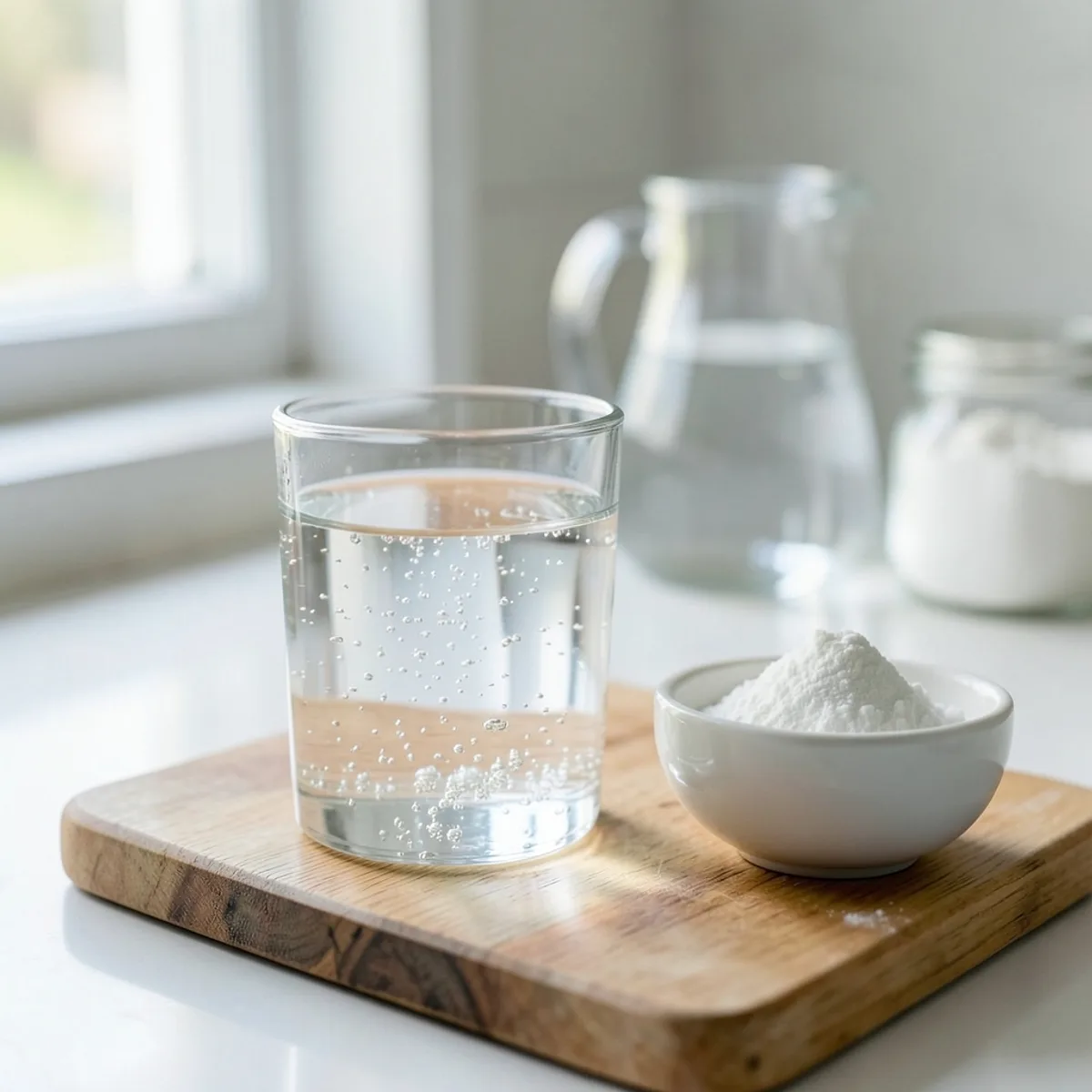 Save
Jump to:
- Drinking baking soda and water benefits, ranked by the evidence
- The Food Science / Lab Kitchen Note: what does baking soda do for your body?
- Three doses compared from the data
- Sports use: real research, a very different dose
- Kidney acidosis: two trials, mixed answers
- Common mistakes
- Substitutes and swaps
- Storage
- Nutrition note
The classic claim goes like this: a glass of baking soda and water cleanses you, turns your body alkaline and melts fat. Here's where it goes wrong. Only one of those has a label behind it, and it's the dullest one, occasional heartburn.
This page ranks each claimed benefit by what the sources say, explains what bicarbonate actually does in your body, and gives you one measured glass. It makes no health promise. For doses and risks in depth, see how much baking soda in water and baking soda side effects.
Drinking baking soda and water benefits, ranked by the evidence
The order below follows what a sourced page can say about a glass like ours. A claim can have real research and still not apply to 1.15 g of powder, so the last column says what that means for your kitchen.
| Claimed benefit | What the sources say | Type of evidence | Verdict for a kitchen glass |
|---|---|---|---|
| Occasional heartburn and acid indigestion | MedlinePlus calls sodium bicarbonate an antacid used for both, and says not to use it longer than 2 weeks unless your doctor tells you to. Healthline rates the evidence limited and short-term (a 2022 review). | Drug information page plus a review | The one recognized use, short term only. See baking soda for heartburn. |
| Exercise performance | The ISSN position stand says it improves performance mainly in efforts of about 30 seconds to 12 minutes, and that part of the effect seems placebo-driven. | Consensus statement based on about 120 primary studies and several meta-analyses | Real research at a dose 12 to 18 times our glass. Not our recipe. |
| Metabolic acidosis in chronic kidney disease | The National Kidney Foundation lists bicarbonate among treatments and says treatment "is highly customized and requires medical supervision." | Two trials with opposite results (see below) | A prescribed treatment for a diagnosed condition. Not a self-treatment. |
| Weight and fat loss | Healthline: no reliable research. | No sourced human trial | Not supported. See does baking soda help you lose weight. |
| Cancer | Healthline: only animal studies and a 2020 minireview calling for large clinical trials. | Animal studies and a minireview | Not supported in people. |
| Inflammation | Healthline: a short, small 2018 study, too brief to recommend. | One small short study | Not enough to go on. |
| Detox, "alkalizing" the body, cleansing the kidneys, skin, urinary infections | No human evidence in the sources behind this page. Healthline also found no evidence that it prevents kidney disease in people who don't have it. | No sourced data | Not supported. |
Notice the pattern. The better the research, the further it sits from a spoonful in a glass.
The Food Science / Lab Kitchen Note: what does baking soda do for your body?
Baking soda is sodium bicarbonate, NaHCO3. Once it's swallowed it does three things, and only three.
It neutralizes some stomach acid. MedlinePlus lists it as an antacid for heartburn and acid indigestion.
It makes carbon dioxide. The reaction gives off gas, which is why the glass fizzes and why belching and bloating follow. The ISSN position stand ties the carbon dioxide formed in the stomach to belching and bloating.
It adds sodium. USDA FoodData Central lists baking soda at 27,360 mg of sodium per 100 g, which is 273.6 mg per gram, and weighs a teaspoon at 4.6 g. A 1/4 teaspoon is 1.15 g. That division is ours, not a USDA portion. The math: 1.15 g x 273.6 mg/g = about 315 mg. The FDA puts the Daily Value for sodium at less than 2,300 mg per day, so 315 mg is 13.7%, about 14%. A level 1/2 tsp (2.3 g) is about 629 mg, or 27.4%. A level teaspoon (4.6 g) is about 1,259 mg, or 54.7%.
The FDA also says Americans eat about 3,400 mg of sodium a day on average, and that uncontrolled high blood pressure can raise the risk of heart attack, heart failure, stroke, kidney disease and blindness. The glass adds to whatever else you ate that day. Our page on how much sodium is in baking soda water has the full spoon-by-spoon table.
Three doses compared from the data
This is a comparison of sourced and calculated numbers, not something we tried at home. Where we found no source for a figure, the cell says so.
| Our glass (recipe card) | Antacid label dose | Sports dose (ISSN) | |
|---|---|---|---|
| Baking soda | 1/4 tsp (1.15 g) | No sourced data here; see how much baking soda in water | 0.2 to 0.3 g/kg, so 14 to 21 g at 70 kg (our arithmetic) |
| Water | 8 fl oz (240 mL) | At least 4 oz (120 mL), the MedlinePlus minimum | No sourced data |
| Sodium | About 315 mg | No sourced data | About 3,830 to 5,750 mg (our math), more than the whole 2,300 mg Daily Value |
| Timing | No sourced rule; not on an overly full stomach | 1 to 2 hours after meals, for heartburn | 60 to 180 minutes before exercise |
| Duration | No sourced limit | Not longer than 2 weeks unless a doctor says so | A single dose before exercise |
| Purpose | Our recipe, not a medical rule | Antacid (MedlinePlus) | Athletic protocol, not a recipe |
The sports column is not the same thing as the first column. At 70 kg it's about 12 to 18 times our 1.15 g, and its sodium alone tops the daily limit. We don't recommend it, and we don't give a sports recipe. For the heartburn timing in more detail, see the best time to drink baking soda water.
Sports use: real research, a very different dose
The ISSN position stand (Grgic and 16 co-authors, Journal of the International Society of Sports Nutrition, 2021) is a consensus statement drawing on about 120 primary studies and several meta-analyses. It names a single dose of at least 0.2 g/kg, with 0.3 g/kg as optimal, taken 60 to 180 minutes before exercise. The gain shows up mainly in efforts of about 30 seconds to 12 minutes.
It also lists the cost: bloating, nausea, vomiting and abdominal pain are the most common side effects, and it says a portion of the effect seems placebo-driven. Healthline's fact-checked 2024 article adds the small print, a 2021 trial of 11 trained male cyclists and a 2021 review for high-intensity efforts up to 12 minutes. That's athletes, at sports doses, for short hard efforts. It says nothing about a morning glass.
Kidney acidosis: two trials, mixed answers
MedlinePlus describes metabolic acidosis as too much acid in the body fluids, which can happen when the kidneys can't remove enough acid. A health care provider makes the diagnosis, and in some cases sodium bicarbonate, "the chemical in baking soda," may be given to reduce the acidity of the blood. That's a diagnosed condition, not a reason to drink baking soda at home.
The first trial leaned positive. De Brito-Ashurst and colleagues (Journal of the American Society of Nephrology, 2009) ran a single-center, open-label trial, so no placebo and no blinding, in 134 adults with stage 4-5 chronic kidney disease. They gave oral sodium bicarbonate averaging 1.82 g a day against standard care for 2 years. Creatinine clearance fell 1.88 versus 5.93 ml/min per 1.73 m2, rapid progression was 9% versus 45%, and end-stage kidney disease was 6.5% versus 33%. Worsening hypertension needing more treatment was 61% versus 48% (P = 0.17), and worsening edema was 39% versus 30%. The authors called for multicenter placebo-controlled confirmation.
The second trial was double-blind and didn't confirm it. BiCARB (BMC Medicine, 2020) enrolled 300 adults aged 60 or older with advanced chronic kidney disease, giving 1.5 to 3 g a day of sodium bicarbonate or placebo for up to 2 years. Physical function didn't improve (SPPB adjusted difference -0.4, 95% CI -0.9 to 0.1), nor did kidney function (eGFR difference 0.6, 95% CI -0.8 to 2.0). Six-minute walk distance was 33 m lower with bicarbonate, and adverse events were higher overall (457 versus 400), including gastrointestinal (45 versus 25) and cardiac (32 versus 19). The authors concluded it did not improve physical or renal function and increased adverse events. Together, the kidney evidence is mixed, and every participant had advanced kidney disease and was under medical care.
Common mistakes
Copying the first dose you find. Pages online don't all give the same dose for this drink. Work from MedlinePlus for the water minimum and from your own spoon for the powder.
A heaped spoon, or powder that isn't dissolved. USDA weighs a level teaspoon at 4.6 g, so a heaped one adds sodium fast. Level it with a knife, stir until the glass is clear, and expect fizz.
Turning it into a shot. Less water skips the dilution rule. Keep it at 4 oz (120 mL) or more, and don't take it on an overly full stomach.
Substitutes and swaps
| Original | Swap | Proportion | What changes |
|---|---|---|---|
| Baking soda in the glass | A lower-sodium version | No sourced data | We found no sourced low-sodium substitute, so we don't recommend one. |
| 8 fl oz (240 mL) of water | Less water | Not below 4 oz (120 mL) | That's the MedlinePlus minimum for dissolving the powder. Our 8 fl oz is just our recipe. |
| Our 1/4 tsp (1.15 g) | The sports dose | Not a swap | A different protocol at 12 to 18 times the powder. |
Storage
Mix one glass and drink it. We found no sourced shelf life for the mixed drink, so we give no number of hours, and there's nothing to reheat.
Nutrition note
Values on the recipe card are estimates calculated from typical USDA FoodData Central values for baking soda, per glass of 8 fl oz with 1/4 tsp (1.15 g). Plain water adds none, so calories, carbohydrate, protein, fat, sugars and fiber are all zero. The only value above zero is sodium: about 315 mg, roughly 14% of the 2,300 mg Daily Value. This glass has no ingredient variant to choose, and the numbers are not measured.
Servings: 1 glass (8 fl oz)
Drinking Baking Soda and Water Benefits, Ranked
Which claimed benefits of baking soda in water hold up? Sourced verdicts from heartburn to sports to kidney disease, what bicarbonate does in the body, and one measured glass with its sodium in mg.
Ingredients
Equipment
- Measuring spoons (a true 1/4 teaspoon, leveled with the back of a knife)
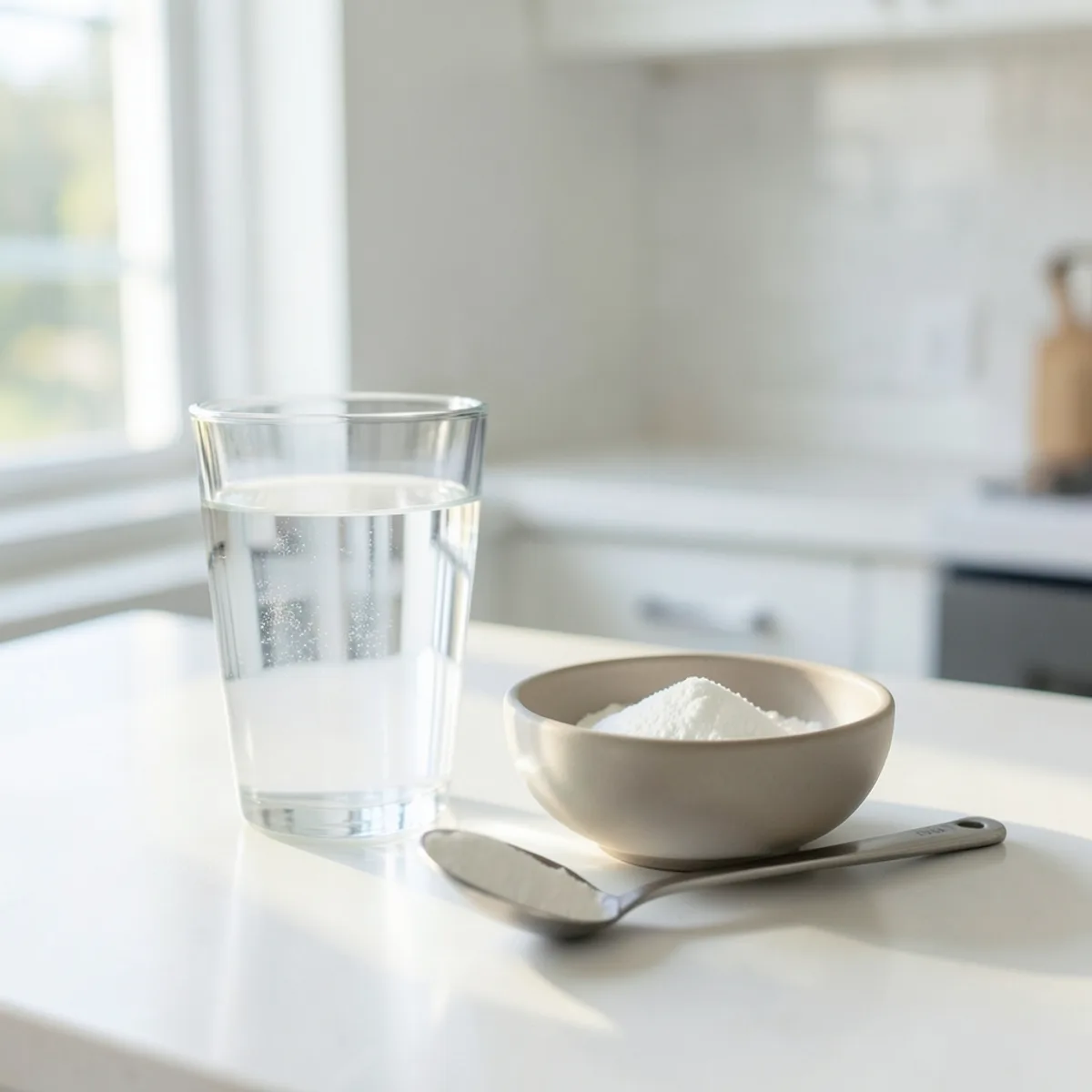
- Clear glass and spoon (so you can see when no white grains are left)
Instructions
- Check the box. Read the ingredient list. You want sodium bicarbonate only, food-grade and aluminum-free.
- Level the spoon. Fill a 1/4 teaspoon (1.15 g) and sweep the top flat with the back of a knife. A heaped spoon holds more, and the sodium rises with it.
- Pour the water first. Pour 8 fl oz (240 mL) of cool water into a clear glass. Don't go below 4 oz (120 mL), the minimum MedlinePlus gives for dissolving the powder.
- Stir until clear. Add the baking soda and stir until the water is clear and no white grains sit at the bottom. It will fizz as it releases carbon dioxide.
- Sip, don't gulp. Wait for the fizz to settle, then drink slowly, not on an overly full stomach. Mix one glass at a time and don't save leftovers.
Notes
Metric amounts are rounded. The 1.15 g figure is our division of the USDA household weight of 4.6 g per teaspoon, not a USDA portion.
The 8 fl oz (240 mL) of water is our recipe. MedlinePlus gives at least 4 oz (120 mL) as the minimum for dissolving the powder. It is not a medical rule.
Nutrition values are estimates calculated from typical USDA FoodData Central values for baking soda (27,360 mg of sodium per 100 g). Plain water adds none. They are not measured.
Nutrition Facts
Per 1 glass (8 fl oz water, 1/4 tsp baking soda) (estimated)
- Total Fat
- 0 g
- Saturated Fat
- 0 g
- Sodium
- 315 mg
- Total Carbohydrate
- 0 g
- Dietary Fiber
- 0 g
- Sugars
- 0 g
- Protein
- 0 g
Frequently asked questions
When is the best time to drink baking soda water?
For heartburn, MedlinePlus says to take it 1 to 2 hours after meals with a full glass of water, not on an overly full stomach, and at least 2 hours apart from other medicines. The ISSN sports window of 60 to 180 minutes before exercise belongs to a far larger dose, so it is not a timing rule for our glass.
What are the side effects of drinking baking soda and water?
MedlinePlus lists increased thirst, stomach cramps and gas as milder effects to report if severe or persistent. At sports doses the ISSN names bloating, nausea, vomiting and abdominal pain, and in the BiCARB kidney trial the bicarbonate group had more gastrointestinal events (45 versus 25).
What can you use instead of baking soda and water?
We found no sourced alternative or low-sodium swap in the sources behind this page, so we don't name one. For occasional heartburn a pharmacist can point to other antacids, and plain water adds no sodium.
Does drinking baking soda and water help you lose weight?
Healthline's review of the viral claims found no reliable research that it does. A glass has zero calories and about 315 mg of sodium by our calculation, and nothing in the sources links it to fat loss.

Steven Dony trained in a restaurant kitchen and lives in Nashville, Tennessee. He covers SodaRecipe’s fact-checks: what works, what does not, and why.
Comments