Baking Soda Horse Trick: What Studies Show (and Risks)
Jump to RecipeThe baking soda horse trick means three different things. Here's what the horse research found, the sodium in every spoon, who should skip it, and a measured plain glass for reference.
 Save
SaveJump to:
Here's where the phrase goes wrong first: it isn't one trick. A viral ad recipe promises a boost for men. Racehorses get a bicarbonate "milkshake." And some pages describe a gelatin drink with a pinch of baking soda. This page sorts out the three, shows what the research found for each, and puts the sodium in milligrams. The broader weight question lives in the baking soda trick.
What does "baking soda horse trick" mean?
Search the phrase and you land on three different things.
The first is the viral ad recipe. It claims a benefit for men from a baking soda drink. We found no human trial behind it, so there's nothing to measure, and this page gives no steps for it.
The second is the racehorse "milkshake." The Conversation (Denham and Hulme, November 2020) describes it as baking soda in water, given through a tube up the nose into the stomach before a race. Racing Australia bans these alkalising agents on race day. The risks named are injury to the nasal cavity, throat and oesophagus, digestive upset, diarrhoea, and lung entry if the tube goes into the windpipe, which can be fatal. That's a horse procedure. It has nothing to do with a glass in your kitchen.
The third is the "horse gelatin trick." Pages describe a gelatin drink with an optional pinch of baking soda. Those pages came from sources we couldn't verify, so we treat the recipe as unsourced and don't repeat it. As far as those pages say, the gelatin is ordinary unflavored gelatin. That would make the name a label, not a different product, but we couldn't verify it. We also saw the phrase used for a soda-chugging stunt. We found no sourced data on it, and it isn't a baking soda drink.
The Food Science / Lab Kitchen Note
Baking soda is sodium bicarbonate. Poison Control says swallowed baking soda rapidly makes a large volume of carbon dioxide, which can cause dangerous pressure in the stomach. The risk is higher after heavy drinking or a large meal. That gas is the reason "dilute it, sip it, skip a full stomach" matters more than any ratio.
Sodium is the other half. USDA FoodData Central lists baking soda at 27,400 mg of sodium per 100 g, with 1 tsp at 4.6 g. The numbers below are our own arithmetic, not a study result. A level 1/4 tsp (1.15 g) is about 315 mg of sodium. A 1/2 tsp (2.3 g) is about 630 mg, and 1 tsp (4.6 g) about 1,260 mg.
The FDA gives the sodium Daily Value as less than 2,300 mg a day. Against that, 1/4 tsp is about 14%, 1/2 tsp about 27% and 1 tsp about 55% (our arithmetic). All of it comes from the baking soda. Water adds none.
Three meanings compared from the data
This is a comparison of published data, not a taste test or a trial of our own. Where nothing is sourced, the cell says so.
| Viral ad recipe | Racehorse bicarbonate milkshake | Measured plain glass (our recipe) | |
|---|---|---|---|
| Amount | no sourced data | no sourced data on the dose in the pages we read | 1/4 tsp (1.15 g) in 8 fl oz (240 mL) |
| How it's given | no sourced data | Tube through the nose into the stomach | Stirred and sipped |
| Timing | no sourced data | 2.5 to 5 hours before a treadmill test or simulated race, in the trials | no sourced time |
| Sodium | no sourced data | no sourced data | About 315 mg, about 14% of 2,300 mg (our arithmetic) |
| Evidence | No human trial found | 8 trials, 74 horses: no change in running performance | Antacid directions from MedlinePlus; sodium from USDA data |
What the studies show
The horse research
The main source is a systematic review and meta-analysis by Denham and Hulme in the Journal of Equine Veterinary Science, 2020. It pooled randomized trials: 8 experimental trials with 74 trained Standardbred and Thoroughbred horses. Sodium bicarbonate given 2.5 to 5 hours before a treadmill test or simulated race did not change running performance. Those are animal studies, not human ones, so they can't confirm or rule out anything for a person. We read the repository record and The Conversation summary, not the full paper.
The human risk reports
Humans show up in two other sources. A California Poison Control System review (J Clin Pharm Ther, 2014) looked back at 192 symptomatic baking soda cases from 2000 to 2012. Twelve were admitted for electrolyte imbalance, metabolic alkalosis or respiratory depression. The authors flag chronic antacid users, pregnant women and young children among the highest-risk groups. A case review shows who gets into trouble, not how often it happens, and we read the abstract only.
Poison Control adds a single case: a 54-year-old woman drank about half a glass for indigestion after a large meal, had a 5 cm stomach tear and lost her stomach to surgery. One case shows a risk, not a rate.
The sports dose is a different thing
Some pages borrow the athlete angle to make the trick sound serious. The ISSN position stand (2021, an expert panel review, not a trial) gives 0.3 g per kg of body weight as the optimal single dose for exercise performance and 0.2 g/kg as the minimum effective dose, taken 60 to 180 minutes before exercise. For a 70 kg adult that's about 14 to 21 g, about 12 to 18 times the 1.15 g in our glass (our arithmetic). Common side effects there include bloating, nausea, vomiting and abdominal pain. These numbers are for contrast only. They aren't an instruction.
How to make the plain glass
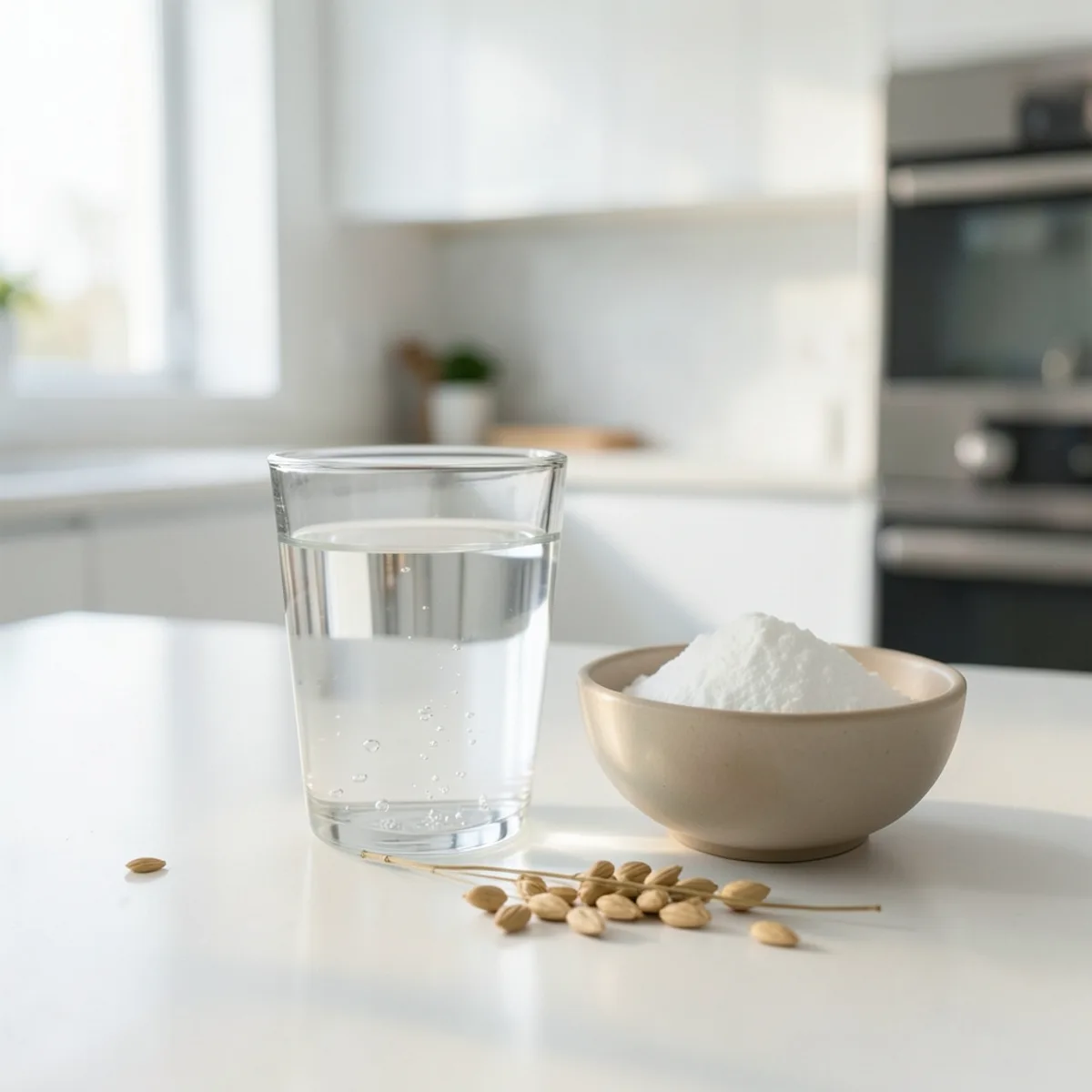
The card above is the whole recipe: 1/4 tsp (1.15 g) food-grade, aluminum-free baking soda in 8 fl oz (240 mL) of plain water, stirred until clear. It is a reference glass, not the viral ad recipe, and it isn't a treatment.
MedlinePlus gives these antacid directions: dissolve the powder in at least 4 oz (120 mL) of water, take it 1 to 2 hours after meals with a full glass of water, avoid an overly full stomach, and keep at least 2 hours between it and other medicines. It says not to use it for more than 2 weeks unless a doctor says so. Our 8 fl oz (240 mL) is double that minimum, by our choice.
For the dose chart by use, see how much baking soda in water. The sodium and side-effect detail is in baking soda side effects. For another viral claim that borrows the baking soda glass, see Vicks and baking soda.
Common mistakes
Heaping the spoon is the first one. Sodium rises with every extra grain, so level it with a knife.
Next comes the concentrated shot. A spoon of powder in a splash of water is the version where the gas and the sodium hit hardest. Use a full glass, and stir until the water is clear.
The last is drinking it on a full stomach, or alongside medicines. Poison Control ties stomach tears to pressure after a large meal, and MedlinePlus says to keep 2 hours between baking soda and other medicines.
Substitutes and swaps
| Original | Swap | Proportion | What changes |
|---|---|---|---|
| Baking soda | Baking powder | Not a substitute | A different product, so the drink isn't the same thing |
| Baking soda | Plain water | Not applicable | No added sodium; the option for a sodium-restricted diet |
Storage and handling
Mix one glass and drink it. We found no USDA or FDA shelf life for mixed baking soda water, so there's no make-ahead version and no duration to quote.
Nutrition note
Values on the recipe card are estimates calculated from typical USDA FoodData Central values for baking soda and plain water, per glass. They aren't measured. The glass carries 0 kcal and about 315 mg of sodium, about 14% of the 2,300 mg daily limit (our arithmetic). The calculation uses plain water and baking soda only, with nothing else added.
Servings: 1 glass (about 8 fl oz)
Baking Soda Horse Trick: What Studies Show (and Risks)
The baking soda horse trick means three different things. Here's what the horse research found, the sodium in every spoon, who should skip it, and a measured plain glass for reference.
Ingredients
Equipment
- Measuring spoons (a true 1/4 teaspoon, leveled with a knife)
- Long-handled spoon (for stirring until the water is clear)
Instructions
- Level the soda. Fill a 1/4 teaspoon (1.15 g) with food-grade, aluminum-free baking soda and sweep the top flat with the back of a knife. The spoon should look flush, not mounded.
- Pour the water first. Pour 8 fl oz (240 mL) of plain water into a clean glass before adding anything, so the powder has room to dissolve. Never mix it as a concentrated shot.
- Stir until dissolved. Add the soda and stir until the water looks clear and no white grains sit on the bottom. Nothing else goes in this glass.
- Sip it fresh. Drink the glass slowly in one sitting, and not on a very full stomach. Mix a new glass each time, since we found no sourced storage time.
Notes
This card is a plain baking soda glass for reference. It is not the viral ad recipe and not a treatment.
Metric amounts are rounded. The 1.15 g figure is 1/4 teaspoon at the USDA household portion of 4.6 g per teaspoon.
Nutrition values are estimates calculated from typical USDA FoodData Central values for baking soda and plain water. They are not measured. Sodium is our arithmetic from the USDA figure of 27,400 mg per 100 g.
The 8 fl oz (240 mL) of water is our recipe, not a medical rule. MedlinePlus gives at least 4 oz (120 mL) for antacid use.
Nutrition Facts
Per 1 glass (8 fl oz water, 1/4 tsp baking soda) (estimated)
- Total Fat
- 0 g
- Saturated Fat
- 0 g
- Sodium
- 315 mg
- Total Carbohydrate
- 0 g
- Dietary Fiber
- 0 g
- Sugars
- 0 g
- Protein
- 0 g
Frequently asked questions
When should you drink baking soda water, if at all?
We found no sourced time of day for the horse trick. The only sourced directions are MedlinePlus antacid ones: 1 to 2 hours after meals with a full glass of water, not on an overly full stomach, and 2 hours apart from other medicines.
What are the side effects of the baking soda horse trick?
MedlinePlus lists increased thirst, stomach cramps and gas, and Poison Control describes dangerous stomach pressure from the carbon dioxide. After a large amount, call Poison Help at 1-800-222-1222.
Is horse gelatin different from regular gelatin?
Pages we could not verify describe ordinary unflavored gelatin, so the name points to a trend and not to a horse product. We found no reliable source on the claim, and this page gives no gelatin recipe.
What can you do instead of the baking soda horse trick?
Plain water adds no sodium, which matters on a sodium-restricted diet. Baking powder is a different product and doesn't substitute, and we found no sourced swap.

Steven Dony trained in a restaurant kitchen and lives in Nashville, Tennessee. He covers SodaRecipe’s fact-checks: what works, what does not, and why.
Comments