1 Tsp Baking Soda in Grams: Why Sources Differ
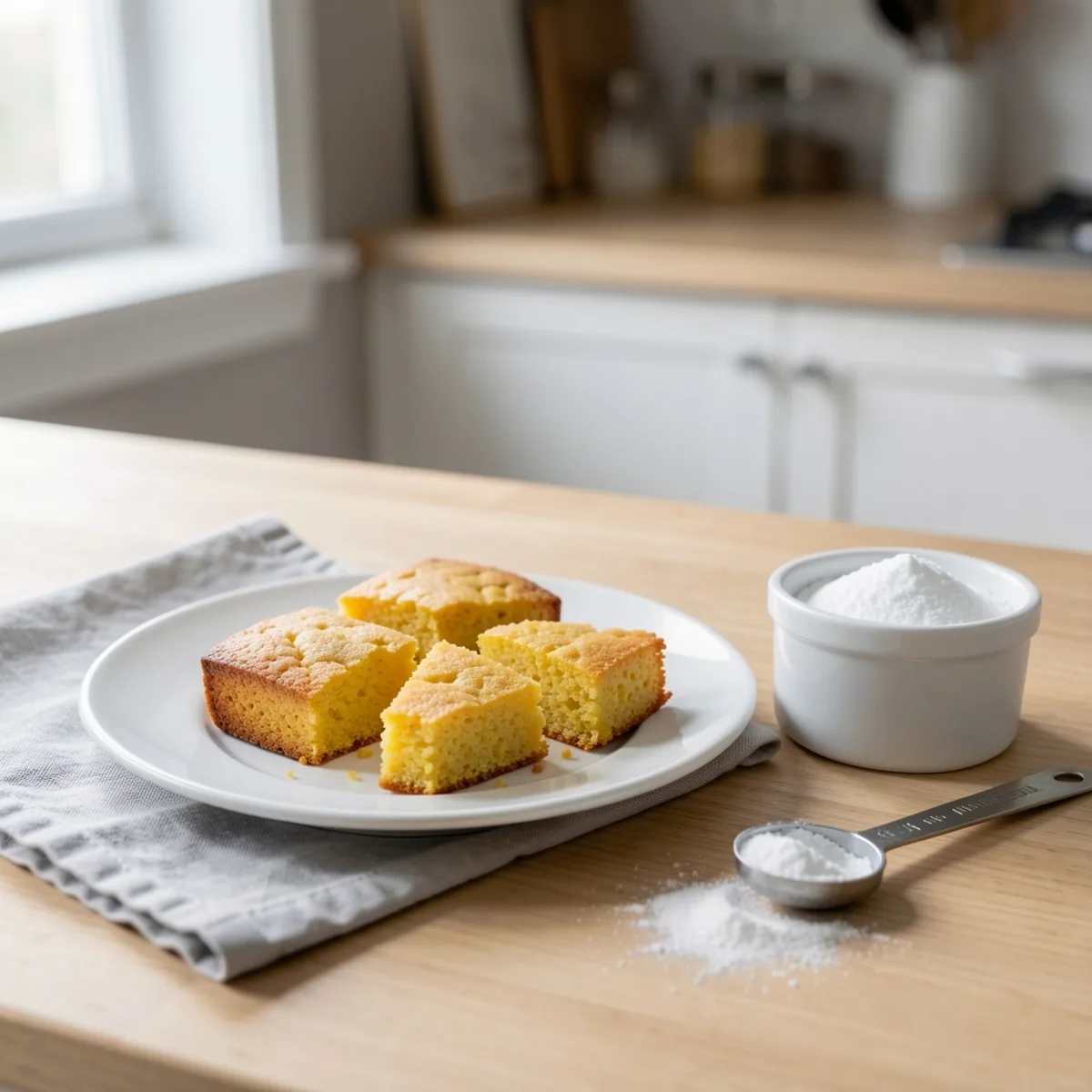
Jump to RecipeOne teaspoon of baking soda is 4.6 g, 4.8 g or 6 g depending on the source. Here is why, the sodium per spoon, and a buttermilk skillet cornbread written in grams.
 Save
Jump to:
A level spoon of baking soda looks like a small thing. But ask three sources how much it weighs and you get three answers. In a recipe written in grams, that gap matters.
This page gives you the number, shows where each number comes from, and then puts it to work in a buttermilk skillet cornbread written in grams. The conversion work is sourced. The recipe and its quantities are ours.
- You get 1/8, 1/4, 1/2 and 1 teaspoon and 1 tablespoon in grams.
- You see why King Arthur, USDA-based data and the Arm & Hammer label disagree.
- You get the sodium per spoon and per wedge, labeled as our own math.
How many grams is 1 tsp of baking soda?
Here's why you can't get one clean answer. The USDA-based figure is 4.6 g per teaspoon and 13.8 g per tablespoon. One nutrition database that cites USDA uses 4.5 g per teaspoon, so even the USDA-based numbers shift a little. The USDA portion table itself couldn't be opened for this page, so these are USDA-based values, not a direct USDA quote.
King Arthur's ingredient weight chart lists baking soda on a single row: 1/2 teaspoon is 1/10 ounce, or 3 grams. That implies 6 g per teaspoon. The chart has no other baking soda volume. And 1/10 ounce is 2.8 g, so the 3 g looks rounded to a whole gram. That is our inference, not something the chart says.
The Arm & Hammer Pure Baking Soda label lists a serving of 1/8 tsp as 0.6 g, which implies 4.8 g per teaspoon. This page works with 4.6 g and 14 g per tablespoon, and shows the other two beside it.
Converter sites land between 4.4 g and 4.8 g per teaspoon. One of them gives 4.44 g in its title but 5.0 g in its own table. Another gives 4.8 g per teaspoon and 21.6 g per tablespoon, which doesn't add up, since three times 4.8 is 14.4. Check the arithmetic before you trust a chart.
Another page on this site, difference between baking soda and baking powder, uses 6 g per teaspoon. That is King Arthur's rounded chart value, not a mistake. It's one source among the three below, and each page says which one it uses.
The Food Science / Lab Kitchen Note
Baking soda is sodium bicarbonate, NaHCO₃. When it meets an acid such as buttermilk, yogurt or vinegar, it releases carbon dioxide (CO₂). Arm & Hammer says baking soda needs an acid like that to activate, and the gas is what lifts the batter.
Why does the weight move? A teaspoon measures volume, and two converter pages say the weight shifts with packing, brand, humidity, settling or compression in the box, and how you fill the spoon. One of them estimates real-world variation at about 6%. Baking soda is also lighter than water: about 4.58 g per teaspoon against 4.9 g for water.
Then rounding piles on. King Arthur rounds to whole grams. The Arm & Hammer label rounds to 0.1 g. A 0.6 g serving read from a label can hide a few hundredths either way, and multiplying it by eight carries that error up to the teaspoon.
There's a scale problem, too. One opinion piece (not a study) reports that its scale read 0 g for a quarter teaspoon of baking soda and says a 3 g amount can be off by about 33% at 1 g resolution. Its author recommends a 0.01 g pocket scale. If you don't own one, a level spoon is the better tool for amounts this small.
Grams and sodium per spoon
Sodium comes from USDA FoodData Central values for baking soda, about 27,400 mg per 100 g (the full-precision listing shows 27,360 mg). We read it through a mirror site, so we don't claim more precision than that. The per-spoon numbers below are our math from that value and each source's weight. The 2,300 mg Daily Value comes from the FDA.
Three sources compared
This table compares published data, not finished bakes. Where a source gives no value, the cell says so.
| Measure | Arm & Hammer label (our math from the 1/8 tsp serving) | USDA-based (4.6 g per tsp) | King Arthur chart (6 g per tsp is implied) |
|---|---|---|---|
| 1/8 tsp | 0.6 g, 150 mg sodium (label) | 0.6 g, about 160 mg (our math) | No sourced data |
| 1/4 tsp | 1.2 g, 300 mg (13% DV) | 1.15 g, about 315 mg (14% DV) | No sourced data |
| 1/2 tsp | 2.4 g, 600 mg (26% DV) | 2.3 g, about 630 mg (27% DV) | 3 g (chart, rounded), about 820 mg (our math) |
| 1 tsp | 4.8 g, 1,200 mg (52% DV) | 4.6 g, about 1,260 mg (55% DV) | 6 g (our arithmetic), about 1,640 mg (71% DV) |
| 1 tbsp | 14.4 g, about 3,600 mg (our math) | 13.8 g, about 3,780 mg (our math) | 18 g (our arithmetic), about 4,930 mg (our math) |
Sodium percentages are of the 2,300 mg Daily Value. The label values for 1/4, 1/2 and 1 tsp are the 1/8 tsp serving multiplied, which is our math. The cupsandgrams.com converter lists 1/8 tsp as 0.573 g and 1 tbsp as 13.75 g, close to the USDA-based column.
Buttermilk skillet cornbread in grams
The full list and steps are on the recipe card. These are the points that matter.
The soda is there for the buttermilk. Our dose is 1/2 tsp (2.3 g) for 1 cup of flour plus 1 cup of cornmeal, which is 1/4 tsp per cup of dry mix. Arm & Hammer says recipes typically use 1/4 teaspoon per cup of flour, so the dose sits where that guidance points (counting the cornmeal as flour, our reading).
Weigh the cornmeal. America's Test Kitchen's Southern-style buttermilk cornbread advises it, because grind size changes the volume. We use that recipe only as a reference for doneness: it bakes 16 to 18 minutes at 450 degrees F in a 10-inch cast-iron skillet, with a different batter. Ours is our own, with its own estimated time. Our time is an estimate, so check doneness with a toothpick.
If you want the leavener math on other swaps, the baking soda replacement page has ratios in teaspoons and grams. The baking soda instead of baking powder page covers the other direction.
Common mistakes
Heaping the spoon. A heaped teaspoon holds more powder than a level one, so none of the weights on this page apply to it. Fill the spoon and level it with a straight edge.
Trusting a 1 g scale for 1/2 tsp. At that resolution, a small amount can read as zero or be off by a large share. Weigh the cornmeal, flour and buttermilk on the scale. Measure the soda with a level spoon, or use a 0.01 g scale.
Mixing sources in one recipe. If you take 6 g from one chart and 4.6 g from another, your dose changes by more than a quarter. Pick one source and stay with it. This recipe uses 4.6 g per teaspoon throughout.
What if you don't have what the recipe calls for
| Original | Replacement | Proportion | What changes |
|---|---|---|---|
| Baking soda | Baking powder | Not repeated here | See can I use baking soda instead of baking powder for the sourced amounts. |
| Baking soda | Another leavener | Not repeated here | See baking soda replacement. |
| Buttermilk | Yogurt or vinegar-soured milk | No sourced proportion | Arm & Hammer names yogurt and vinegar as acids that activate soda. We give no amounts, and the batter will differ. |
| Cornmeal brand | Another grind | Weigh it | Grind size changes volume, so the grams matter more than the cups. |
Sodium in the cornbread
Our math from the card: the whole pan holds about 2,200 mg of sodium, and about 275 mg per wedge, roughly 12% of the 2,300 mg Daily Value. The 1/2 tsp of soda adds about 630 mg to the pan, or about 79 mg a wedge. Most of the rest comes from the salt and the buttermilk. These are estimates, not measurements.
Storing the cornbread and the box
Cool the cornbread completely, then keep it covered in the fridge. To reheat, warm it in the skillet or the oven until it's hot through. No storage time is sourced for this recipe, so this page gives none.
The box matters too. Humidity changes how powder packs, so keep it closed.
Where the numbers come from
The 4.6 g and 13.8 g per teaspoon and tablespoon are USDA-based values, read through converter and nutrition-database pages. The USDA portion table itself couldn't be opened, so we don't present them as a direct USDA quote. The 6 g per teaspoon is King Arthur's chart value doubled, a reference chart with whole-gram rounding. The 4.8 g per teaspoon is the Arm & Hammer label serving, multiplied by eight.
The sodium values come from USDA FoodData Central, a government nutrient database listed per 100 g, and the 2,300 mg Daily Value comes from the FDA. The per-spoon and per-wedge figures are our math on top of them, not measurements. The reasons weight varies come from two converter pages, and the scale-resolution point comes from a single opinion piece, so treat both as reported, not as a controlled comparison. We found no study that weighed baking soda teaspoons across brands.
Servings: 8 wedges from one 10-inch skillet
1 Tsp Baking Soda in Grams: Why Sources Differ
One teaspoon of baking soda is 4.6 g, 4.8 g or 6 g depending on the source. Here is why, the sodium per spoon, and a buttermilk skillet cornbread written in grams.
Ingredients
Dry ingredients
Wet ingredients
For the skillet
Equipment
- 10-inch cast-iron skillet (preheated with the butter)
- Kitchen scale (for the cornmeal, flour, sugar and buttermilk)
- Level measuring spoons (for the soda and salt, because most home scales can't read 2.3 g)
- Mixing bowl
Instructions
Heat the skillet
- Preheat the oven and skillet. Put the skillet in the oven and heat the oven to 425 degrees F (our setting). Add the 1 tablespoon of skillet butter for the last few minutes so it melts and coats the pan.
Mix and bake
- Whisk the dry ingredients. Weigh the cornmeal, flour and sugar into a bowl. Add the level 1/2 tsp of baking soda and the salt, then whisk well so the soda is spread evenly through the dry mix.
- Whisk the wet ingredients. Whisk the buttermilk, the egg and the 3 tablespoons of melted butter together until smooth.
- Combine just until mixed. Pour the wet mixture into the dry and stir just until no dry cornmeal shows. The soda starts making gas on contact with the buttermilk, so move straight to the pan.
- Pour into the hot skillet. Carefully pour the batter into the hot, buttered skillet. It should sizzle at the edges. Level the top with a spatula.
- Bake and check doneness. Bake until the top is golden and a toothpick in the center comes out clean. Our estimate is about 20 minutes, but ovens and pans differ, so check doneness rather than trusting the clock.
Cool and serve
- Cool before slicing. Let it cool in the skillet for a few minutes, then cut it into 8 wedges and serve warm.
Notes
Source for the soda weight: our working value is 4.6 g per teaspoon, a USDA-based figure. King Arthur's chart implies 6 g and the Arm & Hammer label implies 4.8 g. The table on this page shows all three.
The recipe is ours: the quantities, the times and the oven setting are our estimates, not from a source recipe. For reference only, America's Test Kitchen's Southern-style buttermilk cornbread (a different batter, 10-inch cast-iron skillet) bakes 16 to 18 minutes at 450 degrees F, and its authors advise weighing the cornmeal because grind size changes volume.
Soda dose: 1/2 teaspoon for 1 cup of flour plus 1 cup of cornmeal is 1/4 teaspoon per cup of dry mix. Arm & Hammer says recipes typically use 1/4 teaspoon of soda per cup of flour.
Nutrition values are estimates calculated from typical USDA FoodData Central values, with whole-grain yellow cornmeal, all-purpose flour, lowfat cultured buttermilk, unsalted butter (including the skillet butter), a large egg and table salt. Salt gives most of the sodium. The soda adds about 630 mg to the whole pan, our math.
Nutrition Facts
Per one wedge (1 of 8) (estimated)
- Total Fat
- 7.6 g
- Saturated Fat
- 4.2 g
- Sodium
- 275 mg
- Total Carbohydrate
- 29.7 g
- Dietary Fiber
- 1.8 g
- Sugars
- 3.5 g
- Protein
- 5 g
Frequently asked questions
How many grams is 1 tablespoon of baking soda?
USDA-based converters give about 13.8 g per tablespoon, which this page rounds to 14 g. King Arthur's chart implies 18 g (three times its 6 g per teaspoon, our arithmetic), so name your source.
How many grams is 1/2 teaspoon of baking soda?
It is about 2.3 g by USDA-based data, 2.4 g from the Arm & Hammer label (our math) and 3 g on King Arthur's chart. A scale that rounds to 1 g can't separate those, so use a level spoon.
Why do conversion sites give different grams for baking soda?
A teaspoon measures volume, so packing, brand, humidity and chart rounding all move the weight; one converter estimates about 6% real-world variation. Among the sources on this page, the range runs from 4.6 g to 6 g per teaspoon.
How do you measure baking soda accurately without a precise scale?
Use a dry measuring spoon, fill it, and level it with a straight edge. One article reports that a scale rounding to 1 g read 0 g for 1/4 teaspoon and recommends a 0.01 g pocket scale.

Stella Nordi bakes in Portland, Oregon. She weighs everything in grams and explains why a bake fails. She covers SodaRecipe’s quick breads, biscuits and baking guides.
Comments