How Long Apple Cider Vinegar Soda Lasts (Fridge Base)
Jump to RecipeA storage guide for apple cider vinegar soda with a source named for every duration, plus a recipe that keeps the vinegar base in the fridge and adds cold seltzer only when you pour.
 Save
Jump to:
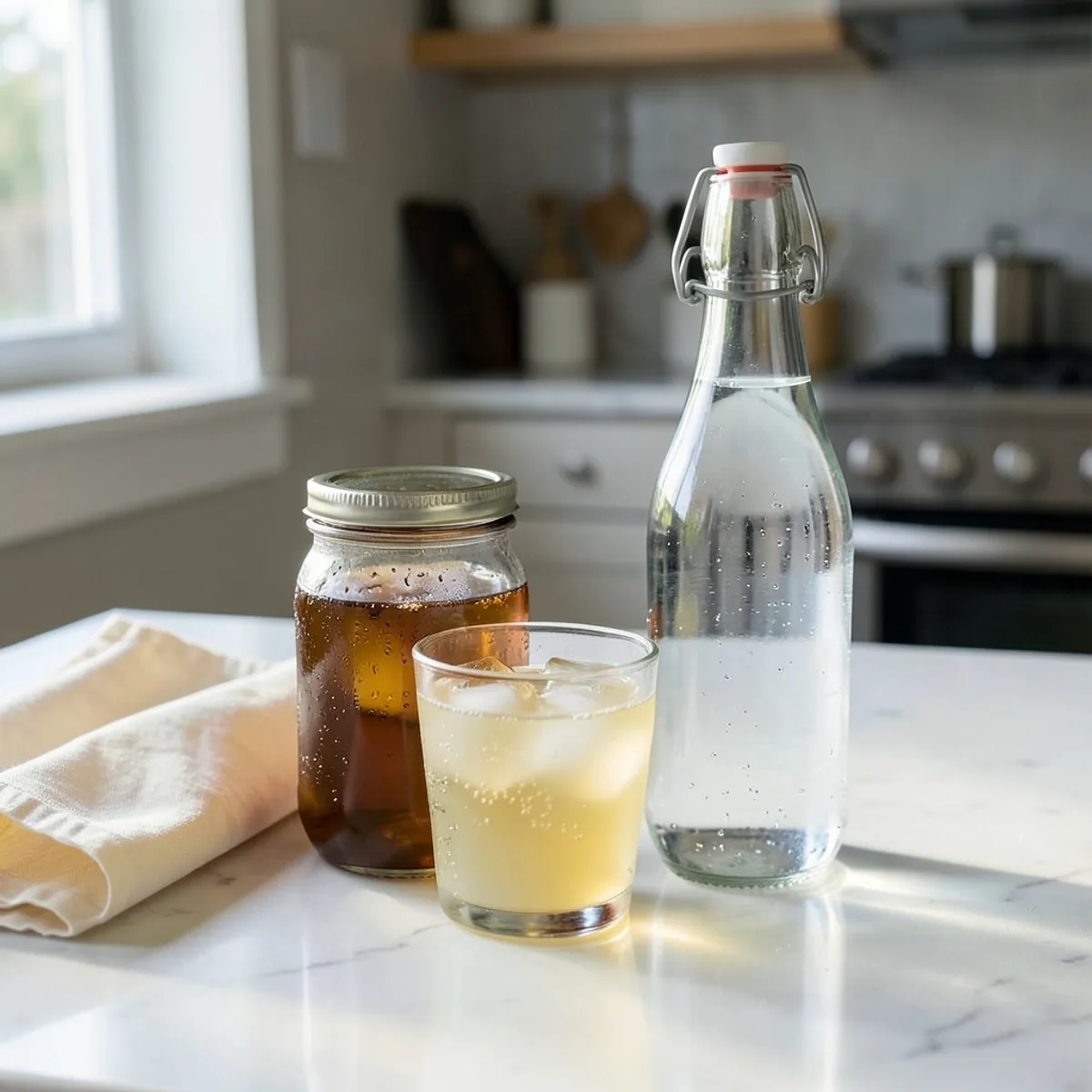
Apple cider vinegar soda lasts only a few hours once mixed, per Diabetes Strong, because the sparkling water goes flat. This recipe keeps 1/2 cup (120 mL) of vinegar base in the fridge and adds 8 fl oz (240 mL) cold seltzer per glass.
This recipe is untested by us. Nobody here has tasted it, so you won't find a flavor review. What you will find is a storage answer for each part of the drink, with the source named for every duration, and an honest "no sourced figure" where nothing exists. If you want the single-glass version first, start with apple cider vinegar soda. For a sweeter make-ahead option, there's the apple cider vinegar shrub soda.
What this page gives you:
- A base with one ingredient in one jar, plus an optional cinnamon stick.
- One batch makes 8 glasses at 1 tbsp each (our arithmetic).
- About 3 kcal and 1 mg of sodium per glass with plain seltzer (our calculation).
Prep 5 minutes, cook 0, total 5 minutes.
How long does apple cider vinegar soda last?
The short version: the finished drink doesn't last, and the parts do. Diabetes Strong, a diabetes-focused recipe site, says it doesn't recommend making the soda in advance because the sparkling water goes flat, and that a pitcher in the fridge goes flat within a few hours. That's blog advice, not a lab test.
Many cooks report the same fix: mix the vinegar part ahead, keep it cold, and pour in the cold sparkling water when you serve. Three recipe pages we compared land there. Nobody agrees on a single number for how long the base keeps, so the table below sets the sourced figures side by side.
Storage times, by item
This compares published figures. It is not a test we ran. "No sourced figure" means we found nothing to compare.
| What you're storing | Figure | Who says so | Caveat |
|---|---|---|---|
| Opened bottle of apple cider vinegar | Best quality for about 2 years (Tasting Table); non-white vinegar best within 2 to 3 years of purchase (Iowa State, citing StillTasty) | Tasting Table (food media, Jan. 26, 2024) and Iowa State University Extension | Quality, not safety; bottled vinegar only |
| Vinegar base made ahead | 5 days (Fork in the Road) versus at least 1 week (Always Use Butter) | Two blogs, neither verified | The 5 days is for a spiced cider spritzer infusion; the figures disagree, so neither is a rule |
| Mixed glass or pitcher | A few hours before it goes flat | Diabetes Strong | Blog advice, not a test |
Everything else is in prose, with its source:
- Unopened bottle. Tasting Table says it often keeps up to five years or more under proper conditions. That's food media, not USDA.
- Plain vinegar base from this recipe. No sourced figure. No extension figure exists for a diluted base.
- Fruit syrup in the fridge. Ask Extension gave no definite shelf life and said it's fine as long as it doesn't mold. That's about sugary syrup, not our base.
- Sealed bottle of home-carbonated plain water. SodaStream, a manufacturer, says up to two weeks with the cap tight in the fridge. That's a company claim for its own bottles, not for a mixed drink.
- Opened store-bought soda. Chowhound, a staff writer with no expert quoted, says some fizz for two to three days, and maybe day five or six in a sealable airtight bottle with less quality. It gives no timeline for sparkling water.
Read the two blog figures for the base side by side. One says 5 days, the other says at least 1 week, and neither is a rule. Let your nose and eyes decide.
Does apple cider vinegar go bad?
Not in the way milk does. Iowa State University Extension says vinegar has an "almost indefinite" shelf life, citing the Vinegar Institute, and that a "Best By" date is about quality, not a safety date. Tasting Table says an opened bottle generally doesn't become unsafe.
What to look for:
- Odor. An off-putting smell is a reason to replace it (Tasting Table).
- Color. An unusual color is another. Iowa State says a color change likely means a taste change.
- Mold. Replace it (Tasting Table).
- Sediment or floating strands. These are normal. Tasting Table says they're part of the vinegar's mother and don't mean spoilage, and Iowa State says cloudiness doesn't affect quality.
Both sources cover bottled vinegar. Neither covers a diluted base, so for that one, use the same senses and err on the side of tossing it.
The Food Science / Lab Kitchen Note
Vinegar is sour because of acetic acid. We found no sourced acetic acid percentage for your particular bottle, so check the label. What Iowa State does say is that vinegar's acidity doesn't change unless moisture or water gets into the container. That's why the base jar stays closed and why the water goes in the glass, not the jar.
The bubbles are carbon dioxide dissolved in the seltzer. Once you pour, the gas starts escaping, and stirring, ice and a wide-open glass speed that up. Chowhound says cold slows carbon dioxide escape and that less air space helps, which is why a sealed, cold bottle holds fizz longer than a pitcher. That's a media explanation, not a measured result.
Here's the math. It's our calculation, not a sourced figure.
- 1/2 cup is 8 tbsp, so one batch of base makes 8 glasses at 1 tbsp each.
- 1 tbsp (15 mL) of base in 8 fl oz (240 mL) of seltzer puts the vinegar at about one part in 17 of the glass. That's an untested starting ratio.
- Sodium comes from the seltzer. Plain seltzer lists carbonated water only on typical labels, while club soda adds sodium bicarbonate, which is baking soda, so read your own can. We found no sourced sodium figure for a vinegar-and-seltzer glass, so the card's 1 mg is our rounded calculation from typical USDA values for cider vinegar. No baking soda is added in this recipe. If you're curious what happens when baking soda does meet vinegar, see baking soda and apple cider vinegar.
What the research says
Iowa State University Extension. This is a university extension article, not a study. It says non-white vinegars are of best quality within 2 to 3 years of purchase, that cloudiness doesn't affect quality and that acidity doesn't change unless water gets in. It covers bottled vinegar only, not a diluted mix.
Ask Extension. This is an expert Q&A, not a study. The expert says a refrigerated cold-process fruit syrup isn't a safety issue as long as it doesn't mold, and that freezing would prevent mold and slow fermentation. The expert couldn't give a definite shelf life. That answer is about sugary fruit syrup, so don't read it as a number for a diluted vinegar base.
One more caution, from Washington State University's fermentation site. It warns that a naturally carbonated homemade soda left to over-ferment in a closed container can build enough pressure to burst the bottle. That's about yeast-fermented soda, not vinegar soda made with bought sparkling water, and we found no source that tests an unpasteurized vinegar and sugar mix. Take it as a reason not to seal a sweetened mix at room temperature.
Common mistakes
Mixing a whole pitcher ahead. Diabetes Strong says a pitcher in the fridge goes flat within a few hours. Fork in the Road only warns that the finished spritzer loses its carbonation. Either way, store the base and pour the seltzer per glass.
Sealing a sweetened mix at room temperature. If you flavor the base with fruit or sugar, keep it in the fridge. WSU's warning is about fermented soda, but it's the reason to be careful.
Tossing vinegar because it looks cloudy. Sediment and strands from the mother are normal, per Tasting Table and Iowa State. Judge by smell, color and mold instead.
Substitutions
| Original | Swap | Proportion | What changes |
|---|---|---|---|
| Seltzer | Club soda | Same 8 fl oz (240 mL) | Adds sodium bicarbonate, so sodium goes up; no sourced figure for this drink |
| Raw vinegar with the mother | Pasteurized vinegar | Same 1/2 cup (120 mL) | Raw shows harmless sediment; pasteurized stays clear |
| Apple cider vinegar | Another vinegar | No sourced ratio | We found nothing on how it affects keeping or flavor |
| Cinnamon stick | Other spices | No sourced amount | Flavor only; the 5 day blog figure was for a spiced cider infusion |
| Cold seltzer | Plain still water | Same 8 fl oz (240 mL) | No fizz, so no flat glass to worry about |
Nutrition note
The card values are estimates, not measurements: about 3 kcal, 0.1 g of sugar and 1 mg of sodium per glass with plain seltzer. They're calculated from typical USDA FoodData Central values for cider vinegar, using plain seltzer rather than club soda. With club soda, the sodium goes up by an amount we didn't source. The optional cinnamon isn't counted. No baking soda is added, so there's no baking soda sodium figure here. If you're wondering how much vinegar to drink in a day, see how much apple cider vinegar per day.
Storage
Keep the base in a clean jar with a tight lid in the refrigerator. If it's plain vinegar, the bottle guidance from Iowa State University Extension applies (an "almost indefinite" shelf life for bottled vinegar), and we found no figure for the diluted version. If you add spices, the two blog figures (5 days and at least 1 week) are the only numbers on the table, and they disagree, so check it by smell, color and mold before each use. Don't seal a sweetened mix at room temperature, per the WSU caution above. A sugary syrup is a different case: Ask Extension says freezing is an option.
Keep the seltzer in a tightly closed bottle in the fridge, with as little air space as you can. SodaStream's up to two weeks is for its own sealed bottles of plain water, so don't count on it for anything else.
Prep once: fill the jar, chill it, and build each glass fresh.
Servings: 8 glasses
How Long Apple Cider Vinegar Soda Lasts (Fridge Base)
A storage guide for apple cider vinegar soda with a source named for every duration, plus a recipe that keeps the vinegar base in the fridge and adds cold seltzer only when you pour.
Ingredients
Fridge base
Each glass
Equipment
- Clean glass jar with a tight lid (for the base in the fridge)
- Measuring spoons (a true tablespoon)
- Low glass (one glass at a time)
Instructions
Make the base
- Fill a clean jar. Pour 1/2 cup (120 mL) of apple cider vinegar into a clean jar. Add the cinnamon stick if you want it, then close the lid tightly.
- Chill it. Put the jar in the fridge. Keep the lid closed between uses so no water or moisture gets in, since Iowa State University Extension says vinegar's acidity changes only if moisture or water gets into the container.
Build a glass
- Add the base and ice. Put 1 tbsp (15 mL) of the base in a low glass and fill the glass with ice. Never drink the base straight.
- Pour the cold fizz. Pour in 8 fl oz (240 mL) of cold seltzer slowly down the side of the glass to keep the bubbles, and stir once.
- Drink it now. Drink it while it's fizzy. Build one glass at a time, because Diabetes Strong says a mixed pitcher goes flat within a few hours.
Notes
This recipe is untested by us. Nothing here comes from tasting the drink or trying the batch. The 1 tbsp of base per 8 fl oz glass is an untested starting ratio.
The yield of 8 glasses at 1 tbsp of base each is our arithmetic (1/2 cup is 8 tbsp).
Storage durations on this page are quoted from the sources named in the text. None is a USDA or FoodKeeper figure for a mixed apple cider vinegar soda or a diluted base, because we found none.
Inspired by the apple cider vinegar soda at Diabetes Strong. We wrote our own steps and added the fridge-base method.
Nutrition is our calculation from typical USDA FoodData Central values for cider vinegar, with plain seltzer. The optional cinnamon is not counted. Protein, fat, saturated fat and fiber are shown as 0 because vinegar and seltzer are not meaningful sources of them.
Metric amounts are rounded.
Nutrition Facts
Per 1 glass (1 tbsp apple cider vinegar in 8 fl oz plain seltzer; no added sweetener) (estimated)
- Total Fat
- 0 g
- Saturated Fat
- 0 g
- Sodium
- 1 mg
- Total Carbohydrate
- 0.1 g
- Dietary Fiber
- 0 g
- Sugars
- 0.1 g
- Protein
- 0 g
Frequently asked questions
How long does apple cider vinegar soda last in the fridge?
The mixed glass goes flat within a few hours, according to Diabetes Strong, and we found no sourced figure for how long it stays drinkable after that. What you can store is the vinegar base, which two blogs put at 5 days and at least 1 week; both are unverified blog figures.
Can you make apple cider vinegar soda ahead of time?
Make the vinegar part ahead and keep it cold, then add cold sparkling water when you serve. Diabetes Strong advises against mixing the whole drink in advance because the sparkling water goes flat.
Does apple cider vinegar need to be refrigerated?
For the bottle, Tasting Table says to store it cool, dark and tightly closed, and we found no sourced rule that says to refrigerate it. The base you make ahead goes in the fridge, because that is where the blog recipes we compared keep theirs.
What are the side effects of drinking apple cider vinegar soda?
Cleveland Clinic says the acidity can erode tooth enamel, which cannot be restored, and that straight vinegar can burn the esophagus. That is why the base always goes into a full glass of sparkling water.

Sana Nikia cooks fresh, balanced food in Austin, Texas, with flavor first and no diet rules. She covers SodaRecipe’s baking soda drinks.
Comments