Apple Cider Vinegar Shrub Soda Recipe (Sugar Counted)
Jump to RecipeA make-ahead apple cider vinegar shrub syrup you dilute into sparkling water, with the sugar per glass counted and fridge storage based on extension guidance.
 Save
Jump to:
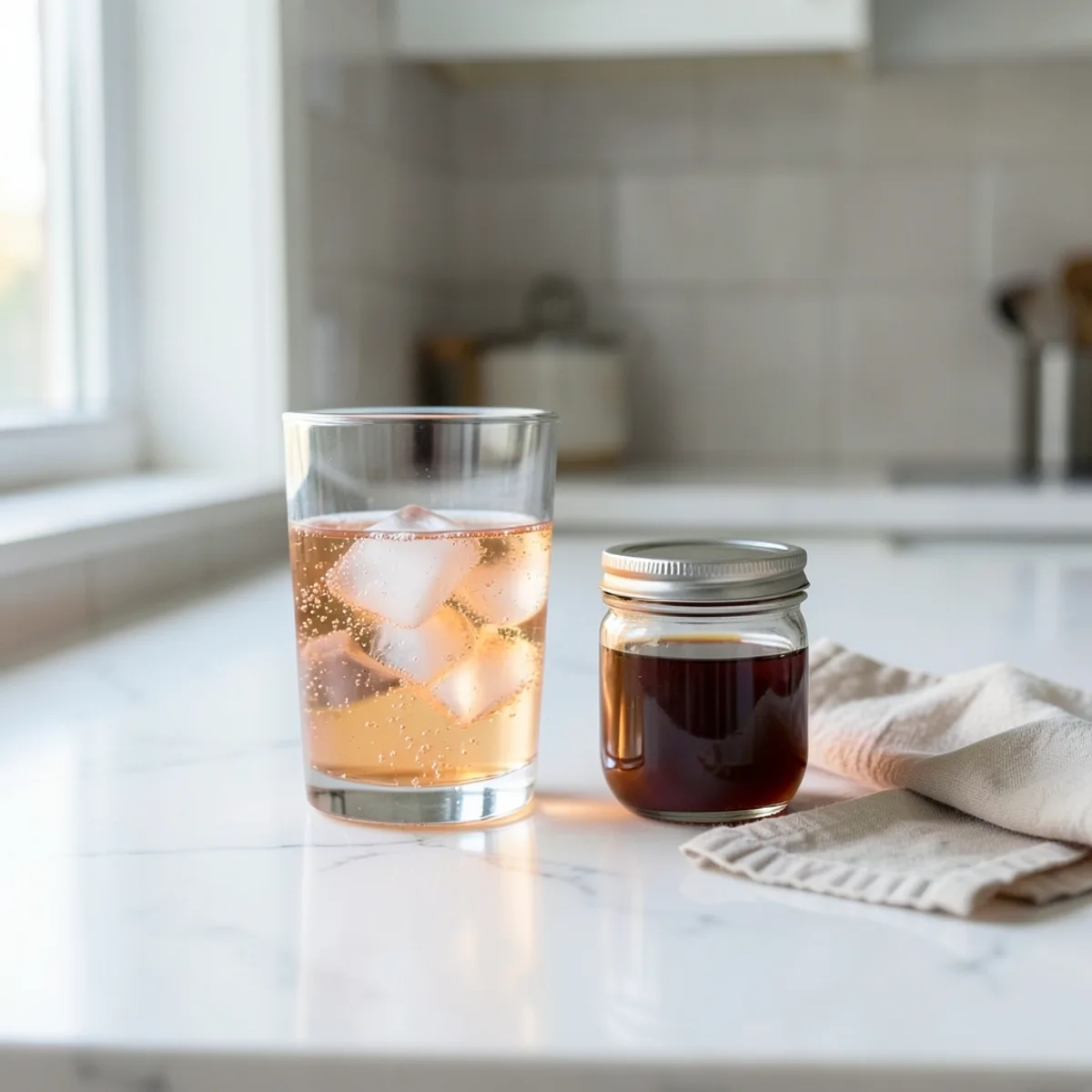
Fruit, sugar and vinegar in a jar, one spoonful in a glass of fizz.
This recipe is untested by us. Nobody here has tasted it, so you won't find a flavor review. What you will find is a starting ratio, the sugar and sodium per glass worked out from USDA and label data, and what the research does and doesn't say about vinegar drinks. The idea is adapted from Wendy Polisi's ginger apple shrub; the steps are ours. If you want a single glass with no syrup at all, that's apple cider vinegar soda.
The syrup keeps the work to one jar. Make it once, then stir a spoonful into fizz whenever you want a glass, and choose club soda or seltzer depending on the sodium you want. The sugar per glass is worked out below from USDA data.
The Food Science / Lab Kitchen Note
Vinegar is sour because of acetic acid. The FDA's compliance policy for vinegar says cider vinegar should contain 4 grams of acetic acid per 100 mL, and diluted vinegar should in no case fall below 4 percent. Pour that into a jar with fruit and sugar and you get a shrub: a sweet-and-sour drinking vinegar. The bubbles in the glass are carbon dioxide from the sparkling water.
Why fridge, not counter? University of Maine Cooperative Extension, quoted by the Bangor Daily News, says flavor development should happen in the refrigerator. Ask Extension adds that refrigerated cold-process fruit syrup isn't a safety concern as long as there is no mold, and that high sugar, fruit acidity and vinegar together help. We found no sourced guidance on hot-process shrubs, so this page sticks to the fridge method.
Here's the sugar math. It's our calculation, and it rests on an estimate.
- USDA FoodData Central lists granulated sugar at 99.8 g of sugars and 387 kcal per 100 g, with 1 cup at 200 g. So the batch holds about 200 g of sugar.
- We assume the batch ends up as about 2 cups (32 tbsp) of syrup. That's our guess, because the apple adds juice and some liquid stays in the solids.
- 200 g of sugar split over 32 tbsp is about 6.2 g per tablespoon. USDA's cider vinegar entry adds a trace (0.40 g of sugars per 100 g), so we round to about 6.3 g per glass.
- Calories work out to about 24 kcal from the sugar plus about 2 kcal from the vinegar (21 kcal per 100 g), so about 26 kcal per glass.
- By the same assumption, each tablespoon of syrup carries about half a tablespoon of vinegar. Cleveland Clinic's cap of 2 tbsp a day applies to diluted vinegar itself, so this is just a rough comparison, not a medical rule.
Each extra tablespoon of syrup adds another 6.3 g of sugar or so, so the sugar scales with how much you pour. The shrub is sugar-heavy, and we make no low-sugar claim. If you want to track it, use the number for your own pour.
Sodium comes mostly from the fizzy water. One national club soda 7.5 oz can label lists carbonated water, sodium bicarbonate (which is baking soda), salt and potassium sulfate, with 60 mg of sodium (3% DV) per can (Hannaford listing). Scaled to 8 fl oz that's about 64 mg. One seltzer 12 oz can label lists carbonated water only and 0 mg (Stop and Shop listing). The vinegar in a glass adds well under 1 mg. The FDA sets the sodium Daily Value at less than 2,300 mg a day, so 64 mg is about 2.8 percent of it, and the FDA calls 5 percent or less per serving low. Formulas vary by brand, so read your own can.
Three versions, compared on sourced data
This compares published data and our arithmetic. It is not a taste test. "No sourced data" means we found nothing to compare.
| Variant | Sodium per glass | Sugar per glass | Source note |
|---|---|---|---|
| Shrub syrup + club soda | About 64 mg (our calculation, one brand's label) | About 6.3 g (our calculation) | Label: 60 mg per 7.5 oz can; formulas vary |
| Shrub syrup + seltzer | Under 1 mg (vinegar only; label shows 0 mg) | About 6.3 g (our calculation) | Label: carbonated water only |
| Shrub syrup + plain still water | No sourced data | About 6.3 g (our calculation) | No fizz from carbonation; sodium depends on your water, which we did not source |
Sugar assumes a 2-cup batch and counts added sugar only.
What the research says
Cleveland Clinic. This medical center article is not a study. It says there is no concrete evidence of long-term appetite suppression and that apple cider vinegar might lower glucose a little, but not enough. There's no standard dose, and it advises no more than 2 tbsp a day, diluted. It also warns that acidity erodes tooth enamel, which does not grow back.
Nutrients 2025 meta-analysis. A systematic review and meta-analysis pooled 10 randomized trials of apple cider vinegar in people with type 2 diabetes and/or overweight. The trials lasted 4 to 12 weeks, heterogeneity was high and five studies were at high risk of bias. The authors call it only a possible adjunct for short-term weight management. None of that tested a sweetened shrub, and nothing here is a promise about weight or blood sugar.
Apple shrub recipe: common mistakes
Straining too fast. Fruit solids left in the syrup can make it cloudy or separated. Use a fine-mesh strainer, let it drip and strain again if needed.
Committing to the full batch before tasting. Shrub guides agree the balance is set by taste, not by the recipe. Too sweet, add a little more vinegar; too sour, add sugar or a splash of water; and use less sugar when the fruit is already sweet. Taste a small amount in sparkling water before you adjust the whole jar.
Steeping on the counter. Maine extension guidance says flavor development should happen in the fridge, so leave the jar there.
Substitutions
| Original | Swap | Proportion | What changes |
|---|---|---|---|
| Granulated sugar | Honey | No sourced ratio | Changes the sugar math, and we found nothing on how it affects keeping |
| Granulated sugar | Swerve | No sourced ratio | One page uses it; we found no sourced swap ratio or effect on keeping |
| Apple | Another fruit | No sourced ratio | Guides advise less sugar when the fruit is already sweet, with no amount given |
| Club soda | Seltzer | Same 8 fl oz (240 mL) | Sodium drops from about 64 mg to under 1 mg (our calculation) |
| Ginger or spices | Add to the jar | No sourced amount | Flavor only; not part of our nutrition |
Nutrition note
The card values are estimates, not measurements: about 26 kcal, 6.3 g of sugar and 64 mg of sodium (about 2.8% of the 2,300 mg Daily Value) per glass with club soda. They're calculated from typical USDA FoodData Central values for granulated sugar and cider vinegar, plus the club soda label above, using the 2-cup batch assumption. The sodium figure uses club soda; with seltzer it's under 1 mg. Apple sugars and any extra sweetener aren't counted.
Storage
Keep the syrup in a clean, closed container in the refrigerator. Ask Extension gave no specific shelf life and said its answer wasn't definite, only that a refrigerated cold-process fruit syrup is not a safety concern as long as there's no mold. Published times for similar syrups disagree widely, from short to very long, and none we found cites an extension, so we give no number. Discard it if you see mold. Ask Extension also describes freezing as a safe option.
Prep once: make the syrup, store it cold, and build each glass fresh.
Servings: 32 glasses (1 tbsp syrup each; our estimate)
Apple Cider Vinegar Shrub Soda Recipe (Sugar Counted)
A make-ahead apple cider vinegar shrub syrup you dilute into sparkling water, with the sugar per glass counted and fridge storage based on extension guidance.
Ingredients
Shrub syrup
Each glass
Equipment
- Glass jar with a lid (large enough for the fruit, sugar and vinegar)
- Fine-mesh strainer (strain well to keep the syrup from going cloudy)
- Clean closed jar or bottle (for the finished syrup in the fridge)
- Measuring cups and spoons (a true tablespoon)
Instructions
Make the syrup
- Combine in a jar. Put 1 cup (240 mL) of chopped apple and 1 cup (200 g) of granulated sugar in a clean jar. Pour in 1 cup (240 mL) of apple cider vinegar, seal the lid and shake until the sugar dissolves.
- Steep in the fridge. Refrigerate the jar. University of Maine Cooperative Extension, as quoted by the Bangor Daily News, says flavor should develop in the refrigerator, not on the countertop. We found no sourced steeping time, so shake it now and then and decide by taste.
- Strain well. Pour the mixture through a fine-mesh strainer into a clean jar, letting the liquid drip through, then discard the solids. Strain again if the syrup looks cloudy.
- Adjust the balance. Stir a little syrup into sparkling water and taste. If it's too sweet, add a little more vinegar; if it's too sour, add a little sugar or a splash of water. Change one small thing at a time.
Build a glass
- Add syrup and ice. Put 1 tbsp (15 mL) of the syrup in a low glass and fill the glass with ice. Never drink the syrup straight.
- Pour the fizz. Pour in 8 fl oz (240 mL) of cold club soda or seltzer slowly down the side of the glass to keep the bubbles, and stir once.
- Sip it now. Drink it while it's fizzy. Build one glass at a time, because fizzy water goes flat.
Notes
This recipe is untested by us. Nothing here comes from tasting the drink or trying the batch. The 1:1:1 fruit, sugar and vinegar start and the 1 tbsp of syrup per glass of sparkling water follow a University of Maine Cooperative Extension guide as quoted by the Bangor Daily News. The 8 fl oz glass is our choice.
Inspired by Wendy Polisi's ginger apple shrub. We adapted the idea and wrote our own steps.
The yield of 32 glasses assumes the batch ends up as about 2 cups (32 tbsp) of syrup. That volume is our estimate, not a sourced figure, and it changes with how much juice the fruit gives up. A different volume changes the sugar per glass.
Nutrition is our calculation from USDA FoodData Central values for granulated sugar and cider vinegar plus one club soda label. It counts the added sugar and vinegar only; sugar from the apple is not counted because the fruit is discarded and we have no sourced figure. Protein, fat, saturated fat and fiber are shown as 0 because sugar and vinegar are not meaningful sources of them.
Metric amounts are rounded.
Nutrition Facts
Per 1 glass (1 tbsp shrub syrup in 8 fl oz club soda; no extra sweetener) (estimated)
- Total Fat
- 0 g
- Saturated Fat
- 0 g
- Sodium
- 64 mg
- Total Carbohydrate
- 6.3 g
- Dietary Fiber
- 0 g
- Sugars
- 6.3 g
- Protein
- 0 g
Frequently asked questions
When should you drink apple cider vinegar shrub soda?
We found no sourced best time of day, so we won't invent one. Build the glass when you're ready to drink it, because the fizz fades.
What are the side effects of drinking a vinegar shrub?
Cleveland Clinic says acidity erodes tooth enamel, which does not grow back, and that undiluted acetic acid can burn the esophagus. That's why the syrup always goes into a full glass of sparkling water.
What can I use instead of club soda in shrub soda?
Plain seltzer. Its 12 oz can label lists carbonated water only and shows 0 mg of sodium, while the club soda label we checked shows 60 mg per 7.5 oz can.
How long does a shrub last in the fridge?
We found no sourced shelf life, and published times disagree widely, so we give none. Ask Extension says refrigerated cold-process fruit syrup is not a safety concern as long as there is no mold; keep it in a clean closed container and discard it if you see mold.

Sana Nikia cooks fresh, balanced food in Austin, Texas, with flavor first and no diet rules. She covers SodaRecipe’s baking soda drinks.
Comments