Baking Soda and Apple Cider Vinegar Drink: One Glass
Jump to RecipeOne measured glass of baking soda and apple cider vinegar: the neutralization math, about 315 mg of sodium, and what the vinegar-only studies do and do not show.
 Save
SaveJump to:
Vinegar, water and a level spoon of baking soda: that's the whole drink. This page gives you a measured glass instead of a guess.
Our glass is untested. We haven't tasted it for this page, so you won't find a flavor review or a result here. What you will find is the math, the sodium in milligrams and the real studies. If weight loss is what brought you here, our baking soda recipe for weight loss compares the options in more detail.
The Food Science / Lab Kitchen Note
Baking soda is sodium bicarbonate (NaHCO₃), a base. Vinegar is sour because of acetic acid (CH₃COOH). They react one to one: NaHCO₃ + CH₃COOH gives sodium acetate, water and carbon dioxide (CO₂). The CO₂ is the fizz. What's left in the glass is a mild salt solution.
The numbers below are our calculation from published figures, not a study. Baking soda has a molar mass of 84.007 g/mol (PubChem). Acetic acid has 60.052 g/mol (NIST WebBook).
- At 5 percent acid (5 g per 100 mL), 1 tbsp (15 mL) of vinegar holds 0.75 g of acetic acid, or 12.5 mmol.
- That much acid is neutralized by about 1.05 g of bicarbonate, about 0.23 tsp.
- A level 1/4 tsp (1.15 g) can cancel about 16 mL of 5 percent vinegar. With 1 tbsp, that leaves about 0.1 g of bicarbonate unreacted.
- At 4 percent, 1 tbsp needs about 0.84 g of bicarbonate.
Why the label matters: the FDA says natural vinegars normally contain more than 4 g of acetic acid per 100 mL, and a diluted vinegar must state its real strength and never fall under 4 percent. Healthline puts apple cider vinegar at 5 to 6 percent. Read your bottle.
The sodium doesn't go anywhere. Neutralizing turns bicarbonate into sodium acetate, and it still counts toward your day. We found no source saying the fizz changes your body's pH, so we make no claim about it.
Sodium in the glass
Using USDA's figure of 27,400 mg of sodium per 100 g of baking soda (FoodData Central), we calculate that 1/4 tsp (1.15 g) is about 315 mg of sodium and 1/2 tsp (2.3 g) about 630 mg. The FDA gives a Daily Value of less than 2,300 mg a day. By our math, 315 mg is about 14 percent of that limit and 630 mg about 27 percent. That sodium lands on top of everything else you eat.
Three versions, compared on sourced data
This compares published data. It is not a taste test. "No sourced data" means we found nothing to compare.
| Variant | Sodium added | Directions or limits (source) | What the research shows |
|---|---|---|---|
| Vinegar only, diluted (1 tbsp in a mug of warm water) | None from baking soda | Cleveland Clinic: no more than 2 tbsp a day, no standard dose | Small vinegar-only trials; weak evidence overall |
| Vinegar plus 1/4 tsp (1.15 g) baking soda, this recipe | About 315 mg | No sourced dose for the mix | No study of the mix |
| Baking soda only in water | About 315 mg for 1/4 tsp | MedlinePlus: at least 4 oz (120 mL) of water, not longer than 2 weeks unless a doctor says so | No weight data sourced |
Calories, sugars and potassium for each version: no sourced data.
What the studies say
Kondo 2009. This double-blind randomized trial in obese Japanese adults ran 12 weeks. People drank 500 mL a day containing 15 mL of vinegar (about 750 mg of acetic acid), 30 mL (about 1,500 mg) or no vinegar. Per the abstract, both vinegar groups had significantly lower body weight, BMI, visceral fat area, waist size and triglycerides than the placebo group. The abstract gives no group sizes or effect sizes, and as we read it, it doesn't say the vinegar was apple cider vinegar. It was vinegar alone, with no baking soda.
Khezri 2018. This randomized controlled trial in adults with overweight or obesity gave 30 mL a day of vinegar for 12 weeks, on top of a diet 250 kcal a day below needs. HCPLive reports weight change of -4 kg with vinegar against -2.3 kg for the control group. It's a small trial of about 40 adults, short, and vinegar-only. The diet change is also part of the result.
Neither study tested this drink. Cleveland Clinic calls the weight-loss evidence for apple cider vinegar weak, and says the old idea that acetic acid burns fat is no longer thought to be true. And here's a catch: baking soda uses up the acetic acid. So even the vinegar-only results can't be carried over to the neutralized glass. For more on the viral claims, see baking soda and lemon water and baking soda side effects.
We also found no source for the "makes you poop" claim, for the mix or for either ingredient alone, so we won't make it.
Common mistakes
Adding the soda to straight vinegar. The acid and the base react on contact and release carbon dioxide. Dilute the vinegar in the water first, then add the soda slowly.
Drinking before the fizz stops. Bubbles mean the reaction is still going. At 5 percent, our 1/4 tsp slightly exceeds what 1 tbsp of vinegar needs, but a stronger vinegar needs more soda than that (our calculation). Wait until the bubbles settle.
Ignoring the label. Vinegar strength differs by bottle, which changes the ratio. Check the percentage before you scoop.
Substitutions
| Original | Swap | Proportion | What changes |
|---|---|---|---|
| Baking soda | Baking powder | Not sourced | Different product; it doesn't work as a swap |
| 5 percent vinegar | 4 percent vinegar | 1 tbsp needs about 0.84 g of bicarbonate (our calculation) | Less soda needed to cancel the acid |
| Apple cider vinegar | White vinegar or lemon juice | Not sourced for this drink | We found nothing to say how it behaves |
Storage and safe use
Mix one glass and drink it. No sourced shelf life exists for the mixed drink, so we give none, and nothing here needs reheating. Skip the pitcher.
MedlinePlus says to dissolve baking soda in at least 4 oz (120 mL) of water. Our 8 fl oz (240 mL) is simply our recipe, not a medical rule. Cleveland Clinic suggests 1 tbsp of vinegar in a mug of warm water and no more than 2 tbsp a day.
Nutrition note
Values on the recipe card are estimates, not measurements. The only figure we list is sodium: about 315 mg per glass, calculated from USDA FoodData Central values for baking soda. We list no calories or other values because we found no sourced figure for the vinegar, and we won't make one up.
Servings: 1 glass (about 8 fl oz)
Baking Soda and Apple Cider Vinegar Drink: One Glass
One measured glass of baking soda and apple cider vinegar: the neutralization math, about 315 mg of sodium, and what the vinegar-only studies do and do not show.
Ingredients
Equipment
- Measuring spoons (a true tablespoon and a true 1/4 teaspoon, leveled with a knife)
- Tall clear glass (leaves room above the water for the bubbles)
- Long-handled spoon (for stirring without splashing)
Instructions
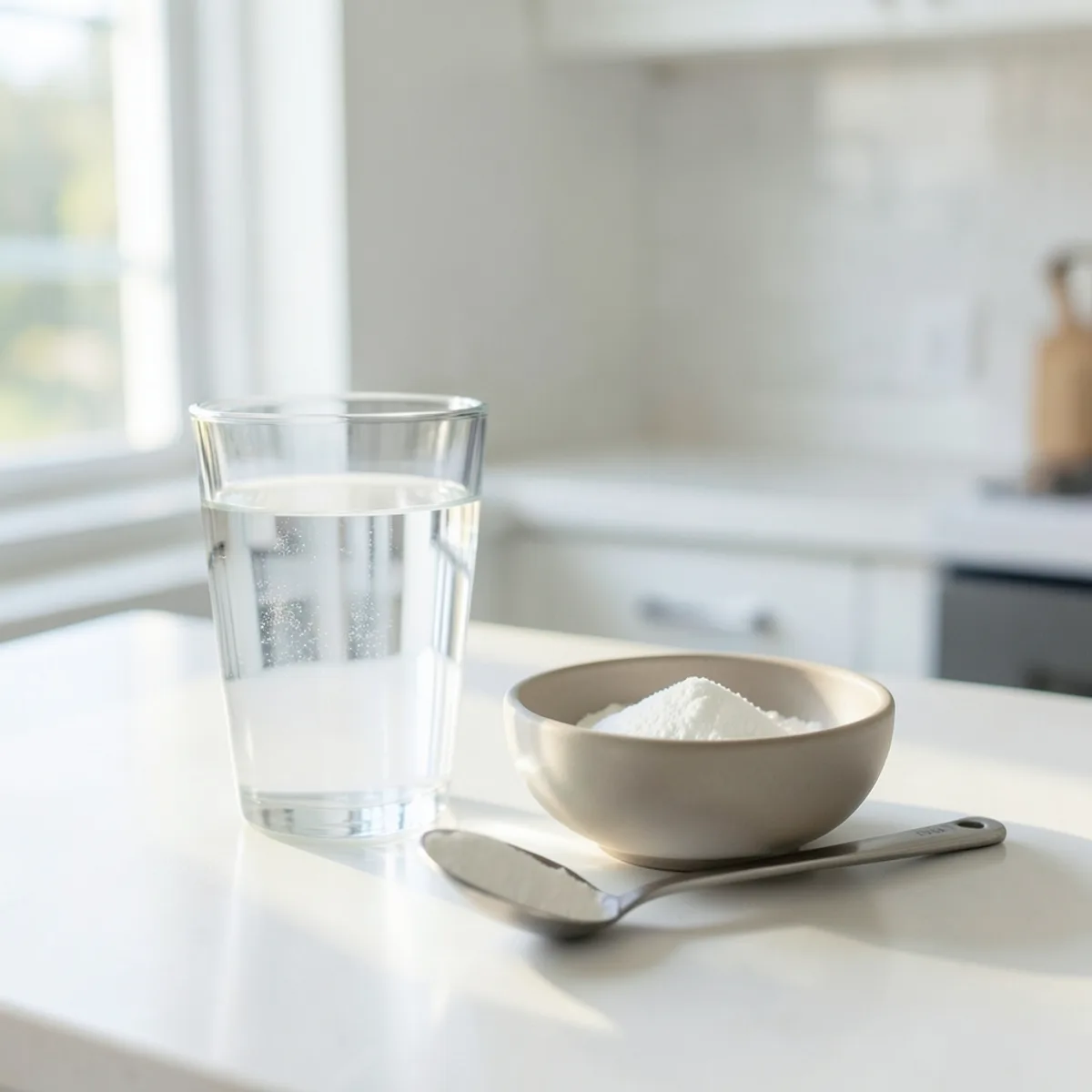
- Pour the water. Pour 8 fl oz (240 mL) of water into a tall glass. The glass should have plenty of empty space above the water for foam.
- Add the vinegar first. Stir 1 tbsp (15 mL) of apple cider vinegar into the water. Vinegar always goes into the water, never the other way around, and never straight into your mouth.
- Level the soda. Fill a 1/4 teaspoon (1.15 g) with food-grade, aluminum-free baking soda and sweep the top flat with the back of a knife.
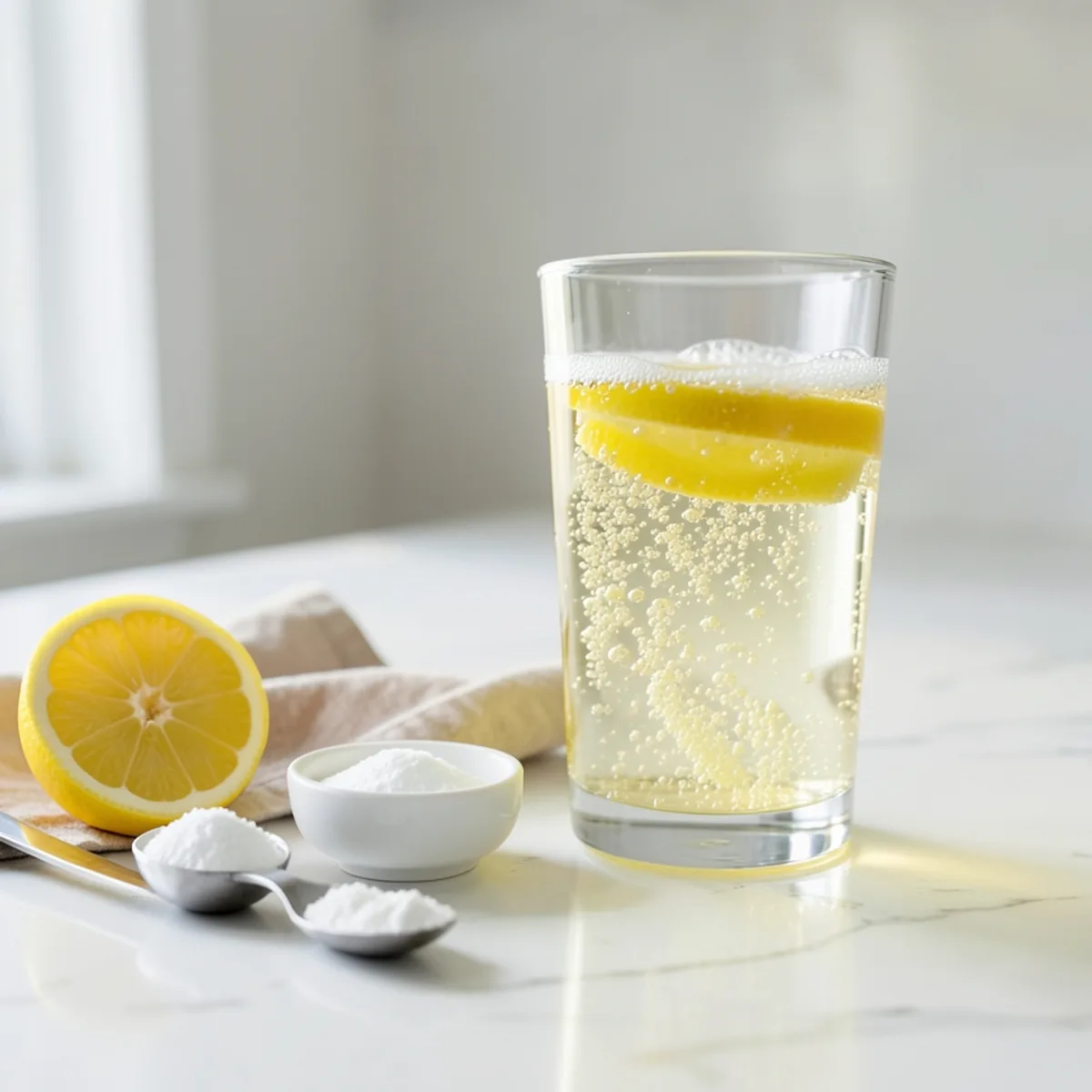
- Add the soda slowly. Sprinkle the soda in a little at a time, stirring gently. The reaction releases carbon dioxide, which is the fizz.
- Wait for the fizz to stop. Let the glass stand until the bubbles thin out and the surface is nearly still. Our reading of the chemistry: when the bubbles stop, the reaction is done.
- Drink it fresh. Drink the glass in one sitting. Mix one glass at a time, since we found no sourced shelf life for the mixed drink.
Notes
Metric amounts are rounded. The 1.15 g figure is 1/4 teaspoon at USDA's household portion of 4.6 g per teaspoon.
Our glass is untested: nothing on this page comes from tasting or trying the drink. The neutralization figures are our own calculation, not a study.
Sodium is calculated from the USDA FoodData Central value of 27,400 mg per 100 g of baking soda. We give no calories, sugar or other values for the vinegar because we found no sourced figure for it.
Nutrition Facts
Per 1 glass (8 fl oz water, 1 tbsp apple cider vinegar, 1/4 tsp baking soda) (estimated)
- Sodium
- 315 mg
Frequently asked questions
When should you drink baking soda and apple cider vinegar?
We found no sourced best time of day for this mix. The only sourced directions are MedlinePlus ones for baking soda: dissolve it in at least 4 oz (120 mL) of water and keep it 2 hours apart from other medicines.
What are the side effects of baking soda and apple cider vinegar?
Vinegar can wear down tooth enamel and, undiluted, irritate the throat. Baking soda adds about 315 mg of sodium to this glass, and no study has looked at the mix itself.
What can I use instead of baking soda and apple cider vinegar?
Cleveland Clinic suggests 1 tbsp of vinegar in a mug of warm water, with no baking soda and no added sodium. We found no sourced swap for apple cider vinegar in this drink, so we do not suggest white vinegar or lemon here.
Does baking soda neutralize apple cider vinegar?
Yes, on paper. By our calculation, 1/4 tsp (1.15 g) of baking soda can cancel about 16 mL of 5 percent vinegar, and the sodium stays behind as sodium acetate.

Sana Nikia cooks fresh, balanced food in Austin, Texas, with flavor first and no diet rules. She covers SodaRecipe’s baking soda drinks.

Comments