Honeycomb Candy Without Baking Soda: What the Sources Say
Jump to RecipeNo source we opened shows honeycomb that foams without baking soda. Here is why, what baking powder, vinegar and citric acid do to the syrup, and a no-soda brittle card. Not tested by us.
 Save
Jump to:
- The honest answer first
- The Food Science / Lab Kitchen Note
- Honeycomb options compared: what the sources report
- Substitutes and swaps
- Hokey pokey without bicarbonate of soda: the brittle route
- What about the soda taste?
- How the sources hold up
- Common mistakes
- Storing the brittle
- Nutrition note: calories and sodium per piece
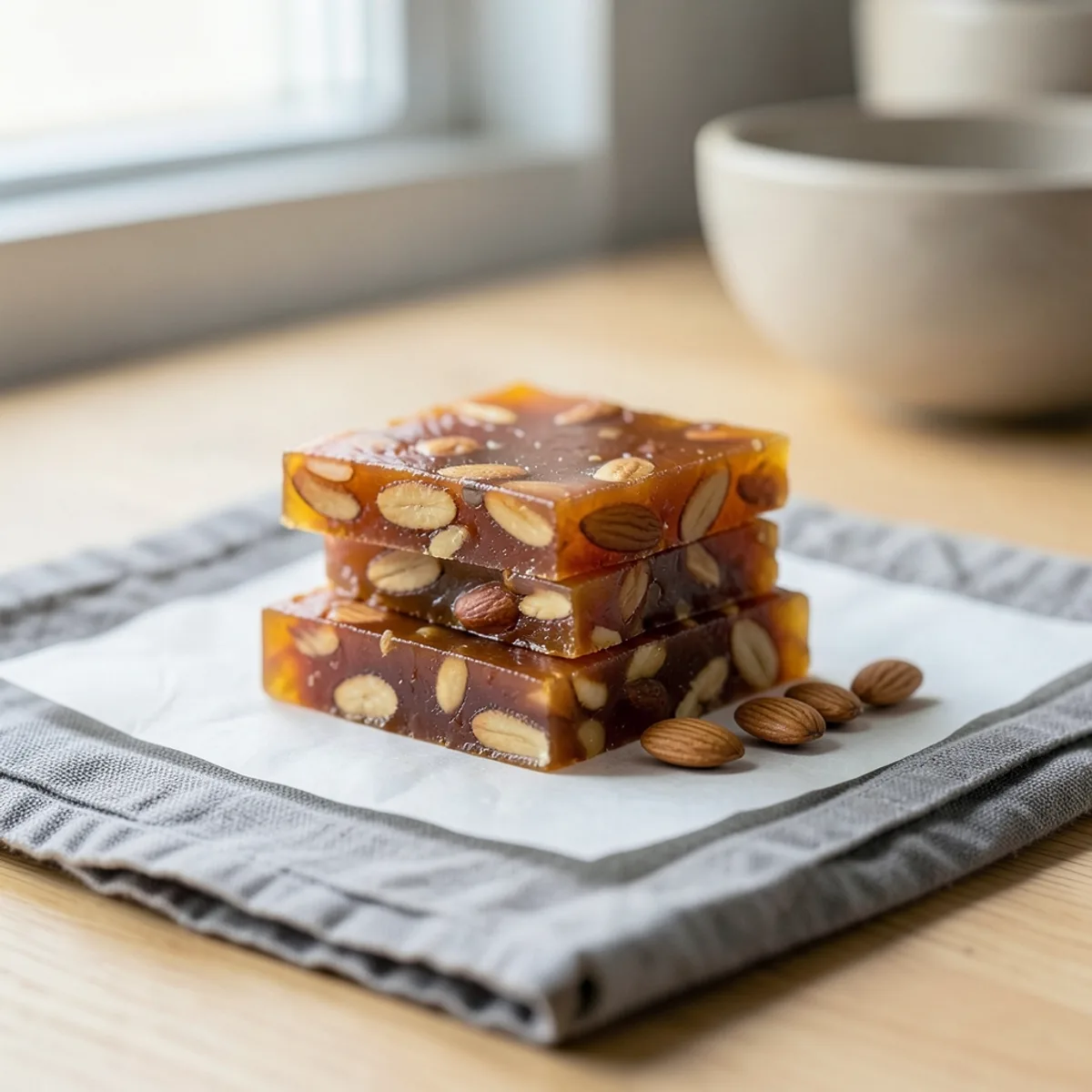
Honeycomb candy without baking soda has no sourced foaming version, so this page gives a flat honey almond brittle instead: sugar, honey and toasted almonds, cooked to 300 F, about 1 hour 25 minutes in all, with 0.7 mg of sodium per piece.
Nobody on our team has made or tasted this brittle. It is a card built from published sources, and every claim below says where it comes from. For the standard foaming recipe, see honey and baking soda honeycomb. If your real complaint is the soda taste, why honeycomb candy tastes like baking soda has the dose table. The brittle idea comes from Ask Nigella, which we adapted and did not copy.
The honest answer first
Recipe writers repeat one warning. Do not put baking powder where honeycomb calls for baking soda. Five sources we opened say so, one blogger admits she used powder the first time and had to make the batch again, and others say there is no substitute at all. None reports a successful swap. None gives a proportion.
So the short version is a choice. Keep the soda, lower the dose if you taste it, or drop the foam and make something else from the same syrup.
The Food Science / Lab Kitchen Note
Baking soda is sodium bicarbonate (NaHCO3). According to Scientific American, it starts to break down at about 176 F (80 C) into sodium carbonate, water and carbon dioxide: 2 NaHCO3 gives Na2CO3 + H2O + CO2. The carbon dioxide is the gas. Syrup at 300 F is far above that threshold, and the Exploratorium puts hard crack at 300-310 F (about 149-154 C) with the syrup about 99 percent sugar. So the bubbles get trapped as the syrup stiffens. Honeycomb recipes typically add the soda off the heat, once the syrup has reached that range.
It follows, by our reading, that a pot of sugar and honey with no bicarbonate has no gas source. Heat alone drives off water, not gas bubbles. That is why the brittle on this page sets flat.
Baking powder looks like a fix, but it is a different product. The American Society of Baking describes it as a bicarbonate, a leavening acid and a filler such as cornstarch. The filler keeps the actives apart. Single-acting powders release gas in one stage, double-acting in two. The typical dose it gives, 3-5 percent of flour weight, is a cake figure, not a candy one.
What that does inside hot syrup is our inference, not a sourced result. Powder has less bicarbonate per teaspoon, and the acid and starch ride along. USDA lists double-acting powder (sodium aluminum sulfate type) at 10,600 mg sodium per 100 g, against 27,400 mg for baking soda. At 4.6 g per teaspoon that is about 488 mg versus about 1,260 mg per teaspoon, our math. The Flavor Bender adds that powder could give the candy an undesirable flavor.
Acid is the other piece. Food Crumbles, a single baking-science blog, says the acid in honeycomb comes from the slightly acidic sugars and corn syrup. It says vinegar added to hot sugar without soda does little for bubbles and can invert the sugar, which makes it sticky. Citric acid added at the end adds acid, and added early it inverts the sugar. Gelatin, per its author, will not work in honeycomb.
Honeycomb options compared: what the sources report
This is a comparison of published data, not a record of batches we cooked. Sodium per teaspoon comes from USDA, with our math at 4.6 g per teaspoon. Where nothing is sourced, the cell says so.
| Baking soda (reference) | Less baking soda | Baking powder | |
|---|---|---|---|
| Source | Food Crumbles base recipe (hobby page) | Food Crumbles test (same page) | Five recipe pages say no (Cake by Courtney, Hill Country Chocolate, The Flavor Bender and others) |
| Amount as written | 1/2 tsp per 100 g of sugar | 1/4 tsp per 150 g of sugar | No sourced proportion |
| Per 100 g of sugar | 2.3 g, our math | About 0.8 g, our math | No sourced data |
| Sodium | About 1,260 mg per tsp | About 1,260 mg per tsp, so a smaller dose carries less | About 488 mg per tsp (sodium aluminum sulfate type) |
| Reported result | The baseline for the other two | Small, sparse bubbles, a denser candy | No source reports a result; writers warn against it |
| Sodium per piece in a published card | 149 mg and 119 kcal (The Flavor Bender) | No sourced data | No sourced data |
The sodium per piece of the Flavor Bender card is for its own recipe and piece size. It is not a like-for-like with the brittle on this page.
Substitutes and swaps
| Original | Replacement | Proportion | What changes |
|---|---|---|---|
| Baking soda in honeycomb | Baking powder | No sourced proportion | Adds acid and starch; writers warn against it; no sourced result |
| Baking soda in honeycomb | Vinegar | No sourced proportion | Does little for bubbles and can invert the sugar, making it sticky (Food Crumbles) |
| Baking soda in honeycomb | Citric acid | No sourced proportion | Late adds acid; early inverts the sugar (Food Crumbles) |
| Baking soda in honeycomb | Gelatin | No sourced proportion | Its author says it will not work |
| Baking soda in honeycomb | No gas at all: nut brittle | About 3/4 cup (75 g) of almonds for Ask Nigella's unstated amount of syrup; 1 1/2 cups (210 g) for our 420 g of sugar and honey, our estimate | Sets flat, no bubbles, no soda taste |
| Almonds | Salted peanuts | No sourced proportion beyond Ask Nigella's 75 g | Adds salt; our nutrition does not count it |
The 3 to 1 baking powder swap in our baking soda replacement guide is for baked goods. It does not carry over to candy, and the post on using baking soda instead of baking powder covers the other direction.
Hokey pokey without bicarbonate of soda: the brittle route
Hokey pokey, sponge candy and cinder toffee are names often used for honeycomb-style candy. A reader asked Ask Nigella how to avoid tasting the bicarbonate in her hokey pokey. The answer: in that recipe there is no substitute. It suggests making a praline or brittle from the syrup, poured over blanched, toasted almonds or salted peanuts.
That is the idea behind the card. Same sugar and honey as our honeycomb card, same hard-crack target, and nothing that makes gas. The nuts do the work the bubbles did. They give the candy something to be besides sugar.
Without soda there is no foam step; the thermometer tells you when to stop.
What about the soda taste?
People who taste the soda even at small doses get practical answers rather than a swap: use less, sift, and stir only until the streaks are gone. Another cook notes that too much soda leaves a metallic aftertaste. Three sources said versions of this.
The Food Crumbles low run is the only sourced number we have: 1/4 tsp per 150 g of sugar, about 0.8 g per 100 g by our calculation, gave small, sparse bubbles and a denser candy. So there is a floor. If you want to stay with honeycomb, the dose comparison shows the published range and a lower-dose card.
How the sources hold up
The temperature stages and the altitude rule come from the Exploratorium's page on sugar stages, a science museum resource. The breakdown temperature and the equation come from a Scientific American article on baking soda, a science magazine piece. The description of baking powder comes from an American Society of Baking article, a trade association page about baked goods, not candy. Nutrition figures come from USDA FoodData Central for baking soda, baking powder, granulated sugar and honey.
The rest are recipe-site and blog sources. Ask Nigella is a reader Q&A page on a celebrity cook's site. The Flavor Bender is a recipe blog. Food Crumbles is a single hobby source, so treat its claims as one cook's account. Cake by Courtney and Hill Country Chocolate are recipe blogs that dismiss a swap in a line. We found no scientific study on honeycomb foaming or on baking powder in candy, so none is cited. Any mechanism for powder on this page is our inference from baking chemistry.
Common mistakes
Swapping in baking powder by habit. Five sources say no and none gives a proportion. Using the same amount you would of soda is a guess with no backing. If you need no soda, make the brittle.
Adding vinegar or citric acid early. Food Crumbles says acid added to hot sugar can invert the sugar and make it sticky. If you add acid at all, it belongs at the end, and no source gives an amount.
Leaving the pieces out. Cooks agree that honeycomb pulls moisture from the air and turns sticky or soft, so it goes in an airtight container once cool, and it is best made on a dry day. The same sugar syrup is the base here, so treat the brittle the same way.
Storing the brittle
Keep the pieces in an airtight container at room temperature, in a dry spot. For uncoated honeycomb, The Flavor Bender says about one week airtight and no fridge or freezer. Hill Country Chocolate allows the freezer, so sources disagree, and we have no sourced guidance for the brittle's shelf life or for freezing it. If pieces turn sticky, we have no sourced fix. Making a fresh batch on a dry day avoids the problem.
Nutrition note: calories and sodium per piece
Values on the card are estimates calculated from typical USDA FoodData Central values for granulated sugar, honey and raw almonds, per one of 16 pieces. The almond values are typical USDA figures, not taken from our brief. No salt is counted, and the almonds are assumed unsalted.
The result is about 169 calories, 24.9 g of sugars, 2.8 g of protein and 0.7 mg of sodium per piece. The reason sodium is so low is that no baking soda goes in. USDA lists baking soda at about 1,260 mg per teaspoon, and The Flavor Bender's honeycomb card carries 149 mg per piece. Our own honeycomb card holds 158 mg per piece.
Servings: 16 pieces
Honeycomb Candy Without Baking Soda: What the Sources Say
No source we opened shows honeycomb that foams without baking soda. Here is why, what baking powder, vinegar and citric acid do to the syrup, and a no-soda brittle card. Not tested by us.
Ingredients
Honey almond brittle
Equipment
- Large, heavy-bottomed pot
- Candy thermometer (rather than judging by color)
- Pan lined with parchment
- Heatproof spatula
Instructions
Prepare
- Toast the almonds. Line the pan with parchment. Toast the almonds in a dry pan over medium heat until they smell nutty, then spread them over the parchment in a single layer.
Cook the syrup
- Melt the sugar and honey. Melt low and slow. Put the sugar and honey in the pot over medium heat and stir gently only until the sugar looks dissolved. Clip the thermometer to the side.
- Cook to 300 F. Cook until the thermometer reads 300 F (149 C), the bottom of the hard-crack range, and take the pot off the heat. Do not drift past 310 F (154 C). Subtract 1 F for every 500 feet above sea level. There is no foam step here, so the syrup stays a flat, thick liquid.
- Pour over the almonds. Pour the syrup over the almonds right away. Nudge the nuts into the syrup with the spatula if you need to, and do not spread it thin.
Set
- Cool undisturbed. Leave the slab alone until it is fully cool and hard. This card counts 60 minutes, which is our estimate.
- Break and store. Break the slab into about 16 pieces and move them to an airtight container right away. Honeycomb pulls moisture from the air, and brittle made from the same syrup may do the same.
Notes
Not tested by us. The sugar and honey amounts are the same as on our honeycomb card in the article on why honeycomb candy tastes like baking soda. The almond amount of 1 1/2 cups (210 g) is our estimate: Ask Nigella suggests about 75 g (3/4 cup) of almonds for an amount of syrup her page does not state.
Cooking to 300 F follows the Exploratorium hard-crack range. Prep, cook and cooling times, the yield of 16 pieces and the gram figures for almonds are our estimates. Gram figures for sugar and honey are our conversions at 200 g and 339 g per cup (USDA).
Nutrition values are estimates calculated from typical USDA FoodData Central values for sugar, honey and raw almonds, per 1 of 16 pieces. The almond values are typical USDA figures we did not source in our brief. The sodium is almost all from the honey, sugar and almonds, and no salt is counted.
Nutrition Facts
Per 1 piece (1/16 of the batch) (estimated)
- Total Fat
- 6.6 g
- Saturated Fat
- 0.5 g
- Sodium
- 0.7 mg
- Total Carbohydrate
- 27.2 g
- Dietary Fiber
- 1.6 g
- Sugars
- 24.9 g
- Protein
- 2.8 g
Frequently asked questions
Can you make honeycomb with baking powder?
Five sources we opened say no, and none gives a proportion, so this page gives none either. One blogger says she used powder the first time and had to make the batch again.
Is there a honeycomb candy substitute for baking soda?
No sourced one. Ask Nigella says there is no substitute in a hokey pokey recipe and suggests a praline or brittle from the same syrup instead, which is what the card on this page does.
Can you cut the baking soda taste without changing the candy?
Cooks suggest using less soda, sifting it and stirring only until the streaks are gone. A Food Crumbles run with 1/4 tsp of soda per 150 g of sugar gave small, sparse bubbles and a denser candy, so lowering the dose has a cost.
How long does honeycomb or brittle keep?
The Flavor Bender says uncoated honeycomb keeps about one week airtight at room temperature and should not go in the fridge or freezer. We found no sourced shelf life for this brittle, so keep it airtight at room temperature; we cannot give a sourced time.

Jimmy Blair spent years in pastry kitchens and lives in Brooklyn, New York. He covers SodaRecipe’s pancakes, cookies, cakes and other sweet bakes.
Comments