Honeycomb Candy Tastes Like Baking Soda? Causes and Fixes
Jump to RecipeA symptom table for bitter, soapy and metallic honeycomb, published soda doses in grams per 100 g of sugar, and a lower-dose recipe in US and metric units. Dosed from sources, not tested by us.
 Save
Jump to:
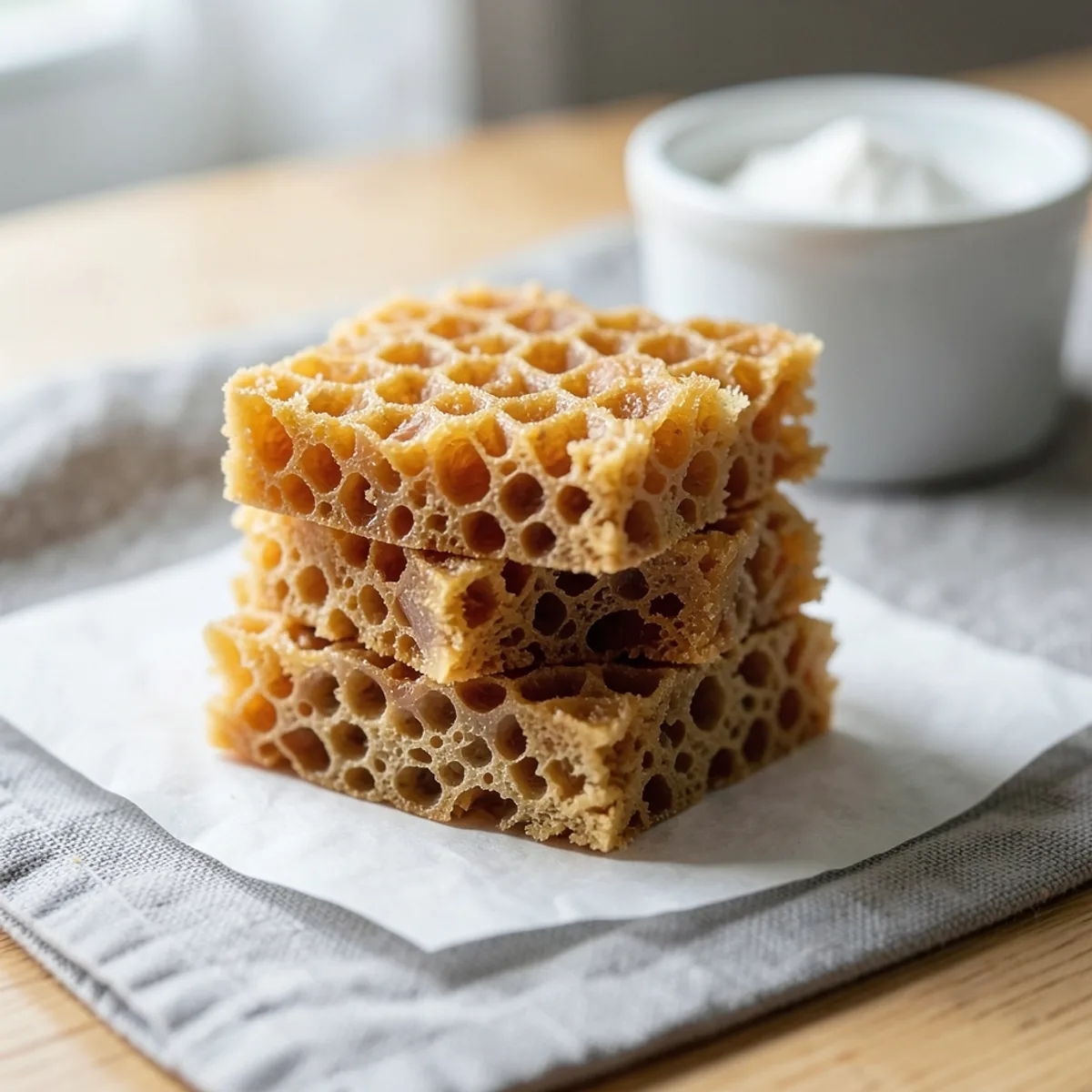
Honeycomb candy that tastes like baking soda often has too much soda, soda not fully mixed in, or syrup cooked too far. Here: a symptom table and a recipe at 2.8 g soda per 100 g of sugar, ready in about 1 hour 25 minutes.
Nobody on our team has made or tasted this version. It is a recipe dosed from published sources, and every claim below says where it comes from. For the standard recipe with 5.5 g of soda per 100 g of sugar, see honey and baking soda honeycomb. This page adds the dose view and a lower-dose card.
What this version changes
- Soda cut to 2.8 g per 100 g of sugar, near the low end of the published range.
- Cooked to 300 F, with a hard stop before the syrup darkens.
- A symptom table, so you can match the taste you got to a likely cause.
What kind of soda taste do you have?
Match the symptom first. The last column says how well each link is backed. Most of it is reasoning from chemistry and a handful of recipe pages, not lab results.
| Symptom | Likely cause | What to change | Backing |
|---|---|---|---|
| Soapy | More soda than the syrup could use up, so alkaline leftovers stay in | Lower the dose | Dickinson College blog (general baking, not candy) |
| Metallic | Unreacted soda | Sift, stir until streaks are gone, use fresh soda | Food Crumbles (single hobby page) |
| Bitter or burnt, dark color | Syrup cooked past its target | Pull at 300 F and use a thermometer | Food Crumbles; one reader report |
| Bitter, cook unclear | Dose or cook, or both | Check both | One reader on a popular honey recipe could not tell which |
| Isolated harsh bites | Clumps of raw soda (likely, not proven) | Sift into a small bowl | 2 sources on sifting, none on taste |
| Weak rise, flat | Old soda, or baking powder used by mistake | Use fresh baking soda | 3 sources; one says no more than 6 months old |
| Soft and sticky | Syrup undercooked, too much water left | Cook to the target temperature | Food Crumbles, Exploratorium |
The reader report is worth a closer look. On a popular honey honeycomb recipe, one reader described a bitter, burnt, baking-soda-like taste at 295 F after doubling the batch. The reader could not say whether the dose or the cook was to blame. So this page lists both as suspects.
The Food Science / Lab Kitchen Note
Baking soda is sodium bicarbonate (NaHCO3). When heated it breaks down: 2 NaHCO3 gives Na2CO3 + H2O + CO2. The carbon dioxide is the gas that puffs the foam. The sodium carbonate is the only solid left behind, according to Scientific American.
That leftover is the problem. Wikipedia says that without an acid, only half of the available carbon dioxide is released, and that the sodium carbonate formed is strongly alkaline and is described as giving baked goods a bitter, soapy taste. In a sugar syrup we have no sourced figure for how much acid is present, so we cannot say how much of your soda reacts with acid and how much is just heated.
Heat sets the speed. Sodium bicarbonate begins to break down at about 176 F (80 C), and higher temperatures speed it up. Syrup at 300 F is far above that threshold, so, by our reading, breakdown in the pot is quick. The Exploratorium puts hard crack at 300-310 F (about 149-154 C), where the syrup is about 99 percent sugar. Soft crack, 270-290 F (about 132-143 C), is about 95 percent sugar. Cooking short of 300 F leaves more water in the syrup.
Overshooting causes a separate problem. The Dickinson College blog notes that extra baking soda makes a batter more alkaline, which speeds the Maillard reaction and darkens browning. Food Crumbles says overshooting the temperature browns and embitters the candy. So a dark, bitter batch can come from heat alone, even with the right dose.
Our calculation: 6.9 g of soda over 250 g of sugar is 2.76 g, rounded to 2.8 g per 100 g. Each teaspoon of soda holds about 1,260 mg of sodium by our calculation from USDA, at 4.6 g per teaspoon.
Baking soda per 100 g of sugar: published doses side by side
This is a comparison of published data, not a record of batches we cooked. The grams per 100 g of sugar are our calculations from each recipe's own amounts. No source ranks these doses by taste, so the table does not show that a lower dose tastes better.
| Lower dose | Middle dose | Highest dose | |
|---|---|---|---|
| Source | Food Crumbles (hobby troubleshooting page); Cake by Courtney (food blog recipe) | A Cozy Kitchen (food blog recipe); Crayons and Cravings (food blog recipe) | Savannah Bee Company (company recipe) |
| Soda as written | 1/2 tsp per 100 g of sugar; 2 1/2 tsp with 350 g of sugar | 1 tbsp with 1 1/4 cups sugar; 4 tsp with 1 1/2 cups sugar | 1 tbsp with 1 cup of sugar |
| Soda per 100 g of sugar | 2.3 g; 2.9 g as listed (3.3 g at 4.6 g per tsp) | 5.5 g; 6.1 g | 6.9 g |
| Cooked to | 300 F (149 C) for both | 295 F (146 C); 300 F (149 C) | 295 F (146 C) |
| Taste notes in the source | Food Crumbles: unreacted soda can leave a metallic aftertaste. Cake by Courtney: one reader noticed a slight aftertaste and linked it to the cream of tartar | A Cozy Kitchen: the doubled-batch reader report above. Crayons and Cravings: advises fresh soda, no taste data | No sourced data |
| Other base | Food Crumbles: no other detail used here. Cake by Courtney: corn syrup, water, honey, cream of tartar | A Cozy Kitchen: honey, no corn syrup, no water. Crayons and Cravings: corn syrup, water, honey | Honey and corn syrup, no water listed |
Food Crumbles also ran a low test of 1/4 tsp per 150 g of sugar, about 0.8 g per 100 g by our calculation. It gave small, sparse bubbles and a fairly dense candy. So there is a floor too: cut the soda too far and the rise suffers. This card, at 2.8 g, sits inside the lower group rather than below it.
How the sources hold up
The temperature stages and the altitude rule come from the Exploratorium's page on sugar stages, a science museum resource. The breakdown temperature and the equation come from a Scientific American article on baking soda, a science magazine piece. Wikipedia on sodium bicarbonate is an encyclopedia entry, and the line about a bitter, soapy taste has no citation there, so we pair it with a second source.
That second source is the Dickinson College Chemistry in the Kitchen post The Science Behind Baking Soda, a college chemistry blog. It says that when there is not enough acid to neutralize baking soda, the soapy taste of the excess is left over. It is a general baking source, not a candy study. We found no scientific study on honeycomb taste, so none is cited, and the link between dose and flavor on this page is an inference from baking chemistry and the published recipes. The sodium figure of 27,400 mg per 100 g comes from USDA FoodData Central. The recipe pages are A Cozy Kitchen, Crayons and Cravings, Cake by Courtney, Savannah Bee Company and Food Crumbles. Food Crumbles is a single hobby source, so treat its claims as one cook's account.
Common mistakes
Adding soda by habit. Published doses run from about 2.3 to 6.9 g per 100 g of sugar, a threefold spread. Doubling a batch makes this worse if you double the soda without checking the ratio. Work out grams per 100 g of sugar instead.
Skipping the sift and over-stirring. Soda clumps, so cooks sift it into a small bowl first and stir only until the streaks are gone. One source says that takes 20 to 30 seconds. Lumps are the most plausible spot for raw soda, though no page we opened says so outright.
Going past the target temperature. A dark cook can taste burnt and bitter whatever the dose. Use a thermometer and pull at 300 F, because the Exploratorium puts hard crack at 300-310 F, and every 500 feet of altitude lowers the target by 1 F.
Substitutes and swaps
| Original | Replacement | Proportion | What changes |
|---|---|---|---|
| Fresh baking soda | Baking powder | Not tested here | Recipe writers say never to use it |
| Honey and sugar | Add corn syrup and water, as Cake by Courtney does | See the table above | A different base from this card, and the card is not tested |
| Corn syrup (in other recipes) | Liquid glucose or molasses (an author reply on Cake by Courtney) | No sourced proportion | A reader suggested vinegar as an acid; no sourced amount |
| Soda dose | A higher published dose, 5.5 g per 100 g of sugar | See honey and baking soda | More soda, and a higher risk of the taste this page is about |
Nutrition note: calories and sodium per piece
Values on the card are estimates calculated from typical USDA FoodData Central values for granulated sugar, honey and baking soda, per one of 12 pieces. Vanilla and the pinch of salt are left out. The result is about 124 calories, 32.4 g of sugars and 158 mg of sodium per piece.
Nearly all the sodium is the baking soda. USDA lists it at 27,400 mg per 100 g, about 1,260 mg per teaspoon at 4.6 g. By our calculation, the 1 1/2 teaspoons on the card hold about 1,890 mg across the whole batch, and we assume all of it stays in the candy. The standard card at 3 teaspoons holds about 3,780 mg.
Storing honeycomb
Keep the pieces airtight. Crayons and Cravings says up to 5 days airtight and best in the first 1 to 2 days. We found no source on whether a soda taste gets stronger or weaker over time, so we do not claim either way, and we have no sourced guidance on freezing.
If the next batch still tastes like baking soda, change one thing at a time so you can tell which change mattered.
Servings: 12 pieces
Honeycomb Candy Tastes Like Baking Soda? Causes and Fixes
A symptom table for bitter, soapy and metallic honeycomb, published soda doses in grams per 100 g of sugar, and a lower-dose recipe in US and metric units. Dosed from sources, not tested by us.
Ingredients
Honeycomb
Equipment
- Large, heavy-bottomed pot (the mixture foams to a large volume)
- Candy thermometer (rather than judging by color)
- Fine sieve or sifter (for the baking soda)
- Pan lined with parchment
- Heatproof spatula
Instructions
Prepare
- Set up. Line the pan with parchment. Sift the baking soda into a small bowl, then keep it, the vanilla and the salt next to the stove. Once the syrup is at temperature, there is no time to measure.
Cook and foam
- Melt the sugar and honey. Our method: put the sugar and honey in the pot over medium heat, melt low and slow, and stir gently only until the sugar looks dissolved. Clip the thermometer to the side.
- Cook to 300 F. Cook until the thermometer reads 300 F (149 C), the bottom of the hard-crack range, and take the pot off the heat. Do not drift past 310 F (154 C). Subtract 1 F for every 500 feet above sea level.
- Add the soda. Stir in the salt and vanilla, then sift the baking soda over the syrup. The syrup foams up quickly; stop stirring as soon as no dry streaks of soda remain. One source says that takes 20 to 30 seconds.
- Pour without spreading. Pour the foam straight into the lined pan and do not spread it.
Set
- Cool undisturbed. Leave the slab alone until it is fully cool and hard. This card counts 60 minutes, which is our estimate.
- Break and store. Our method: break the slab into pieces and move them to an airtight container right away.
Notes
Not tested by us. The soda dose is our choice, set in the low part of the published range (2.3 to 3.3 g per 100 g of sugar). The sugar and honey amounts follow A Cozy Kitchen's corn-syrup-free honeycomb.
Cooking to 300 F follows the Exploratorium hard-crack range, not A Cozy Kitchen's 295 F. We omitted the cream of tartar that Cake by Courtney uses.
Prep, cook and cooling times and the yield of 12 pieces are our estimates. Gram and milliliter figures are our conversions at 200 g per cup of sugar and 4.6 g per teaspoon of soda.
Nutrition values are estimates calculated from typical USDA FoodData Central values for sugar, honey and baking soda, per 1 of 12 pieces. Vanilla and salt are not counted, and all the soda's sodium is assumed to stay in the candy.
Nutrition Facts
Per 1 piece (1/12 of the batch) (estimated)
- Total Fat
- 0 g
- Saturated Fat
- 0 g
- Sodium
- 158 mg
- Total Carbohydrate
- 32.5 g
- Dietary Fiber
- 0 g
- Sugars
- 32.4 g
- Protein
- 0 g
Frequently asked questions
Can you fix honeycomb candy that already tastes like baking soda?
We found no sourced way to remove the taste once the soda is cooked in, and nobody here has tried a rescue. The practical move is a new batch with a lower dose, sifted soda and a thermometer.
Do you need to sift baking soda for honeycomb?
Two sources say cooks sift it into a small bowl because it clumps, then stir only until the streaks are gone. No page we opened ties lumps to a bad taste directly, but a lump is a likely pocket of raw soda.
Can you use baking powder instead of baking soda in honeycomb?
Recipe writers repeatedly say to use baking soda and never baking powder. We have no sourced proportion for a swap, so this page does not give one.
How long does honeycomb candy keep?
One recipe blog says up to 5 days airtight, best in the first 1 to 2 days. We found no source on whether a soda taste gets stronger or weaker with time.

Jimmy Blair spent years in pastry kitchens and lives in Brooklyn, New York. He covers SodaRecipe’s pancakes, cookies, cakes and other sweet bakes.
Comments