Difference Between Baking Soda and Baking Powder (Pancakes)
Jump to RecipeBaking soda needs an acid, baking powder brings its own. See how each one works in a single pan of buttermilk pancakes, with grams per teaspoon and the sodium math.
 Save
Jump to:
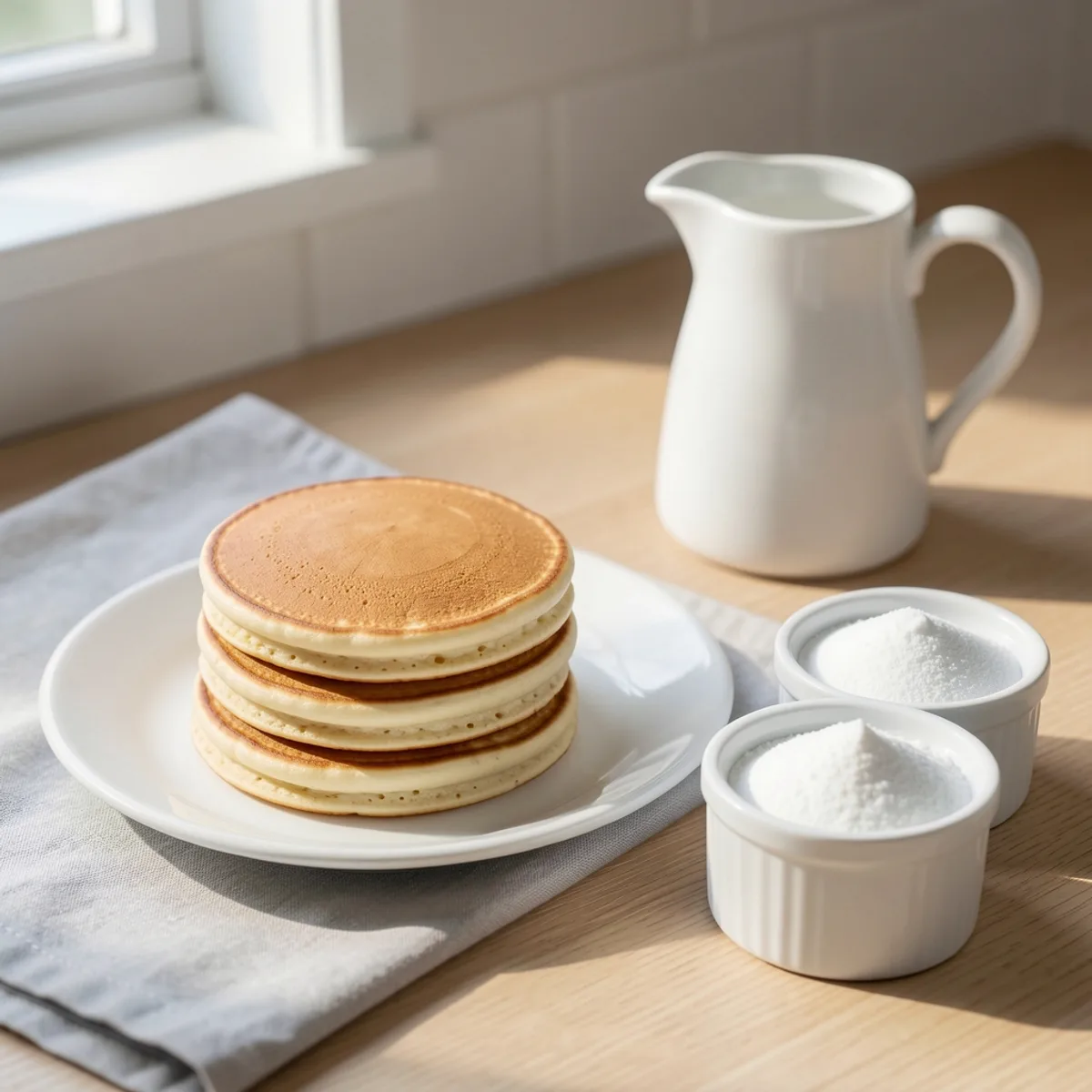
Pancakes look simple. A white powder goes in, a stack comes out. But the two white powders in the pantry do different jobs, and the pancake pan is a good place to watch them work.
So this page explains the difference through one recipe: buttermilk pancakes that use both. The doses are adapted from King Arthur's buttermilk pancakes. The method and the explanations are ours.
- You get a gram weight for every spoon of leavener, so the dose is repeatable.
- You see which ingredient reacts with which, and why a recipe would ask for both.
- You get the sodium math per teaspoon, labeled as our own calculation.
Baking soda vs baking powder in one pan
Here's why this works. King Arthur describes baking soda as sodium bicarbonate, a base with a pH of 8. On its own it has nothing to react with. Baking powder is a complete mixture: soda plus a dry acid, which King Arthur names as cream of tartar, plus starch. This page says only that much about what is inside powder, because no source opened for it gives the share of soda.
Add that up for the pancakes. The buttermilk is the acid in the bowl, and it reacts with the soda. King Arthur also says that when a recipe has both, there is usually some acid, but not enough to react with the soda alone, so the powder does most of the leavening while the soda neutralizes the acid and adds some lift.
Soda also changes more than the rise. Two review sources report that soda gives deeper color and a bit more spread, while a version leaning on powder alone comes out paler, puffier and less chewy. That is what bakers report, not a measured result.
The Food Science / Lab Kitchen Note
Except where a source is named, this section is standard food chemistry.
Baking soda is NaHCO₃. When it meets an acid, it releases carbon dioxide (CO₂), and that gas is what lifts a batter. The buttermilk is the acid here. Once the acid is used up, any leftover soda just sits in the batter, which is why a recipe with too much soda can taste bitter.
Baking powder carries its own acid, so it needs only moisture and heat. King Arthur says grocery-store double-acting powder reacts twice: once when it dissolves in the batter, and again when the batter hits the heat. The practical lesson for pancakes: don't let the batter wait.
A bit of our own arithmetic on the doses. The recipe uses 1 teaspoon of soda for 2 cups of buttermilk, which is 1/2 teaspoon per cup. That lines up with Kitchen Savvy's figure of about 1/2 teaspoon of soda per cup of buttermilk when the recipe has no other acid, though that site notes that published ratios vary by up to 2 to 1 and that molasses or natural cocoa call for more.
One general rule of thumb in baking guides is about 1 teaspoon of powder and about 1/4 teaspoon of soda per cup of flour. The page we found for that rule (Sally's Baking Addiction) wouldn't open, so treat it as a rule of thumb, not a law. These pancakes sit differently from it: 1 teaspoon of powder and 1 teaspoon of soda for 2 cups of flour is half the powder and twice the soda. Buttermilk is why.
Grams and sodium per teaspoon
King Arthur's weight chart lists 1 teaspoon of baking powder as 4 g and 1/2 teaspoon of baking soda as 3 g. The chart has no full-teaspoon row for soda, so we double it: 1 teaspoon is 6 g. Other pages on this site use a figure of 14 g per tablespoon, about 4.7 g per teaspoon. For this page we use the King Arthur weight, 6 g.
The sodium figures come from USDA FoodData Central, which lists baking soda at 27,360 mg of sodium per 100 g, and double-acting baking powder made with sodium aluminum sulfate at about 10,600 mg per 100 g. The per-teaspoon numbers below are our math from those two values and the King Arthur weights.
| Leavener | Weight per teaspoon | Sodium per teaspoon (our math) |
|---|---|---|
| Baking soda | 6 g (our arithmetic from King Arthur's 3 g per 1/2 teaspoon) | about 1,640 mg |
| Baking powder, sodium aluminum sulfate type | 4 g (King Arthur) | about 424 mg |
| Both, as in this recipe | 10 g | about 2,060 mg in the whole batter |
Spread over 15 pancakes, that is about 138 mg per pancake from the leaveners, before the salt and buttermilk. At 14 pancakes it would be about 148 mg and at 16 about 129 mg. Other powder formulations, aluminum-free ones included, differ, so the product label wins.
Soda, powder or both compared
The table below compares published data about the three options, not finished bakes. Where no source gives a figure, the cell says so.
| Option | What it needs in the batter | How it makes gas | Weight per teaspoon | Sodium per teaspoon (our math) | What bakers report |
|---|---|---|---|---|---|
| Baking soda only | An acid, such as buttermilk (King Arthur) | Base with a pH of 8 that reacts with the acid | 6 g (our arithmetic) | about 1,640 mg | Deeper color and a bit more spread (two review sources) |
| Baking powder only | No added acid; it carries its own | Double-acting powder reacts twice, in the batter and in the heat (King Arthur) | 4 g | about 424 mg (sodium aluminum sulfate type) | Paler, puffier, less chewy (two review sources) |
| Both, as in this recipe | Some acid, but not enough for the soda alone (King Arthur) | Powder does most of the leavening; soda neutralizes the acid and adds lift | 6 g soda plus 4 g powder | about 2,060 mg in the batter | No sourced data on the combined result |
Buttermilk pancakes: what each dose does
The full list and steps are on the recipe card above. These are the points that matter.
The soda is there for the buttermilk. Without it, the acid in the buttermilk has nothing to react with, and the batter loses both gas and the soda's effect on color. The powder is there for the rise. The two sit in the flour together, so whisk them in well before the liquid goes in.
Use food-grade, aluminum-free baking soda, and level every spoon. A kitchen scale takes the guesswork out of the heaping-spoon problem, and the weights on the card are what turn this page's numbers into a repeatable dose.
One more thing the explainers skip: bake right after mixing. Gas starts forming as soon as the soda meets the buttermilk, so a batter that sits has already spent some of it.
Common mistakes
Too much soda, or no acid. Extra soda doesn't add lift. Once the acid is used up, basic chemistry says the leftover soda stays alkaline and can taste bitter, so keep the buttermilk and the doses on the card.
The quiet mistake is letting the batter sit. The soda starts reacting on contact, and the powder's first reaction starts when it gets wet. Pour the batter onto the heat soon after you mix it. Trust the timer, not your nose.
King Arthur says equal amounts of soda and powder can't be swapped, because soda is the stronger of the two. So swapping them one for one is a guess. Use the sourced amounts on the baking soda instead of baking powder page.
What if you don't have what the recipe calls for
| Original | Replacement | Proportion | What changes |
|---|---|---|---|
| Baking soda | Baking powder | Not repeated here | See can I use baking soda instead of baking powder for the sourced amounts. |
| Baking soda or powder | Another leavener or an alternative | Not repeated here | See baking soda replacement. |
| Buttermilk | Another liquid | No sourced data | The recipe leans on buttermilk's acid, and no source opened for this page covers a swap. |
| Baking powder with cream of tartar | Aluminum-free or aluminum-based powder | No sourced data | Powders differ by formulation, and so does their sodium. Read the label. |
Storing the pancakes and the leaveners
Cool leftover pancakes, then keep them covered in the fridge. No fridge or freezer time is sourced for this recipe, so this page gives none.
Check the leaveners, too. A weak box makes less gas than the recipe counts on, and the does baking soda go bad article has the fizz test for soda, plus the warm-water test for powder.
Where the numbers come from
The chemistry and the double-acting description come from King Arthur Baking, a specialist baking site (blog post, 2021). It is an explainer, not a trial, so it has no sample size. The gram weights per teaspoon come from King Arthur's ingredient weight chart, a reference chart. The pancake doses come from King Arthur's buttermilk pancake recipe, a published recipe whose page doesn't explain why it uses both leaveners. The explanation of the two doses is ours.
The sodium values come from USDA FoodData Central, a government nutrient database that lists values per 100 g. The per-teaspoon and per-pancake figures are our math on top of it, not measurements, and one powder value was read through a mirror site. The buttermilk-to-soda ratio comes from Kitchen Savvy, a food site that notes its own ratios vary. The color and puffiness observations come from two review sources, so they are what bakers report and not measured results. We found no controlled comparison of soda-only, powder-only and combined pancakes.
Servings: 15 four-inch pancakes
Difference Between Baking Soda and Baking Powder (Pancakes)
Baking soda needs an acid, baking powder brings its own. See how each one works in a single pan of buttermilk pancakes, with grams per teaspoon and the sodium math.
Ingredients
Dry ingredients
Wet ingredients
Equipment
- Griddle or large skillet (lightly greased)
- Two large bowls (one for dry, one for wet)
- Kitchen scale (the gram weights above are what makes the doses repeatable)
- Level measuring spoons (for the powder, soda and salt)
Instructions
Mix the batter
- Whisk the dry ingredients. Whisk the flour, sugar, baking powder, baking soda and salt in a large bowl until the two leaveners are spread evenly through the flour.
- Whisk the wet ingredients. In a second bowl, whisk the egg, buttermilk and melted butter together until smooth.
- Combine just until mixed. Pour the wet mixture into the dry and stir just until no dry flour shows. A few small lumps are fine, and the batter will start to bubble on its own.
Cook right away
- Heat the pan. Heat a lightly greased griddle or large skillet over medium heat while you mix, so the pan is ready the moment the batter is.
- Pour four-inch pancakes. Pour the batter in rounds about four inches across, leaving room for spread. Don't let the bowl of batter sit while you cook the first batch through.
- Flip when bubbles set. Cook until bubbles break on the surface and the edges look set, then flip. Cook the second side until golden and the pancake springs back when pressed.
- Serve warm. Stack the finished pancakes on a plate as you go and serve them while they are warm.
Notes
Credit: the doses are adapted from King Arthur's buttermilk pancakes (14 to 16 four-inch pancakes). The method and the wording are ours. King Arthur's page doesn't explain why it uses both leaveners; the explanation on this page is ours.
Weights: King Arthur's ingredient weight chart lists 1 teaspoon baking powder as 4 g and 1/2 teaspoon baking soda as 3 g. We use one soda weight on this whole page: 6 g per teaspoon, which is that chart's 3 g doubled.
Times: the 10-minute prep and 20-minute cook are our estimates for mixing and cooking in batches. They are not from the source recipe.
Yield: the source makes 14 to 16 pancakes. The nutrition below assumes 15 and is per pancake.
Nutrition values are estimates calculated from typical USDA FoodData Central values, with all-purpose flour, unsalted butter, lowfat cultured buttermilk, table salt and sodium aluminum sulfate baking powder. A little fat for the pan is not counted. A different powder formulation changes the sodium, so the label wins.
Sodium for the two leaveners is our math from the USDA figures in the text, not a measurement.
Nutrition Facts
Per one pancake (1 of 15) (estimated)
- Total Fat
- 2.3 g
- Saturated Fat
- 1.2 g
- Sodium
- 252 mg
- Total Carbohydrate
- 16 g
- Dietary Fiber
- 0.4 g
- Sugars
- 3.8 g
- Protein
- 3.1 g
Frequently asked questions
Why do some recipes use both baking soda and baking powder?
The soda neutralizes the acid in the batter, such as buttermilk, and adds some lift. The powder then carries most of the rise, which is the split in the pancakes on this page.
Is baking soda stronger than baking powder?
Yes, King Arthur calls soda the stronger of the two. That is why equal amounts can't be swapped, and the sourced amounts are on the baking soda instead of baking powder page.
Why does my baking taste bitter?
Too much leavener is the usual suspect. King Arthur warns that swapping in too much powder for soda may leave a slightly bitter, off-putting taste, and soda with no acid left to react with is the same kind of problem.
How do I know my leaveners still work?
Run a fizz check before you bake. The does baking soda go bad article walks through the test.

Stella Nordi bakes in Portland, Oregon. She weighs everything in grams and explains why a bake fails. She covers SodaRecipe’s quick breads, biscuits and baking guides.
Comments