Yield: 15 four-inch pancakes
Difference Between Baking Soda and Baking Powder (Pancakes)
Baking soda needs an acid, baking powder brings its own. See how each one works in a single pan of buttermilk pancakes, with grams per teaspoon and the sodium math.
Ingredients
Dry ingredients
- 2 cups all-purpose flour, 240 g
- 3 tablespoons sugar, 35 g
- 1 tsp (4 g) baking powder, double-acting, 4 g, from the King Arthur weight chart; check the label for aluminum
- 1 tsp (6 g) baking soda, food-grade and aluminum-free, 6 g; King Arthur lists 1/2 tsp as 3 g, so 1 tsp is our arithmetic
- 1/2 teaspoon table salt, 2.5 ml, standard conversion
Wet ingredients
- 1 large egg, about 50 g, typical reference weight
- 2 cups buttermilk, 454 g; the acid that reacts with the soda
- 2 tablespoons unsalted butter, melted, 28 g
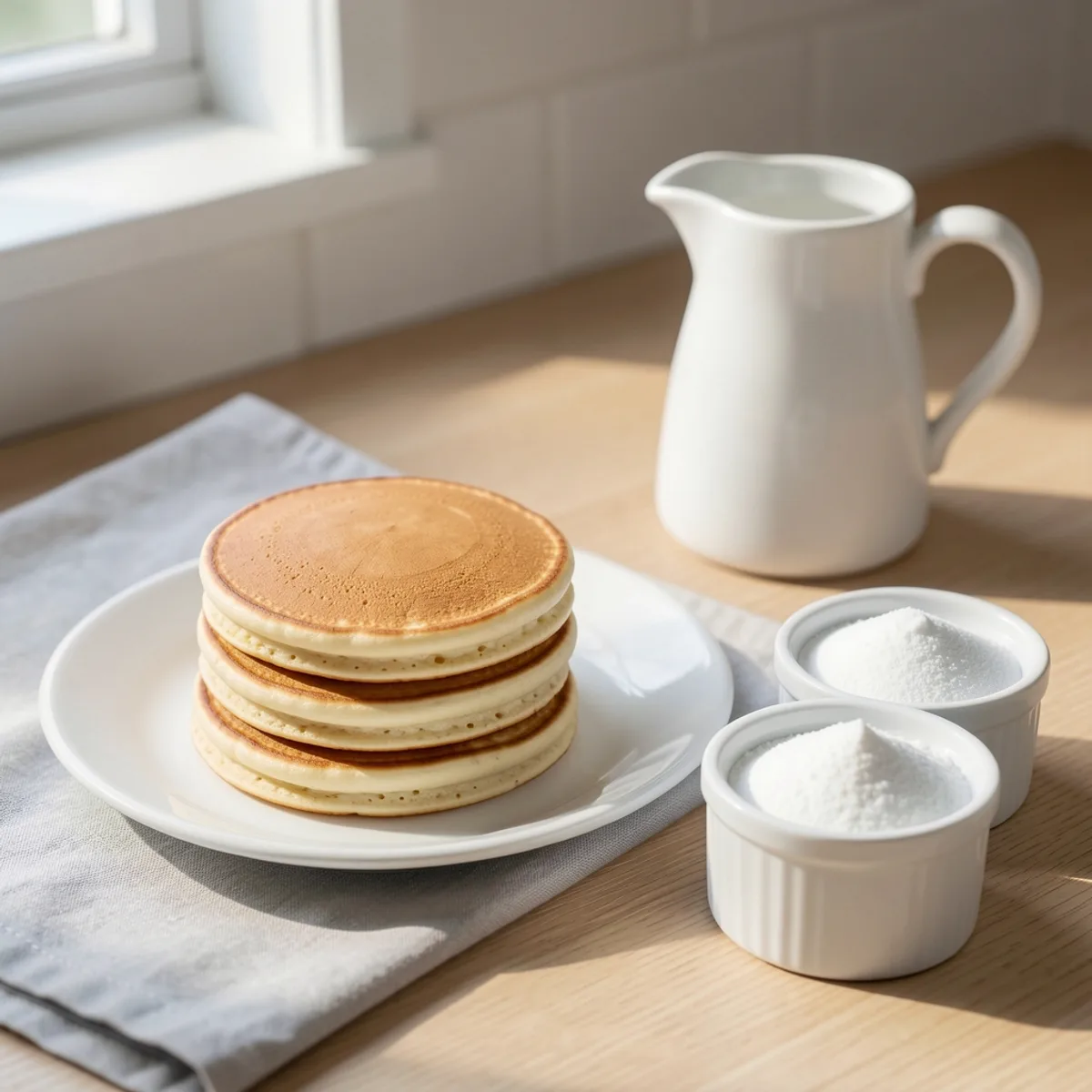
Instructions
Mix the batter
- Whisk the dry ingredients. Whisk the flour, sugar, baking powder, baking soda and salt in a large bowl until the two leaveners are spread evenly through the flour.
- Whisk the wet ingredients. In a second bowl, whisk the egg, buttermilk and melted butter together until smooth.
- Combine just until mixed. Pour the wet mixture into the dry and stir just until no dry flour shows. A few small lumps are fine, and the batter will start to bubble on its own.
Cook right away
- Heat the pan. Heat a lightly greased griddle or large skillet over medium heat while you mix, so the pan is ready the moment the batter is.
- Pour four-inch pancakes. Pour the batter in rounds about four inches across, leaving room for spread. Don't let the bowl of batter sit while you cook the first batch through.
- Flip when bubbles set. Cook until bubbles break on the surface and the edges look set, then flip. Cook the second side until golden and the pancake springs back when pressed.
- Serve warm. Stack the finished pancakes on a plate as you go and serve them while they are warm.
Notes
Credit: the doses are adapted from King Arthur's buttermilk pancakes (14 to 16 four-inch pancakes). The method and the wording are ours. King Arthur's page doesn't explain why it uses both leaveners; the explanation on this page is ours.
Weights: King Arthur's ingredient weight chart lists 1 teaspoon baking powder as 4 g and 1/2 teaspoon baking soda as 3 g. We use one soda weight on this whole page: 6 g per teaspoon, which is that chart's 3 g doubled.
Times: the 10-minute prep and 20-minute cook are our estimates for mixing and cooking in batches. They are not from the source recipe.
Yield: the source makes 14 to 16 pancakes. The nutrition below assumes 15 and is per pancake.
Nutrition values are estimates calculated from typical USDA FoodData Central values, with all-purpose flour, unsalted butter, lowfat cultured buttermilk, table salt and sodium aluminum sulfate baking powder. A little fat for the pan is not counted. A different powder formulation changes the sodium, so the label wins.
Sodium for the two leaveners is our math from the USDA figures in the text, not a measurement.
Nutrition Information: Serving size: one pancake (1 of 15) (estimated)
Calories: 98Total Fat: 2.3gSaturated Fat: 1.2gSodium: 252mgCarbohydrates: 16gFiber: 0.4gSugar: 3.8gProtein: 3.1g
Cuisine: American / Category: Breads & Biscuits
https://www.sodarecipe.com/difference-between-baking-soda-and-baking-powder