Baking Soda vs Baking Powder in Cookies: Two Formulas
Jump to RecipeOne chocolate chip cookie dough written two ways, with baking soda only and with baking soda plus baking powder, in cups and grams. A formula comparison built on published tests, not on bakes of our own.
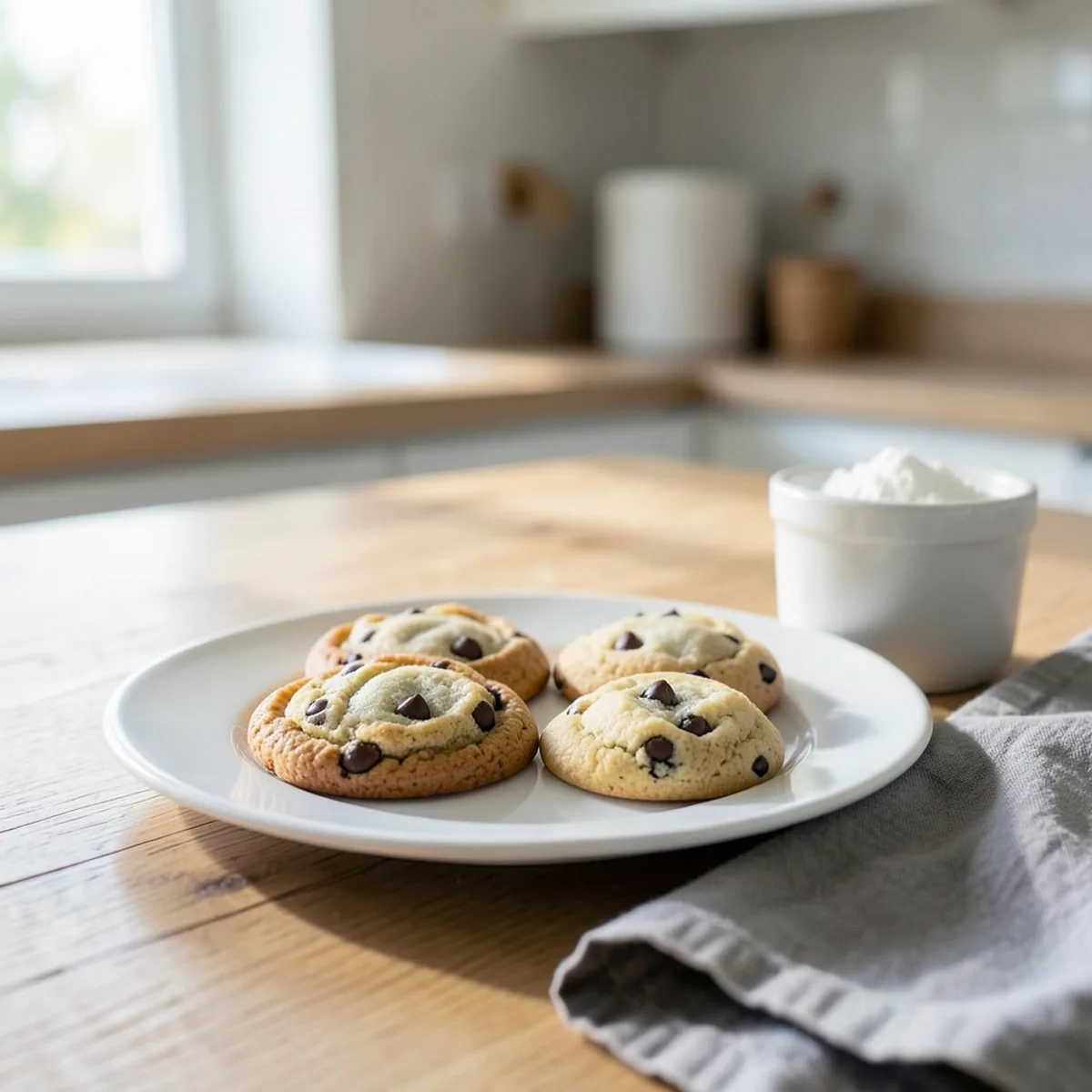 Save
Jump to:
In published tests, baking soda alone gives chocolate chip cookies more spread and deeper browning. Add baking powder, or swap to it, and the cookie moves toward thicker and cakier, and powder alone also comes out paler.
Most pages on this topic define the two powders and stop. This one gives you a dough to bake. It's a Toll House style chocolate chip cookie, written with baking soda only (version A) and with baking soda plus baking powder (version B), in cups and grams.
One honest limit up front. This is a formula comparison, not a bake-off. Nobody here has baked or tasted these cookies, so every result below is credited to someone else's published test.
- You get the full dough in US measures and grams, with the leavener as the only change.
- You see what published tests report for soda only, powder only and a half-and-half mix.
- You get the sodium the leavener adds per cookie, with the arithmetic shown.
One dough, two leaveners
The two source formulas are not a matched pair. The soda-only one, from Cookies for Days, uses 1 tsp of baking soda. The other, from Desserts on a Dime, uses 1/2 tsp of baking soda and 1/2 tsp of baking powder, but with a different sugar and flour balance. Compare those two bakes and you'd be comparing doughs, not leaveners.
So we kept one dough, the soda-only one, and moved only the leavener. Version A is 1 tsp (4.6 g) of baking soda. Version B is 1/2 tsp (2.3 g) of baking soda plus 1/2 tsp of baking powder, the split Desserts on a Dime uses. The full list and steps are on the recipe card.
Use food-grade, aluminum-free baking soda, and level the spoon. If you want the teaspoon-to-gram detail, 1 tsp baking soda in grams explains why 4.6 g is our working value and where other sources differ. For the general difference between the two powders, see difference between baking soda and baking powder.
The Food Science / Lab Kitchen Note
Baking soda is sodium bicarbonate. It makes gas only when it meets an acid. Baking powder is baking soda packed with a dry acid and starch, and double-acting powder releases its gas in two stages, once when wet and again in the oven's heat.
Chocolate chip dough carries its own acid: brown sugar. We don't put a number on it, because no source we opened gave one. That's why the soda-only formula can work in this dough. In the Cook's Country test, the sugar cookies had no acidic ingredient at all, so the dough there is a different case.
Why does soda change the cookie's shape and color? The Takeout explains it qualitatively, with no pH values. Baking soda raises dough pH, which delays the point where proteins firm up in the oven, so the dough has more time to spread. The added alkalinity also promotes browning and weakens gluten for a more tender cookie.
Now the numbers we can source. Handle the Heat says about 1 tsp of baking powder raises 1 cup of flour, against about 1/4 tsp of baking soda for the same lift, and calls soda about 4 times stronger. It adds that 1 tsp of lemon juice or vinegar neutralizes 1/2 tsp of baking soda.
Here's our own arithmetic with that rule, and it's only a lift rule. Our dough has 2 1/4 cups plus 2 tbsp of flour, about 2 3/8 cups, which works out to about 0.6 tsp of baking soda for lift. The source formula uses 1 tsp, which fits the point above: in cookies, soda is also doing browning and spread. Version B swaps half of that soda for 1/2 tsp of powder, worth about 1/8 tsp of soda by the same rule (our math). So B has less soda and less total lift on paper.
Soda only, powder only, half and half
This table compares published data, not our bakes. Where no source gives a value, the cell says so. Our version B is a half-and-half split by volume, and the published tests don't say exactly how they split theirs.
| Variant | Tasty (five Toll House batches, panel scores) | Cook's Country (sugar cookies, three batches each) | Handle the Heat (its own comparison, subjective) | Spread, height, pH |
|---|---|---|---|---|
| Soda only | 8/10: average spread, pleasantly browned, chewy, slight lift | Deep brown, spread rather than rose | Well browned | No sourced data |
| Powder only | 2/10 to 3/10: cakey with too much air, or very pale with little spread | Pale and crisp, very little spread | Extra thick and tall | No sourced data |
| Half soda, half powder | 6/10: cracked, well browned, slightly too cakey | Called pasty by tasters | No sourced data | No sourced data |
Tasty also baked a batch with no leavener, which scored 0/10: underbaked, pale and dense. Neither Tasty nor Cook's Country gives quantities, and Tasty gives no oven temperature or bake time. For our own dough, the leavener adds about 35 mg of sodium per cookie in the soda-only version and about 24 mg in the half-and-half version (our math, shown below). We wrote no powder-only formula here, so that cell stays empty.
What the studies and tests show
The one peer-reviewed cookie study we found and opened is Sung and Chen 2017, in the Journal of Food and Nutrition Research. It's a lab study on the AACC 10-54 sugar cookie recipe: 80 g of cake flour with 0.8 g of sodium bicarbonate, which is 1% of the flour weight, baked at 205 C for 10, 15 and 20 minutes, with three replicates per treatment. The control cookie dough's pH fell from 9.1 to 6.2 during baking. In flour-and-water model cookies, the authors attributed the heavier browning by-products they measured with bicarbonate to the higher dough pH. The study is about browning chemistry, not spread, and the sample count isn't fully stated, so we use it only to back up the pH and browning point.
The rest is informal testing. Tasty baked five batches of Toll House dough with the same amount of leavener each time and scored them by tasting panel. Cook's Country baked three batches each of sugar cookies with soda, powder or a 50-50 mix. Both are published tests with panel judgments, not measurements. We found no study that measured cookie spread against leavener, and none of the sources we opened reports spread diameters. If you see a precise spread number for this comparison elsewhere, ask where it came from.
Common mistakes
Swapping powder for soda one to one. In published tests, powder alone gave a paler, puffier, more cake-like cookie with little spread. If you must swap, use the sourced ratio of about 1/4 tsp of soda to 1 tsp of powder per cup of flour, and expect a different cookie, not a copy.
Heaping the soda spoon. Too much soda is a common cause of a metallic, soapy or bitter taste, because extra soda has no acid left to react with. Level the spoon, or weigh 4.6 g for 1 tsp. Mix it evenly into the flour first.
Blaming the leavener when the cookies are flat. Old leavener is a real cause, and Handle the Heat says opened baking soda and baking powder last about 6 to 12 months. But sources disagree on whether powder-only cookies spread little or come out flat, so dough fat and flour balance matter too.
Swaps and what changes
| Original | Replacement | Proportion | What changes |
|---|---|---|---|
| Baking soda | Baking powder | About 1 tsp of powder for 1/4 tsp of soda, per cup of flour (Handle the Heat) | A rough substitute in cookies. Published tests report paler, puffier cookies with little spread. See can I use baking soda instead of baking powder for the swap in the other direction. |
| Soda plus powder (version B) | Soda alone (version A) | 1 tsp soda, as written on this page | A formula comparison, not baked here. Published tests report more browning and spread with soda alone. |
| Baking soda | Another leavener | Not repeated here | See baking soda replacement for ratios in teaspoons and grams. |
Tips for the dough
Change one thing at a time. If you bake both versions from one batch, split the base by weight before the flour goes in, as the optional steps on the card describe.
Weigh the flour. Cups of flour vary a lot from scoop to scoop, and the dough's spread depends on the fat and flour balance, not just the leavener. The soda needs to be whisked into the flour so it doesn't pocket in the dough.
Portion by weight too. The sources call for about 1 tbsp of dough per cookie, but this dough works out to about 40 g a cookie (our math), so a tablespoon scoop would give you far more than 36. Bake time moves with portion size, so check the edges rather than the clock.
Sodium the leavener adds
Our math, step by step, from two USDA FoodData Central values. Baking soda has 27,360 mg of sodium per 100 g. At 4.6 g per teaspoon, 1 tsp of soda carries about 1,260 mg (27,360 x 0.046). That is the leavener's share of version A for the whole batch, and over 36 cookies it comes to about 35 mg per cookie.
Double-acting baking powder of the sodium aluminum sulfate type has 10,600 mg of sodium per 100 g in the same database, and other powder types differ. We assume 4.6 g per teaspoon for powder, which isn't from the sources opened for this page. That puts 1/2 tsp (2.3 g) of powder at about 244 mg (10,600 x 0.023). In version B, 1/2 tsp of soda adds about 629 mg, so the two leaveners together add about 873 mg per batch, or about 24 mg per cookie.
Salt and the other ingredients add the rest of the sodium, and we give no figure for them here. The per-cookie total on the recipe card is an estimate, not a measurement, and it depends on your brands.
Storing the cookies and the dough
Let the cookies cool completely, then keep them in an airtight container. No cookie storage time is sourced for this recipe, so this page gives none.
Raw dough can wait in the fridge, covered, but no dough storage time is sourced either. Keep the leaveners themselves in closed containers, since Handle the Heat gives about 6 to 12 months once opened.
Where the numbers come from
The tasting scores come from Tasty's five-batch test, and the sugar cookie results from Cook's Country. The swap ratio and the leavener shelf life come from Handle the Heat. The sodium per 100 g values for the leaveners come from USDA FoodData Central records for baking soda and double-acting baking powder, read through a mirror site. The leavener sodium per batch and per cookie is our arithmetic on top of those values. The nutrition on the recipe card is an estimate from typical USDA values.
One variable at a time
If your cookies misbehave, change only the leavener. Keep the dough, the portion weight and the oven the same, then write down what you see in spread, color and texture.
Servings: 36 cookies
Baking Soda vs Baking Powder in Cookies: Two Formulas
One chocolate chip cookie dough written two ways, with baking soda only and with baking soda plus baking powder, in cups and grams. A formula comparison built on published tests, not on bakes of our own.
Ingredients
Dough (the same for both versions)
Leavener: pick version A or version B
Equipment
- Kitchen scale (for the flour, sugars, butter and chips)
- Level measuring spoons (for the leaveners and salt, because most home scales can't read 2.3 g)
- Mixing bowls
- Baking sheets and parchment
Instructions
Make the dough
- Preheat the oven. Heat the oven to 375 degrees F (190 C) and line baking sheets with parchment.
- Whisk the dry ingredients. Whisk the flour and salt with your leavener. For version A that is 1 level tsp of baking soda. For version B it is 1/2 level tsp of baking soda and 1/2 level tsp of baking powder. Whisk until no clumps of powder remain.
- Cream the butter and sugars. Beat the softened butter with the granulated and brown sugar until the mixture is combined and smooth.
- Add the eggs and vanilla. Beat in the eggs and the vanilla until the mixture looks uniform.
- Stir in the flour and chips. Add the flour mixture and stir just until no dry streaks remain, then fold in the chocolate chips.
- Portion the dough. The dough weighs roughly 1,440 g in total (our math), so cut it into 36 equal portions of about 40 g each. Space them on the sheets.
Bake
- Bake and check the edges. Bake at 375 degrees F (190 C). The soda-only source says 7 to 9 minutes and the soda-plus-powder source says 10 to 12 minutes, from different doughs, so start checking at 7 minutes. Pull the sheets when the edges are set and golden.
- Cool before moving. Let the cookies sit on the sheet for a few minutes so they firm up, then move them to a rack.
Optional: bake both versions side by side
- Split the dough before the flour. Make the butter, sugar, egg and vanilla base, then divide it equally by weight into two bowls. Into each bowl goes 171 g of flour, half the salt and 200 g of chips. Whisk the leavener into each bowl's flour first: 1/2 tsp of baking soda for A, 1/4 tsp of baking soda plus 1/4 tsp of baking powder for B. This is our suggested method, not a bake we have run.
Notes
Formula sources: the dough and the 1 tsp of baking soda in version A are adapted from Cookies for Days (a Toll House style soda-only formula). The 1/2 tsp soda plus 1/2 tsp baking powder split in version B comes from Desserts on a Dime, whose own dough has a different sugar and flour balance. We kept one dough for both versions and changed only the leavener, so the two versions here are a controlled pair on paper only.
This is a formula comparison. Nobody at SodaRecipe has baked these cookies, so every result described on this page comes from published tests by others.
Time and temperature come from the two source formulas: 375 degrees F (190 C), 7 to 9 minutes for the soda-only source and 10 to 12 minutes for the soda-plus-powder source. The 10 minutes on the card sits inside the second range. The 20 minutes of prep is our estimate.
Yield: both sources say 36 cookies of about 1 tablespoon of dough, but the dough here weighs roughly 1,440 g by our math (using our estimated weights for the eggs, vanilla and salt), which is about 40 g per cookie. Portion by weight and expect to adjust the bake time.
Nutrition values are estimates calculated from typical USDA FoodData Central values, shown for version A with unsalted butter, enriched all-purpose flour, semi-sweet chocolate chips, large eggs and table salt. Version B has the same values except for a lower sodium figure. The baking powder is assumed to be the double-acting sodium aluminum sulfate type at 4.6 g per teaspoon.
Nutrition Facts
Per one cookie (1 of 36), version A (estimated)
- Total Fat
- 8.7 g
- Saturated Fat
- 5.3 g
- Sodium
- 107 mg
- Total Carbohydrate
- 24.2 g
- Dietary Fiber
- 0.9 g
- Sugars
- 15.5 g
- Protein
- 1.8 g
Frequently asked questions
Can you use both baking soda and baking powder in cookies?
Yes, version B of this recipe does. In published tests a half-and-half mix browned and cracked well, but Tasty's panel found it slightly too cakey and Cook's Country's tasters called it pasty.
Can I use baking powder instead of baking soda in cookies?
It is only a rough substitute, because in published tests powder alone gave paler, puffier cookies with little spread. If you try it, the sourced rule is about 1 tsp of baking powder for each 1/4 tsp of baking soda per cup of flour, and the cookie will come out different.
Why are my cookies flat even with leavening?
Old leavener is one cause, since opened baking soda and baking powder last about 6 to 12 months according to Handle the Heat. Soda also makes dough spread by design, and the fat and flour balance of the dough matters too.
Why do my cookies taste bitter or metallic?
Too much baking soda is a common culprit on the pages we read, because soda the dough's acid can't neutralize can taste soapy, bitter or metallic. Level the spoon, and weigh 1 tsp as 4.6 g if you use a scale.

Jimmy Blair spent years in pastry kitchens and lives in Brooklyn, New York. He covers SodaRecipe’s pancakes, cookies, cakes and other sweet bakes.

Comments