Why Is My Honeycomb Candy Chewy? Causes and Fixes
Jump to RecipeA cause, sign and fix table for chewy honeycomb, the water and hard crack chemistry behind it, and a card in US and metric units. Adapted from published recipes, not tested by us.
 Save
Jump to:
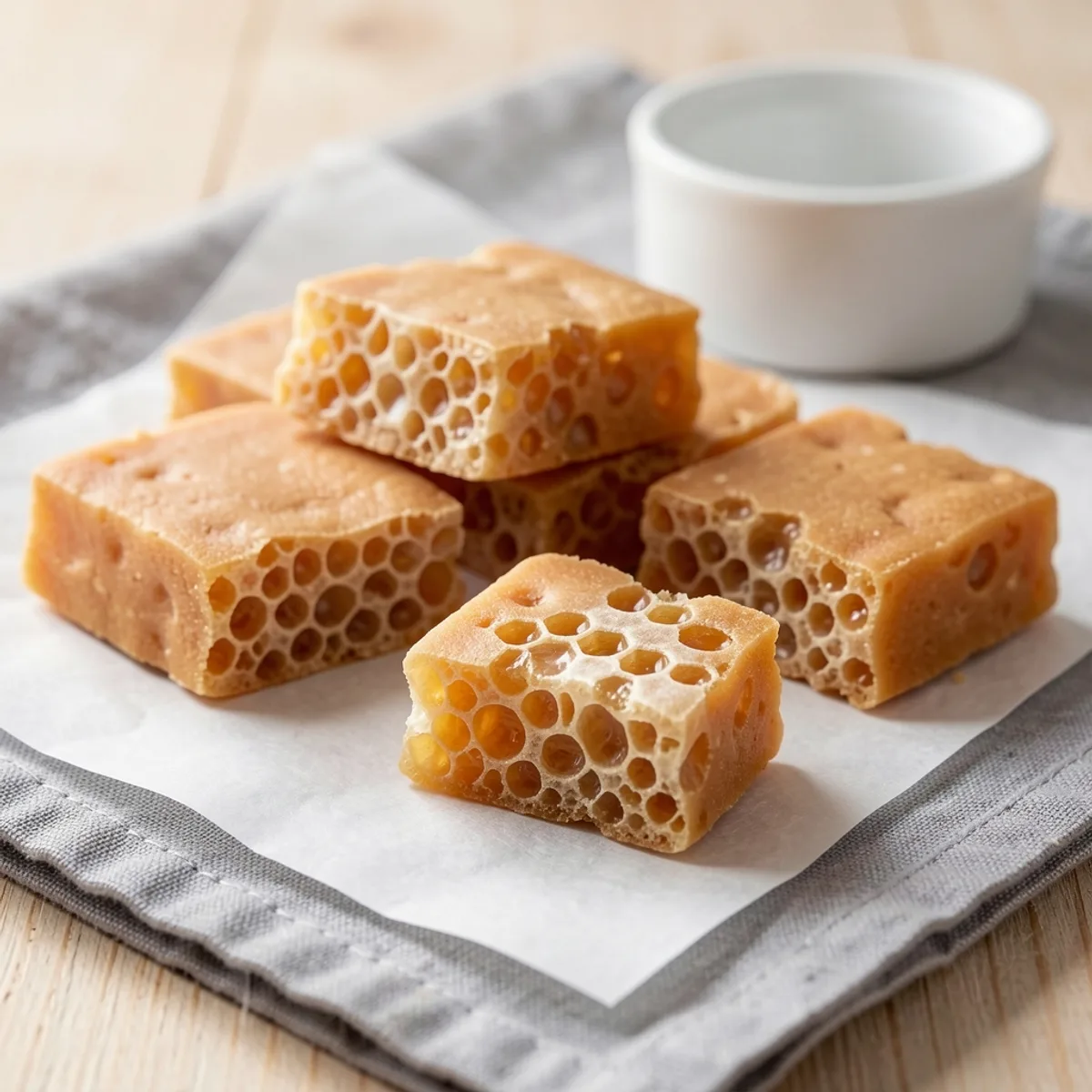
Honeycomb candy that turns chewy is usually syrup taken off the heat too soon; this card of sugar, light corn syrup, water and baking soda is cooked to 300 F (150 C), poured fast and cooled, about 1 hour 25 minutes in all.
Nobody on our team has made or tasted it. The card is our adaptation of published recipes, built to avoid the chewy result, and it is not a guarantee. It starts from the base batch on Food Crumbles, and the chewy diagnosis leans on Tales From The Kitchen Shed, which we adapted and did not copy.
- A cause, sign and fix table, so you can match what you see to what went wrong.
- A short chemistry note on water, hard crack and sugar that grabs moisture from the air.
- A small card with US and metric units and a sodium figure.
If the problem is flavor and not texture, why honeycomb candy tastes like baking soda covers the dose. For a version with no foam at all, see honeycomb candy without baking soda.
Why honeycomb gets chewy: cause, sign and fix
Many cooks report the same first suspect. The syrup came off the heat too early, so the candy kept water and never reached a crisp set. Five sources point to a thermometer and the hard crack range, and one adds that a batch pulled at the right temperature set hard for a reader.
Moisture is the second suspect. Many cooks report that honeycomb pulls water from the air, so it softens and goes sticky after setting. Their advice matches: skip humid days, cool fully, then seal it airtight. One author warns about humid climates, and another notes that uncovered pieces went tough within days.
| Cause | Sign | Fix |
|---|---|---|
| Syrup off the heat too early | Chewy, sticky, soft candy; the syrup kept water and stays soft (Food Crumbles) | Cook to the hard crack range on a thermometer. Our card uses 300 F (150 C). Ask Nigella describes the color as a rich brown like maple syrup, not as dark as caramel |
| Target set too low | Chewy even though you stopped at a number. A Cozy Kitchen cooks to 295 F, below the Exploratorium's 300-310 F range | Aim inside the Exploratorium range, and subtract 1 F per 500 feet above sea level |
| Thermometer or altitude off | Same chewy result, though you followed the recipe | We found no sourced thermometer check. For altitude, Food Crumbles lowers its target by about 19 F at about 3,000 m (about 9,800 ft, our conversion), where water boils near 90 C (about 194 F, our conversion) |
| Moisture picked up from the air | Soft or sticky after setting; uncovered pieces went tough within days | Make it on a dry day, cool to room temperature, then seal airtight. Food Crumbles says cooking a few degrees hotter removes more water on humid days, but gives no number |
| Too much honey or golden syrup | Sticky (invert sugars; Food Crumbles, one source) | Use light corn syrup as the steadier base, as our card does |
| Vinegar or citric acid added early | Sticky, because early acid inverts the sugar (Food Crumbles) | Add acid late if at all; no sourced proportion |
| Stored in the fridge | Softens in cold, humid air; four sources advise against it | Keep at room temperature in an airtight container, parchment between layers |
Too much heat has its own cost. Overcooked syrup can taste burnt or bitter, and we found no sourced number for where that starts. The Exploratorium range stops at 310 F, so the fix is to take the pot off before it drifts past that.
The Food Science / Lab Kitchen Note
Sugar syrup is a water problem. The Exploratorium lists soft crack at 270-290 F (about 132-143 C) with the syrup about 95 percent sugar, and hard crack at 300-310 F (about 149-154 C) at about 99 percent sugar. By our reading, that leaves roughly 5 percent water at soft crack and about 1 percent at hard crack. Pull the pot at soft crack and the candy still holds several times more water, which is what a chewy bite is.
Food Crumbles, a single hobby science blog, makes the same point. Undercooked syrup stays soft because water is left in it. Its own math puts the base batch at about 15 percent water going into the pot, from 25 g of water in roughly 170 g of batch.
Baking soda is the foam. In hot syrup it gives off carbon dioxide, and the bubbles set in place as the syrup stiffens. By our reading, a syrup that still holds water stays loose, so the bubbles can collapse or merge, and the candy sets soft.
Sugar then keeps working against you. Honeycomb is hygroscopic, which means it absorbs moisture quickly, per Food Crumbles. A candy that set dry can still turn chewy on the counter. That is why the cooling and sealing steps on the card matter as much as the temperature.
The card's sodium comes almost entirely from the soda. The full calculation is in the nutrition note below.
Three syrups compared: what the sources report
This is a comparison of published data, not a record of batches we cooked. Where nothing in our sources covers a cell, it says so.
| Sugar and light corn syrup | Sugar and golden syrup | Sugar and honey | |
|---|---|---|---|
| Source | Food Crumbles (hobby science blog) | Tales From The Kitchen Shed (recipe blog) | A Cozy Kitchen (general blog) |
| Amounts as written | 100 g sugar (1/2 cup), 45 g corn syrup (about 2 tbsp), 25 g water (about 1 2/3 tbsp), 1/2 tsp soda; US equivalents are our conversions | 175 g caster sugar (about 7/8 cup, our conversion), 4 tbsp golden syrup (about 80 g), 1 tsp bicarbonate of soda | Sugar, honey, soda, kosher salt, vanilla; no amounts in our data |
| Syrup per 100 g of sugar | 45 g | About 46 g, our math | No sourced data |
| Cooked to | 150 C (300 F) | 150 C | 295 F |
| Stickiness reported | Called the steadier base | Food Crumbles warns that too much honey or golden syrup makes it sticky | Food Crumbles' warning applies; this author only mentions humid climates, which may make it hard to keep crispy |
| Storage claim | Airtight, a few weeks | Up to 3 months or longer, 6 months in her jars; one blog's claim that conflicts with other pages | No duration on the card |
| Calories from the source | No sourced data | No sourced data | 234 kcal per sheet, an automatic estimate for a different yield |
None of these pages runs the three syrups side by side. Food Crumbles is the only one that ties honey and golden syrup to stickiness, and it is a single source.
Substitutes and swaps
| Original | Replacement | Proportion | What changes |
|---|---|---|---|
| Light corn syrup | Golden syrup | Kitchen Shed's own recipe uses 4 tbsp (about 80 g) with 175 g sugar (about 7/8 cup, our conversion); not a swap ratio, not tested here | Invert sugar; Food Crumbles says too much makes it sticky |
| Light corn syrup | Honey | Not tested here | Invert sugar; stickier if you use too much (Food Crumbles) |
| Baking soda | Baking powder | No sourced proportion | Our card uses plain baking soda; no sourced proportion for baking powder |
| Early acid | Vinegar or citric acid | No sourced proportion | Early addition inverts the sugar and makes it sticky |
Common mistakes
Pulling the pot early. The syrup looks amber, so you stop. The thermometer says it is not there yet. Keep going until the number, then take the pot off the heat.
Setting the target too low. Some recipes stop at 295 F. Tales From The Kitchen Shed puts the hard crack range at 146-155 C (295-310 F) and says candy taken off before at least 146 C (295 F) is chewy or sticky. The Exploratorium starts at 300 F, which is why our card uses it. Ask Nigella lists 150-160 C (300-310 F).
Leaving the pieces out. Hygroscopic sugar picks up water fast. Food Crumbles says to cool to room temperature, about an hour for its batch, before sealing airtight, and not to leave honeycomb out overnight in humid weather.
Storing honeycomb airtight
Keep the pieces airtight at room temperature, with parchment between layers, and do not put plain honeycomb in the fridge. Many cooks report that cold, humid air softens it, and a recipe author doubts a reader's two-week fridge plan. A chocolate coating can act as a moisture barrier, but we found no sourced data on how well.
The sources disagree on how long it lasts. Hill Country Chocolate says uncoated pieces keep about a week airtight at room temperature. Food Crumbles says airtight honeycomb keeps a few weeks. Tales From The Kitchen Shed claims up to 3 months or longer, and 6 months in her jars. Treat the last as one blog's claim, since it conflicts with the others.
The freezer is also disputed. Hill Country Chocolate says freezing helps keep the crunch, while another page does not recommend cold storage at all. We have no sourced way to bring sticky pieces back, and no sourced reheating method, so a fresh batch on a dry day is the safe route.
How the sources hold up
The temperature stages, the sugar percentages and the altitude rule come from the Exploratorium's page on sugar stages, a science museum resource. The sodium and sugar figures come from USDA FoodData Central, a government nutrient database, for baking soda, granulated sugar and light corn syrup.
Everything else is recipe-site opinion. Ask Nigella is a reader Q&A page on a celebrity cook's site, and it does not mention humidity. Tales From The Kitchen Shed, A Cozy Kitchen and Hill Country Chocolate are recipe blogs, and Hill Country is inconsistent on soda amounts. Food Crumbles is a single hobby source, so read its claims as one cook's account. We found no scientific study on chewy honeycomb, so none is cited, and the mechanism on this page is our reading of the sourced numbers.
Nutrition note: calories and sodium per piece
Values on the card are estimates calculated from typical USDA FoodData Central values for granulated sugar (387 kcal and 99.8 g of sugars per 100 g), light corn syrup (283 kcal calculated and 76.8 g of sugars per 100 g) and baking soda. The calculation uses light corn syrup, not a different syrup. It is our own math, not a lab measurement.
The batch comes to about 512 kcal, 134 g of sugars and 658 mg of sodium. For the sodium, USDA lists baking soda at 27,400 mg per 100 g, so 2.3 g carries about 630 mg; the corn syrup adds a little more and the sugar almost none. Divided by 8 pieces, that is about 64 calories, 16.7 g of sugars and 82 mg of sodium per piece. A Cozy Kitchen's 234 kcal per sheet is for a different recipe and yield, so it is not a like-for-like.
If a batch still comes out chewy, check three things in order: the temperature you pulled it at, the weather that day, and where the pieces sat afterward.
Servings: 8 pieces
Why Is My Honeycomb Candy Chewy? Causes and Fixes
A cause, sign and fix table for chewy honeycomb, the water and hard crack chemistry behind it, and a card in US and metric units. Adapted from published recipes, not tested by us.
Ingredients
Honeycomb
Equipment
- Heavy-bottomed pot
- Candy thermometer (the card is built around a number, not a color)
- Pan lined with parchment
- Small whisk or heatproof spatula
Instructions
Prepare
- Set up before the heat. Line the pan with parchment and measure the baking soda into a small bowl. The soda goes in as soon as the pot is off the heat, so keep everything within reach.
Cook the syrup
- Dissolve the sugar. Put the sugar, corn syrup and water in the pot over medium heat. Melt low and slow, stirring gently only until the sugar looks dissolved, then clip the thermometer to the side. The heat level and the stirring are our adaptation, not from the sources.
- Cook to 300 F. Cook until the thermometer reads 300 F (150 C), the bottom of the hard crack range, and take the pot off the heat. Subtract 1 F for every 500 feet above sea level. Coming off early is the usual cause of chewy candy, so trust the thermometer, not the clock.
- Add the soda and pour. Whisk the soda in for about 5 seconds (Hill Country Chocolate), then pour into the lined pan at once. Expect the foam to climb the pot; that look is our description, not from the sources. Keep going.
Set
- Cool undisturbed. Leave the slab alone until it is fully cool and hard. This card counts 60 minutes, our estimate; Hill Country Chocolate says 1 to 2 hours.
- Break and seal. Break the slab into about 8 pieces once it is cool to the touch, and put them in an airtight container with parchment between layers. Do not refrigerate.
Notes
Not tested by us. This is our adaptation of the Food Crumbles base batch (100 g or 1/2 cup sugar, 45 g or about 2 tbsp corn syrup, 25 g or about 1 2/3 tbsp water, 1/2 tsp baking soda, cooked to 150 C or 300 F, 8-10 portions), with the corn syrup rounded to 2 tbsp (44 g). US equivalents are our conversions. The 5-second soda step follows Hill Country Chocolate.
Prep, cook and cooling times and the yield of 8 pieces are our estimates, as are the medium heat, the gentle stirring and the description of the foam. Gram figures for sugar, corn syrup and baking soda are our conversions from USDA cup, tablespoon and teaspoon weights.
Nutrition values are estimates calculated from typical USDA FoodData Central values, per 1 of 8 pieces: granulated sugar, light corn syrup and baking soda. Carbs are counted equal to sugars, and protein, fat and fiber are counted as zero. The sodium is almost all from the baking soda. This is our own calculation.
Nutrition Facts
Per 1 piece (1/8 of the batch) (estimated)
- Total Fat
- 0 g
- Saturated Fat
- 0 g
- Sodium
- 82 mg
- Total Carbohydrate
- 16.7 g
- Dietary Fiber
- 0 g
- Sugars
- 16.7 g
- Protein
- 0 g
Frequently asked questions
Can you save honeycomb candy that is already chewy?
We found no source that rescues chewy or sticky pieces, and nobody here has tried it. The sourced move is a new batch cooked to the hard crack range, with a thermometer and a dry day.
How long does homemade honeycomb candy stay crisp?
Sources disagree. Hill Country Chocolate says about a week airtight for uncoated pieces, Food Crumbles says a few weeks, and Tales From The Kitchen Shed claims up to 3 months or longer, a claim that conflicts with the other pages.
Can you make honeycomb candy without a thermometer?
No source we opened tests a thermometer-free method, so we cannot give a timing. Ask Nigella describes the target color as a rich brown like maple syrup, not as dark as caramel, next to its 150-160 C (300-310 F) range.
Can you put honeycomb candy in the fridge?
Four sources say not to, because cold, humid air softens it. The freezer is disputed: Hill Country Chocolate says freezing helps keep the crunch, while others do not recommend cold storage at all.

Jimmy Blair spent years in pastry kitchens and lives in Brooklyn, New York. He covers SodaRecipe’s pancakes, cookies, cakes and other sweet bakes.
Comments