How Much Sodium in Club Soda? 75 mg per 12 oz Can
Jump to RecipeUSDA data puts club soda at about 75 mg of sodium per 12 fl oz, 3.2% of 2,300 mg. See how seltzer, mineral water and tonic compare, then a calculated homemade version.
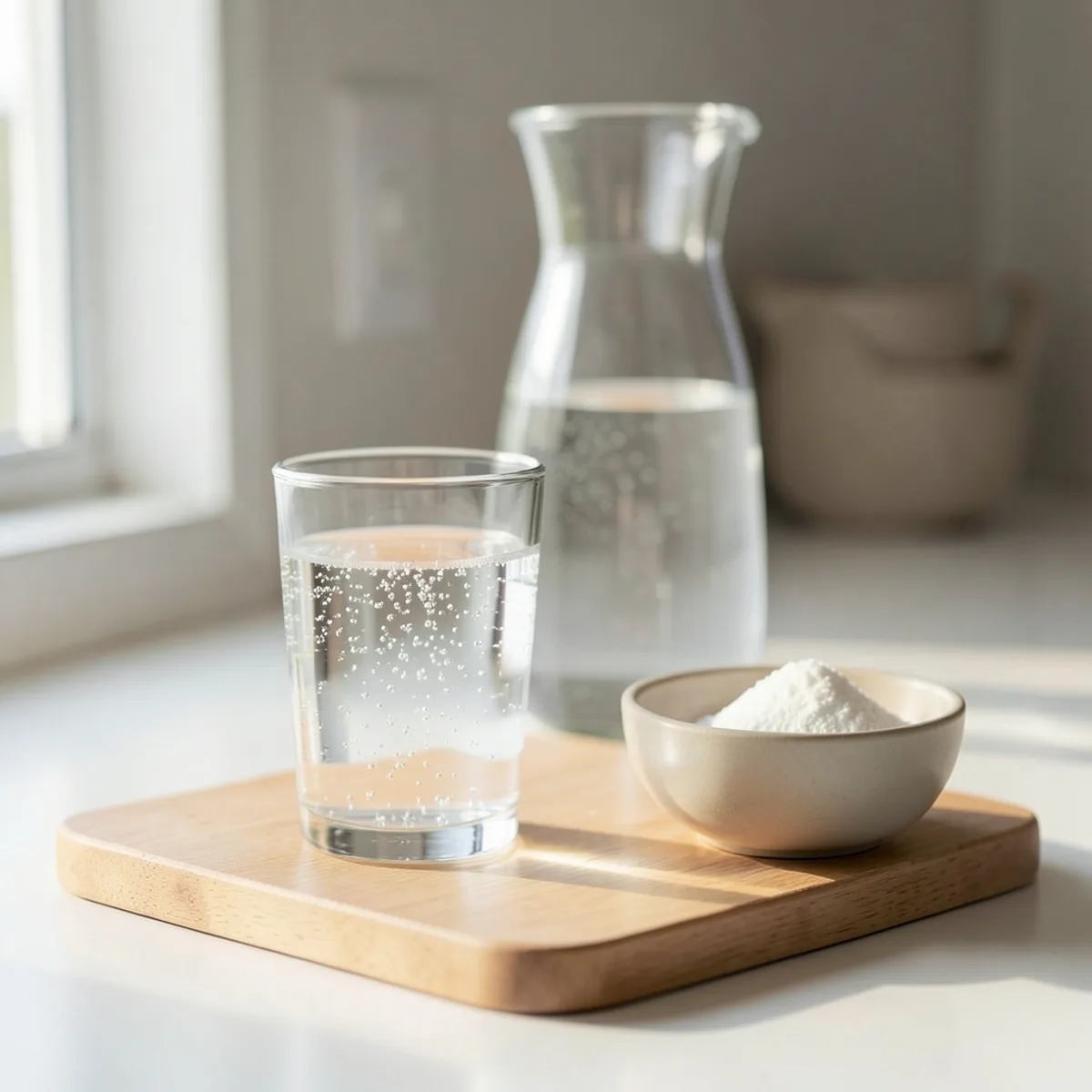 Save
Jump to:
Most people ask this because the label lists sodium on a bubbly drink. Here's the number, and here's where it comes from. The USDA figure is a generic one, and your can may differ. We show every step of the math so you can redo it with your own label.
This page stays on sodium. We found no source that links club soda to weight or fat loss, and we make no health promise. If you came for baking soda itself, the per-spoon numbers live in how much sodium in baking soda water, and we won't repeat those tables here.
The Food Science / Lab Kitchen Note
Club soda is carbonated water with minerals added. Healthline lists potassium sulfate, sodium chloride, sodium bicarbonate and disodium phosphate as examples. Seltzer generally has no added minerals, though that may vary by brand. That is the main difference between club soda and seltzer.
Why add them? Healthline says the minerals are mainly for taste and unlikely to offer health benefits at these amounts. We found no sourced explanation beyond that, so we won't guess at the chemistry of the flavor.
Sodium chloride and sodium bicarbonate (baking soda) are two of the salts Healthline names, and both contain sodium. That's why a homemade version works at all. Add a little baking soda to plain seltzer and you have rebuilt part of the recipe on the can.
The arithmetic is simple. USDA FoodData Central (club soda, fdcId 174842) lists 21.0 mg of sodium per 100 g, and a 12 fl oz can or bottle weighs 355 g. So 21.0 x 3.55 = about 75 mg, which is 3.2% of 2,300 mg. Those last two steps are ours, not a published value.
Club soda vs seltzer vs the rest (data only)
This is a comparison of published and calculated data, not a taste test or a trial of our own. All per-12-fl-oz figures are our arithmetic on 355 g, using USDA per-100-g values.
| Drink | Sodium per 100 g (USDA) | Per 12 fl oz (355 mL), our math | Share of 2,300 mg | Healthline, per 12 oz |
|---|---|---|---|---|
| Club soda (fdcId 174842) | 21.0 mg | About 75 mg | 3.2% | 3% of DV |
| Seltzer | No sourced USDA value | No sourced figure | No sourced figure | 0% of DV |
| Sparkling mineral water: Perrier (fdcId 173233) | 1.0 mg | About 4 mg | 0.2% | 2% of DV (sparkling water) |
| Sparkling mineral water: Topo Chico (USDA branded) | About 1.1 mg | About 4 mg per 360 g serving | 0.2% | 2% of DV (sparkling water) |
| Tonic water (fdcId 171869) | 12.0 mg | About 43 mg | 1.9% | 2% of DV |
| Bottled water, generic (fdcId 174158) | 2.0 mg | About 7 mg | 0.3% | n/a |
USDA's branded entry for Perrier shows 0 mg per serving, while its SR Legacy entry gives 1.0 mg per 100 g. Sparkling mineral water sodium depends on the source and the brand, so the label decides. Tonic water has less sodium than club soda in this data; check its label for what else it contains.
Healthline's figures are rounded percentages from a consumer article, which is why they don't line up to the decimal with our math. We show both and trust neither blindly. The can in your hand beats both of them.
What the sources say
The USDA FoodData Central entries above are reference values for generic and branded products, not lab tests of your drink. That's the first caveat on the 75 mg figure: a brand with more added salts will sit higher, and one with fewer will sit lower. Healthline, a consumer health article rather than a study, reaches the same ballpark at 3% of the Daily Value per 12 oz.
The FDA says the sodium Daily Value is less than 2,300 mg per day, that Americans average about 3,400 mg, and that too much sodium is linked to high blood pressure, heart attack, heart failure, stroke, kidney disease and blindness. It also defines two label terms: Very Low Sodium means 35 mg or less per serving, and Low Sodium means 140 mg or less. Our 75 mg club soda figure is under the low cutoff but over the very low one. In the USDA entries above, Perrier (about 4 mg per 12 fl oz by our arithmetic) and Topo Chico (about 4 mg per 360 g) sit under the 35 mg very low line. We found no USDA value for seltzer, so check the label.
Our calculated homemade club soda
The recipe card uses 1 liter (1,000 mL) of plain seltzer and 1/8 tsp (0.575 g) of food-grade, aluminum-free baking soda. USDA lists baking soda (fdcId 175040) at 27,360 mg of sodium per 100 g, with 4.6 g per teaspoon. That is 273.6 mg per gram.
The math: 0.575 g x 273.6 = about 157 mg of sodium per liter. A 12 fl oz (355 mL) glass is about 56 mg, or 2.4% of 2,300 mg. That assumes the seltzer itself has 0 mg, so check your label.
Sources online disagree on homemade ratios, and none of them is sourced, so we call ours a calculation. We did not taste-test it and we make no claim about how it tastes. Our amount is a flavoring pinch. It is never a sports dose, and it is not the medicine.
Common mistakes
Heaping the spoon. Sodium rises with the powder. Level the 1/8 teaspoon with a knife.
Pouring the seltzer onto the soda from a height. It foams over fast. Powder first, then pour slowly down the side of the pitcher.
Assuming seltzer is always zero. It's the near-zero option, but check the label. The same goes for sparkling mineral water.
Substitutes and swaps
| Original | Swap | Proportion | What changes |
|---|---|---|---|
| Club soda | Plain seltzer | No sourced proportion | Generally no added minerals, so less sodium; check the label |
| Club soda | Sparkling mineral water | No sourced proportion | Sodium depends on the source and brand, so the label decides |
| Club soda | Tonic water | No sourced proportion | About 43 mg per 12 fl oz in USDA data; check the label for what else it contains |
| Baking soda | Baking powder | Not a substitute | A different product; no sourced data here |
Storage
Mix homemade club soda per glass or per pitcher and drink it soon after pouring, as the bubbles fade once opened. We found no sourced shelf life for the mixed drink, so we give no duration. Make-ahead tip: level the dry soda into a spoon or small container, and add the seltzer only when you're ready to pour.
Nutrition note
Values on the recipe card are estimates calculated from typical USDA FoodData Central values for baking soda, per 12 fl oz (355 mL) glass from the 1 liter batch, not measured. The calculation uses plain seltzer at 0 mg of sodium. The drink is water and baking soda, so calories, carbohydrate, protein, fat, sugars and fiber are all zero. Sodium is about 56 mg, or 2.4% of 2,300 mg.
Servings: 1 liter (about 2.8 glasses of 12 fl oz)
How Much Sodium in Club Soda? 75 mg per 12 oz Can
USDA data puts club soda at about 75 mg of sodium per 12 fl oz, 3.2% of 2,300 mg. See how seltzer, mineral water and tonic compare, then a calculated homemade version.
Ingredients
Equipment
- Measuring spoons (a true 1/8 teaspoon, leveled with the back of a knife)
- Pitcher or large glass (tall enough that the foam has room to rise)
Instructions
- Level the soda. Fill a 1/8 teaspoon (0.575 g) with food-grade, aluminum-free baking soda and sweep the top flat with a knife. A heaped spoon adds powder, and the sodium rises with it.
- Add it to the empty pitcher. Put the powder in the pitcher before the seltzer. Pour the 1 liter (1,000 mL) of plain seltzer slowly down the side so it doesn't foam over.
- Stir gently and pour. Stir once or twice until no grains are left, then pour 12 fl oz (355 mL) per glass. Stirring hard knocks the bubbles out.
- Mix to order. We found no sourced shelf life for the mixed drink. Make it per glass or per pitcher, and drink it soon after pouring, as the bubbles fade once opened.
Notes
Metric amounts are rounded. The 0.575 g figure is our division of the USDA household portion of 4.6 g per teaspoon, not a USDA portion itself.
Nutrition values are estimates calculated from typical USDA FoodData Central values for baking soda (27,360 mg of sodium per 100 g). They assume the seltzer has 0 mg of sodium, so check your label. Everything except sodium is zero.
Our recipe uses far more water than the 4 oz (120 mL) minimum MedlinePlus gives for the medicine. That is our recipe, not a medical rule.
Nutrition Facts
Per 1 glass (12 fl oz or 355 mL) from the 1 liter batch (estimated)
- Total Fat
- 0 g
- Saturated Fat
- 0 g
- Sodium
- 56 mg
- Total Carbohydrate
- 0 g
- Dietary Fiber
- 0 g
- Sugars
- 0 g
- Protein
- 0 g
Frequently asked questions
Does club soda have sodium?
Yes. USDA FoodData Central lists club soda at 21 mg per 100 g, about 75 mg per 12 fl oz by our arithmetic, and brand labels differ, so read yours.
When is the best time to drink club soda or homemade club soda?
We found no sourced best time for either one, so we don't set one. Mix homemade club soda one glass at a time and count its sodium with the rest of your day.
Can club soda cause bloating or other side effects?
We found no sourced data on bloating from club soda, so we make no claim either way. Healthline says the added minerals are mainly for taste, and the sodium is the number we can source.
Is there a club soda without sodium?
Plain seltzer is the nearest option, since Healthline says it generally has no added minerals and lists it at 0% of the Daily Value. Brands vary, so check the label for 0 mg.

Steven Dony trained in a restaurant kitchen and lives in Nashville, Tennessee. He covers SodaRecipe’s fact-checks: what works, what does not, and why.
Comments