Irish Soda Bread (Tender, Never Dense or Gummy)
Jump to RecipeA traditional loaf of flour, baking soda, salt and buttermilk, with the dough cues and the doneness test that keep it from turning dense or gummy.
 Save
SaveJump to:
Irish soda bread is a four-ingredient loaf of flour, baking soda, salt and buttermilk that needs no rise time and bakes in about 30 minutes. This version stays tender because the dough is mixed briefly and baked hot.
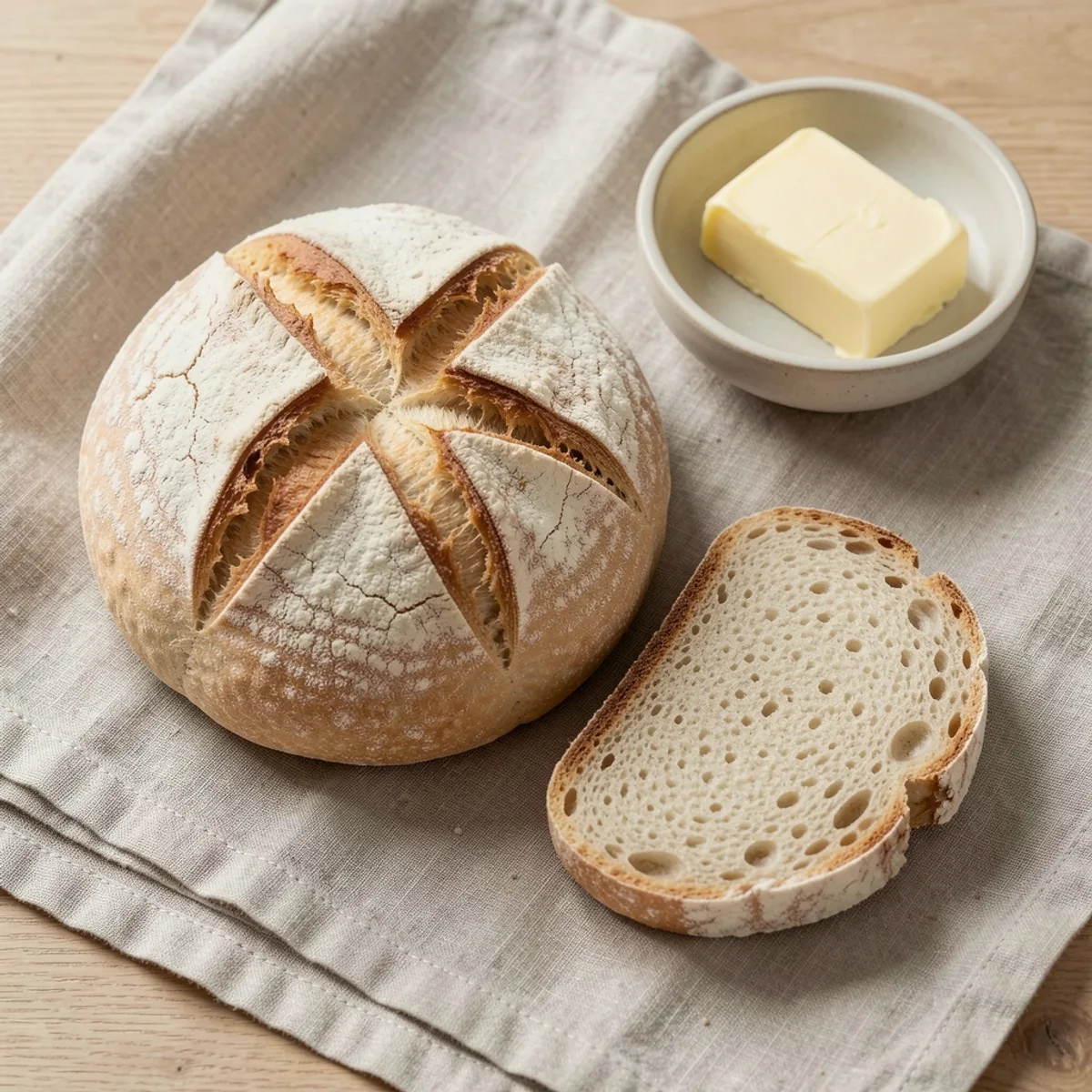
It earns its place on nights when you want fresh bread with the soup or stew already on the stove, and there is no rise time to plan around. The loaf has a thin, floury crust and a close, soft crumb that slices cleanly once it has cooled. Two problems come up often: a heavy, tight crumb, or a damp center. The sections below explain what causes each and what to look for instead.
What each ingredient does
The traditional loaf needs only four things, and each one has a job.
- All-purpose flour gives the crumb its structure. It suits this loaf better than bread flour, since the goal is a tender, biscuit-like slice rather than a chewy one.
- Baking soda is the only leavener. It needs an acid to react with, so it works the moment it meets the buttermilk.
- Salt seasons a loaf that has no sugar or butter to lean on.
- Buttermilk supplies that acid, along with moisture and a gentle tang.
Because the reaction starts on contact, the dough is not allowed to sit. Mix, shape and bake without a pause.
How the dough should look and feel
"Do not overmix" is easier to follow when you know what finished dough looks like. After about 30 seconds of stirring, it should be shaggy, with a few floury patches still visible at the edges, soft to the touch and only barely sticky. It should come together on the counter in two or three folds and hold a round shape without spreading.
If the dough is crumbly and will not come together, add buttermilk a tablespoon at a time. If it is slack and sticks to your hands in strings, dust the counter lightly and shape it fast rather than kneading in more flour. Cookbook author Cherie Denham, in an interview with 177 Milk Street, lists dough that is too wet or too dry among the most common soda bread problems.
Common mistakes and how to fix them
Overworking the dough. Many bakers report that handling is the most frequent reason for a heavy loaf. Stir only until the flour is moistened, shape in seconds, and treat the dough like a biscuit dough, not a yeast dough. Kneading builds toughness that this loaf cannot hide.
Old baking soda. A tired box of soda is a hidden cause of a flat, dense loaf. Bakers suggest buying a fresh box and checking it with a splash of vinegar, which should fizz quickly. Sifting the soda into the flour also avoids bitter, yellowish pockets in the finished bread, a point Denham raises as well.
Pulling it too early. A gummy or damp center is usually an underbaked loaf, or a dough that had too much liquid. Crust color alone can mislead you, because a deep brown outside can hide a wet middle. Tap the bottom of the loaf: a hollow sound means it is done. An instant-read thermometer in the center is a useful second check. Denham also warns that an oven that is not hot enough makes the dough spread instead of rising, which is why this recipe starts hot.
Bake it hot, then let it set
IrishCentral describes the classic bake as 450 F followed by 400 F, about 30 minutes in total, with the loaf done when it sounds hollow underneath. This recipe follows that plan. The hot start helps the loaf rise before it can spread, and the lower second stage helps the center bake through without scorching the outside.
Wrap the baked loaf in a clean towel while it cools. Denham recommends this to avoid crumbly slices. Resist cutting for at least 30 minutes: the crumb is still setting, and a warm loaf squashes under the knife.
Why there is a cross on top
The cross is traditional, and folklore attaches several meanings to it. In practice, a deep cut divides the round into four wedges that pull apart neatly at the table. Cut firmly, about three quarters of the way down, so the marks stay open instead of sealing as the loaf rises.
Irish soda bread without buttermilk
Buttermilk is the stumbling block for many cooks, because few keep it on hand. The rule that matters is that any substitute must be acidic, and it should rest for a few minutes before it goes into the dough. Plain milk will not lift the loaf by itself.
| Original | Replacement | Proportion | What changes |
|---|---|---|---|
| Buttermilk | Plain yogurt plus milk | One 6-ounce container of plain yogurt plus 1 cup of milk (King Arthur Baking's stand-in) | Avoid nonfat dairy, which makes the bread tough |
| Buttermilk | Milk plus lemon juice or white vinegar | Commonly used, not verified here; rest a few minutes before using | Effect on texture not verified here |
| Buttermilk | Milk plus cream of tartar | Not verified here | Flavor and crumb may differ from buttermilk |
| Buttermilk | Plant milk plus acid (dairy-free) | Not verified here | Flavor and crumb change; treat it as an idea to try, not a proven swap |
King Arthur's guidance comes from its American-style Irish soda bread post, which notes that low-fat dairy makes the bread less tender and nonfat dairy makes it tough. That recipe is the sweeter version, so use its yogurt stand-in as a guide to the dairy, not to the rest of the dough. Whichever swap you pick, adjust by feel: the dough should still be soft and just barely sticky.
Variations
Wheaten or brown soda bread. Replace part of the white flour with whole wheat for a nuttier, denser loaf. Start with a partial swap and adjust by feel: if the dough looks dry, add buttermilk a tablespoon at a time.
American-style sweet loaf. The sweeter version adds sugar, egg, butter and raisins or currants. It is a different loaf from the traditional one, so treat it as a variation rather than the base. If you want fruit in this recipe, stir a handful of raisins or currants into the dry ingredients before the buttermilk goes in.
Farls. Soda bread can also be shaped into flat wedges, or farls, which suit a stovetop pan. Cooking times differ from the loaf, so this page does not give one.
Storing, freezing and reheating
Soda bread is at its best the day it is baked, because it has no fat to keep it soft. Once cool, keep it wrapped in a cloth or paper bag at room temperature for a few days. These are general guidelines, not food-safety limits. The refrigerator tends to dry bread out, so room temperature is the usual choice unless your kitchen is warm.
For longer storage, slice the cooled loaf, wrap the slices tightly, and freeze them. Pull out only what you need. Toasting is the best way to bring back day-old or frozen slices: the crust crisps and the crumb softens. Alternatively, wrap the loaf in foil and warm it in a moderate oven until it is warm through.
What to serve with it
Butter is the classic partner. The loaf also suits soups and stews, where the crumb soaks up broth, and it makes a sturdy base for a sandwich. Soda bread was introduced to Ireland in the 1840s, according to IrishCentral,.
Nutrition note
Values on the recipe card are estimates calculated from typical USDA FoodData Central figures, using enriched all-purpose flour and cultured low-fat buttermilk, for one of eight slices. Using a different dairy or flour will shift the numbers. If you follow a medical diet, talk to your doctor or a dietitian about how this fits.
Servings: 8 slices
Irish Soda Bread (Tender, Never Dense or Gummy)
A traditional loaf of flour, baking soda, salt and buttermilk, with the dough cues and the doneness test that keep it from turning dense or gummy.
Ingredients
Equipment
- Rimmed baking sheet (lined with parchment so the base browns evenly and the loaf lifts off cleanly)
- Fine-mesh sieve (for sifting the baking soda)
- Sharp knife (for cutting the cross)
- Instant-read thermometer (optional, to check the center)
Instructions
- Heat the oven. Set a rack in the center of the oven and heat it to 450 F. Line a rimmed baking sheet with parchment.
- Mix the dry ingredients. Whisk the flour and salt in a large bowl. Sift the baking soda over the top through a fine sieve, then whisk again so no bitter pockets of soda remain.
- Add the buttermilk. Make a well in the center and pour in the cold buttermilk. Stir with a fork or your fingertips for about 30 seconds, only until no dry flour is visible. The dough should look shaggy and feel soft and just barely sticky.
- Shape quickly. Turn the dough onto a lightly floured counter. Pat and fold it two or three times, then press it into a round about 7 inches across and 1 1/2 inches thick. Do not knead; overworking makes the crumb tough.
- Cut the cross. Lift the round onto the lined sheet. With a floured knife, cut a deep cross across the top, going about three quarters of the way through the loaf.
- Bake hot. Bake at 450 F for the first 15 minutes, until the crust has set and begun to color.
- Lower the heat and finish. Reduce the oven to 400 F and bake about 15 minutes more, for roughly 30 minutes in total. The loaf is done when the crust is deep golden and it sounds hollow when tapped on the bottom.
- Cool wrapped. Move the loaf to a wire rack and wrap it loosely in a clean kitchen towel. Cool for at least 30 minutes before slicing so the center can set.
Notes
Metric weights are rounded. Cup measures assume flour spooned and leveled; weighing the flour is the more reliable method.
Baked at 450 F for the first part, then 400 F, for about 30 minutes in total. This follows one sourced temperature plan rather than a mix of several.
Nutrition values are estimates calculated from typical USDA FoodData Central values for enriched all-purpose flour, cultured low-fat buttermilk, baking soda and table salt, per 1 of 8 slices. They are not measured.
Nutrition Facts
Per 1 slice (1/8 of the loaf) (estimated)
- Total Fat
- 1.1 g
- Saturated Fat
- 0.4 g
- Sodium
- 503 mg
- Total Carbohydrate
- 50.1 g
- Dietary Fiber
- 1.7 g
- Sugars
- 2.6 g
- Protein
- 8.1 g
Frequently asked questions
Does Irish soda bread have yeast?
No. The lift comes from baking soda reacting with the acid in buttermilk, so there is no yeast, no proofing and no kneading. The dough goes into the oven as soon as it is shaped.
Why is my Irish soda bread dense?
The usual causes are overworking the dough, old baking soda, or an oven that was not hot enough. Stir only until the flour is moistened, use a fresh box of soda, and start the bake at a high temperature.
Why is my Irish soda bread gummy in the middle?
A gummy center usually means the loaf is underbaked or the dough held too much liquid. Judge doneness by a hollow sound when you tap the bottom, not by crust color alone.
Can I make Irish soda bread without buttermilk?
Yes, as long as the substitute is acidic. Plain yogurt thinned with milk is the version this page can source, and milk soured with lemon juice or vinegar is a common stand-in. Plain milk alone will not lift the loaf.
Why do you cut a cross in Irish soda bread?
Tradition gives it symbolic meaning, and the deep cuts also divide the round into wedges that pull apart easily. Cut deeply so the marks hold open as the loaf rises.
Is traditional Irish soda bread supposed to have raisins?
The traditional loaf is just flour, baking soda, salt and buttermilk. Raisins or currants, sugar, egg and butter belong to the sweeter American-style version.
How long does Irish soda bread last, and can I freeze it?
Wrapped in a cloth or bag, it keeps for a few days at room temperature and is best toasted once it begins to dry. Slice it first, wrap it tightly, and freeze the slices for longer storage.
How do you reheat Irish soda bread?
Toast the slices, or warm the loaf wrapped in foil in a moderate oven until it is warm through. Frozen slices can go straight into the toaster.
Comments