How Much Baking Soda in Water for Pretzels (Soft Recipe)
Jump to RecipeA full soft pretzel recipe built around the bath: the baking soda to water ratio in cups and grams, how long to dip, and why the alkaline water browns the crust.
 Save
SaveJump to:
- The Food Science / Lab Kitchen Note
- Plain baking soda, baked baking soda or lye: a data comparison
- Where these numbers come from
- How much baking soda for the bath
- Dough and shaping notes
- Common mistakes and how to fix them
- Substitutes and swaps
- Optional: a baked baking soda bath
- Nutrition note: calories and sodium per pretzel
- Storing, freezing and reheating
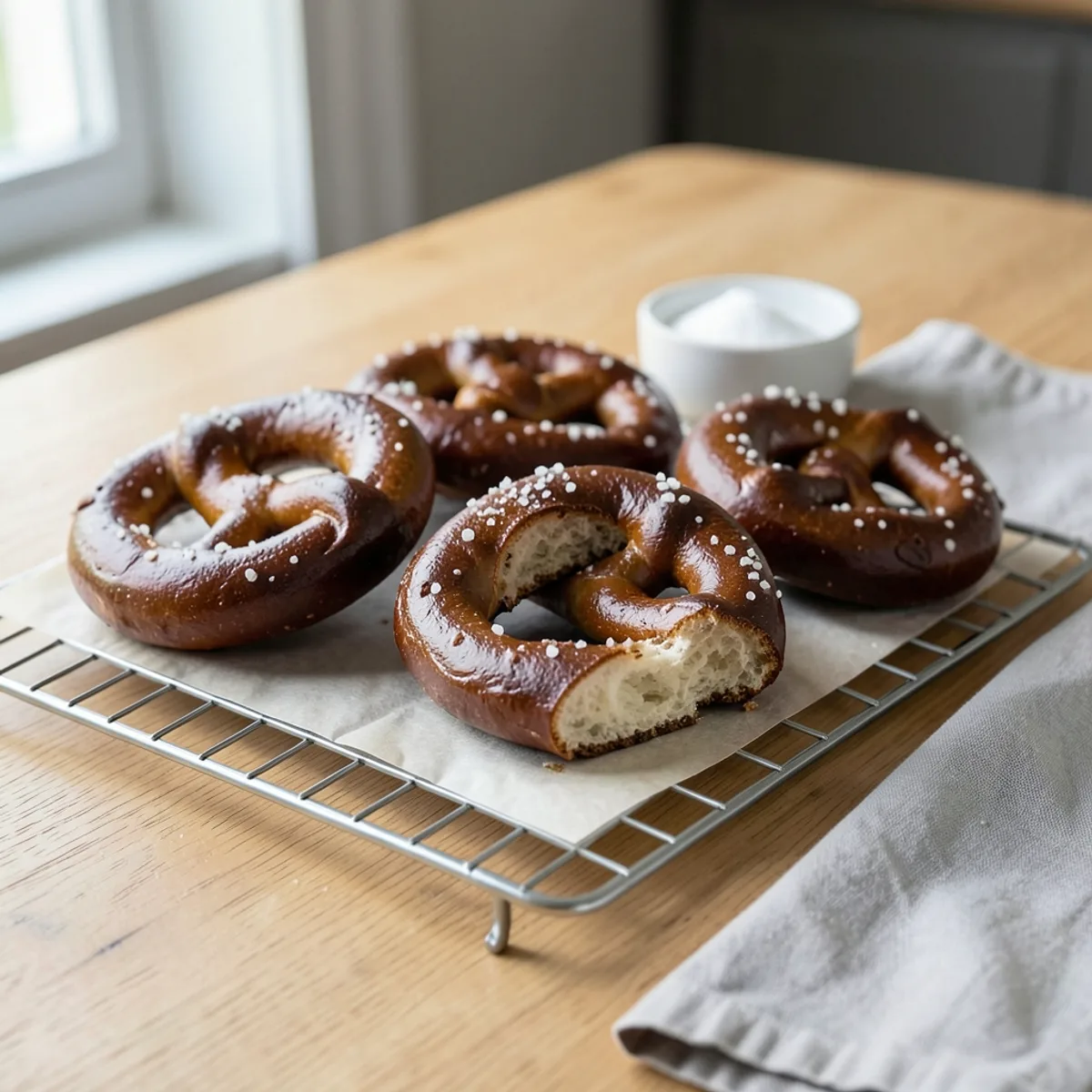
Soft pretzels with a baking soda bath need 1/2 cup (about 110 g) soda in 9 cups of water and a 20 to 30 second dip. This 12-pretzel recipe takes about 2 hours and bakes to a dark brown crust with no lye.
A soft pretzel gets its dark brown crust from the bath, not from the oven. Skip the bath and the crust stays pale. Get the bath wrong and you can end up with a metallic aftertaste. This page gives you the ratio in cups and grams, the dip time, and the reason it works.
Why you'll love it
- One bath ratio, written in cups and grams.
- No lye, and an optional baked baking soda bath for a stronger solution.
- A make-ahead route: dip, then refrigerate or freeze.
Prep 30 minutes, rising and resting 80 minutes, bake 15 minutes. About 2 hours in all.
The Food Science / Lab Kitchen Note
Here's why this works. Baking soda is sodium bicarbonate, and a solution of it has a pH of about 8. America's Test Kitchen reports that baking it turns it into sodium carbonate, which has a pH of about 11. Lye (sodium hydroxide) sits at 13 to 14 and is highly corrosive, which is why it calls for goggles and gloves.
The alkaline water coats the surface of each pretzel. An alkaline surface speeds up Maillard browning, the set of reactions that turns the crust dark brown and builds baked flavor. A bath with a higher pH should brown deeper, and the ATK page says exactly that: plain baking soda gives pale, bland pretzels, while the baked soda solution browns deeper with better flavor.
That is also why the baking soda in the bath behaves so differently from the baking soda in Irish soda bread. There it is a leavener that reacts with buttermilk inside the dough. Here it never goes into the dough at all. It only changes the surface.
A little arithmetic of our own shows how different the baths are. The plain bath on this page is about 110 g of soda in about 2,130 g of water, which works out to about 5 percent soda by weight. Sugarologie's baked soda bath is 100 g in 500 g of water, or 20 percent. By our calculation, that is about four times as concentrated, which fits with the fact that baked soda is the stronger alkali.
Plain baking soda, baked baking soda or lye: a data comparison
This table lines up what the sources say. It is a comparison of published data, not a record of batches we baked. Where no source gave a number, the cell says so.
| Plain baking soda bath | Baked baking soda bath | Lye bath | |
|---|---|---|---|
| Compound | Sodium bicarbonate | Sodium carbonate (baked baking soda) | Sodium hydroxide |
| pH (ATK) | About 8 | About 11 | 13 to 14 |
| Bath in the sources | 1/2 cup in 9 cups of water (Peanut Blossom) | 100 g (about 1/2 cup) in 500 g (about 2 cups) of cold water (Sugarologie) | No sourced data here |
| Dip time | 20 to 30 seconds (Peanut Blossom, The Scramble) | 3 minutes, pretzels face down (Sugarologie) | No sourced data here |
| Extra prep | None | Bake the soda first: 1 hour at 300 F (Sugarologie) | No sourced data here |
| Oven in the source | 400 F, 12 to 15 minutes (Peanut Blossom) | 425 F, 8 to 12 minutes (Sugarologie) | No sourced data here |
| Crust (ATK) | Pale and bland | Deeper brown, better flavor | No sourced data here |
| Handling | Hot pot, adult dips | No bare hands, no aluminum, see the box below | Highly corrosive: goggles and gloves |
The oven times come from two different doughs, so do not swap one into the other's recipe.
Home bakers who try baked baking soda report a darker, better-flavored crust than plain baking soda, but they also say it still does not match a real lye bath. Many bakers pick baking soda or baked baking soda over lye for a plain reason: lye is a single-use, corrosive ingredient that needs gloves and eye protection, and they accept a slightly milder pretzel flavor. This page gives no lye recipe. Treat lye as a professional-style bath and read a source that covers the safety side in full.
Where these numbers come from
The pH figures and the "plain soda is pale" point come from America's Test Kitchen's how-to page on professional-quality soft pretzels at home. That is a practical kitchen page from a test kitchen, not a peer-reviewed study. It does not state a dip time, so we do not borrow one from it.
The dough formula, the weights in grams and the safety steps come from Sugarologie's easy soft pretzels guide, a recipe blog page. Its step 3 says brown sugar while its ingredient list says white sugar, and we followed the list. The plain bath ratio and the 400 F bake come from Peanut Blossom, and the dip time, the egg wash and the make-ahead notes from The Scramble. Both are family food blogs. We found no scientific study on pretzel baths, so none is cited here.
How much baking soda for the bath
The ratio on the card, 1/2 cup in 9 cups of water, is the one Peanut Blossom uses and the most common one we saw. Other sources range from 3 tablespoons in 9 cups to 2/3 cup in 10 cups. By our conversion, that is roughly 40 g to 150 g of soda, using about 224 g per cup as Sugarologie's weights imply. The range is wide, so pick one ratio and stay with it.
Use food-grade, aluminum-free baking soda, and a nonreactive pot. Skip aluminum, which the baked soda guide also warns against.
The sources we read use a boiled bath for the plain version. Peanut Blossom calls its bath a boiled bath, and we found no guidance on simmering versus boiling beyond that. The baked soda bath is the exception: Sugarologie uses it cold.
Dough and shaping notes
Weigh the dough. Twelve pieces of about 75 g each keep the pretzels the same size, and equal pretzels cook in the same time. Roll the ropes to 18 to 24 inches, and know that a shorter rope gives a more bun-like pretzel.
Rest the shaped pretzels uncovered for 20 to 30 minutes. If they feel puffy, refrigerate them for the rest. The dough is meant to be smooth and elastic after kneading, and a quick windowpane check tells you when it is there.
Common mistakes and how to fix them
Leaving the pretzels in the bath too long. Many cooks report that a dip of about 20 to 30 seconds is fine, but a minute or more brings a metallic taste. Set a timer, work one or two pretzels at a time, and drain each one before it goes on the sheet.
Adding the soda to hot water. A Fresh Loaf poster describes the pot boiling over when soda hits hot water. Stir the soda into cold water first, then heat the pot, and use a wide, deep pot so there is room to foam.
Ending up with pale pretzels. Plain baking soda gives paler pretzels than baked soda, per ATK. A weak baked soda solution can also come out pale: one baker reported exactly that when the solution was probably too weak. Measure the soda and the water on the scale if you go the baked route.
Substitutes and swaps
| Original | Replacement | Proportion | What changes |
|---|---|---|---|
| Baking soda bath | Baked baking soda bath | 100 g (about 1/2 cup) baked soda in 500 g (about 2 cups) of cold water, 3 minute dip (Sugarologie) | Deeper color and flavor, more handling care |
| Baking soda bath | Egg wash, no bath | 1 egg and 2 tablespoons of milk, brushed on (The Scramble) | Texture differs slightly; no alkaline browning |
| Baking soda bath | Lye bath | No sourced proportion | Highly corrosive; goggles and gloves |
| Baking soda bath | Other alkaline or acidic swaps | No sourced ratio found | Not covered by any source we read |
| Instant yeast | Active dry yeast | 1 1/2 tsp, bloomed about 5 minutes (Sugarologie) | One extra step |
| Kosher salt (Diamond Crystal) | Table salt | 3/4 tsp for 1 1/2 tsp (Sugarologie) | Table salt is finer, so it takes less |
Optional: a baked baking soda bath
This is the no-lye route to a darker crust. It uses Sugarologie's method only. ATK's page gives different times, temperatures and a different bath, so do not mix the two.
Spread about 1 1/2 cups (336 g) of baking soda on a foil-lined sheet pan. Bake it at 300 F (150 C), with the fan off, for 1 hour, then let it cool. The bath is 100 g (about 1/2 cup) of that baked soda in 500 g (about 2 cups) of cold water. Place the pretzels face down for 3 minutes, then bake at 425 F (220 C) for 8 to 12 minutes. Do not carry the 3 minute dip back to the plain bath above, where a minute or more brings the metallic taste.
Coarse salt left on baked soda pretzels for over 24 hours can blister, so salt only the pretzels you will eat the same day.
Nutrition note: calories and sodium per pretzel
Values on the recipe card are estimates calculated from typical USDA FoodData Central figures for all-purpose flour, sugar and salted butter, plus yeast, for one of 12 pretzels. The dough uses unsalted butter, but our sources gave no unsalted values, so we used salted butter's calories and fat as a stand-in and left its sodium out. Table salt is counted at about 4.5 g, our conversion of 3/4 teaspoon.
That comes to about 201 calories and 147 mg of sodium per pretzel. Treat the sodium as a low estimate. The dough accounts for it, but the bath and any coarse salt on top are not counted, and no source we found measures how much sodium a pretzel picks up from the bath. For scale, USDA lists baking soda at 27,360 mg of sodium per 100 g, so by our calculation the 110 g in the pot holds about 30,000 mg in total. We cannot say how much of that stays on the dough.
If you are wondering whether soft pretzels are healthy, this page can give only the numbers above: calories and sodium per pretzel.
Storing, freezing and reheating
Eat the pretzels the day they are made. Peanut Blossom says they will keep in an airtight container for up to 3 days, and that is a blog's guideline, not a food-safety limit. Pretzels with salt that sit longer than a day can blister if you used the baked soda bath.
To make ahead, The Scramble refrigerates the pretzels for up to 24 hours or freezes them for up to 3 months after the bath, unbaked. It bakes them from frozen at 350 F (about 175 C by our conversion) for 20 minutes. To bring leftovers back, warm them in the oven until they are hot through.
Servings: 12 pretzels
How Much Baking Soda in Water for Pretzels (Soft Recipe)
A full soft pretzel recipe built around the bath: the baking soda to water ratio in cups and grams, how long to dip, and why the alkaline water browns the crust.
Ingredients
Dough
Baking soda bath
To finish
Equipment
- Wide, deep nonreactive pot (stainless steel or enamel; avoid aluminum)
- Slotted spoon or spider (to lift each pretzel out of the bath)
- Kitchen scale (for the dough and the 75 g pieces)
- Rimmed baking sheets (lined with parchment)
- Stand mixer (optional; hand kneading works)
Instructions
Dough
- Mix the dough. Stir the yeast into the warm water (if you use active dry yeast, let it bloom for about 5 minutes). Add the flour, melted butter, sugar, salt and malt powder, if using, and mix until a shaggy dough forms.
- Knead. Knead for 5 to 8 minutes, by hand or on stand mixer setting 3, until the dough is smooth, elastic and passes the windowpane test.
- Let it rise. Cover and leave the dough at about 85 F (29 C) for about 1 hour, until doubled in size.
- Divide and shape. Divide the dough into 12 pieces of about 75 g each. Roll each into a rope 18 to 24 inches long (a shorter rope gives a more bun-like pretzel), shape a U, cross the legs twice and press the ends down to seal.
- Rest the shaped pretzels. Leave the pretzels uncovered on parchment-lined sheets for 20 to 30 minutes. If they look puffy, refrigerate them for this rest instead. Heat the oven to 400 F while they rest.
Bath and bake
- Make the bath. Stir the baking soda into 9 cups of cold water in a wide nonreactive pot, then bring it to a boil. Adding soda to water that is already hot makes it foam up and boil over.
- Dip. Lower one or two pretzels at a time into the bath for 20 to 30 seconds. An adult should do this step, because the water is hot. Lift each pretzel out with a slotted spoon, drain it and set it back on the lined sheet.
- Salt. Sprinkle coarse salt over the wet pretzels right away, if you are eating them the same day.
- Bake. Bake at 400 F for 12 to 15 minutes, until the crust is deep golden. The range comes from a recipe written for a smaller dough, so judge by color and trust the timer only as a guide.
- Cool. Move the pretzels to a wire rack. Let them cool a little before you serve them warm.
Notes
Dough formula and weights follow Sugarologie, yield 12 pretzels. The bath ratio and the 400 F bake follow Peanut Blossom. Gram weights for the bath are our conversion.
The 12 to 15 minute bake is a source range for a smaller dough. Judge by a deep golden color.
Prep time covers kneading and shaping and is our estimate. Rising (about 1 hour) and the rest (20 to 30 minutes) are counted as passive time.
Nutrition values are estimates calculated from typical USDA FoodData Central values, per 1 of 12 pretzels. They count the dough only, so the sodium picked up in the bath and from any coarse salt topping is not included. Fiber is left out because our sources did not list a value.
Nutrition Facts
Per 1 pretzel (1/12 of the recipe), dough only (estimated)
- Total Fat
- 4 g
- Saturated Fat
- 2.1 g
- Sodium
- 147 mg
- Total Carbohydrate
- 35.4 g
- Sugars
- 2.5 g
- Protein
- 6 g
Frequently asked questions
How long should pretzels stay in the baking soda bath?
Dip each pretzel for 20 to 30 seconds, one or two at a time, then lift it out and let it drain. A minute or more in the bath is where cooks report a metallic taste.
Why do my soft pretzels taste metallic?
Bath time is the usual suspect. Cooks who dislike the aftertaste point to a dip of a minute or more, so keep to 20 to 30 seconds and drain each pretzel well before it goes on the sheet.
What can I use instead of a baking soda bath for pretzels?
An egg wash is the only alternative with a source here: brush on 1 egg whisked with 2 tablespoons of milk. The Scramble says the texture differs slightly, and the crust will not get the same alkaline browning.
How long do soft pretzels last?
Peanut Blossom says to eat them the day they are made and keep leftovers airtight for up to 3 days. For longer storage, The Scramble freezes them unbaked after the bath for up to 3 months and bakes them from frozen at 350 F (about 175 C by our conversion) for 20 minutes.

Stella Nordi bakes in Portland, Oregon. She weighs everything in grams and explains why a bake fails. She covers SodaRecipe’s quick breads, biscuits and baking guides.
Comments