Why Baking Soda Browns Meat Faster (pH, Maillard, Dose)
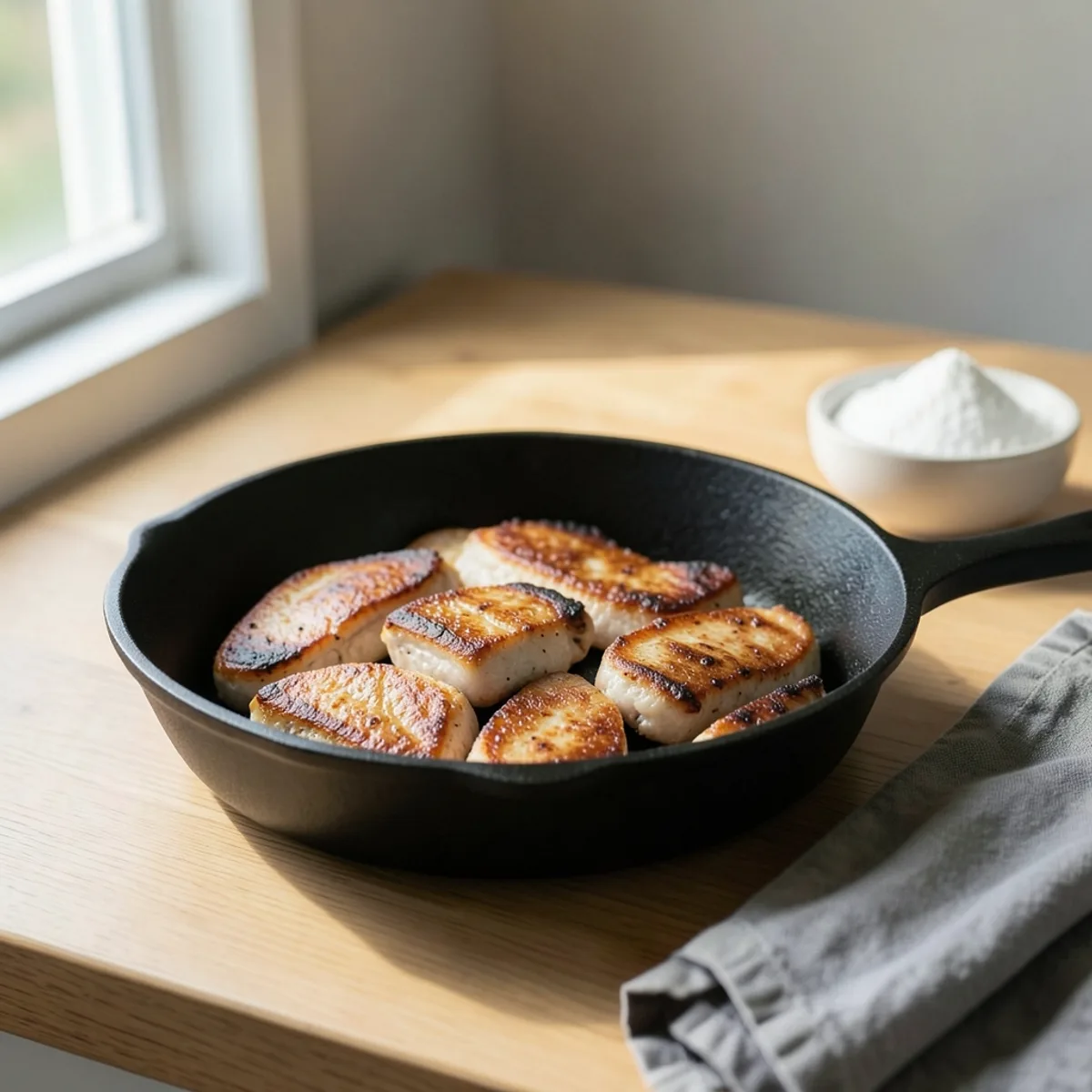
Jump to RecipeA fact-check of the pH and Maillard science behind browning meat with baking soda, shown on sliced chicken with the dose, the rest, the 165 F check and the sodium cost.
 Save
Jump to:
Everybody says baking soda browns meat faster. Almost nobody tells you why, or what it costs. Here's where it goes wrong: people stop at "it raises pH" and never mention the dose, the rest time or the sodium.
This page fact-checks the claim against what's published. We haven't cooked it side by side ourselves, so you won't find a "we tried it" verdict. You'll find the chemistry, the sourced doses, and a clear line where the evidence ends. It's a companion to our baking soda ground beef fact-check, which covers the ground beef dose in full. This one is about the why, shown on sliced chicken.
Why you might try it
- The sources agree on the direction: less pooled liquid and earlier color.
- The soak is one bowl and a short wait.
- The sodium is easy to count (the math is below).
The Food Science / Lab Kitchen Note
Baking soda is a weak base. A short soak raises the pH on the surface of the meat, and ATK's explanation is that this makes it harder for the proteins to bond too tightly. Our reading of that: proteins that bond tightly squeeze out water. That water pools in the pan, and the meat simmers in it instead of searing. The Daily Meal puts the same effect from the pan side: raise the pH and the meat releases less liquid, so it browns better and faster.
The second piece is the Maillard reaction, the browning chemistry that gives seared meat its flavor. The food chemist behind the Khymos blog notes that raising pH, making food less acidic and more alkaline, speeds that reaction, and that baking soda can do it. A pinch browned onions faster on that page. Too much made them mushy and wet. It's a blog post, not a peer-reviewed study, and there's no meat experiment on it.
What do the numbers look like? One model-system study from Briao and colleagues at the Universidade de Passo Fundo (year not stated on the page, about 2008) heated sugar and amino acid solutions at 97 C. This was not meat. Glucose and glycine browned with a first-order rate constant of 0.2127 per minute at pH 7.0, against 0.0390 at pH 5.1. Across four sugar-amino acid pairs, the rate was about 5 to 8 times higher at neutral pH. The induction period, the lag before browning starts, was about 15 minutes at pH 7.0 versus about 45 minutes at pH 5.1.
Meat starts on the acidic side. A study of beef Longissimus lumborum muscle measured pH at 5.75 on day 0 of postmortem aging, then 5.65, 5.45 and 5.55 at days 1, 2 and 7. So raw beef sits around 5.5 to 5.75. A supplier data sheet we'd call weak evidence lists pH 8.3 for a 0.1 M baking soda solution, so a soda solution is well above meat's natural range.
Then there's the water. Maillard browning runs at 230 to 340 F (110 to 170 C), per Khymos, and water boils at 212 F (100 C). Our inference, not a sourced finding: with less liquid sitting in the pan, the surface isn't held near boiling, so it can climb into browning range sooner.
Where the evidence stops:
- No source we found measured the surface pH of baking soda-treated meat.
- No source measured browning time on treated versus untreated meat.
- The Maillard rate constants come from model solutions, not meat.
- The "less water, hotter surface" link is ours.
Many cooks who compare treated and untreated meat side by side report that the untreated batch sits in its own released liquid first (about five minutes of simmering in one test, darker juices in another), while the treated batch starts to color sooner and gives off less pooled liquid.
Dose comparison: what each source says
This compares published data. It isn't a test we ran. Where a source gives no figure, the table says so.
| Variant | Dose | Water and rest | Sodium from the soda (our math) | Browning time |
|---|---|---|---|---|
| Sliced chicken or pork (ATK; The Daily Meal) | 1 tsp per 12 oz (340 g), same in both | The Daily Meal: 1/2 cup water, about 15 minutes. ATK: 15 minutes, no water amount | about 1,259 mg per 1 tsp | no sourced data |
| Ground beef (ATK; The Daily Meal; Scripps/Simplemost) | ATK: 1/4 tsp per 12 oz. The Daily Meal: 1/2 tsp plus 1 tbsp water per lb. Scripps: 1/6 tsp per lb | The Daily Meal: 5 to 15 minutes. Scripps: 15 minutes | about 315 mg per 1/4 tsp | Scripps, one test, no measurements: treated beef browned faster and looked darker |
| No baking soda | none | none | none from soda | Scripps, one test: untreated beef simmered in liquid for about five minutes before absorbing it |
By our math, sliced chicken or pork gets about four times the ground beef dose per 12 oz (1 tsp versus 1/4 tsp), which is the gap most guides skip. The three guides on ground beef also disagree with each other (1/6, 1/3 and 1/2 tsp per pound; the 1/3 is ATK's 1/4 tsp per 12 oz converted to a pound, by our math), and the Scripps author preferred the untreated beef and blamed overcooking for a rubbery result.
What the sources are, and how big they are
The weight of each source matters. The dose and rest time rest on ATK's kitchen test and The Daily Meal's editorial guide. ATK tested the amounts per 12 oz (340 g) and said 15 minutes is long enough. Its page publishes no sample size, no pH number and no rinse step, so we can't say more than that. The Daily Meal is an editorial guide. It says baking soda raises beef pH and helps meat brown better and faster, but it names no pH value and no temperature.
The mechanism is thinner. Khymos is a food chemist's blog with an onion example and no meat. The Briao study is a laboratory model with sugar and amino acid solutions, and its sample size isn't published on the page we read. The beef pH study measures aged muscle with no baking soda in it. The Scripps/Simplemost piece is one informal test on one pound of beef. Put together, they make a reasonable case for the mechanism. They don't prove how much faster treated meat browns.
Ingredients and method
The recipe card has everything in US and metric. Three notes before you start:
- Use food-grade, aluminum-free baking soda. Not baking powder.
- The 1/2 cup of water comes from The Daily Meal's wet brine. ATK gives no water amount.
- Drain and pat dry. A wet strip goes straight back to steaming.
Common mistakes
Skipping the pat-dry. The whole point is less water in the pan. Chicken that goes in dripping soda water undoes that. Drain, then blot the strips with paper towels.
Using too much, or leaving it on unmixed. Cooks report that too much baking soda, or soda that isn't worked in or rinsed off, is the most common complaint: a slippery feel, a soapy or bitter taste, a fishy smell on sliced meat, or a baking soda taste in the finished dish. Dissolve it in the water and stay at the sourced ratio.
Leaving it on the heat too long. Treated meat cooks fast and can turn rubbery if it stays on the heat, which is what the Scripps author reported. Pull it at 165 F (74 C) instead of cooking until it looks done.
Check doneness with a thermometer
Color doesn't tell you. The Nebraska Extension page, citing the USDA Safe Minimum Internal Temperature Chart, gives 165 F (73.9 C) for all poultry, including parts, and 160 F (71.1 C) for ground meats such as beef, pork, veal and lamb. It also says color is not a good way to judge doneness. Since baking soda speeds up browning, color is an even weaker cue here.
Sodium: the math
Baking soda is a sodium compound. USDA FoodData Central lists 27,360 mg sodium per 100 g for baking soda (FDC 175040), so 1 tsp (4.6 g) is about 1,259 mg. The FDA sets the sodium Daily Value at 2,300 mg, and counts 5 percent or less per serving as low and 20 percent or more as high.
Our calculation splits the 1 tsp across four servings:
| Item | Sodium per serving | Share of 2,300 mg |
|---|---|---|
| Baking soda alone (1 tsp over 4 servings) | about 315 mg | about 13.7 percent |
| Whole serving (3 oz / 85 g chicken, oil and soda) | about 353 mg | about 15.3 percent |
Raw chicken breast carries 45 mg per 100 g by USDA's entry, so the chicken is a small part of the total. The soda is most of it. Some of the soda goes down the drain with the soak water, and nobody has measured how much, so 353 mg is our upper estimate. It lands between the FDA's low and high marks.
Substitutes and swaps
| Original | Swap | Proportion | What changes |
|---|---|---|---|
| Baking soda | Baking powder | no sourced ratio | RecipeTin Eats says it isn't strong enough, so don't swap by guesswork |
| Sliced chicken breast | Sliced pork | 1 tsp per 12 oz (340 g), per ATK | ATK gives the same ratio for both |
| Baking soda | A lower-sodium alternative | no sourced data | We found no sourced low-sodium option |
| 1/2 cup water | A different water amount | no sourced data | ATK gave none; 1/2 cup is The Daily Meal's brine |
Storage and make-ahead
Treat soaked chicken as raw poultry and keep it in the refrigerator, not on the counter. We could not open the USDA storage pages, so we have no figure for how long treated raw or cooked chicken keeps. Plan on a short window and verify against current USDA guidance.
Make-ahead tip: slice the chicken ahead and keep it chilled, then mix the baking soda solution fresh. That way the 15 minute soak happens right before the pan, and you aren't holding treated raw meat longer than you need to.
Servings: 4 servings (3 oz / 85 g raw chicken each)
Why Baking Soda Browns Meat Faster (pH, Maillard, Dose)
A fact-check of the pH and Maillard science behind browning meat with baking soda, shown on sliced chicken with the dose, the rest, the 165 F check and the sodium cost.
Ingredients
Chicken strips
Equipment
- Bowl (wide enough to soak the strips in one layer)
- Cast-iron or heavy skillet (a hot, dry-surfaced pan so the strips sear rather than steam)
- Food thermometer (needed for the 165 F (74 C) check)
- Paper towels (for patting the strips dry after draining)
Instructions
Method
- Dissolve the soda. Stir 1 tsp (4.6 g) baking soda into 1/2 cup (120 mL) water until no grains are left.
- Soak the chicken. Add 12 oz (340 g) thinly sliced chicken breast to the solution and turn it so every strip is wet. Keep it in the refrigerator while it soaks.
- Drain and pat dry. Drain the strips well and pat them dry with paper towels. Surface water is what you're trying to keep out of the pan.
- Heat the pan. Heat the skillet over medium-high heat, add 1 tbsp (14 g) oil and let it get hot before the chicken goes in.
- Sear without stirring. Lay the strips in a single layer with room between them. Don't stir until the underside has color, then turn them.
- Check 165 F. Cook until a food thermometer reads 165 F (74 C) in the thickest strip. Cook time varies with slice thickness and pan, so go by the thermometer, not the clock. Color alone isn't a reliable sign.
Notes
Dose: 1 tsp per 12 oz (340 g) is the ATK kitchen-test amount for sliced chicken and sliced pork. The water amount (1/2 cup per 12 oz) comes from The Daily Meal's wet brine; ATK gives no water amount.
Timing: the 8 minute cook time is our unsourced estimate for thin strips. Go by 165 F (74 C), not the clock.
Nutrition note: values are estimates calculated by us from typical USDA FoodData Central values (raw skinless boneless chicken breast, FDC 171077; canola oil, FDC 172336; baking soda, FDC 175040), per 3 oz (85 g) raw serving. We counted all the baking soda and none rinsed or drained away, so the sodium figure is a ceiling. Neutral canola oil is the variant used.
Storage: treat the soaked chicken as raw poultry and keep it refrigerated. We could not open the USDA storage pages, so we give no storage durations here.
Nutrition Facts
Per 1 serving (3 oz / 85 g raw chicken with its share of the baking soda and oil) (estimated)
- Total Fat
- 5.7 g
- Saturated Fat
- 0.7 g
- Sodium
- 353 mg
- Total Carbohydrate
- 0 g
- Dietary Fiber
- 0 g
- Sugars
- 0 g
- Protein
- 19.1 g
Frequently asked questions
How long should baking soda sit on sliced chicken?
Fifteen minutes is the figure America's Test Kitchen (ATK) gives, and it found a 45-minute soak on beef kept only about 3 percent more moisture. Drain and pat the meat dry before it hits the pan.
What happens if you use too much baking soda on meat?
Cooks report a slippery feel, a soapy or bitter taste, and a lingering baking soda flavor in the finished dish. Stay at the sourced ratio and don't add extra to speed things up.
Can baking powder replace baking soda for browning meat?
RecipeTin Eats says baking powder isn't strong enough for this job, and we found no sourced swap ratio. Use plain baking soda, food-grade and aluminum-free.
Should you rinse baking soda off meat before cooking?
Cooks disagree. Some rinse sliced meat to avoid any soda taste, others cook it with the soda still on, and ATK's page gives no rinse step.

Steven Dony trained in a restaurant kitchen and lives in Nashville, Tennessee. He covers SodaRecipe’s fact-checks: what works, what does not, and why.
Comments