Baking Soda Ground Beef: Does It Work? (1/4 tsp per lb)
Jump to RecipeA fact-check of the kitchen trick: what a small dose of baking soda does to pH, moisture and browning in ground beef, what ATK found, and what goes wrong with too much.
 Save
Jump to:
A common mistake is to shake baking soda straight into the pan, the way you'd salt a steak. The trick works as a short soak, not a seasoning, and the dose is small enough that a heavy hand ruins the batch.
This page fact-checks the trick against what's published. We haven't cooked it side by side ourselves, so you won't find a "we tried it" verdict here. You'll find what America's Test Kitchen (ATK) tested, where the editorial guides disagree, and one default dose to start from.
Why you might try it
- Lean beef (90/10 or 93/7) is the case where the sources say it helps most.
- The soak takes 15 minutes and one spoonful of water.
- The sodium it adds is small and easy to count (the math is below).
Our default is the conservative end of the published range: 1/4 tsp per pound. ATK's own test ratio was 1/4 tsp per 12 oz (340 g), which works out to about 1/3 tsp per pound, so our dose is slightly gentler than ATK's. The Daily Meal sits at the other end with 1/2 tsp per pound.
The Food Science / Lab Kitchen Note
Baking soda is a base, so a brief soak raises the pH at the surface of the meat. ATK's finding is that a higher surface pH makes it harder for the proteins to bond too tightly. Proteins that clamp down squeeze out water, and that water is what makes ground beef stew in its own liquid instead of browning.
The Daily Meal describes the same effect from the pan side: with the pH raised, the proteins release less liquid, so the beef browns better and faster.
A second piece is shakier. Food chemists note that a higher pH speeds up Maillard browning, the reaction that gives seared meat its roasted flavor. The example on the chemist's blog Khymos is informal: a pinch of baking soda made frying onions brown faster. That's a blog post, not a peer-reviewed trial, and it wasn't run on beef. Treat it as a reasonable mechanism, not a proven one.
Many cooks report that the treated beef gives off less liquid in the pan and browns more deeply instead of stewing, and that the difference is easiest to see when one pound is split in two. Many cooks also report that a small dose is invisible in the finished taste, while a heavy hand leaves a slippery, soapy or bitter note. One caveat: we found no forum thread about ground beef itself, so the soapy-taste reports partly rest on steak threads.
Dose comparison: what each source says
This compares published data. It isn't a test we ran. Where a source gives no figure, the table says so.
| Source | Dose | Water | Rest | Sodium from soda per lb (our math) | Type of source |
|---|---|---|---|---|---|
| America's Test Kitchen | 1/4 tsp per 12 oz (340 g), about 1/3 tsp per lb | no sourced data | 15 minutes; a 45-minute soak kept only about 3 percent more moisture | about 420 mg | Kitchen test |
| Sporked | 1/4 tsp per lb | 1 tbsp (15 mL) | at least 15 minutes | about 315 mg | Editorial guide |
| The Daily Meal | 1/2 tsp per lb | 1 tbsp (15 mL) | 5 to 15 minutes, before seasoning and shaping | about 630 mg | Editorial guide |
Two more guides land in the same range. Tasting Table says 1/4 to 1/2 tsp per pound in 1 tbsp water, 15 minutes or longer at room temperature, and no more than 2 hours out of the fridge. The Takeout suggests about 1/2 tsp per pound and a 15 minute rest.
Why the spread? ATK tested a ratio and reports what the soak does. The other guides are editorial how-tos with no lab data behind the exact dose, and none of the three top guides says what too much does. We picked 1/4 tsp per pound because it's the lowest dose in the published range and adds the least sodium, and the sources still treat it as workable.
Ingredients and method
The recipe card has everything in US and metric. Three notes before you start:
- Use food-grade, aluminum-free baking soda. Not baking powder (see the swaps table).
- ATK gives no water amount. The 1 tbsp comes from Sporked, Tasting Table and The Daily Meal, and dissolving the soda helps you spread it evenly.
- Season after the rest, not before.
Common mistakes
Dumping dry powder in one spot. Soda that lands in one clump leaves a strong patch and a plain one. Dissolve it in the water first, then drizzle and work it through the meat with your hands or a fork. Tasting Table stresses even spreading for the same reason.
Doubling the dose or resting for hours. More isn't better. ATK found a 45-minute soak kept only about 3 percent more moisture than 15 minutes, so the long rest buys almost nothing. A heavy dose is what gets you the slippery, soapy or bitter note.
Stirring right away or crowding the pan. The Takeout says to wait until the beef shows color before stirring, because early stirring squeezes out moisture. Break the meat into similar-size pieces and give it room, or it steams anyway.
Check doneness with a thermometer
Color doesn't tell you. USDA FSIS says to cook all raw ground beef to an internal temperature of 160 F (71 C), measured with a food thermometer, and that color is not a reliable sign the beef is cooked enough to kill harmful bacteria such as E. coli O157:H7. Browned meat can still be under 160 F. The Daily Meal says baking soda makes beef brown faster, which makes color an even weaker cue here.
What the evidence covers
The strongest evidence is ATK's test. They tested 1/4 tsp of baking soda per 12 oz (340 g) of ground beef and found that a brief soak raises the surface pH and keeps proteins from bonding too tightly. They also found 15 minutes is long enough. The write-up we used doesn't state a sample size, so we can't tell you more than that. It's a kitchen test, not a clinical trial.
The rest is thinner. Sporked, Tasting Table, The Daily Meal and The Takeout are editorial guides with no lab data on ground beef, and the browning-speed claim comes from a chemist's informal onion test. None of that makes the trick wrong. It means the dose and rest time rest on one real test plus consistent advice, so stay at the conservative end.
Sodium: the math
Baking soda is a sodium compound. The USDA entry for baking soda (FDC 175040) lists 27,360 mg sodium per 100 g, so 1 tsp (about 4.6 g) is about 1,259 mg. The FDA sets the Daily Value for sodium at less than 2,300 mg per day, with 5 percent or less per serving counted as low and 20 percent or more as high.
Our calculation splits 1 lb into four 4-oz (113 g) servings and counts the baking soda only:
| Dose per lb | Sodium in the dose | Per 4-oz serving | Share of 2,300 mg per serving |
|---|---|---|---|
| 1/4 tsp (1.15 g) | about 315 mg | about 79 mg | 3.4 percent |
| 1/2 tsp | about 630 mg | about 157 mg | 6.8 percent |
At 1/4 tsp per pound, the baking soda alone stays under the FDA's 5 percent mark per serving. At 1/2 tsp it doesn't. The beef's own sodium comes on top, and the recipe card's total of about 154 mg per serving (roughly 6.7 percent of 2,300 mg) includes it. That beef figure is our estimate from the USDA entry for raw 90/10 beef (FDC 174030, 66 mg sodium per 100 g).
Substitutes and swaps
| Original | Swap | Proportion | What changes |
|---|---|---|---|
| 90/10 or 93/7 beef | 80/20 beef | same dose per pound | Sporked says it's still helpful on 80/20, but lean beef gains more |
| Baking soda | Baking powder | no sourced ratio | Unchecked, so don't swap by guesswork |
| 1 tbsp water | No water | no sourced data | ATK gave no water amount; the other guides all use 1 tbsp |
Storage and make-ahead
Treat the soaked meat as raw beef. FoodSafety.gov lists raw hamburger and ground meats at 1 to 2 days in the refrigerator and 3 to 4 months in the freezer for best quality. We found no source on freezing beef that's already been treated with baking soda, so we can't say how it holds up. Tasting Table's limit applies during the soak: don't leave it out past 2 hours.
For meal prep, cook the batch to 160 F (71 C), cool it quickly and refrigerate it. We found no sourced reheating guidance for treated beef, so reheat it until it's hot all the way through.
Make-ahead tip: portion the beef into containers and mix the baking soda solution fresh when you're ready to cook. Then the 15 minute rest happens at the stove, and you aren't holding treated raw meat longer than you need to.
Servings: 4 servings (4 oz / 113 g raw beef each)
Baking Soda Ground Beef: Does It Work? (1/4 tsp per lb)
A fact-check of the kitchen trick: what a small dose of baking soda does to pH, moisture and browning in ground beef, what ATK found, and what goes wrong with too much.
Ingredients
Ground beef
Equipment
- Wide mixing bowl (room to spread the beef before the rest)
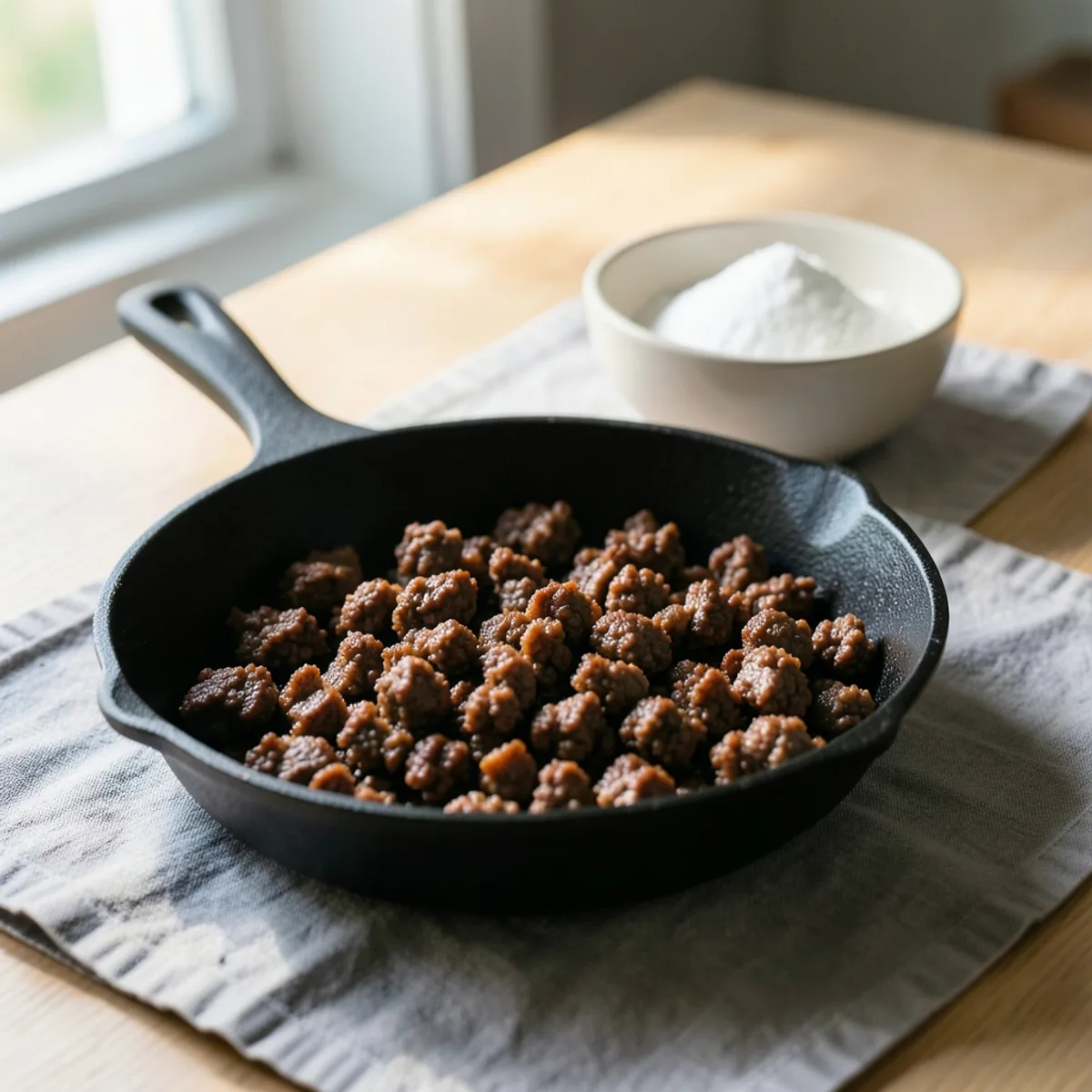
- Cast-iron or heavy skillet (wide enough not to crowd the beef)
- Food thermometer (needed for the 160 F (71 C) check)
Instructions
Method
- Dissolve the soda. Stir 1/4 tsp (1.15 g) baking soda into 1 tbsp (15 mL) water until no grains are left.
- Work it through the beef. Break 1 lb (454 g) beef into a wide bowl. Drizzle the solution over it and mix with your hands or a fork until it is spread evenly, with no dry spots or pooled liquid.
- Rest 15 minutes. Let the beef sit for 15 minutes. A longer soak adds very little, and the meat should not be out of the fridge past 2 hours in total.
- Season and heat the pan. Season the rested beef. Heat the skillet, then add the beef in an even layer, broken into similar-size pieces, without crowding.
- Wait for color. Leave the beef alone until it shows color on the bottom. Stirring early squeezes out moisture. Then break it up and keep cooking.
- Check 160 F. Cook until a food thermometer reads 160 F (71 C). Color is not a reliable sign it is done. If you drain, keep about 1 tbsp of fat in the pan.
Notes
Dose: 1/4 tsp per lb is the low end of published doses. ATK tested 1/4 tsp per 12 oz (340 g), about 1/3 tsp per lb, and The Daily Meal uses 1/2 tsp per lb.
Nutrition note: values are estimates calculated by us from the USDA FoodData Central entry for raw 90/10 ground beef (FDC 174030) plus the baking soda, per 4 oz (113 g) raw serving. Sodium is about 75 mg from the beef and about 79 mg from the soda. Cooking and draining change the final numbers.
Storage: raw ground meat keeps 1 to 2 days in the refrigerator and 3 to 4 months in the freezer for best quality (FoodSafety.gov). We found no source on freezing beef already treated with baking soda.
Nutrition Facts
Per 1 serving (4 oz / 113 g raw beef with its share of the baking soda) (estimated)
- Total Fat
- 11.3 g
- Saturated Fat
- 4.4 g
- Sodium
- 154 mg
- Total Carbohydrate
- 0 g
- Dietary Fiber
- 0 g
- Sugars
- 0 g
- Protein
- 22.6 g
Frequently asked questions
How long should baking soda sit on ground beef?
Fifteen minutes is the figure ATK and most guides use. ATK found a 45-minute soak kept only about 3 percent more moisture than 15 minutes, so a longer rest buys very little.
Can you use too much baking soda on ground beef?
Yes. Cooks who try it report that a small dose is invisible, while a heavier hand leaves a slippery, soapy or bitter taste, so stay near 1/4 tsp per pound.
Does baking soda work on 80/20 ground beef?
Sporked says it is still helpful on 80/20, though lean 90/10 or 93/7 gains the most. Use the same dose per pound rather than adding more to make up for the fat.
Do you rinse baking soda off ground beef?
We found no source that calls for rinsing ground beef. The guides we used go from the 15 minute rest to the pan, with the water already mixed in.

Steven Dony trained in a restaurant kitchen and lives in Nashville, Tennessee. He covers SodaRecipe’s fact-checks: what works, what does not, and why.

Comments