Does Baking Soda Neutralize Apple Cider Vinegar? The Math
Jump to RecipeYes, they cancel one to one by moles. Here is how much soda cancels how much 5 percent vinegar, what is left in the glass, and the sodium that stays.
 Save
SaveJump to:
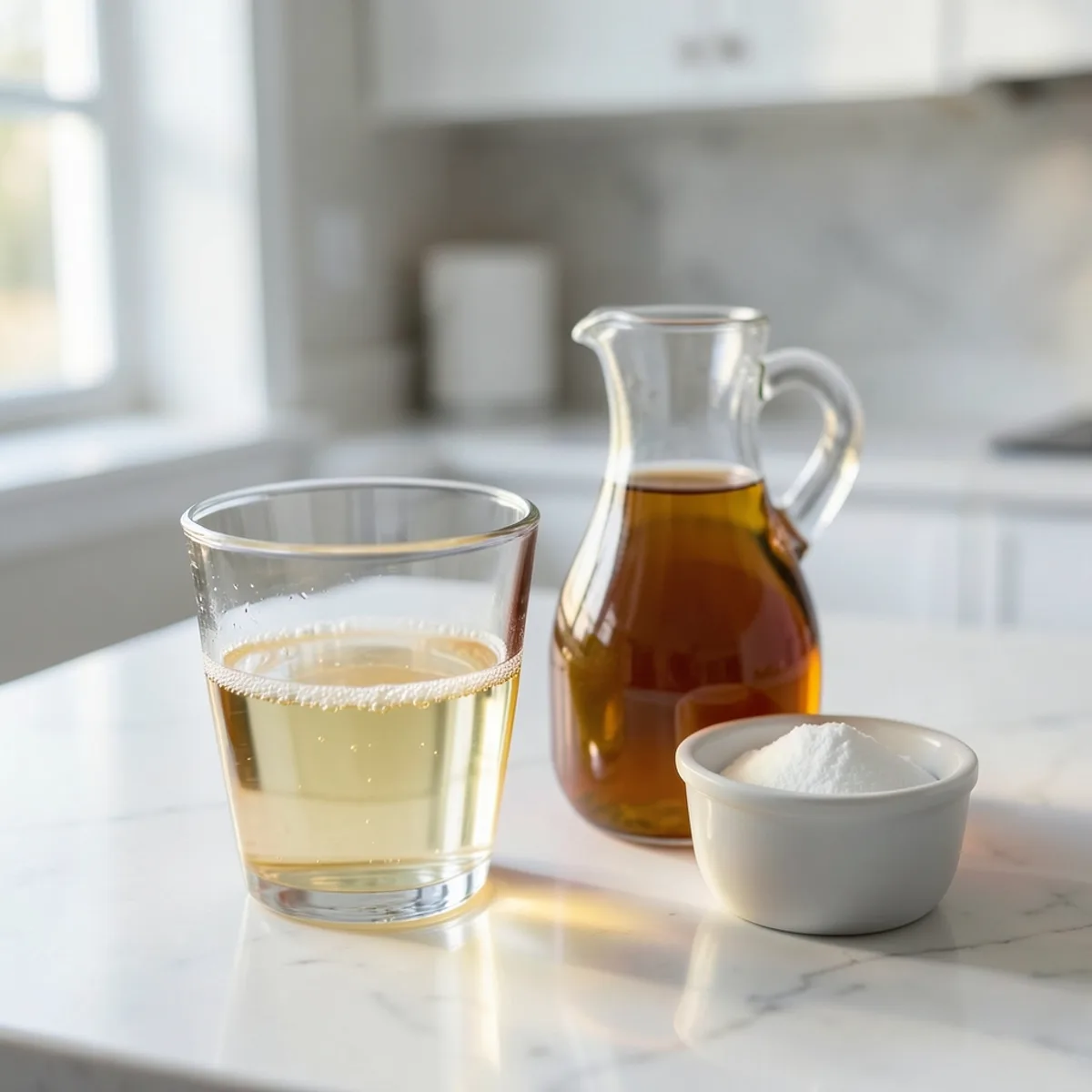
Here's where the viral version goes wrong: it treats the fizz as magic. It's arithmetic. One acid, one base, and they cancel. This page does the arithmetic, shows what's left in the glass, and keeps the sodium on the table. For the drink itself, see the baking soda and apple cider vinegar drink. This page is the why and the how much.
Healthline covers the benefits and risks of the combination in general terms, with no amounts and no sodium figure. The amounts are what we add.
The Food Science / Lab Kitchen Note
Baking soda is sodium bicarbonate (NaHCO₃), a base. Vinegar is sour because of acetic acid (CH₃COOH). They react one to one:
NaHCO₃ + CH₃COOH → CH₃COONa + H₂O + CO₂
That's sodium acetate, water and carbon dioxide. The CO₂ is the fizz.
The numbers below are our calculation, not a study. Sodium bicarbonate has a molar mass of 84.007 g/mol (PubChem). Acetic acid has 60.052 g/mol (NIST WebBook). The FDA says natural vinegars normally hold more than 4 g of acetic acid per 100 mL, and a diluted vinegar must state its real strength and never fall under 4 percent.
- 1 mL of 5 percent vinegar holds 0.05 g of acetic acid, or about 0.83 mmol.
- Same number of mmol of bicarbonate: about 0.070 g.
- Our glass uses 1 1/2 tsp (7.4 mL) of vinegar: about 0.37 g of acid, which needs about 0.52 g of soda.
- We add 1/8 tsp (0.575 g). That leaves about 0.06 g of soda unreacted, a slight excess, so the finished glass isn't acidic by our calculation.
Why a slight excess stays mild: a University of Calgary chemistry textbook explains that acetate is a weak base (Kb about 5.6e-10), so a sodium acetate solution is slightly basic once the acid is used up. We found no pH reading for this exact glass, so we give none.
How much baking soda to neutralize vinegar
The label decides the soda amount, so here are three strengths side by side. This is a comparison of calculated data, not a taste test. The 4 percent row is the FDA minimum, 5 percent is the usual apple cider vinegar label, and the 6 percent row is our assumption for a stronger bottle, not a sourced product.
| Vinegar strength | Acid in 1 tbsp (15 mL) | Soda to cancel 1 tbsp | Soda to cancel 1 1/2 tsp (7.4 mL) | Does 1/8 tsp (0.58 g) cover it? | pH of the glass |
|---|---|---|---|---|---|
| 4 percent (FDA minimum) | 0.60 g | 0.84 g | 0.41 g | Yes, about 0.16 g left over | no sourced data |
| 5 percent (usual label) | 0.75 g | 1.05 g | 0.52 g | Yes, about 0.06 g left over | no sourced data |
| 6 percent (our assumption) | 0.90 g | 1.26 g | 0.62 g | No, short by about 0.05 g | no sourced data |
At 6 percent, a bit of acid would stay in the glass. That's why the card says to check the label.
What is left in the glass
When the fizzing stops, the acid is used up or the soda is. In our glass the soda is in slight excess at 5 percent. What remains is dissolved sodium acetate, a little leftover bicarbonate, and water. The CO₂ mostly leaves as bubbles.
Two things follow. The sodium stays, and the soda that reacted is gone. Both come from the chemistry, so treat them as our deductions, not findings.
The sodium that stays
Neutralizing turns bicarbonate into sodium acetate. The sodium is still in the glass.
USDA FoodData Central lists baking soda at 27,400 mg of sodium per 100 g, with 1 tsp at 4.6 g. Our calculation: 1/8 tsp (0.575 g) is about 158 mg of sodium. The FDA sets the sodium Daily Value at less than 2,300 mg a day. So the glass is about 7% of 2,300 mg, and a full 1/4 tsp (1.15 g) would be about 315 mg, about 14%.
Is the neutralized glass an antacid?
MedlinePlus calls sodium bicarbonate an antacid for heartburn and acid indigestion, taken dissolved in at least 4 oz (120 mL) of water. Our deduction, not a sourced claim: bicarbonate that has already reacted with vinegar is spent, so it can't also work as an antacid in the same glass. We found nothing on the neutralized glass for heartburn.
What the sources show
Teeth. The one study we found is an in vitro study from 2022 on sections of 190 extracted human teeth soaked in nine solutions. Vinegar and apple cider caused the maximum demineralizing effect. It was a lab study on extracted teeth, not people drinking a diluted or neutralized drink. We found nothing on the neutralized glass, so we can't say it's easier on enamel.
Excess soda. The Merck Manual is a professional reference, not a trial. It lists sodium bicarbonate loading as a cause of metabolic alkalosis, with overzealous loading or loading in people with low potassium. Severe cases bring headache, lethargy and tetany. Our glass has 0.575 g of soda; the Merck Manual describes overzealous loading, not this amount.
No study has looked at this mix. For sodium and side effects of baking soda on its own, see baking soda side effects, and for the dose chart by use, how much baking soda in water.
Common mistakes
Reaching for 1/4 tsp out of habit. It's a different glass, and it's more than the vinegar needs at 5 percent. Measure 1/8 tsp and level it.
Skipping the label. At 4, 5 or 6 percent the soda amount changes (see the table). Read the percentage first.
Adding the soda to straight vinegar. The fizz is fast and foamy. Dilute the vinegar in the water, then add the soda slowly.
Substitutes and swaps
| Original | Swap | Proportion | What changes |
|---|---|---|---|
| Baking soda | Baking powder | Not a substitute | Different product; the math on this page doesn't apply |
| Apple cider vinegar | White vinegar | Same acid strength gives the same soda amount (our calculation, not tried here) | The acid is acetic acid in both; other components differ, no sourced data |
| Baking soda and vinegar | Plain water | Not applicable | No added sodium; the option for a sodium-restricted diet |
Storage and handling
Mix one glass and drink it. We found no sourced shelf life for the finished glass, which is a sodium acetate solution, so there's no make-ahead version.
Nutrition note
Values on the recipe card are estimates calculated from typical USDA FoodData Central values for baking soda. They aren't measured. We list sodium only, about 158 mg per glass, about 7% of 2,300 mg (our calculation). We give no calories because we found no sourced figure for the vinegar.
Servings: 1 glass (about 8 fl oz)
Does Baking Soda Neutralize Apple Cider Vinegar? The Math
Yes, they cancel one to one by moles. Here is how much soda cancels how much 5 percent vinegar, what is left in the glass, and the sodium that stays.
Ingredients
Equipment
- Measuring spoons (a true 1/2 teaspoon, 1/8 teaspoon and a 1 teaspoon, leveled with a knife)
- Tall clear glass (leaves room above the water for the bubbles)
- Long-handled spoon (for stirring without splashing)
Instructions
- Pour the water. Pour 8 fl oz (240 mL) of plain water into a tall glass, leaving empty space above it for foam.
- Stir in the vinegar. Measure 1 1/2 tsp (7.4 mL) of apple cider vinegar that is labeled 5 percent and stir it into the water. Vinegar goes into the water, never straight into your mouth.
- Level the soda. Fill a 1/8 tsp (0.58 g) measure with food-grade, aluminum-free baking soda and sweep the top flat with the back of a knife.
- Add the soda slowly. Sprinkle it in a little at a time and stir gently. The reaction releases carbon dioxide, which is the fizz.
- Wait for the fizz to stop. Let the glass stand until the bubbles thin out and the surface is nearly still. By our reading of the chemistry, that means the acid is used up.
- Drink it fresh. Drink the glass in one sitting. Mix a new glass each time, since we found no sourced shelf life.
Notes
Metric amounts are rounded. The 0.58 g figure is 1/8 teaspoon at the USDA household weight of 4.6 g per teaspoon.
Every neutralization figure on this page is our own calculation from published molar masses and the FDA's vinegar definition. It is not a measurement and not a study.
Nutrition values are estimates calculated from typical USDA FoodData Central values for baking soda (27,400 mg of sodium per 100 g). We list sodium only, because we found no sourced figure for the vinegar.
The 8 fl oz (240 mL) of water is our recipe. MedlinePlus gives at least 4 oz (120 mL) for antacid use.
Nutrition Facts
Per 1 glass (8 fl oz water, 1 1/2 tsp apple cider vinegar, 1/8 tsp baking soda) (estimated)
- Sodium
- 158 mg
Frequently asked questions
When should you drink baking soda and apple cider vinegar water?
We found no sourced time of day for this glass. The only sourced timing rule is MedlinePlus's for baking soda as an antacid: keep it at least 2 hours apart from other medicines.
What are the side effects of mixing baking soda and apple cider vinegar?
We found no study of the mix itself. The Merck Manual lists sodium bicarbonate loading as a cause of metabolic alkalosis, and severe cases bring headache, lethargy and tetany.
What can I use instead of baking soda and apple cider vinegar?
Plain water adds no sodium, which matters on a sodium-restricted diet. We found no sourced swap for this glass, so we don't suggest one.
Does vinegar neutralize baking soda?
Yes, it's the same reaction from the other side: acetic acid and bicarbonate cancel one to one by moles. Whichever one runs out first decides what's left, and in our glass the soda is slightly in excess.

Steven Dony trained in a restaurant kitchen and lives in Nashville, Tennessee. He covers SodaRecipe’s fact-checks: what works, what does not, and why.
Comments