Can Baking Soda Make Heartburn Worse? What to Know
Jump to RecipeA sourced look at when baking soda in water can backfire: fast CO2 gas, a big dose on a full stomach, the sodium in mg, and what no open source confirms about acid rebound.
 Save
Jump to:
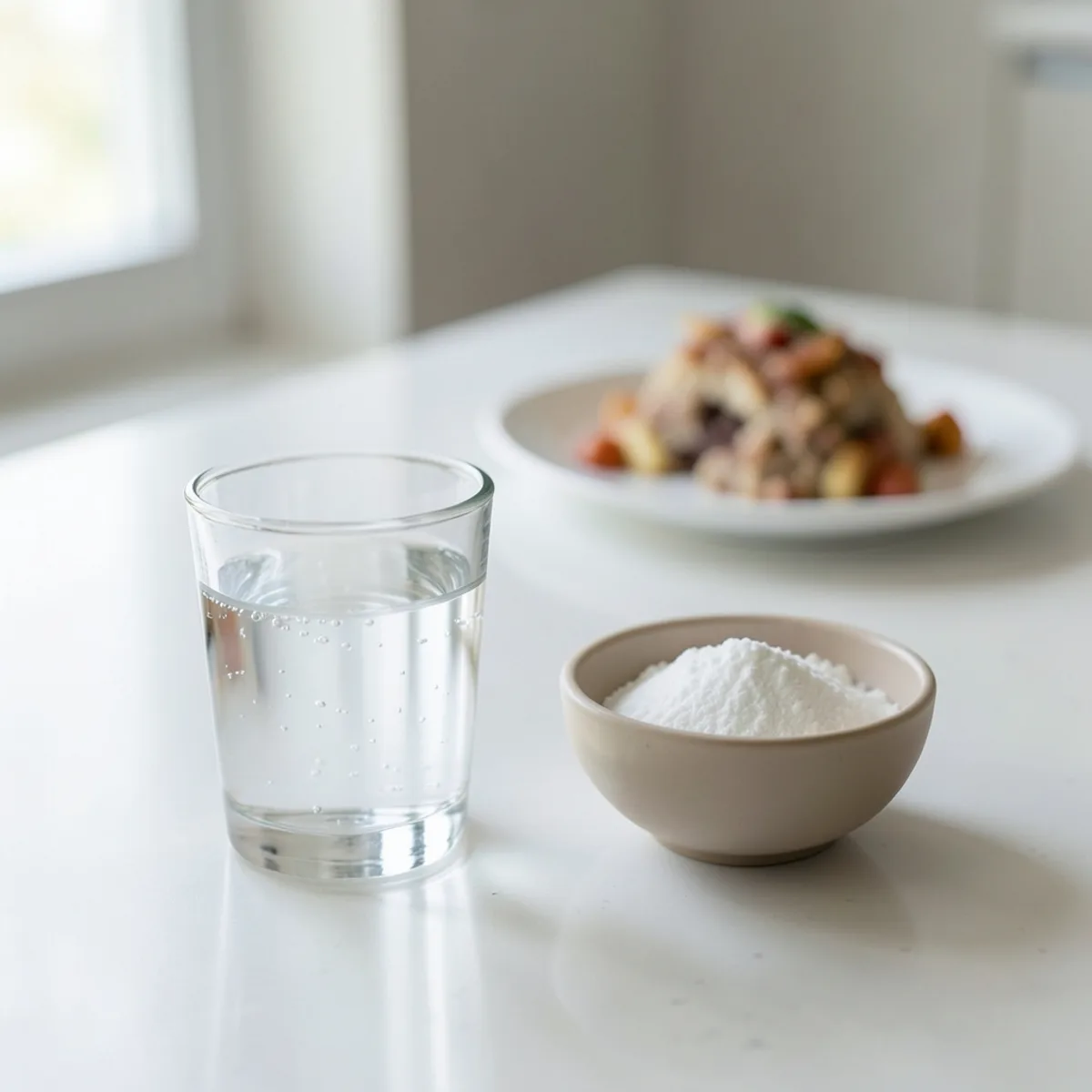
Baking soda in water can make heartburn feel worse when the dose is big or the stomach is full: it releases carbon dioxide gas fast. Our glass is 1/4 tsp (1.15 g) in 8 fl oz (240 mL) of water, mixed in 2 minutes.
Here's where it goes wrong. The viral version says a spoon in water calms heartburn every time. The sources say something narrower. They describe gas, cramps and thirst as the usual effects, and a serious pressure problem when a large dose meets a stomach that's already stuffed.
This page covers the backfire. The full dose chart and the antacid comparison live in baking soda for heartburn, so we don't repeat them. The wider list of effects is in baking soda side effects, and the situation-by-situation verdict is in is baking soda safe to drink.
The Food Science / Lab Kitchen Note
Baking soda is sodium bicarbonate, NaHCO₃. Stomach acid is hydrochloric acid, HCl. When they meet, they react:
NaHCO₃ + HCl → NaCl + H₂O + CO₂
That's the antacid doing its job. Acid gets used up and turns into salt, water and carbon dioxide. The CO₂ is a gas, and that's the whole story behind the burps and the bloat. Poison Control says swallowed baking soda rapidly makes a large volume of carbon dioxide, which can build dangerous pressure in the stomach.
Now the sodium. USDA FoodData Central lists 27,400 mg of sodium per 100 g of baking soda, and a teaspoon is 4.6 g. That gives about 315 mg for our 1/4 tsp glass and about 630 mg for the 1/2 tsp dose Healthline gives. Both figures are our calculation from USDA values, so they can differ slightly from a package label; the heartburn pillar quotes the label figure. The FDA puts the Daily Value for sodium at less than 2,300 mg a day, says Americans eat about 3,400 mg on average, and lists baking soda among common additives that contain sodium. Against 2,300 mg, our glass is about 14% and Healthline's dose about 27%.
What the sources show, and what they don't
Gas is documented. MedlinePlus, the NIH drug page for sodium bicarbonate, lists increased thirst, stomach cramps and gas as milder effects to report if they're severe or lasting.
Too much baking soda for heartburn can be dangerous, and the pressure story is why. Poison Control says stomach ruptures occur after alcohol binging or a large meal, and that too much as a homemade antacid can form gas fast. Early signs of too much are vomiting and diarrhea. After absorption it lists seizures, dehydration and kidney failure, and says a high pH can slow breathing. It gives no toxic dose.
Baking soda acid rebound heartburn: one claim, no confirmation
Healthline, reviewed by a PA-C, says research on baking soda for reflux is limited. It also says a sudden drop in stomach acid may cause acid rebound, meaning more acid production and worse symptoms. That sentence has no inline source. We found no open source that confirms rebound for baking soda, and neither MedlinePlus nor Poison Control mentions it. So treat it as one health site's claim. We can't call it a fact, and we can't rule it out.
Three variants, compared
This table compares data, not finished drinks. Sodium is our calculation from USDA values, against 2,300 mg.
| Variant | Baking soda | Water | Sodium (our calculation) | Share of 2,300 mg |
|---|---|---|---|---|
| Our diluted glass | 1/4 tsp (1.15 g) | 8 fl oz (240 mL) | About 315 mg | About 14% |
| Healthline's dose | 1/2 tsp (2.3 g) | 4 fl oz (120 mL), the MedlinePlus minimum | About 630 mg | About 27% |
| Viral concentrated "shot" | No sourced data | No sourced data | No sourced data | No sourced data |
The shot row is empty on purpose. We found no source that gives an amount for a concentrated shot, and none that calls one a dose. What the sources do give is a minimum of 4 fl oz (120 mL) of water, so any version with less water falls outside the MedlinePlus directions. The first two rows differ in water as well as in spoon size: our glass has half the baking soda in twice the water.
What the studies say
The best-documented harm is rare and extreme. A 2022 case review in the Journal of Eating Disorders looked at 2 new cases plus 36 published cases of spontaneous gastric rupture. Sodium bicarbonate was involved in 10 of the 36, and overall mortality was 41.6%. It's a case review, not a trial, and it says nothing about a quarter teaspoon in a full glass. The full write-up sits in the heartburn pillar.
The other signals are a case report and a column. Poison Control describes one 54-year-old woman who drank half a glass for indigestion after a large meal. She had a 5 cm stomach tear, lost her stomach to surgery and went home after 5 days. It's one patient. A consumer column in People's Pharmacy counts about 15 rupture cases in the medical literature, often after overeating. It says gastroenterologists estimated that 1/2 tsp releases only a small amount of gas, while some doses released several hundred mL of gas within 3 minutes. It calls occasional use for mild heartburn generally low risk. It's a column, not a trial.
Common mistakes
Gulping the glass. Gas arrives fast, and so does the discomfort. Sip it, and stop if you feel pressure.
Heaping the spoon. Every figure here rests on a level measure. A heaped spoon is a bigger dose, and Poison Control warns that too much can form gas fast.
Drinking it on a full stomach. The rupture cases often follow overeating or a large meal. MedlinePlus says to take it 1 to 2 hours after meals, which is the opposite of right after you eat.
Keeping it going. MedlinePlus says not to use it longer than 2 weeks unless your doctor says so. Heartburn that keeps coming back is a reason to call your provider, not a reason to mix another glass.
Substitutes and swaps
| Original | Swap | Proportion | What changes |
|---|---|---|---|
| Baking soda | Baking powder | No sourced proportion | A different product; we found no sourced dose or safety data for it as an antacid |
| Baking soda | Magnesium antacid | Follow its label | MedlinePlus says magnesium types may cause diarrhea |
| Baking soda | Calcium or aluminum antacid | Follow its label | MedlinePlus says these types may cause constipation |
| Baking soda | A lower-sodium option | No sourced option | We found no sourced low-sodium alternative; ask a pharmacist |
Spacing from other medicines
The two MedlinePlus pages don't agree. The sodium bicarbonate page says to take it at least 2 hours apart from other medicines. The page on taking antacids says other medicines go 1 hour before or 24 hours after antacids. We can't tell you which applies to your prescription. Ask a pharmacist, and bring the list of what you take.
Storage and make-ahead
Mix one fresh glass at a time. We found no sourced shelf life for the mixed drink, so this page gives no duration. Make-ahead tip: level 1/4 tsp (1.15 g) into a small cup and keep the baking soda in a closed jar away from baking powder, so you don't grab the wrong tin.
Nutrition note
Values on the recipe card are estimates calculated from typical USDA FoodData Central values, not measured. The glass is water and food-grade, aluminum-free baking soda only, so calories, carbs, protein, fat, sugar and fiber are zero. Sodium is about 315 mg per glass, our calculation from 27,400 mg per 100 g and 4.6 g per teaspoon.
Servings: 1 glass (8 fl oz)
Can Baking Soda Make Heartburn Worse? What to Know
A sourced look at when baking soda in water can backfire: fast CO2 gas, a big dose on a full stomach, the sodium in mg, and what no open source confirms about acid rebound.
Ingredients
Equipment
- Measuring spoons (a true 1/4 teaspoon, leveled with the back of a knife; never a tablespoon)
- Clear glass and spoon (so you can see when no white grains are left)
Instructions
- Wait until well after the meal. MedlinePlus says to take it 1 to 2 hours after meals. Poison Control ties its stomach-rupture cases to a large meal or alcohol binging, so a full stomach is the setup to avoid.
- Level the soda. Fill a 1/4 teaspoon (1.15 g) with food-grade, aluminum-free baking soda and sweep the top flat with a knife. Don't heap it.
- Pour the water first. Pour 8 fl oz (240 mL) of water into a clear glass. Never go below 4 fl oz (120 mL), the MedlinePlus minimum for dissolving the powder.
- Stir until fully dissolved. Add the soda and stir until the water is clear and no grains sit on the bottom.
- Sip, don't gulp. Drink the glass in sips rather than as a shot. Mix one fresh glass at a time, since we found no sourced shelf life for the mixed drink.
Notes
The 8 fl oz glass with 1/4 tsp is our recipe choice, half the dose Healthline gives (1/2 tsp in a 4 fl oz / 120 mL glass). MedlinePlus sets the minimum water at 4 fl oz (120 mL). Our glass isn't a medical rule.
Sodium is our calculation: USDA FoodData Central lists 27,400 mg of sodium per 100 g of baking soda and a teaspoon is 4.6 g, so 1/4 tsp is about 315 mg, about 14% of 2,300 mg.
Nutrition values are estimates calculated from typical USDA FoodData Central values, not measured. The glass is water and baking soda only, so everything except sodium is zero. Nothing here was made, tasted or measured by us.
Nutrition Facts
Per 1 glass (8 fl oz water, 1/4 tsp baking soda) (estimated)
- Total Fat
- 0 g
- Saturated Fat
- 0 g
- Sodium
- 315 mg
- Total Carbohydrate
- 0 g
- Dietary Fiber
- 0 g
- Sugars
- 0 g
- Protein
- 0 g
Frequently asked questions
Should you take baking soda for heartburn before or after a meal?
After. MedlinePlus says 1 to 2 hours after meals with a full glass of water, and its general antacid page says about 1 hour after eating or when heartburn starts.
What side effects can baking soda in water cause?
MedlinePlus lists increased thirst, stomach cramps and gas as milder effects to report if they are severe or lasting. Serious signs include severe headache, vomit like coffee grounds, slow breathing and swelling of the feet or lower legs.
What can you use instead of baking soda for heartburn?
MedlinePlus describes other antacid types: magnesium ones may cause diarrhea, and calcium or aluminum ones may cause constipation. We found no sourced head-to-head data, so ask a pharmacist which suits you.
When should you see a doctor about heartburn?
MedlinePlus says to contact your provider for symptoms every day or at night, antacids needed on most days, chest pain, trouble swallowing, vomiting, dark stools or pain that does not improve. It also says not to use baking soda longer than 2 weeks unless your doctor says so.

Steven Dony trained in a restaurant kitchen and lives in Nashville, Tennessee. He covers SodaRecipe’s fact-checks: what works, what does not, and why.
Comments