Banana Bread Without Baking Soda (Baking Powder Only)
Jump to RecipeA banana bread leavened by baking powder alone, with the oven numbers for a 9x5 pan, the 3 to 1 swap, and the reason the crust and crumb come out paler.
 Save
Jump to:
- Why you'll love it
- Why banana bread works without baking soda
- The Food Science / Lab Kitchen Note
- Baking soda, baking powder or soda with lemon juice: what the sources report
- Substitute for baking soda in banana bread, and other swaps
- Common mistakes
- Tips from the sources
- How the sources hold up
- Sodium and nutrition note
- Storing and reheating
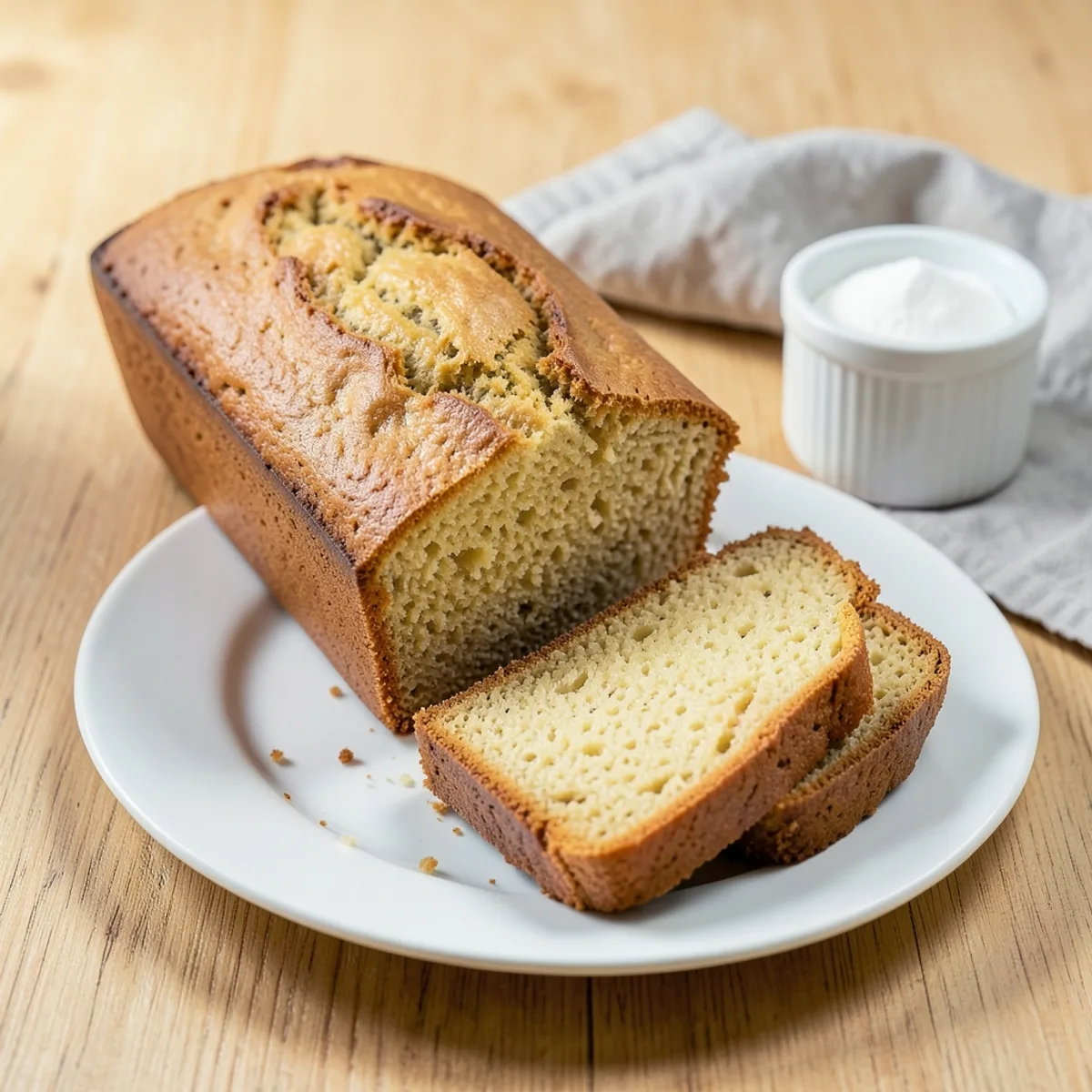
Banana bread without baking soda leans on 2 tsp (8 g) of baking powder alone: 250 g flour, 300 g mashed banana, butter, sugar and eggs in a 9x5 pan, about 110 minutes start to finish, with a lighter crust and paler crumb.
Nobody on our team has baked or tasted this loaf. The card is adapted from Bake School's baking-powder-only banana bread, and every claim below says where it comes from. If you only want to convert a recipe you already love, the ratio guides are baking soda replacement and using baking soda instead of baking powder. This page doesn't repeat them.
Why you'll love it
- A banana bread recipe with no baking soda, so an empty tin doesn't stop the bake. Reviewers on three recipe pages say that is exactly why they made it, and that it still came out well.
- Gram weights for the mashed fruit, so it doesn't matter whether your bananas were big or small.
- The oven numbers in one place: 350 F, a 9x5 pan, 60 to 65 minutes.
Prep: 15 minutes (our estimate). Bake: 60 to 65 minutes. Cooling: about 30 minutes (our estimate). Total: about 1 hour 50 minutes.
Why banana bread works without baking soda
Here's why this works. In general terms, baking powder is a leavener on its own: it packages a bicarbonate with the acid it needs, so it makes gas without help from the batter. Baking soda needs an acid in the bowl to do the same. That is why a banana bread with powder alone still rises.
What you give up is some lift and a lot of color. Reviewers on three recipe pages describe a lighter result: a paler golden crust and a pale-yellow crumb instead of the deep brown of a soda loaf. Reviewers on two pages say it can be a touch denser or flatter, and the recipes that avoid that lean on well-creamed butter and sugar and on not overmixing once the flour goes in. State of Dinner says the same, and calls its loaf only slightly flatter than a soda version.
The Food Science / Lab Kitchen Note
Baking soda is a base. Stirred into batter, it raises the pH, and a more alkaline batter browns faster. Bake School says exactly that: soda makes the crust and crumb brown more and darker, and without it the loaf is milder and more buttery, with a lighter golden-brown crust and a pale-yellow crumb. No numeric pH comes with that statement, and we won't make one up.
In general terms, the browning is the Maillard reaction, a reaction between sugars and proteins under heat. A Dickinson College chemistry class post on classic banana bread adds two details. Overripe bananas carry more sugar (fructose), which increases browning. And in the classic recipe the soda is balanced by lemon juice, which helps slow that browning; used alone, the soda would darken the bread and change its taste.
Put those together and the paler loaf makes sense. In general terms, baking powder has its own acid built in, so it leaves the batter closer to neutral. Less alkalinity means less browning, so the crust and crumb stay light even when the loaf is fully baked. That last step is our reading of the sources, not something either page measured. The practical result is that color stops being a good doneness signal, so use a toothpick or a thermometer.
Lift comes from the powder and from the air you beat into the butter and sugar. State of Dinner says it relies on creaming and on eggs for lift, because it found a straight 3 times swap is not that straightforward: powder is usually not strong enough on its own to avoid a dense loaf.
Baking soda, baking powder or soda with lemon juice: what the sources report
Is baking soda or baking powder better for banana bread? The sources don't crown a winner, and no controlled test compares them. This is a comparison of published data, not a record of loaves we baked. Where nothing is sourced, the cell says so.
| Baking soda only | Baking powder only | Baking soda + lemon juice (Dickinson) | |
|---|---|---|---|
| Source | Dickinson College class post (student science blog) | Bake School and three other recipe blogs | Dickinson College class post (student science blog) |
| Amount as written | No sourced data | 2 tsp (8 g) in the Bake School card | No sourced data |
| Weight per tsp | About 6 g (King Arthur) | 4 g (King Arthur) | No sourced data |
| Crust and crumb | Would darken the bread and change its taste if used alone | Lighter golden-brown crust, pale-yellow crumb (Bake School) | Lemon juice helps slow Maillard browning |
| Texture | No sourced data | A bit denser than standard (Rich and Delish); slightly flatter (State of Dinner) | No sourced data |
| Sodium per tsp | No sourced data | About 424 mg for a sodium aluminum sulfate type (USDA, our math) | No sourced data |
Four published powder-only loaves show how much the amounts vary. All are 350 F loaves; the oven is 350 F (175 C to 180 C) on each page.
| Source | Flour | Baking powder | Bake time |
|---|---|---|---|
| Bake School (our card) | 250 g | 2 tsp | 60 to 65 minutes, 9x5 pan |
| State of Dinner | 2 cups (260 g) | 2 tsp | 60 to 65 minutes on the card |
| Rich and Delish | 1 1/2 cups | 3 tsp | 50 to 60 minutes |
| Dollop of Dough | 240 g | 3 1/2 tsp | 65 to 80 minutes, 9x5 pan |
Bake School adds a rule of thumb: at least 1 tsp of baking powder per cup of flour. The card sits right at that line. The Dollop of Dough loaf also uses an acid, so it isn't a plain powder-only comparison.
Substitute for baking soda in banana bread, and other swaps
The swap itself is two lines. Healthline says to use triple the baking powder for the baking soda, so 1 tsp of soda (about 6 g) becomes 3 tsp of powder (12 g). The result may taste slightly saltier and more acidic, so it advises cutting any salt in the recipe by at least half and reducing or replacing some other acidic ingredients. It is an editorial guide, not a trial.
| Original | Replacement | Proportion | What changes |
|---|---|---|---|
| Baking soda in your own recipe | Baking powder | 3 tsp (12 g) per 1 tsp (about 6 g) of soda (Healthline) | May taste slightly saltier and more acidic; lighter crust |
| Salt in a recipe that used soda | Less salt | At least half (Healthline) | Offsets the sodium that the extra powder brings |
| Apple cider vinegar (in some recipes) | Lemon juice | No sourced proportion | A reader answer on Dollop of Dough; flavor and acid may differ |
| Sour cream | Greek yogurt | No sourced proportion for this card | Rich and Delish lists them as either-or in its own batter |
| Self-rising flour | Not covered | No sourced data | We found no source for it in banana bread |
Common mistakes
Judging doneness by color. Without baking soda the crust stays lighter, so the top can look underdone while the middle is still wet. Sources run from 50 to 80 minutes depending on pan and recipe. Go by a clean toothpick and edges that are deep golden, and tent with foil if the top is getting there too fast.
Overmixing after the flour goes in. Stirring past the point where the dry streaks vanish gives a dense loaf. Fold gently and stop.
Counting bananas instead of weighing them. Readers ask whether two bananas will do, or use only three and find the loaf slightly different. The advice that comes back is to weigh the mashed fruit. The card says 300 g for a reason.
Tips from the sources
Cream the butter and sugar properly. It's the step that does the most to make up for the soda you left out, and two of the sources we read lean on it.
If you want muffins, a reader on Bake School's page got about 12 muffins and checked them after 20 minutes. That is one reader's answer, not a tested card, so treat it as a starting point and watch the first batch.
How the sources hold up
We found no scientific study on banana bread without baking soda, so none is cited. The sources here are guides, blogs and a government database. The swap ratio comes from Healthline's baking soda substitute guide, an editorial guide. The weights per teaspoon and per cup come from the King Arthur ingredient weight chart, a reference chart from a flour company. Sodium figures come from USDA FoodData Central for baking powder and table salt, read through mirror pages, and the math from grams to teaspoons is ours.
The rest is recipe-site and class-blog material. Bake School is a specialist baking blog, and its pH and browning explanation is a statement, not a controlled test. The Dickinson College post is a student science blog with no numeric pH. Rich and Delish, State of Dinner and Dollop of Dough are recipe blogs. The "denser" claim rests on two of them, and the reader reports come from review comments. There are no forum threads behind this page.
Sodium and nutrition note
Sodium is where leaving out the soda changes the numbers most. USDA lists double-acting baking powder (sodium aluminum sulfate type) at 10,600 mg sodium per 100 g. At 4 g per teaspoon that is about 424 mg per teaspoon, so the 2 tsp on the card carry about 848 mg, our math. Table salt is about 38,758 mg per 100 g, which at 6 g per teaspoon is about 2,325 mg per teaspoon, our math. Other powder types differ, so check the tin.
The card adds no salt, and our estimate comes to about 102 mg of sodium per slice of 10, of which about 85 mg is the powder alone. For comparison, Bake School's own page estimates 210 mg per serving (auto-calculated, serving count not stated), and Dollop of Dough lists 395.5 mg per slice for 10 slices, with 3 1/2 tsp of powder and 1 tsp of salt. By our math that loaf's powder and salt alone come to about 381 mg per slice, which lines up. If you add 1/4 tsp of salt, as State of Dinner does, that adds about 581 mg to the whole loaf, our math, or about 58 mg per slice.
The nutrition on the card is an estimate calculated from typical USDA FoodData Central values, per 1 of 10 slices, with unsalted butter and large eggs. It comes to about 335 calories, 23.8 g of sugars, 4.3 g of protein and 102 mg of sodium per slice. The values for flour, butter, sugar, eggs and bananas are typical USDA figures we did not source in our brief.
Storing and reheating
Cool the loaf completely, then wrap it. Rich and Delish says airtight at room temperature up to 4 days, refrigerator up to 1 week and freezer up to 3 months, and Dollop of Dough says room temperature up to 5 days and freezer up to 3 months. That is blog guidance, and thaw times conflict between pages, so we give none.
No page we read explains slicing before freezing or how to refresh a slice. Our own suggestion, not a sourced one: slice first so you can take out one piece at a time, and warm a slice in a toaster or a low oven until it is soft again.
Servings: 10 slices
Banana Bread Without Baking Soda (Baking Powder Only)
A banana bread leavened by baking powder alone, with the oven numbers for a 9x5 pan, the 3 to 1 swap, and the reason the crust and crumb come out paler.
Ingredients
Banana bread
Equipment
- 9x5 loaf pan (an 8.5x4.5 pan holds the batter but bakes up to 75 minutes)
- Parchment paper
- Kitchen scale (for the flour, butter and mashed banana)
- Electric mixer or sturdy whisk (for creaming the butter and sugar)
- Toothpick or instant-read thermometer (the loaf is done at about 212 F (100 C) inside)
- Aluminum foil (to tent the top if it browns early)
Instructions
Prepare
- Heat the oven and the pan. Heat the oven to 350 F (175 C) with a rack in the middle. Grease a 9x5 loaf pan and line it with parchment so the loaf lifts out cleanly.
Mix
- Whisk the dry ingredients. Whisk the flour and baking powder together in a bowl. Powder is your only lift here, so spread it evenly through the flour.
- Cream the butter and sugar. Beat the softened butter and sugar until pale and light. With no soda in the bowl, the air you beat in here does a lot of the lifting, so don't rush it.
- Add the eggs and bananas. Beat in the eggs one at a time, then the mashed banana. The batter may look uneven at this point. That's fine.
- Fold in the flour. Add the flour mix and fold only until no dry streaks remain. Stop there. Overmixing is the quickest way to a dense loaf.
Bake
- Bake and check halfway. Scrape the batter into the pan and bake at 350 F for 60 to 65 minutes. Check about halfway through, and tent the top with foil if it is browning fast.
- Check doneness. Don't go by color. Without baking soda the crust stays lighter. Look for deep golden edges and a toothpick that comes out clean, which is about 212 F (100 C) inside.
Cool
- Cool before slicing. Cool the loaf in the pan for about 30 minutes, then lift it out and slice into 10 pieces. Let it cool. Really.
Notes
Not baked or tasted by us. The flour, baking powder, butter, sugar, egg and banana amounts, the 350 F oven and the 60 to 65 minutes in a 9x5 pan follow the Bake School baking-powder-only loaf; the card is adapted from it, not copied. The method steps are ours.
Prep time, the 30-minute cooling time, the yield of 10 slices, the softened unsalted butter and the egg weight are our estimates or assumptions. Gram figures for butter and banana are our conversions from King Arthur weights per tablespoon and per cup.
The card lists no salt, as the source figures in our brief list none. If you add salt or use salted butter, the sodium in the nutrition below goes up; see the sodium section.
Nutrition values are estimates calculated from typical USDA FoodData Central values for all-purpose flour, unsalted butter, sugar, large eggs, bananas and baking powder (sodium aluminum sulfate type, 424 mg sodium per tsp), per 1 of 10 slices. Those USDA values for flour, butter, sugar, eggs and bananas are typical figures we did not source in our brief. A different baking powder or salted butter changes the sodium.
Nutrition Facts
Per 1 slice (1/10 of the loaf) (estimated)
- Total Fat
- 15.5 g
- Saturated Fat
- 9.4 g
- Sodium
- 102 mg
- Total Carbohydrate
- 46.2 g
- Dietary Fiber
- 1.5 g
- Sugars
- 23.8 g
- Protein
- 4.3 g
Frequently asked questions
How much baking powder replaces baking soda in banana bread?
Healthline's guide says to use triple the powder: 1 tsp of baking soda (about 6 g) becomes 3 tsp of baking powder (12 g at 4 g per tsp). That is an editorial rule, not a trial, and it may taste slightly saltier, so the guide suggests cutting any salt by at least half.
Why is banana bread without baking soda paler?
Bake School says baking soda raises the batter's pH and browns the crust and crumb more, so without it the loaf is a lighter golden brown with a pale-yellow crumb. That is a baking blog's statement, not a controlled test, so judge doneness by a clean toothpick and not by color.
Can too much baking powder spoil banana bread?
Healthline says a tripled amount of powder may taste slightly saltier and more acidic. Powder made with aluminum can also taste off in larger amounts, so stay near the card's 2 tsp (8 g) and check the tin.
How long does banana bread without baking soda keep?
Recipe blogs give 4 to 5 days airtight at room temperature and up to 3 months in the freezer, and one adds up to 1 week in the refrigerator. That is author guidance, not a food-safety test, and we found no sourced thaw time.

Stella Nordi bakes in Portland, Oregon. She weighs everything in grams and explains why a bake fails. She covers SodaRecipe’s quick breads, biscuits and baking guides.
Comments