Baking Soda Recipe for Weight Loss: Does It Work?
Jump to RecipeThe exact baking soda and lemon water ratio in US and metric measures, the sodium in each version, and a plain look at what the research does and does not show.
 Save
SaveJump to:
This is the glass to make when you already plan to try baking soda water and want the measurements right, with the sodium counted. The recipe card shows the steps and estimated nutrition, and the sections here cover the chemistry, the sodium, and what research does and does not say. Nothing on this page promises weight loss, because we found no evidence for it. For the full evidence review, see does baking soda help you lose weight; for lime, ginger and honey versions, see baking soda and lemon water; and for morning or pre-workout timing, see the best time to drink baking soda water.
The Food Science / Lab Kitchen Note
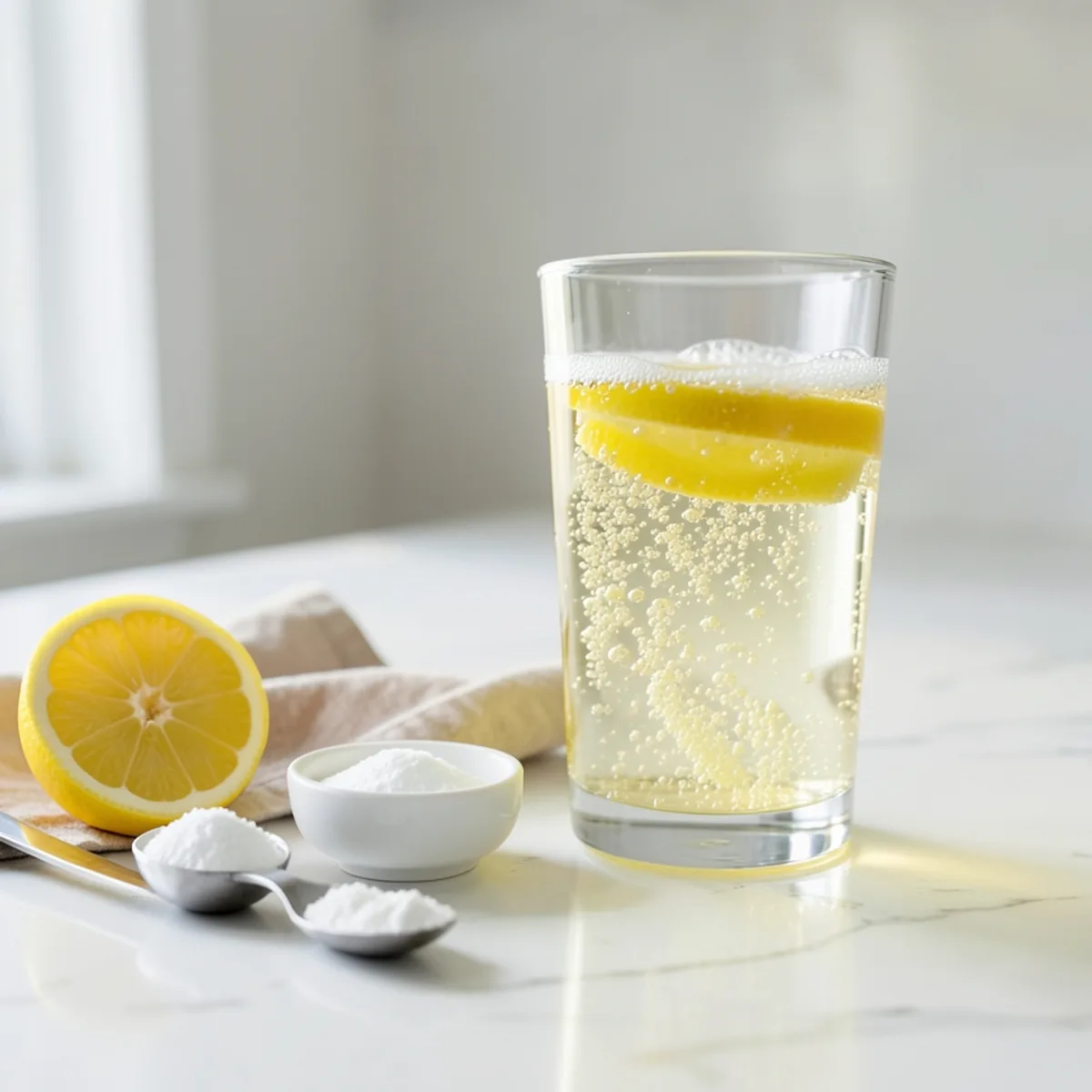
Baking soda is sodium bicarbonate, a base. Lemon juice is acidic because of citric acid, and the two react on contact. The acid takes up the bicarbonate and releases carbon dioxide, which is the fizz you see. What is left in the glass is sodium citrate, water and the dissolved gas. That is why the order matters: a glass can foam over when soda is poured onto lemon juice.
The numbers below are our own calculation from published figures, not a result from a study. Penniston and colleagues, in a 2008 Journal of Endourology analysis of commercial and fresh juices, measured fresh lemon juice at 1.44 g of citric acid per ounce (48.0 g/L in their Table 1, from two samples). Citric acid has three acid groups, so one mole (192.12 g, per PubChem) can neutralize up to three moles of sodium bicarbonate (3 x 84.007 g = 252.02 g). One gram of citric acid therefore neutralizes about 1.31 g of bicarbonate.
Half a lemon gives about 24 g of juice, which holds about 1.1 g of citric acid and can neutralize about 1.5 g of bicarbonate, roughly 1/3 teaspoon. Our 1/4 teaspoon is 1.15 g, so on paper the lemon covers it. Lemons vary in acidity, so treat that as a likely outcome rather than a guarantee.
The sodium does not go anywhere. Neutralizing the bicarbonate turns it into sodium citrate, which still counts toward your daily sodium. Lemon changes the chemistry of the drink, not its salt load.
Three versions compared from the data
This is a comparison built from the sources above, not a taste or lab test of our own. The vinegar column stays thin on purpose: we found no sourced acidity figure for apple cider vinegar, so we cannot calculate what it neutralizes.
| Water and baking soda | With lemon juice | With apple cider vinegar | |
|---|---|---|---|
| Dose | 1/4 tsp (1.15 g) in 8 fl oz (240 mL) | Same, plus juice of 1/2 lemon (about 24 g) | Same, plus vinegar (amount and acidity not sourced) |
| Sodium | About 315 mg | About 315 mg (lemon adds about 0.2 mg) | About 315 mg (vinegar sodium not sourced) |
| Share of the 2,300 mg daily limit | About 14 percent | About 14 percent | About 14 percent |
| Bicarbonate neutralized | None; all 1.15 g remains | Up to about 1.5 g with half a lemon, so likely all of it | Cannot be calculated without a sourced acidity |
| What the sodium becomes | Not changed by lemon | Becomes sodium citrate | Not sourced |
| Potassium | None sourced | About 25 mg | Not sourced |
The sodium per dose is where people go wrong, because it scales with the spoon. Using the USDA figure of 27,400 mg of sodium per 100 g of baking soda (FoodData Central), we calculate:
| Dose | Weight | Sodium | Share of 2,300 mg |
|---|---|---|---|
| 1/4 tsp | 1.15 g | About 315 mg | About 14 percent |
| 1/2 tsp | 2.3 g | About 630 mg | About 27 percent |
| 1 tsp | 4.6 g | About 1,260 mg | About 55 percent |
The 2,300 mg limit comes from the FDA's sodium guidance, which also notes that limits are lower for children under 14. That sodium arrives on top of everything else you eat that day.
What the research does and does not show
The most relevant source we found on baking soda is a sports one. The International Society of Sports Nutrition position stand (Grgic and colleagues, 2021) is an expert statement based on a literature review. It concludes that sodium bicarbonate can improve high-intensity exercise lasting about 30 seconds to 12 minutes, at a minimum effective single dose of about 0.2 g per kg of body weight. It reports no extra benefit at 0.4 to 0.5 g/kg and more side effects, notably bloating, nausea, vomiting and abdominal pain, and it says some of the benefit may be placebo. It concerns performance, not fat loss. For a 70 kg (154 lb) adult, 0.2 g/kg works out to 14 g, our arithmetic, which is about 3 teaspoons and roughly 3,800 mg of sodium. That is far above this recipe and above the daily limit.
The caution side comes from case reports, which describe single patients and cannot tell us how often something happens. In a 2022 case report with literature review in Experimental and Therapeutic Medicine, a 69-year-old man who used baking soda as a gout remedy was hospitalized with metabolic alkalosis (pH 7.61), low potassium and acute kidney and liver injury, and his markers improved after treatment. A 2020 BMC Nephrology report traced long-standing alkalosis with low potassium in an 80-year-old woman to baking soda used as a toothpaste additive, and noted that one teaspoon holds roughly 59 mEq of bicarbonate. Neither involved a weight-loss drink, and both show risk, not frequency. Separately, we found no human trial of fat loss with baking soda water, and MedlinePlus lists no weight-loss use.
Common mistakes
Pouring soda onto lemon juice. The reaction is immediate, and the foam can overflow the glass. Dissolve the soda in water first and add the juice slowly.
Using baking powder. Baking powder is a different product from baking soda, so it is not a substitute. Check the label for sodium bicarbonate alone, food-grade and aluminum-free.
Heaping the spoon. Sodium rises in step with the dose, as the second table shows. Level the measure every time.
Storage and safe use
Mix one glass and drink it. Our sources give no storage time for the mixed drink, so we do not state one.
For antacid use, MedlinePlus advises against using sodium bicarbonate for more than 2 weeks and does not list it for children under 12 without medical advice. It names high blood pressure, heart failure, kidney disease and sodium-restricted diets as conditions to raise first, since it increases the sodium in the body. It should be taken at least 2 hours apart from other medicines. If any of these applies to you, or you are unsure, speak with your doctor or a dietitian before trying it.
Nutrition note
Values on the recipe card are estimates calculated from typical USDA FoodData Central figures for raw lemon juice and baking soda, per glass. They are not measured. Half a lemon (24 g of juice) comes to about 5 kcal, 1.7 g of carbohydrate, 0.6 g of sugars and about 25 mg of potassium, with sodium of about 315 mg that comes almost entirely from the baking soda. A glass made without lemon would carry the same sodium.
Servings: 1 glass (about 8 fl oz)
Baking Soda Recipe for Weight Loss: Does It Work?
The exact baking soda and lemon water ratio in US and metric measures, the sodium in each version, and a plain look at what the research does and does not show.
Ingredients
Equipment
- Measuring spoons (a true 1/4 teaspoon, leveled with a knife)
- Long-handled spoon (for stirring without splashing)
Instructions
- Measure the soda. Level 1/4 teaspoon (1.15 g) of food-grade, aluminum-free baking soda with the back of a knife. A heaped spoon can hold much more, and the sodium rises with it.
- Dissolve it in the water. Pour 8 fl oz (240 mL) of cold water into the glass, add the baking soda and stir until the water looks clear and no white grains sit at the bottom.
- Add the lemon slowly. Pour the juice of half a lemon in a thin stream while stirring gently. Fine bubbles will rise and the surface will foam a little. Adding the juice to the water, rather than soda to the juice, keeps the foam from climbing the glass.
- Wait for the fizz to stop. Let the glass stand until the bubbles thin out and the surface is nearly still. A glass that has stopped fizzing has finished reacting.
- Drink it fresh. Drink the glass in one sitting. Make a new one each time, since we found no sourced storage time.
Notes
Metric amounts are rounded. The 1.15 g figure is 1/4 teaspoon at USDA's household portion of 4.6 g per teaspoon.
Nutrition values are estimates calculated from typical USDA FoodData Central values for raw lemon juice (half a lemon, 24 g) and for baking soda. They are not measured. Only the listed values were calculated.
Potassium, calculated from USDA lemon juice data: about 25 mg per glass. The recipe card has no potassium field.
Nutrition Facts
Per 1 glass (8 fl oz water, 1/4 tsp baking soda, juice of 1/2 lemon) (estimated)
- Sodium
- 315 mg
- Total Carbohydrate
- 1.7 g
- Sugars
- 0.6 g
Frequently asked questions
What is the best time to drink baking soda water?
We found no sourced best time for weight goals. The sourced directions come from MedlinePlus, which treats baking soda as an antacid: dissolve it in at least 4 oz (120 mL) of water and keep it at least 2 hours apart from other medicines. The ISSN stand covers exercise performance only, and it involves much larger doses than this recipe.
What are the side effects of drinking baking soda water?
MedlinePlus lists thirst, stomach cramps and gas as mild effects. The ISSN position stand reports bloating, nausea, vomiting and abdominal pain at exercise doses. Published case reports describe metabolic alkalosis, a blood pH that is too high, after baking soda was used as a gout remedy or as a toothpaste additive, but each covers one patient, so they show a risk rather than how often it happens.
What can I drink instead of baking soda water?
Plain water with lemon juice skips the bicarbonate and its sodium. By our USDA-based calculation, the juice of half a lemon adds about 5 kcal, 1.7 g of carbohydrate, about 25 mg of potassium and about 0.2 mg of sodium. Nothing in our sources shows that either drink changes body fat.
Comments